Record Information
Version1.0
Creation Date2014-08-29 05:51:17 UTC
Update Date2026-04-16 21:50:32 UTC
Accession NumberCHEM003148
Identification
Common NameHeptanal
ClassSmall Molecule
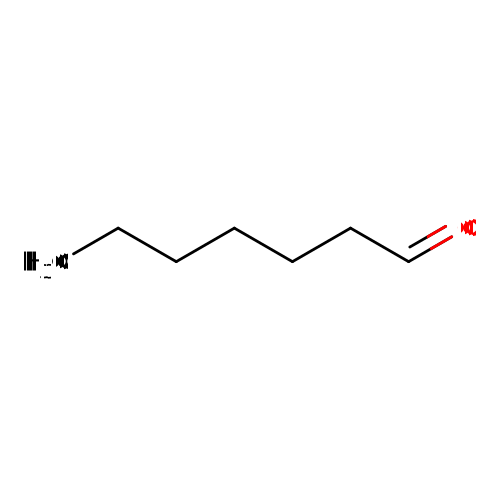
DescriptionHeptanal is a uremic toxin. Uremic toxins can be subdivided into three major groups based upon their chemical and physical characteristics: 1) small, water-soluble, non-protein-bound compounds, such as urea; 2) small, lipid-soluble and/or protein-bound compounds, such as the phenols and 3) larger so-called middle-molecules, such as beta2-microglobulin. Chronic exposure of uremic toxins can lead to a number of conditions including renal damage, chronic kidney disease and cardiovascular disease. Heptanal is found in allspice. Heptanal is found in essential oils of ylang-ylang, clary sage, California orange, bitter orange and others. Heptanal is a flavouring agent Heptanal or heptanaldehyde is an alkyl aldehyde with a strong fruity odor which is used as an ingredient in cosmetics, perfumes, and flavors. It can be obtained from castor oil by distillation under reduced pressure. Industrially, it is used in the manufacture of 1-heptanol and ethyl heptanoate. Heptanal belongs to the family of Medium-chain Aldehydes. These are An aldehyde with a chain length containing between 6 and 12 carbon atoms.
Contaminant Sources
  • EAFUS Chemicals
  • FooDB Chemicals
  • HMDB Contaminants - Feces
  • HPV EPA Chemicals
  • STOFF IDENT Compounds
  • T3DB toxins
  • ToxCast & Tox21 Chemicals
Contaminant Type
  • Aldehyde
  • Cosmetic Toxin
  • Flavouring Agent
  • Food Toxin
  • Industrial/Workplace Toxin
  • Metabolite
  • Natural Compound
  • Organic Compound
  • Uremic Toxin
Chemical Structure
Thumb
Synonyms
ValueSource
Aldehyde C-7ChEBI
EnanthalChEBI
EnanthaldehydeChEBI
Enanthic aldehydeChEBI
HeptaldehydeChEBI
HeptanaldehydeChEBI
Heptyl aldehydeChEBI
HeptylaldehydeChEBI
N-C6H13CHOChEBI
N-HeptaldehydeChEBI
N-HeptanalChEBI
N-HeptylaldehydeChEBI
OenanthalChEBI
OenanthaldehydeChEBI
Oenanthic aldehydeChEBI
OenantholChEBI
1-HeptaldehydeHMDB
1-HeptanalHMDB
Aldehyde C7HMDB
EnantholeHMDB
FEMA 2540HMDB
Heptan-1-alHMDB
OenantholeHMDB
HeptanalMeSH
Chemical FormulaC7H14O
Average Molecular Mass114.186 g/mol
Monoisotopic Mass114.104 g/mol
CAS Registry Number111-71-7
IUPAC Nameheptanal
Traditional Nameheptanal
SMILESCCCCCCC=O
InChI IdentifierInChI=1S/C7H14O/c1-2-3-4-5-6-7-8/h7H,2-6H2,1H3
InChI KeyFXHGMKSSBGDXIY-UHFFFAOYSA-N
Chemical Taxonomy
Description belongs to the class of organic compounds known as medium-chain aldehydes. These are an aldehyde with a chain length containing between 6 and 12 carbon atoms.
KingdomOrganic compounds
Super ClassOrganic oxygen compounds
ClassOrganooxygen compounds
Sub ClassCarbonyl compounds
Direct ParentMedium-chain aldehydes
Alternative Parents
Substituents
  • Medium-chain aldehyde
  • Alpha-hydrogen aldehyde
  • Organic oxide
  • Hydrocarbon derivative
  • Aliphatic acyclic compound
Molecular FrameworkAliphatic acyclic compounds
External Descriptors
Biological Properties
StatusDetected and Not Quantified
OriginEndogenous
Cellular Locations
  • Membrane
Biofluid LocationsNot Available
Tissue LocationsNot Available
PathwaysNot Available
ApplicationsNot Available
Biological RolesNot Available
Chemical RolesNot Available
Physical Properties
StateLiquid
AppearanceNot Available
Experimental Properties
PropertyValue
Melting Point-43.3°C
Boiling PointNot Available
Solubility1.25 mg/mL at 25°C
Predicted Properties
PropertyValueSource
Water Solubility1.34 g/LALOGPS
logP2.59ALOGPS
logP2.1ChemAxon
logS-1.9ALOGPS
pKa (Strongest Acidic)17.79ChemAxon
pKa (Strongest Basic)-6.9ChemAxon
Physiological Charge0ChemAxon
Hydrogen Acceptor Count1ChemAxon
Hydrogen Donor Count0ChemAxon
Polar Surface Area17.07 ŲChemAxon
Rotatable Bond Count5ChemAxon
Refractivity34.75 m³·mol⁻¹ChemAxon
Polarizability14.4 ųChemAxon
Number of Rings0ChemAxon
Bioavailability1ChemAxon
Rule of FiveYesChemAxon
Ghose FilterNoChemAxon
Veber's RuleYesChemAxon
MDDR-like RuleNoChemAxon
Spectra
Spectra
Spectrum TypeDescriptionSplash KeyView
GC-MSGC-MS Spectrum - EI-B (Non-derivatized)splash10-0006-9000000000-183283cb2427145b7678Spectrum
GC-MSGC-MS Spectrum - EI-B (Non-derivatized)splash10-0006-9000000000-aedf02ade0aa5bd82d71Spectrum
GC-MSGC-MS Spectrum - EI-B (Non-derivatized)splash10-0006-9000000000-a85809c1e2c6b7471781Spectrum
GC-MSGC-MS Spectrum - EI-B (Non-derivatized)splash10-006x-9000000000-d026c39b0c01ca9d12eeSpectrum
GC-MSGC-MS Spectrum - EI-B (Non-derivatized)splash10-0006-9000000000-183283cb2427145b7678Spectrum
GC-MSGC-MS Spectrum - EI-B (Non-derivatized)splash10-0006-9000000000-aedf02ade0aa5bd82d71Spectrum
GC-MSGC-MS Spectrum - EI-B (Non-derivatized)splash10-0006-9000000000-a85809c1e2c6b7471781Spectrum
GC-MSGC-MS Spectrum - EI-B (Non-derivatized)splash10-006x-9000000000-d026c39b0c01ca9d12eeSpectrum
Predicted GC-MSPredicted GC-MS Spectrum - GC-MS (Non-derivatized) - 70eV, Positivesplash10-056u-9000000000-721c1006ed41ad91802fSpectrum
Predicted GC-MSPredicted GC-MS Spectrum - GC-MS (Non-derivatized) - 70eV, PositiveNot AvailableSpectrum
Predicted LC-MS/MSPredicted LC-MS/MS Spectrum - 10V, Positivesplash10-014i-4900000000-66f451ed07dec07dc2bdSpectrum
Predicted LC-MS/MSPredicted LC-MS/MS Spectrum - 20V, Positivesplash10-014j-9300000000-f683fbeaae9661c3375fSpectrum
Predicted LC-MS/MSPredicted LC-MS/MS Spectrum - 40V, Positivesplash10-052f-9000000000-62e7748838e417c074baSpectrum
Predicted LC-MS/MSPredicted LC-MS/MS Spectrum - 10V, Negativesplash10-03di-1900000000-242e518285d8711c88d3Spectrum
Predicted LC-MS/MSPredicted LC-MS/MS Spectrum - 20V, Negativesplash10-03di-4900000000-2b9ed46fa89f52e6874eSpectrum
Predicted LC-MS/MSPredicted LC-MS/MS Spectrum - 40V, Negativesplash10-0006-9000000000-614ce9045eac88449a8aSpectrum
Predicted LC-MS/MSPredicted LC-MS/MS Spectrum - 10V, Positivesplash10-0a4l-9000000000-e5c26cac568c7e70be7fSpectrum
Predicted LC-MS/MSPredicted LC-MS/MS Spectrum - 20V, Positivesplash10-052f-9000000000-0497fb39284b3eae18e7Spectrum
Predicted LC-MS/MSPredicted LC-MS/MS Spectrum - 40V, Positivesplash10-0006-9000000000-7f7db6b93b3268b34898Spectrum
Predicted LC-MS/MSPredicted LC-MS/MS Spectrum - 10V, Negativesplash10-03di-0900000000-87ba7764343ecec4c93fSpectrum
Predicted LC-MS/MSPredicted LC-MS/MS Spectrum - 20V, Negativesplash10-03di-4900000000-baad9901fa250e031cb5Spectrum
Predicted LC-MS/MSPredicted LC-MS/MS Spectrum - 40V, Negativesplash10-052f-9000000000-8ffddb005d2cb639ad09Spectrum
MSMass Spectrum (Electron Ionization)splash10-0006-9000000000-781fd8622d3cd4023d6fSpectrum
1D NMR1H NMR SpectrumNot AvailableSpectrum
1D NMR13C NMR SpectrumNot AvailableSpectrum
1D NMR1H NMR SpectrumNot AvailableSpectrum
1D NMR13C NMR SpectrumNot AvailableSpectrum
1D NMR1H NMR SpectrumNot AvailableSpectrum
1D NMR13C NMR SpectrumNot AvailableSpectrum
1D NMR1H NMR SpectrumNot AvailableSpectrum
1D NMR13C NMR SpectrumNot AvailableSpectrum
1D NMR1H NMR SpectrumNot AvailableSpectrum
1D NMR13C NMR SpectrumNot AvailableSpectrum
1D NMR1H NMR SpectrumNot AvailableSpectrum
1D NMR13C NMR SpectrumNot AvailableSpectrum
1D NMR1H NMR SpectrumNot AvailableSpectrum
1D NMR13C NMR SpectrumNot AvailableSpectrum
1D NMR1H NMR SpectrumNot AvailableSpectrum
1D NMR13C NMR SpectrumNot AvailableSpectrum
1D NMR1H NMR SpectrumNot AvailableSpectrum
1D NMR13C NMR SpectrumNot AvailableSpectrum
1D NMR1H NMR SpectrumNot AvailableSpectrum
1D NMR13C NMR SpectrumNot AvailableSpectrum
1D NMR1H NMR SpectrumNot AvailableSpectrum
Toxicity Profile
Route of ExposureEndogenous, Ingestion, Dermal (contact)
Mechanism of ToxicityUremic toxins such as heptanal are actively transported into the kidneys via organic ion transporters (especially OAT3). Increased levels of uremic toxins can stimulate the production of reactive oxygen species. This seems to be mediated by the direct binding or inhibition by uremic toxins of the enzyme NADPH oxidase (especially NOX4 which is abundant in the kidneys and heart) (2). Reactive oxygen species can induce several different DNA methyltransferases (DNMTs) which are involved in the silencing of a protein known as KLOTHO. KLOTHO has been identified as having important roles in anti-aging, mineral metabolism, and vitamin D metabolism. A number of studies have indicated that KLOTHO mRNA and protein levels are reduced during acute or chronic kidney diseases in response to high local levels of reactive oxygen species (3).
MetabolismUremic toxins tend to accumulate in the blood either through dietary excess or through poor filtration by the kidneys. Most uremic toxins are metabolic waste products and are normally excreted in the urine or feces.
Toxicity ValuesNot Available
Lethal DoseNot Available
Carcinogenicity (IARC Classification)No indication of carcinogenicity to humans (not listed by IARC).
Uses/SourcesNaturally produced by the body (endogenous).
Minimum Risk LevelNot Available
Health EffectsChronic exposure to uremic toxins can lead to a number of conditions including renal damage, chronic kidney disease and cardiovascular disease.
SymptomsAs a uremic toxin, this compound can cause uremic syndrome. Uremic syndrome may affect any part of the body and can cause nausea, vomiting, loss of appetite, and weight loss. It can also cause changes in mental status, such as confusion, reduced awareness, agitation, psychosis, seizures, and coma. Abnormal bleeding, such as bleeding spontaneously or profusely from a very minor injury can also occur. Heart problems, such as an irregular heartbeat, inflammation in the sac that surrounds the heart (pericarditis), and increased pressure on the heart can be seen in patients with uremic syndrome. Shortness of breath from fluid buildup in the space between the lungs and the chest wall (pleural effusion) can also be present.
TreatmentKidney dialysis is usually needed to relieve the symptoms of uremic syndrome until normal kidney function can be restored.
Concentrations
Not Available
DrugBank IDNot Available
HMDB IDHMDB0031475
FooDB IDFDB008048
Phenol Explorer IDNot Available
KNApSAcK IDC00034880
BiGG IDNot Available
BioCyc IDNot Available
METLIN IDNot Available
PDB IDNot Available
Wikipedia LinkHeptanal
Chemspider ID7838
ChEBI ID34787
PubChem Compound ID8130
Kegg Compound IDC14390
YMDB IDYMDB01704
ECMDB IDNot Available
References
Synthesis ReferenceNot Available
MSDSNot Available
General References
1. https://www.ncbi.nlm.nih.gov/pubmed/?term=13684163
2. https://www.ncbi.nlm.nih.gov/pubmed/?term=13802512
3. https://www.ncbi.nlm.nih.gov/pubmed/?term=15556514
4. https://www.ncbi.nlm.nih.gov/pubmed/?term=20120041
5. https://www.ncbi.nlm.nih.gov/pubmed/?term=22626821
6. https://www.ncbi.nlm.nih.gov/pubmed/?term=24401388
7. https://www.ncbi.nlm.nih.gov/pubmed/?term=24421258
8. https://www.ncbi.nlm.nih.gov/pubmed/?term=28292517
9. https://www.ncbi.nlm.nih.gov/pubmed/?term=28366212
10. https://www.ncbi.nlm.nih.gov/pubmed/?term=29526787
11.
12. Toso B, Procida G, Stefanon B: Determination of volatile compounds in cows' milk using headspace GC-MS. J Dairy Res. 2002 Nov;69(4):569-77.
13. Brigitta Gaspardo et al. Determination of volatile fractions in raw milk and ripened cheese by means of GC-MS. Results of a survey performed in the marginal area between Italy and Slovenia. Italian Jounal of Animal Science Vol 8, 377-390, 2009
14. Duranton F, Cohen G, De Smet R, Rodriguez M, Jankowski J, Vanholder R, Argiles A: Normal and pathologic concentrations of uremic toxins. J Am Soc Nephrol. 2012 Jul;23(7):1258-70. doi: 10.1681/ASN.2011121175. Epub 2012 May 24.
15. Yannai, Shmuel. (2004) Dictionary of food compounds with CD-ROM: Additives, flavors, and ingredients. Boca Raton: Chapman & Hall/CRC.