Record Information
Version1.0
Creation Date2014-08-29 05:50:57 UTC
Update Date2026-04-06 13:36:34 UTC
Accession NumberCHEM003144
Identification
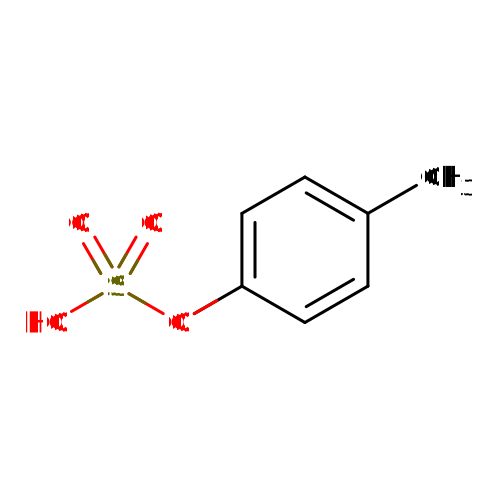
Common Namep-Cresol sulfate
ClassSmall Molecule
Descriptionp-Cresol sulfate is a uremic toxin. Uremic toxins can be subdivided into three major groups based upon their chemical and physical characteristics: 1) small, water-soluble, non-protein-bound compounds, such as urea; 2) small, lipid-soluble and/or protein-bound compounds, such as the phenols and 3) larger so-called middle-molecules, such as beta2-microglobulin. Chronic exposure of uremic toxins can lead to a number of conditions including renal damage, chronic kidney disease and cardiovascular disease. p-Cresol sulfate is a microbial metabolite that is found in urine and likely derives from secondary metabolism of p-cresol. It appears to be elevated in the urine of individuals with progressive multiple sclerosis p-Cresol sulfate is the major component of urinary MBPLM (myelin basic protein-like material). p-Cresol sulfate is a small protein-bound molecule that is poorly cleared with dialysis and is often considered to be a uremic toxin. Uremic toxins include low-molecular-weight compounds such as indoxyl sulfate, p-cresol sulfate, 3-carboxy-4-methyl-5-propyl-2-furanpropionic acid and asymmetric dimethylarginine It has also been linked to cardiovascular disease and oxidative injury. (2, 3).
Contaminant Sources
  • FooDB Chemicals
  • HMDB Contaminants - Urine
  • T3DB toxins
Contaminant Type
  • Ester
  • Food Toxin
  • Metabolite
  • Natural Compound
  • Organic Compound
  • Uremic Toxin
Chemical Structure
Thumb
Synonyms
ValueSource
4-Cresol sulfateChEBI
Sulfuric acid mono-p-tolyl esterChEBI
4-Cresol sulfuric acidGenerator
4-Cresol sulphateGenerator
4-Cresol sulphuric acidGenerator
Sulfate mono-p-tolyl esterGenerator
Sulphate mono-p-tolyl esterGenerator
Sulphuric acid mono-p-tolyl esterGenerator
p-Cresol sulfuric acidGenerator
p-Cresol sulphateGenerator
p-Cresol sulphuric acidGenerator
mono(4-Methylphenyl) sulfateHMDB
p-Cresyl sulfateHMDB
p-Cresyl sulphateHMDB
p-Cresyl-sulfateHMDB
p-Cresyl-sulphateHMDB
p-CresylsulfateHMDB
p-CresylsulphateHMDB
p-Tolyl sulfate (6ci,7ci)HMDB
p-Tolyl sulphate (6ci,7ci)HMDB
Para-cresol sulfateHMDB
Para-cresol sulphateHMDB
Sulfuric acid mono(p-tolyl) ester (8ci)HMDB
Sulfuric acid, mono(4-methylphenyl) esterHMDB
Chemical FormulaC7H8O4S
Average Molecular Mass188.201 g/mol
Monoisotopic Mass188.014 g/mol
CAS Registry Number3233-58-7
IUPAC Name(4-methylphenyl)oxidanesulfonic acid
Traditional Name(4-methylphenyl)oxidanesulfonic acid
SMILESCC1=CC=C(OS(O)(=O)=O)C=C1
InChI IdentifierInChI=1S/C7H8O4S/c1-6-2-4-7(5-3-6)11-12(8,9)10/h2-5H,1H3,(H,8,9,10)
InChI KeyWGNAKZGUSRVWRH-UHFFFAOYSA-N
Chemical Taxonomy
Description belongs to the class of organic compounds known as phenylsulfates. Phenylsulfates are compounds containing a sulfuric acid group conjugated to a phenyl group.
KingdomOrganic compounds
Super ClassOrganic acids and derivatives
ClassOrganic sulfuric acids and derivatives
Sub ClassArylsulfates
Direct ParentPhenylsulfates
Alternative Parents
Substituents
  • Phenylsulfate
  • Phenoxy compound
  • Toluene
  • Benzenoid
  • Sulfuric acid ester
  • Sulfate-ester
  • Sulfuric acid monoester
  • Monocyclic benzene moiety
  • Organic oxygen compound
  • Organic oxide
  • Hydrocarbon derivative
  • Organooxygen compound
  • Aromatic homomonocyclic compound
Molecular FrameworkAromatic homomonocyclic compounds
External Descriptors
Biological Properties
StatusDetected and Not Quantified
OriginEndogenous
Cellular Locations
  • Cytoplasm
  • Extracellular
Biofluid LocationsNot Available
Tissue LocationsNot Available
PathwaysNot Available
ApplicationsNot Available
Biological RolesNot Available
Chemical RolesNot Available
Physical Properties
StateSolid
AppearanceWhite powder.
Experimental Properties
PropertyValue
Melting PointNot Available
Boiling PointNot Available
SolubilityNot Available
Predicted Properties
PropertyValueSource
Water Solubility1.58 g/LALOGPS
logP-0.55ALOGPS
logP1.71ChemAxon
logS-2.1ALOGPS
pKa (Strongest Acidic)-2ChemAxon
Physiological Charge-1ChemAxon
Hydrogen Acceptor Count3ChemAxon
Hydrogen Donor Count1ChemAxon
Polar Surface Area63.6 ŲChemAxon
Rotatable Bond Count2ChemAxon
Refractivity43.07 m³·mol⁻¹ChemAxon
Polarizability17.17 ųChemAxon
Number of Rings1ChemAxon
Bioavailability1ChemAxon
Rule of FiveYesChemAxon
Ghose FilterYesChemAxon
Veber's RuleNoChemAxon
MDDR-like RuleNoChemAxon
Spectra
Spectra
Spectrum TypeDescriptionSplash KeyView
GC-MSGC-MS Spectrum - GC-EI-TOF (Non-derivatized)splash10-004m-7970000000-1d52a5deeb555385dd84Spectrum
Predicted GC-MSPredicted GC-MS Spectrum - GC-MS (Non-derivatized) - 70eV, Positivesplash10-0a4r-5900000000-a697bdc119a940cbfd87Spectrum
Predicted GC-MSPredicted GC-MS Spectrum - GC-MS (Non-derivatized) - 70eV, PositiveNot AvailableSpectrum
LC-MS/MSLC-MS/MS Spectrum - LC-ESI-IT , negativesplash10-053r-8900000000-d93b8dfbd273b034801fSpectrum
LC-MS/MSLC-MS/MS Spectrum - 40V, Negativesplash10-004i-9000000000-11570a4a776bcf5ec9c3Spectrum
LC-MS/MSLC-MS/MS Spectrum - 10V, Negativesplash10-000i-0900000000-7338e81b9250096b6fc5Spectrum
LC-MS/MSLC-MS/MS Spectrum - 20V, Negativesplash10-004r-9800000000-ac89c33600013a77c141Spectrum
Predicted LC-MS/MSPredicted LC-MS/MS Spectrum - 10V, Positivesplash10-000i-0900000000-9b2c2e9cce622bbce4d0Spectrum
Predicted LC-MS/MSPredicted LC-MS/MS Spectrum - 20V, Positivesplash10-0a4r-1900000000-9e92c57df7e82ededa95Spectrum
Predicted LC-MS/MSPredicted LC-MS/MS Spectrum - 40V, Positivesplash10-0fb9-9200000000-e8e0a9477934a6c4a93cSpectrum
Predicted LC-MS/MSPredicted LC-MS/MS Spectrum - 10V, Negativesplash10-000i-0900000000-7983b119ea08e1ce64dbSpectrum
Predicted LC-MS/MSPredicted LC-MS/MS Spectrum - 20V, Negativesplash10-0a4i-0900000000-956ac4acd6542c4e75d1Spectrum
Predicted LC-MS/MSPredicted LC-MS/MS Spectrum - 40V, Negativesplash10-0a4i-6900000000-2dae39fab819632545a9Spectrum
Predicted LC-MS/MSPredicted LC-MS/MS Spectrum - 10V, Positivesplash10-000i-0900000000-c3c2c7c1b4570035b39fSpectrum
Predicted LC-MS/MSPredicted LC-MS/MS Spectrum - 20V, Positivesplash10-0006-9700000000-d79f4e77126c3cf9ae26Spectrum
Predicted LC-MS/MSPredicted LC-MS/MS Spectrum - 40V, Positivesplash10-0006-9000000000-ae3f3f10d7ec0a17d107Spectrum
Predicted LC-MS/MSPredicted LC-MS/MS Spectrum - 10V, Negativesplash10-000i-0900000000-1a8286d1aadcdc168ec6Spectrum
Predicted LC-MS/MSPredicted LC-MS/MS Spectrum - 20V, Negativesplash10-000i-0900000000-1a8286d1aadcdc168ec6Spectrum
Predicted LC-MS/MSPredicted LC-MS/MS Spectrum - 40V, Negativesplash10-05o0-9400000000-b79e09b3601b2f9c758dSpectrum
1D NMR1H NMR SpectrumNot AvailableSpectrum
1D NMR13C NMR SpectrumNot AvailableSpectrum
1D NMR1H NMR SpectrumNot AvailableSpectrum
1D NMR13C NMR SpectrumNot AvailableSpectrum
1D NMR1H NMR SpectrumNot AvailableSpectrum
1D NMR13C NMR SpectrumNot AvailableSpectrum
1D NMR1H NMR SpectrumNot AvailableSpectrum
1D NMR13C NMR SpectrumNot AvailableSpectrum
1D NMR1H NMR SpectrumNot AvailableSpectrum
1D NMR13C NMR SpectrumNot AvailableSpectrum
1D NMR1H NMR SpectrumNot AvailableSpectrum
1D NMR13C NMR SpectrumNot AvailableSpectrum
1D NMR1H NMR SpectrumNot AvailableSpectrum
1D NMR13C NMR SpectrumNot AvailableSpectrum
1D NMR1H NMR SpectrumNot AvailableSpectrum
1D NMR13C NMR SpectrumNot AvailableSpectrum
1D NMR1H NMR SpectrumNot AvailableSpectrum
1D NMR13C NMR SpectrumNot AvailableSpectrum
1D NMR1H NMR SpectrumNot AvailableSpectrum
1D NMR13C NMR SpectrumNot AvailableSpectrum
1D NMR1H NMR SpectrumNot AvailableSpectrum
Toxicity Profile
Route of ExposureEndogenous, Ingestion, Dermal (contact)
Mechanism of ToxicityUremic toxins such as p-Cresol sulfate are actively transported into the kidneys via organic ion transporters (especially OAT3). Increased levels of uremic toxins can stimulate the production of reactive oxygen species. This seems to be mediated by the direct binding or inhibition by uremic toxins of the enzyme NADPH oxidase (especially NOX4 which is abundant in the kidneys and heart) (4). Reactive oxygen species can induce several different DNA methyltransferases (DNMTs) which are involved in the silencing of a protein known as KLOTHO. KLOTHO has been identified as having important roles in anti-aging, mineral metabolism, and vitamin D metabolism. A number of studies have indicated that KLOTHO mRNA and protein levels are reduced during acute or chronic kidney diseases in response to high local levels of reactive oxygen species (5).
MetabolismUremic toxins tend to accumulate in the blood either through dietary excess or through poor filtration by the kidneys. Most uremic toxins are metabolic waste products and are normally excreted in the urine or feces.
Toxicity ValuesNot Available
Lethal DoseNot Available
Carcinogenicity (IARC Classification)No indication of carcinogenicity to humans (not listed by IARC).
Uses/SourcesNaturally produced by the body (endogenous).
Minimum Risk LevelNot Available
Health EffectsChronic exposure to uremic toxins can lead to a number of conditions including renal damage, chronic kidney disease and cardiovascular disease.
SymptomsAs a uremic toxin, this compound can cause uremic syndrome. Uremic syndrome may affect any part of the body and can cause nausea, vomiting, loss of appetite, and weight loss. It can also cause changes in mental status, such as confusion, reduced awareness, agitation, psychosis, seizures, and coma. Abnormal bleeding, such as bleeding spontaneously or profusely from a very minor injury can also occur. Heart problems, such as an irregular heartbeat, inflammation in the sac that surrounds the heart (pericarditis), and increased pressure on the heart can be seen in patients with uremic syndrome. Shortness of breath from fluid buildup in the space between the lungs and the chest wall (pleural effusion) can also be present.
TreatmentKidney dialysis is usually needed to relieve the symptoms of uremic syndrome until normal kidney function can be restored.
Concentrations
Not Available
DrugBank IDNot Available
HMDB IDHMDB0011635
FooDB IDFDB028333
Phenol Explorer IDNot Available
KNApSAcK IDC00052378
BiGG IDNot Available
BioCyc IDNot Available
METLIN IDNot Available
PDB IDNot Available
Wikipedia LinkNot Available
Chemspider ID3806481
ChEBI ID82914
PubChem Compound ID4615423
Kegg Compound IDNot Available
YMDB IDNot Available
ECMDB IDNot Available
References
Synthesis ReferenceNot Available
MSDSNot Available
General References
1. https://www.ncbi.nlm.nih.gov/pubmed/?term=10775436
2. https://www.ncbi.nlm.nih.gov/pubmed/?term=18941347
3. https://www.ncbi.nlm.nih.gov/pubmed/?term=21751871
4. https://www.ncbi.nlm.nih.gov/pubmed/?term=24231664
5. https://www.ncbi.nlm.nih.gov/pubmed/?term=25147155
6. Kurt J. Boudonck, Matthew W. Mitchell, Jacob Wulff and John A. Ryals. Characterization of the biochemical variability of bovine milk using metabolomics. Metabolomics (2009) 5:375?386
7. Kurt J. Boudonck, Matthew W. Mitchell, Jacob Wulff, John A. Ryals. Characterization of the biochemical variability of bovine milk using metabolomics. Metabolomics (2009) 5:375-386 doi: 10.1007/s11306-009-0160-8
8. Cao L, Kirk MC, Coward LU, Jackson P, Whitaker JN: p-Cresol sulfate is the dominant component of urinary myelin basic protein like material. Arch Biochem Biophys. 2000 May 1;377(1):9-21.
9. Raff AC, Meyer TW, Hostetter TH: New insights into uremic toxicity. Curr Opin Nephrol Hypertens. 2008 Nov;17(6):560-5. doi: 10.1097/MNH.0b013e32830f45b6.
10. Sivsammye G, Sims HV: Presumptive identification of Clostridium difficile by detection of p-cresol in prepared peptone yeast glucose broth supplemented with p-hydroxyphenylacetic acid. J Clin Microbiol. 1990 Aug;28(8):1851-3.
11. Duranton F, Cohen G, De Smet R, Rodriguez M, Jankowski J, Vanholder R, Argiles A: Normal and pathologic concentrations of uremic toxins. J Am Soc Nephrol. 2012 Jul;23(7):1258-70. doi: 10.1681/ASN.2011121175. Epub 2012 May 24.
12. Elshenawy S, Pinney SE, Stuart T, Doulias PT, Zura G, Parry S, Elovitz MA, Bennett MJ, Bansal A, Strauss JF 3rd, Ischiropoulos H, Simmons RA: The Metabolomic Signature of the Placenta in Spontaneous Preterm Birth. Int J Mol Sci. 2020 Feb 4;21(3). pii: ijms21031043. doi: 10.3390/ijms21031043.