Record Information
Version1.0
Creation Date2014-08-29 05:50:30 UTC
Update Date2026-04-17 18:17:30 UTC
Accession NumberCHEM003141
Identification
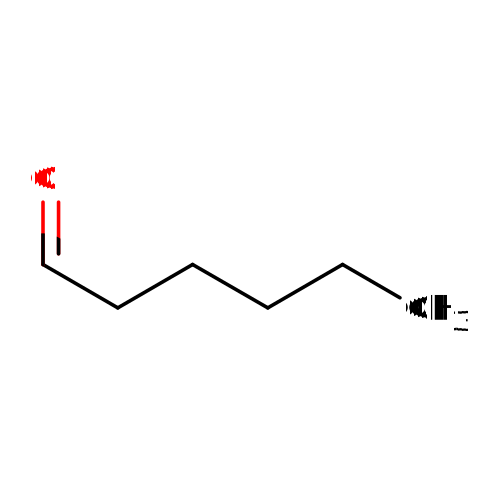
Common NameHexanal
ClassSmall Molecule
DescriptionHexanal is a uremic toxin. Uremic toxins can be subdivided into three major groups based upon their chemical and physical characteristics: 1) small, water-soluble, non-protein-bound compounds, such as urea; 2) small, lipid-soluble and/or protein-bound compounds, such as the phenols and 3) larger so-called middle-molecules, such as beta2-microglobulin. Chronic exposure of uremic toxins can lead to a number of conditions including renal damage, chronic kidney disease and cardiovascular disease. Hexanal is an alkyl aldehyde found in human biofluids. Human milk samples collected from women contains hexanal. Among mediators of oxidative stress, highly reactive secondary aldehydic lipid peroxidation products can initiate the processes of spontaneous mutagenesis and carcinogenesis and can also act as a growth-regulating factors and signaling molecules. In specimens obtained from adult patients with brain astrocytomas, lower levels of n-hexanal are associated with poorer patient prognosis. Hexanal is a volatile compound that has been associated with the development of undesirable flavours. The content of hexanal, which is a major breakdown product of linoleic acid (LA, n - 6 PUFA) oxidation, has been used to follow the course of lipid oxidation and off-flavour development in foods, and have been proposed as one potential marker of milk quality. A cardboard-like off-flavour is frequently associated with dehydrated milk products. This effect is highly correlated with the headspace concentration of hexanal. (4, 5).
Contaminant Sources
  • EAFUS Chemicals
  • FooDB Chemicals
  • HMDB Contaminants - Feces
  • HMDB Contaminants - Urine
  • HPV EPA Chemicals
  • STOFF IDENT Compounds
  • T3DB toxins
  • ToxCast & Tox21 Chemicals
Contaminant Type
  • Aldehyde
  • Food Toxin
  • Metabolite
  • Natural Compound
  • Organic Compound
  • Uremic Toxin
Chemical Structure
Thumb
Synonyms
ValueSource
1-HexanalChEBI
Aldehyde C-6ChEBI
C6 AldehydeChEBI
CaproaldehydeChEBI
Caproic aldehydeChEBI
HexaldehydeChEBI
Hexan-1-alChEBI
HexanaldehydeChEBI
Hexoic aldehydeChEBI
HexylaldehydeChEBI
N-C5H11CHOChEBI
N-CaproaldehydeChEBI
N-Caproic aldehydeChEBI
N-HexanalChEBI
N-HexylaldehydeChEBI
CapronaldehydeHMDB
HexanalMeSH
n-CapronaldehydeHMDB
Chemical FormulaC6H12O
Average Molecular Mass100.159 g/mol
Monoisotopic Mass100.089 g/mol
CAS Registry Number66-25-1
IUPAC Namehexanal
Traditional Namehexanal
SMILESCCCCCC=O
InChI IdentifierInChI=1S/C6H12O/c1-2-3-4-5-6-7/h6H,2-5H2,1H3
InChI KeyJARKCYVAAOWBJS-UHFFFAOYSA-N
Chemical Taxonomy
Description belongs to the class of organic compounds known as medium-chain aldehydes. These are an aldehyde with a chain length containing between 6 and 12 carbon atoms.
KingdomOrganic compounds
Super ClassOrganic oxygen compounds
ClassOrganooxygen compounds
Sub ClassCarbonyl compounds
Direct ParentMedium-chain aldehydes
Alternative Parents
Substituents
  • Medium-chain aldehyde
  • Alpha-hydrogen aldehyde
  • Organic oxide
  • Hydrocarbon derivative
  • Aliphatic acyclic compound
Molecular FrameworkAliphatic acyclic compounds
External Descriptors
Biological Properties
StatusDetected and Not Quantified
OriginEndogenous
Cellular Locations
  • Cytoplasm
  • Extracellular
Biofluid LocationsNot Available
Tissue LocationsNot Available
PathwaysNot Available
ApplicationsNot Available
Biological RolesNot Available
Chemical RolesNot Available
Physical Properties
StateLiquid
AppearanceNot Available
Experimental Properties
PropertyValue
Melting Point-56°C
Boiling PointNot Available
Solubility5.64 mg/mL at 30°C
Predicted Properties
PropertyValueSource
Water Solubility4.49 g/LALOGPS
logP2.37ALOGPS
logP1.65ChemAxon
logS-1.4ALOGPS
pKa (Strongest Acidic)17.79ChemAxon
pKa (Strongest Basic)-6.9ChemAxon
Physiological Charge0ChemAxon
Hydrogen Acceptor Count1ChemAxon
Hydrogen Donor Count0ChemAxon
Polar Surface Area17.07 ŲChemAxon
Rotatable Bond Count4ChemAxon
Refractivity30.15 m³·mol⁻¹ChemAxon
Polarizability12.32 ųChemAxon
Number of Rings0ChemAxon
Bioavailability1ChemAxon
Rule of FiveYesChemAxon
Ghose FilterNoChemAxon
Veber's RuleYesChemAxon
MDDR-like RuleNoChemAxon
Spectra
Spectra
Spectrum TypeDescriptionSplash KeyView
GC-MSGC-MS Spectrum - EI-B (Non-derivatized)splash10-0006-9000000000-65f52440a5d20229be6cSpectrum
GC-MSGC-MS Spectrum - EI-B (Non-derivatized)splash10-052f-9000000000-89f4d5edf8639a778ef4Spectrum
GC-MSGC-MS Spectrum - EI-B (Non-derivatized)splash10-052f-9000000000-98fd24ab2b6d3d9cf3cfSpectrum
GC-MSGC-MS Spectrum - EI-B (Non-derivatized)splash10-0006-9000000000-65f52440a5d20229be6cSpectrum
GC-MSGC-MS Spectrum - EI-B (Non-derivatized)splash10-052f-9000000000-89f4d5edf8639a778ef4Spectrum
GC-MSGC-MS Spectrum - EI-B (Non-derivatized)splash10-052f-9000000000-98fd24ab2b6d3d9cf3cfSpectrum
Predicted GC-MSPredicted GC-MS Spectrum - GC-MS (Non-derivatized) - 70eV, Positivesplash10-004l-9000000000-f6f6f2d2922256923f62Spectrum
Predicted GC-MSPredicted GC-MS Spectrum - GC-MS (Non-derivatized) - 70eV, PositiveNot AvailableSpectrum
LC-MS/MSLC-MS/MS Spectrum - Quattro_QQQ 10V, N/A (Annotated)splash10-0089-9200000000-a864c6ae8f499374570fSpectrum
LC-MS/MSLC-MS/MS Spectrum - Quattro_QQQ 25V, N/A (Annotated)splash10-00lr-9000000000-c35aa664e0abaa7ff754Spectrum
LC-MS/MSLC-MS/MS Spectrum - Quattro_QQQ 40V, N/A (Annotated)splash10-00lr-9100000000-32a2d24a74c86ead890bSpectrum
LC-MS/MSLC-MS/MS Spectrum - EI-B (HITACHI RMU-6M) , Positivesplash10-0006-9000000000-65f52440a5d20229be6cSpectrum
LC-MS/MSLC-MS/MS Spectrum - EI-B (HITACHI M-80B) , Positivesplash10-052f-9000000000-13ae9f72ffb8573eac28Spectrum
LC-MS/MSLC-MS/MS Spectrum - EI-B (HITACHI RMU-6M) , Positivesplash10-052f-9000000000-e06f68e7ce93f5ced938Spectrum
Predicted LC-MS/MSPredicted LC-MS/MS Spectrum - 10V, Positivesplash10-0udi-4900000000-3680e8fedab54e7572cbSpectrum
Predicted LC-MS/MSPredicted LC-MS/MS Spectrum - 20V, Positivesplash10-0ue9-9400000000-d3150dfd70fdee4bfc78Spectrum
Predicted LC-MS/MSPredicted LC-MS/MS Spectrum - 40V, Positivesplash10-052f-9000000000-c161db43b692fc558533Spectrum
Predicted LC-MS/MSPredicted LC-MS/MS Spectrum - 10V, Negativesplash10-0002-9000000000-16f962506c9316343166Spectrum
Predicted LC-MS/MSPredicted LC-MS/MS Spectrum - 20V, Negativesplash10-0002-9000000000-1fd34894f517ecf1f19aSpectrum
Predicted LC-MS/MSPredicted LC-MS/MS Spectrum - 40V, Negativesplash10-0006-9000000000-054aa18a9a05fa35cf01Spectrum
Predicted LC-MS/MSPredicted LC-MS/MS Spectrum - 10V, Negativesplash10-0002-9000000000-658fe53778817eb82301Spectrum
Predicted LC-MS/MSPredicted LC-MS/MS Spectrum - 20V, Negativesplash10-001i-9000000000-b0e3f2f55178b8aacda1Spectrum
Predicted LC-MS/MSPredicted LC-MS/MS Spectrum - 40V, Negativesplash10-0006-9000000000-c5c7ace495de00bff008Spectrum
Predicted LC-MS/MSPredicted LC-MS/MS Spectrum - 10V, Positivesplash10-0a5c-9000000000-d214e2877cddafdcb757Spectrum
Predicted LC-MS/MSPredicted LC-MS/MS Spectrum - 20V, Positivesplash10-052f-9000000000-f2f5a7e46a17ef9b2c6bSpectrum
Predicted LC-MS/MSPredicted LC-MS/MS Spectrum - 40V, Positivesplash10-0a4l-9000000000-7d79b3949754c5802624Spectrum
MSMass Spectrum (Electron Ionization)splash10-052f-9000000000-72ae5d9e7cc61abeff7fSpectrum
1D NMR1H NMR SpectrumNot AvailableSpectrum
1D NMR13C NMR SpectrumNot AvailableSpectrum
1D NMR1H NMR SpectrumNot AvailableSpectrum
1D NMR13C NMR SpectrumNot AvailableSpectrum
1D NMR1H NMR SpectrumNot AvailableSpectrum
1D NMR13C NMR SpectrumNot AvailableSpectrum
1D NMR1H NMR SpectrumNot AvailableSpectrum
1D NMR13C NMR SpectrumNot AvailableSpectrum
1D NMR1H NMR SpectrumNot AvailableSpectrum
1D NMR13C NMR SpectrumNot AvailableSpectrum
1D NMR1H NMR SpectrumNot AvailableSpectrum
1D NMR13C NMR SpectrumNot AvailableSpectrum
1D NMR1H NMR SpectrumNot AvailableSpectrum
1D NMR13C NMR SpectrumNot AvailableSpectrum
1D NMR1H NMR SpectrumNot AvailableSpectrum
1D NMR13C NMR SpectrumNot AvailableSpectrum
1D NMR1H NMR SpectrumNot AvailableSpectrum
1D NMR13C NMR SpectrumNot AvailableSpectrum
1D NMR1H NMR SpectrumNot AvailableSpectrum
1D NMR13C NMR SpectrumNot AvailableSpectrum
1D NMR1H NMR SpectrumNot AvailableSpectrum
2D NMR[1H,13C] 2D NMR SpectrumNot AvailableSpectrum
Toxicity Profile
Route of ExposureEndogenous, Ingestion, Dermal (contact)
Mechanism of ToxicityUremic toxins such as hexanal are actively transported into the kidneys via organic ion transporters (especially OAT3). Increased levels of uremic toxins can stimulate the production of reactive oxygen species. This seems to be mediated by the direct binding or inhibition by uremic toxins of the enzyme NADPH oxidase (especially NOX4 which is abundant in the kidneys and heart) (2). Reactive oxygen species can induce several different DNA methyltransferases (DNMTs) which are involved in the silencing of a protein known as KLOTHO. KLOTHO has been identified as having important roles in anti-aging, mineral metabolism, and vitamin D metabolism. A number of studies have indicated that KLOTHO mRNA and protein levels are reduced during acute or chronic kidney diseases in response to high local levels of reactive oxygen species (3).
MetabolismUremic toxins tend to accumulate in the blood either through dietary excess or through poor filtration by the kidneys. Most uremic toxins are metabolic waste products and are normally excreted in the urine or feces.
Toxicity ValuesNot Available
Lethal DoseNot Available
Carcinogenicity (IARC Classification)No indication of carcinogenicity to humans (not listed by IARC).
Uses/SourcesNaturally produced by the body (endogenous).
Minimum Risk LevelNot Available
Health EffectsChronic exposure to uremic toxins can lead to a number of conditions including renal damage, chronic kidney disease and cardiovascular disease.
SymptomsAs a uremic toxin, this compound can cause uremic syndrome. Uremic syndrome may affect any part of the body and can cause nausea, vomiting, loss of appetite, and weight loss. It can also cause changes in mental status, such as confusion, reduced awareness, agitation, psychosis, seizures, and coma. Abnormal bleeding, such as bleeding spontaneously or profusely from a very minor injury can also occur. Heart problems, such as an irregular heartbeat, inflammation in the sac that surrounds the heart (pericarditis), and increased pressure on the heart can be seen in patients with uremic syndrome. Shortness of breath from fluid buildup in the space between the lungs and the chest wall (pleural effusion) can also be present.
TreatmentKidney dialysis is usually needed to relieve the symptoms of uremic syndrome until normal kidney function can be restored.
Concentrations
Not Available
DrugBank IDNot Available
HMDB IDHMDB0005994
FooDB IDFDB008068
Phenol Explorer IDNot Available
KNApSAcK IDC00000357
BiGG IDNot Available
BioCyc IDHEXANAL
METLIN IDNot Available
PDB IDNot Available
Wikipedia LinkHexanal
Chemspider ID5949
ChEBI ID88528
PubChem Compound ID6184
Kegg Compound IDC02373
YMDB IDYMDB01759
ECMDB IDNot Available
References
Synthesis ReferenceHershberg, E. B. Aldehyde synthesis. Helvetica Chimica Acta (1934), 17 351-8. CODEN: HCACAV ISSN:0018-019X. CAN 28:28437 AN 1934:28437
MSDSLink
General References
1. https://www.ncbi.nlm.nih.gov/pubmed/?term=17487452
2. https://www.ncbi.nlm.nih.gov/pubmed/?term=19167006
3. https://www.ncbi.nlm.nih.gov/pubmed/?term=22284503
4. https://www.ncbi.nlm.nih.gov/pubmed/?term=27025353
5. Hershberg, E. B. Aldehyde synthesis. Helvetica Chimica Acta (1934), 17 351-8. CODEN: HCACAV ISSN:0018-019X. CAN 28:28437 AN 1934:28437
6. Toso B, Procida G, Stefanon B: Determination of volatile compounds in cows' milk using headspace GC-MS. J Dairy Res. 2002 Nov;69(4):569-77.
7. Brigitta Gaspardo et al. Determination of volatile fractions in raw milk and ripened cheese by means of GC-MS. Results of a survey performed in the marginal area between Italy and Slovenia. Italian Jounal of Animal Science Vol 8, 377-390, 2009
8. Hershberg, E. B. Aldehyde synthesis. Helvetica Chimica Acta (1934), 17 351-8. CODEN: HCACAV ISSN:0018-019X. CAN 28:28437 AN 1934:28437
9. Aronson DB, Bosch S, Gray DA, Howard PH, Guiney PD: A comparative human health risk assessment of p-dichlorobenzene-based toilet rimblock products versus fragrance/surfactant-based alternatives. J Toxicol Environ Health B Crit Rev. 2007 Oct;10(7):467-526.
10. Zajdel A, Wilczok A, Slowinski J, Orchel J, Mazurek U: Aldehydic lipid peroxidation products in human brain astrocytomas. J Neurooncol. 2007 Sep;84(2):167-73. Epub 2007 May 9.
11. Duranton F, Cohen G, De Smet R, Rodriguez M, Jankowski J, Vanholder R, Argiles A: Normal and pathologic concentrations of uremic toxins. J Am Soc Nephrol. 2012 Jul;23(7):1258-70. doi: 10.1681/ASN.2011121175. Epub 2012 May 24.