Record Information
Version1.0
Creation Date2014-08-29 05:50:17 UTC
Update Date2026-04-05 16:41:09 UTC
Accession NumberCHEM003139
Identification
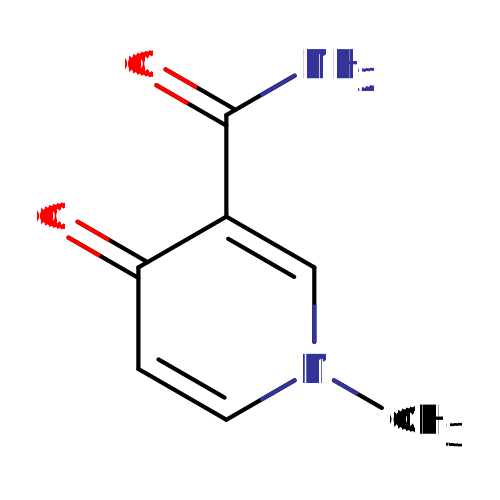
Common NameN1-Methyl-4-pyridone-3-carboxamide
ClassSmall Molecule
DescriptionN-methyl-4-pyridone-3-carboxamide is a uremic toxin. Uremic toxins can be subdivided into three major groups based upon their chemical and physical characteristics: 1) small, water-soluble, non-protein-bound compounds, such as urea; 2) small, lipid-soluble and/or protein-bound compounds, such as the phenols and 3) larger so-called middle-molecules, such as beta2-microglobulin. Chronic exposure of uremic toxins can lead to a number of conditions including renal damage, chronic kidney disease and cardiovascular disease. N1-Methyl-4-pyridone-5-carboxamide (4PY ) is a normal human metabolite (one of the end products of nicotinamide-adenine dinucleotide (NAD) degradation). 4PY concentration in serum is elevated in non-dialyzed chronic renal failure (CRF) patients when compared with controls. (2).
Contaminant Sources
  • FooDB Chemicals
  • HMDB Contaminants - Urine
  • T3DB toxins
Contaminant Type
  • Amide
  • Food Toxin
  • Metabolite
  • Natural Compound
  • Organic Compound
  • Uremic Toxin
Chemical Structure
Thumb
Synonyms
ValueSource
1,4-Dihydro-1-methyl-4-oxo-3-pyridinecarboxamideChEBI
1-Methyl-4-oxo-1,4-dihydro-3-pyridinecarboxamideChEBI
1-Methyl-4-pyridone-3-carboximideChEBI
1-Methyl-4-pyridone-5-carboxamideChEBI
3-(Aminocarbonyl)-1-methyl-4(1H)-pyridoneChEBI
5-Aminocarbonyl-1-methyl-4(1H)-pyridoneChEBI
N'-methyl-4-pyridone-5-carboxamideChEBI
N-Methyl-4-pyridone-5-carboxamideChEBI
N1-Methyl-4-pyridone-5-carboxamideChEBI
1-Methyl-4-pyridone-3-carboxamideHMDB
Chemical FormulaC7H8N2O2
Average Molecular Mass152.151 g/mol
Monoisotopic Mass152.059 g/mol
CAS Registry Number769-49-3
IUPAC Name1-methyl-4-oxo-1,4-dihydropyridine-3-carboxamide
Traditional Name1-methyl-4-oxopyridine-3-carboxamide
SMILESCN1C=CC(=O)C(=C1)C(N)=O
InChI IdentifierInChI=1S/C7H8N2O2/c1-9-3-2-6(10)5(4-9)7(8)11/h2-4H,1H3,(H2,8,11)
InChI KeyKTLRWTOPTKGYQY-UHFFFAOYSA-N
Chemical Taxonomy
Description belongs to the class of organic compounds known as nicotinamides. These are heterocyclic aromatic compounds containing a pyridine ring substituted at position 3 by a carboxamide group.
KingdomOrganic compounds
Super ClassOrganoheterocyclic compounds
ClassPyridines and derivatives
Sub ClassPyridinecarboxylic acids and derivatives
Direct ParentNicotinamides
Alternative Parents
Substituents
  • Nicotinamide
  • Dihydropyridine
  • Hydropyridine
  • Vinylogous amide
  • Heteroaromatic compound
  • Carboxamide group
  • Primary carboxylic acid amide
  • Cyclic ketone
  • Carboxylic acid derivative
  • Azacycle
  • Organooxygen compound
  • Organonitrogen compound
  • Organopnictogen compound
  • Organic oxygen compound
  • Organic nitrogen compound
  • Organic oxide
  • Hydrocarbon derivative
  • Aromatic heteromonocyclic compound
Molecular FrameworkAromatic heteromonocyclic compounds
External Descriptors
Biological Properties
StatusDetected and Not Quantified
OriginEndogenous
Cellular Locations
  • Cytoplasm
  • Membrane
Biofluid LocationsNot Available
Tissue LocationsNot Available
Pathways
NameSMPDB LinkKEGG Link
Nicotinate and Nicotinamide MetabolismSMP00048 map00760
ApplicationsNot Available
Biological Roles
Chemical RolesNot Available
Physical Properties
StateSolid
AppearanceWhite powder.
Experimental Properties
PropertyValue
Melting PointNot Available
Boiling PointNot Available
SolubilityNot Available
Predicted Properties
PropertyValueSource
Water Solubility115 g/LALOGPS
logP-1ALOGPS
logP-0.56ChemAxon
logS-0.12ALOGPS
pKa (Strongest Acidic)15.73ChemAxon
pKa (Strongest Basic)0.39ChemAxon
Physiological Charge0ChemAxon
Hydrogen Acceptor Count3ChemAxon
Hydrogen Donor Count1ChemAxon
Polar Surface Area63.4 ŲChemAxon
Rotatable Bond Count1ChemAxon
Refractivity40.81 m³·mol⁻¹ChemAxon
Polarizability14.7 ųChemAxon
Number of Rings1ChemAxon
Bioavailability1ChemAxon
Rule of FiveYesChemAxon
Ghose FilterNoChemAxon
Veber's RuleNoChemAxon
MDDR-like RuleNoChemAxon
Spectra
Spectra
Spectrum TypeDescriptionSplash KeyView
Predicted GC-MSPredicted GC-MS Spectrum - GC-MS (Non-derivatized) - 70eV, Positivesplash10-0zg0-4900000000-20331ed897c9e0a9fc31Spectrum
Predicted GC-MSPredicted GC-MS Spectrum - GC-MS (Non-derivatized) - 70eV, PositiveNot AvailableSpectrum
LC-MS/MSLC-MS/MS Spectrum - 30V, Positivesplash10-0006-9200000000-1cb822771a6ad4a05575Spectrum
LC-MS/MSLC-MS/MS Spectrum - 0V, Positivesplash10-0udr-0900000000-1d0361e9faeabeb71262Spectrum
LC-MS/MSLC-MS/MS Spectrum - 10V, Positivesplash10-000i-0900000000-6f959701aa7326eb0c63Spectrum
LC-MS/MSLC-MS/MS Spectrum - 0V, Positivesplash10-0udr-0900000000-208827e4de225e9d8d63Spectrum
LC-MS/MSLC-MS/MS Spectrum - 10V, Positivesplash10-000i-0900000000-f55ef59743379eae48baSpectrum
LC-MS/MSLC-MS/MS Spectrum - 30V, Positivesplash10-0006-9200000000-ae1cfccb1887632aa147Spectrum
LC-MS/MSLC-MS/MS Spectrum - 20V, Positivesplash10-000i-4900000000-63099c0a130f1a93fd19Spectrum
LC-MS/MSLC-MS/MS Spectrum - 10V, Positivesplash10-000i-0900000000-081f0ec3c9d46b1b3bd8Spectrum
LC-MS/MSLC-MS/MS Spectrum - 30V, Positivesplash10-0006-9200000000-050f4f2282bac4a4ede9Spectrum
LC-MS/MSLC-MS/MS Spectrum - 40V, Positivesplash10-0006-9000000000-39816589e8ae9e5f8604Spectrum
Predicted LC-MS/MSPredicted LC-MS/MS Spectrum - 10V, Positivesplash10-0udi-0900000000-584bee8b1d116d28ad72Spectrum
Predicted LC-MS/MSPredicted LC-MS/MS Spectrum - 20V, Positivesplash10-0w2i-0900000000-9b1ca159ad8a687a6449Spectrum
Predicted LC-MS/MSPredicted LC-MS/MS Spectrum - 40V, Positivesplash10-0ab9-9500000000-8c23a4085269713574deSpectrum
Predicted LC-MS/MSPredicted LC-MS/MS Spectrum - 10V, Negativesplash10-0udi-0900000000-fdc0b46552431f575ba6Spectrum
Predicted LC-MS/MSPredicted LC-MS/MS Spectrum - 20V, Negativesplash10-0pb9-2900000000-280bfbe85df4a0da0894Spectrum
Predicted LC-MS/MSPredicted LC-MS/MS Spectrum - 40V, Negativesplash10-0pbc-9200000000-ca4c67126b692467c9eeSpectrum
Predicted LC-MS/MSPredicted LC-MS/MS Spectrum - 10V, Positivesplash10-000i-0900000000-7d7c2fb30321be106dbaSpectrum
Predicted LC-MS/MSPredicted LC-MS/MS Spectrum - 20V, Positivesplash10-052r-0900000000-5da27f9f442b311a97fcSpectrum
Predicted LC-MS/MSPredicted LC-MS/MS Spectrum - 40V, Positivesplash10-0a59-9500000000-02d654c5564e7e65df73Spectrum
Predicted LC-MS/MSPredicted LC-MS/MS Spectrum - 10V, Negativesplash10-0udi-0900000000-222319115ca49603e9d0Spectrum
Predicted LC-MS/MSPredicted LC-MS/MS Spectrum - 20V, Negativesplash10-0a4i-0900000000-2682511e81f9b8e4a101Spectrum
Predicted LC-MS/MSPredicted LC-MS/MS Spectrum - 40V, Negativesplash10-0zfr-9200000000-ecbc5d1685a2efb1bb50Spectrum
1D NMR13C NMR SpectrumNot AvailableSpectrum
1D NMR1H NMR SpectrumNot AvailableSpectrum
1D NMR13C NMR SpectrumNot AvailableSpectrum
1D NMR1H NMR SpectrumNot AvailableSpectrum
1D NMR13C NMR SpectrumNot AvailableSpectrum
1D NMR1H NMR SpectrumNot AvailableSpectrum
1D NMR13C NMR SpectrumNot AvailableSpectrum
1D NMR1H NMR SpectrumNot AvailableSpectrum
1D NMR13C NMR SpectrumNot AvailableSpectrum
1D NMR1H NMR SpectrumNot AvailableSpectrum
1D NMR13C NMR SpectrumNot AvailableSpectrum
1D NMR1H NMR SpectrumNot AvailableSpectrum
1D NMR13C NMR SpectrumNot AvailableSpectrum
1D NMR1H NMR SpectrumNot AvailableSpectrum
1D NMR13C NMR SpectrumNot AvailableSpectrum
1D NMR1H NMR SpectrumNot AvailableSpectrum
1D NMR13C NMR SpectrumNot AvailableSpectrum
1D NMR1H NMR SpectrumNot AvailableSpectrum
1D NMR13C NMR SpectrumNot AvailableSpectrum
1D NMR1H NMR SpectrumNot AvailableSpectrum
Toxicity Profile
Route of ExposureEndogenous, Ingestion, Dermal (contact)
Mechanism of ToxicityUremic toxins such as N-methyl-4-pyridone-3-carboxamide are actively transported into the kidneys via organic ion transporters (especially OAT3). Increased levels of uremic toxins can stimulate the production of reactive oxygen species. This seems to be mediated by the direct binding or inhibition by uremic toxins of the enzyme NADPH oxidase (especially NOX4 which is abundant in the kidneys and heart) (3). Reactive oxygen species can induce several different DNA methyltransferases (DNMTs) which are involved in the silencing of a protein known as KLOTHO. KLOTHO has been identified as having important roles in anti-aging, mineral metabolism, and vitamin D metabolism. A number of studies have indicated that KLOTHO mRNA and protein levels are reduced during acute or chronic kidney diseases in response to high local levels of reactive oxygen species (4).
MetabolismUremic toxins tend to accumulate in the blood either through dietary excess or through poor filtration by the kidneys. Most uremic toxins are metabolic waste products and are normally excreted in the urine or feces.
Toxicity ValuesNot Available
Lethal DoseNot Available
Carcinogenicity (IARC Classification)No indication of carcinogenicity to humans (not listed by IARC).
Uses/SourcesNaturally produced by the body (endogenous).
Minimum Risk LevelNot Available
Health EffectsChronic exposure to uremic toxins can lead to a number of conditions including renal damage, chronic kidney disease and cardiovascular disease.
SymptomsAs a uremic toxin, this compound can cause uremic syndrome. Uremic syndrome may affect any part of the body and can cause nausea, vomiting, loss of appetite, and weight loss. It can also cause changes in mental status, such as confusion, reduced awareness, agitation, psychosis, seizures, and coma. Abnormal bleeding, such as bleeding spontaneously or profusely from a very minor injury can also occur. Heart problems, such as an irregular heartbeat, inflammation in the sac that surrounds the heart (pericarditis), and increased pressure on the heart can be seen in patients with uremic syndrome. Shortness of breath from fluid buildup in the space between the lungs and the chest wall (pleural effusion) can also be present.
TreatmentKidney dialysis is usually needed to relieve the symptoms of uremic syndrome until normal kidney function can be restored.
Concentrations
Not Available
DrugBank IDNot Available
HMDB IDHMDB0004194
FooDB IDFDB023331
Phenol Explorer IDNot Available
KNApSAcK IDNot Available
BiGG IDNot Available
BioCyc IDNot Available
METLIN IDNot Available
PDB IDNot Available
Wikipedia LinkNot Available
Chemspider ID389671
ChEBI ID27838
PubChem Compound ID440810
Kegg Compound IDC05843
YMDB IDNot Available
ECMDB IDNot Available
References
Synthesis ReferenceChaykin, Sterling. Biosynthesis of N-methyl-4-pyridone-3-carboxamide. Biochimica et Biophysica Acta, General Subjects (1964), 82(3), 633-4.
MSDSNot Available
General References
1. Chaykin, Sterling. Biosynthesis of N-methyl-4-pyridone-3-carboxamide. Biochimica et Biophysica Acta, General Subjects (1964), 82(3), 633-4.
2. Rutkowski B, Slominska E, Szolkiewicz M, Smolenski RT, Striley C, Rutkowski P, Swierczynski J: N-methyl-2-pyridone-5-carboxamide: a novel uremic toxin? Kidney Int Suppl. 2003 May;(84):S19-21.
3. Duranton F, Cohen G, De Smet R, Rodriguez M, Jankowski J, Vanholder R, Argiles A: Normal and pathologic concentrations of uremic toxins. J Am Soc Nephrol. 2012 Jul;23(7):1258-70. doi: 10.1681/ASN.2011121175. Epub 2012 May 24.
4. https://www.ncbi.nlm.nih.gov/pubmed/?term=12694300
5. https://www.ncbi.nlm.nih.gov/pubmed/?term=13692332
6. https://www.ncbi.nlm.nih.gov/pubmed/?term=17190852