Record Information
Version1.0
Creation Date2014-08-29 05:49:09 UTC
Update Date2026-05-14 17:13:01 UTC
Accession NumberCHEM003131
Identification
Common NameAsymmetric dimethylarginine
ClassSmall Molecule
DescriptionAsymmetric dimethylarginine is a uremic toxin. Uremic toxins can be subdivided into three major groups based upon their chemical and physical characteristics: 1) small, water-soluble, non-protein-bound compounds, such as urea; 2) small, lipid-soluble and/or protein-bound compounds, such as the phenols and 3) larger so-called middle-molecules, such as beta2-microglobulin. Chronic exposure of uremic toxins can lead to a number of conditions including renal damage, chronic kidney disease and cardiovascular disease. Asymmetric dimethylarginine (ADMA) is a naturally occurring chemical found in blood plasma. It is a metabolic by-product of continual protein modification processes in the cytoplasm of all human cells. It is closely related to L-arginine, a conditionally-essential amino acid. ADMA interferes with L-arginine in the production of nitric oxide, a key chemical to endothelial and hence cardiovascular health. Asymmetric dimethylarginine is created in protein methylation, a common mechanism of post-translational protein modification. This reaction is catalyzed by an enzyme set called S-adenosylmethionine protein N-methyltransferases (protein methylases I and II). The methyl groups transferred to create ADMA are derived from the methyl group donor S-adenosylmethionine, an intermediate in the metabolism of homocysteine. (Homocysteine is an important blood chemical, because it is also a marker of cardiovascular disease). After synthesis, ADMA migrates into the extracellular space and thence into blood plasma. Asymmetric dimethylarginine is measured using high performance liquid chromatography.
Contaminant Sources
  • FooDB Chemicals
  • HMDB Contaminants - Urine
  • T3DB toxins
Contaminant Type
  • Amide
  • Amine
  • Enzyme Inhibitor
  • Food Toxin
  • Industrial/Workplace Toxin
  • Metabolite
  • Natural Compound
  • Organic Compound
  • Uremic Toxin
Chemical Structure
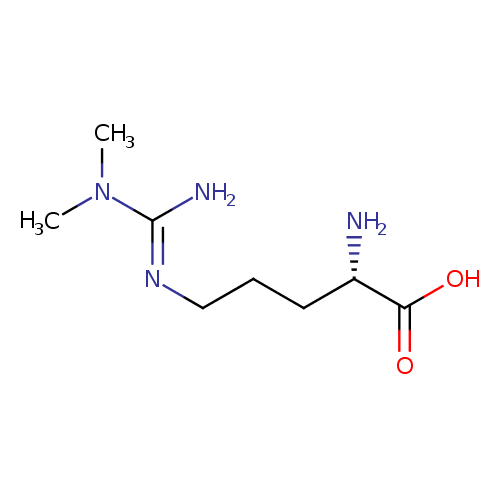
Thumb
Synonyms
ValueSource
ADMAChEBI
Guanidino-N,N-dimethylarginineChEBI
N,N-DimethylarginineChEBI
N(5)-((Dimethylamino)iminomethyl)-L-ornithineChEBI
NG,NG-Dimethyl-L-arginineChEBI
N(g),N(g)-DimethylarginineChEBI
N(g)-DimethylarginineChEBI
N(g1),N(g1)-DimethylarginineChEBI
Nomega,nomega-dimethyl-L-arginineKegg
2-Amino-5-(amino-dimethylamino-methylidene)amino-pentanoateHMDB
2-Amino-5-(amino-dimethylamino-methylidene)amino-pentanoic acidHMDB
Dimethyl-L-arginineHMDB
N(Omega),N(omega)-dimethyl-L-arginineHMDB
NG,NG-DimethylarginineHMDB
NG-DimethylarginineHMDB
Nomega,nomega'-dimethyl-L-arginineHMDB
Asymmetric dimethylarginineChEBI
Chemical FormulaC8H18N4O2
Average Molecular Mass202.254 g/mol
Monoisotopic Mass202.143 g/mol
CAS Registry Number30315-93-6
IUPAC Name(2S)-2-amino-5-[(E)-[amino(dimethylamino)methylidene]amino]pentanoic acid
Traditional Nameasymmetric dimethylarginine
SMILESN[C@@H](CCC\N=C(/N)N(C)C)C(O)=O
InChI IdentifierInChI=1S/C8H18N4O2/c1-12(2)8(10)11-5-3-4-6(9)7(13)14/h6H,3-5,9H2,1-2H3,(H2,10,11)(H,13,14)/t6-/m0/s1
InChI KeyYDGMGEXADBMOMJ-LURJTMIESA-N
Chemical Taxonomy
Description belongs to the class of organic compounds known as arginine and derivatives. Arginine and derivatives are compounds containing arginine or a derivative thereof resulting from reaction of arginine at the amino group or the carboxy group, or from the replacement of any hydrogen of glycine by a heteroatom.
KingdomOrganic compounds
Super ClassOrganic acids and derivatives
ClassCarboxylic acids and derivatives
Sub ClassAmino acids, peptides, and analogues
Direct ParentArginine and derivatives
Alternative Parents
Substituents
  • Arginine or derivatives
  • Alpha-amino acid
  • L-alpha-amino acid
  • Fatty acid
  • Guanidine
  • Amino acid
  • Carboximidamide
  • Monocarboxylic acid or derivatives
  • Carboxylic acid
  • Hydrocarbon derivative
  • Organopnictogen compound
  • Organic oxygen compound
  • Primary amine
  • Organooxygen compound
  • Organonitrogen compound
  • Primary aliphatic amine
  • Imine
  • Carbonyl group
  • Amine
  • Organic nitrogen compound
  • Organic oxide
  • Aliphatic acyclic compound
Molecular FrameworkAliphatic acyclic compounds
External Descriptors
Biological Properties
StatusDetected and Not Quantified
OriginEndogenous
Cellular Locations
  • Cytoplasm
  • Membrane
Biofluid LocationsNot Available
Tissue Locations
  • Kidney
  • Liver
PathwaysNot Available
ApplicationsNot Available
Biological Roles
Chemical Roles
Physical Properties
StateSolid
AppearanceWhite powder.
Experimental Properties
PropertyValue
Melting Point195 - 197°C
Boiling PointNot Available
SolubilityNot Available
Predicted Properties
PropertyValueSource
Water Solubility6.77 g/LALOGPS
logP-3.1ALOGPS
logP-2.7ChemAxon
logS-1.5ALOGPS
pKa (Strongest Acidic)2.54ChemAxon
pKa (Strongest Basic)12.34ChemAxon
Physiological Charge1ChemAxon
Hydrogen Acceptor Count6ChemAxon
Hydrogen Donor Count3ChemAxon
Polar Surface Area104.94 ŲChemAxon
Rotatable Bond Count5ChemAxon
Refractivity53.7 m³·mol⁻¹ChemAxon
Polarizability22.19 ųChemAxon
Number of Rings0ChemAxon
Bioavailability1ChemAxon
Rule of FiveYesChemAxon
Ghose FilterNoChemAxon
Veber's RuleNoChemAxon
MDDR-like RuleNoChemAxon
Spectra
Spectra
Spectrum TypeDescriptionSplash KeyView
GC-MSGC-MS Spectrum - GC-EI-TOF (Non-derivatized)splash10-0f6w-1920000000-352e317361bed495b71bSpectrum
Predicted GC-MSPredicted GC-MS Spectrum - GC-MS (Non-derivatized) - 70eV, Positivesplash10-00dl-9300000000-4fc2a444d078a1eb4d85Spectrum
Predicted GC-MSPredicted GC-MS Spectrum - GC-MS (1 TMS) - 70eV, Positivesplash10-00dl-9520000000-928759e33b3f9821da4aSpectrum
Predicted GC-MSPredicted GC-MS Spectrum - GC-MS (Non-derivatized) - 70eV, PositiveNot AvailableSpectrum
LC-MS/MSLC-MS/MS Spectrum - 35V, Negativesplash10-0006-9100000000-2849c1945541be90da8aSpectrum
LC-MS/MSLC-MS/MS Spectrum - 35V, Positivesplash10-00di-9200000000-f7af59f4a85b35ee2239Spectrum
LC-MS/MSLC-MS/MS Spectrum - 35V, Positivesplash10-00di-9310000000-901ceea58124eb646d2dSpectrum
Predicted LC-MS/MSPredicted LC-MS/MS Spectrum - 10V, Positivesplash10-0pbi-1930000000-6a12bc30dbe08d316d09Spectrum
Predicted LC-MS/MSPredicted LC-MS/MS Spectrum - 20V, Positivesplash10-0abi-8900000000-47e0a5a868dce918c9b7Spectrum
Predicted LC-MS/MSPredicted LC-MS/MS Spectrum - 40V, Positivesplash10-00di-9000000000-d674ec18daa47f080be4Spectrum
Predicted LC-MS/MSPredicted LC-MS/MS Spectrum - 10V, Negativesplash10-0udi-3390000000-2b624585e91010265a57Spectrum
Predicted LC-MS/MSPredicted LC-MS/MS Spectrum - 20V, Negativesplash10-0f79-9420000000-b8fe15104f41182b9d9bSpectrum
Predicted LC-MS/MSPredicted LC-MS/MS Spectrum - 40V, Negativesplash10-00dl-9100000000-120212bd5d151152c8adSpectrum
Predicted LC-MS/MSPredicted LC-MS/MS Spectrum - 10V, Negativesplash10-0uk9-9370000000-4bea91f4d0256a94739fSpectrum
Predicted LC-MS/MSPredicted LC-MS/MS Spectrum - 20V, Negativesplash10-01si-2900000000-8fc254a7c96b0565c1ffSpectrum
Predicted LC-MS/MSPredicted LC-MS/MS Spectrum - 40V, Negativesplash10-0006-9200000000-428e5ae3fbdfa34b338cSpectrum
Predicted LC-MS/MSPredicted LC-MS/MS Spectrum - 10V, Positivesplash10-0udr-2690000000-5766392f870c77d53359Spectrum
Predicted LC-MS/MSPredicted LC-MS/MS Spectrum - 20V, Positivesplash10-00dr-9200000000-a7b438425f1f49a1a48bSpectrum
Predicted LC-MS/MSPredicted LC-MS/MS Spectrum - 40V, Positivesplash10-00di-9000000000-e6f7e053fa2072aa45ffSpectrum
1D NMR1H NMR SpectrumNot AvailableSpectrum
1D NMR13C NMR SpectrumNot AvailableSpectrum
1D NMR1H NMR SpectrumNot AvailableSpectrum
1D NMR13C NMR SpectrumNot AvailableSpectrum
1D NMR1H NMR SpectrumNot AvailableSpectrum
1D NMR13C NMR SpectrumNot AvailableSpectrum
1D NMR1H NMR SpectrumNot AvailableSpectrum
1D NMR13C NMR SpectrumNot AvailableSpectrum
1D NMR1H NMR SpectrumNot AvailableSpectrum
1D NMR13C NMR SpectrumNot AvailableSpectrum
1D NMR1H NMR SpectrumNot AvailableSpectrum
1D NMR13C NMR SpectrumNot AvailableSpectrum
1D NMR1H NMR SpectrumNot AvailableSpectrum
1D NMR13C NMR SpectrumNot AvailableSpectrum
1D NMR1H NMR SpectrumNot AvailableSpectrum
1D NMR13C NMR SpectrumNot AvailableSpectrum
1D NMR1H NMR SpectrumNot AvailableSpectrum
1D NMR13C NMR SpectrumNot AvailableSpectrum
1D NMR1H NMR SpectrumNot AvailableSpectrum
1D NMR13C NMR SpectrumNot AvailableSpectrum
Toxicity Profile
Route of ExposureEndogenous, Ingestion, Dermal (contact)
Mechanism of ToxicityUremic toxins such as asymmetric dimethylarginine are actively transported into the kidneys via organic ion transporters (especially OAT3). Increased levels of uremic toxins can stimulate the production of reactive oxygen species. This seems to be mediated by the direct binding or inhibition by uremic toxins of the enzyme NADPH oxidase (especially NOX4 which is abundant in the kidneys and heart) (3). Reactive oxygen species can induce several different DNA methyltransferases (DNMTs) which are involved in the silencing of a protein known as KLOTHO. KLOTHO has been identified as having important roles in anti-aging, mineral metabolism, and vitamin D metabolism. A number of studies have indicated that KLOTHO mRNA and protein levels are reduced during acute or chronic kidney diseases in response to high local levels of reactive oxygen species (4).
MetabolismUremic toxins tend to accumulate in the blood either through dietary excess or through poor filtration by the kidneys. Most uremic toxins are metabolic waste products and are normally excreted in the urine or feces.
Toxicity ValuesNot Available
Lethal DoseNot Available
Carcinogenicity (IARC Classification)No indication of carcinogenicity to humans (not listed by IARC).
Uses/SourcesNaturally produced by the body (endogenous).
Minimum Risk LevelNot Available
Health EffectsChronic exposure to uremic toxins can lead to a number of conditions including renal damage, chronic kidney disease and cardiovascular disease.
SymptomsAs a uremic toxin, this compound can cause uremic syndrome. Uremic syndrome may affect any part of the body and can cause nausea, vomiting, loss of appetite, and weight loss. It can also cause changes in mental status, such as confusion, reduced awareness, agitation, psychosis, seizures, and coma. Abnormal bleeding, such as bleeding spontaneously or profusely from a very minor injury can also occur. Heart problems, such as an irregular heartbeat, inflammation in the sac that surrounds the heart (pericarditis), and increased pressure on the heart can be seen in patients with uremic syndrome. Shortness of breath from fluid buildup in the space between the lungs and the chest wall (pleural effusion) can also be present.
TreatmentKidney dialysis is usually needed to relieve the symptoms of uremic syndrome until normal kidney function can be restored.
Concentrations
Not Available
DrugBank IDDB01686
HMDB IDHMDB0001539
FooDB IDFDB000508
Phenol Explorer IDNot Available
KNApSAcK IDNot Available
BiGG IDNot Available
BioCyc IDNot Available
METLIN ID6309
PDB IDNot Available
Wikipedia LinkAsymmetric dimethylarginine
Chemspider ID110375
ChEBI ID17929
PubChem Compound ID123831
Kegg Compound IDC03626
YMDB IDYMDB01554
ECMDB IDNot Available
References
Synthesis ReferenceNot Available
MSDSLink
General References
1. A. Foroutan et al. The Chemical Composition of Commercial Cow's Milk (in preparation)
2. Surdacki A, Nowicki M, Sandmann J, Tsikas D, Boeger RH, Bode-Boeger SM, Kruszelnicka-Kwiatkowska O, Kokot F, Dubiel JS, Froelich JC: Reduced urinary excretion of nitric oxide metabolites and increased plasma levels of asymmetric dimethylarginine in men with essential hypertension. J Cardiovasc Pharmacol. 1999 Apr;33(4):652-8.
3. Martens-Lobenhoffer J, Bode-Boger SM: Measurement of asymmetric dimethylarginine (ADMA) in human plasma: from liquid chromatography estimation to liquid chromatography-mass spectrometry quantification. Eur J Clin Pharmacol. 2006 Feb;62(Supplement 13):61-68.
4. Watanabe T, Kato S, Sato K, Nagata K: Nitric oxide regulation system in degenerative lumbar disease. Kurume Med J. 2005;52(1-2):39-47.
5. Nijveldt RJ, Teerlink T, Siroen MP, van der Hoven B, Prins HA, Wiezer MJ, Meijer C, van der Sijp JR, Cuesta MA, Meijer S, van Leeuwen PA: Elevation of asymmetric dimethylarginine (ADMA) in patients developing hepatic failure after major hepatectomy. JPEN J Parenter Enteral Nutr. 2004 Nov-Dec;28(6):382-7.
6. Siroen MP, Warle MC, Teerlink T, Nijveldt RJ, Kuipers EJ, Metselaar HJ, Tilanus HW, Kuik DJ, van der Sijp JR, Meijer S, van der Hoven B, van Leeuwen PA: The transplanted liver graft is capable of clearing asymmetric dimethylarginine. Liver Transpl. 2004 Dec;10(12):1524-30.
7. Tarnow L, Hovind P, Teerlink T, Stehouwer CD, Parving HH: Elevated plasma asymmetric dimethylarginine as a marker of cardiovascular morbidity in early diabetic nephropathy in type 1 diabetes. Diabetes Care. 2004 Mar;27(3):765-9.
8. Wang J, Sim AS, Wang XL, Salonikas C, Naidoo D, Wilcken DE: Relations between plasma asymmetric dimethylarginine (ADMA) and risk factors for coronary disease. Atherosclerosis. 2006 Feb;184(2):383-8. Epub 2005 Jun 6.
9. van Guldener C, Nanayakkara PW, Stehouwer CD: Homocysteine and asymmetric dimethylarginine (ADMA): biochemically linked but differently related to vascular disease in chronic kidney disease. Clin Chem Lab Med. 2007;45(12):1683-7.
10. Duranton F, Cohen G, De Smet R, Rodriguez M, Jankowski J, Vanholder R, Argiles A: Normal and pathologic concentrations of uremic toxins. J Am Soc Nephrol. 2012 Jul;23(7):1258-70. doi: 10.1681/ASN.2011121175. Epub 2012 May 24.
11. Elshenawy S, Pinney SE, Stuart T, Doulias PT, Zura G, Parry S, Elovitz MA, Bennett MJ, Bansal A, Strauss JF 3rd, Ischiropoulos H, Simmons RA: The Metabolomic Signature of the Placenta in Spontaneous Preterm Birth. Int J Mol Sci. 2020 Feb 4;21(3). pii: ijms21031043. doi: 10.3390/ijms21031043.