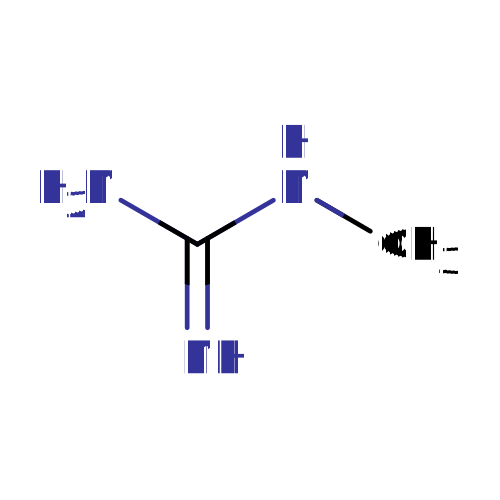
Record Information
Version1.0
Creation Date2014-08-29 05:49:01 UTC
Update Date2026-04-04 19:28:27 UTC
Accession NumberCHEM003130
Identification
Common NameMethylguanidine
ClassSmall Molecule
DescriptionMethylguanidine is a uremic toxin. Uremic toxins can be subdivided into three major groups based upon their chemical and physical characteristics: 1) small, water-soluble, non-protein-bound compounds, such as urea; 2) small, lipid-soluble and/or protein-bound compounds, such as the phenols and 3) larger so-called middle-molecules, such as beta2-microglobulin. Chronic exposure of uremic toxins can lead to a number of conditions including renal damage, chronic kidney disease and cardiovascular disease. Methylguanidine (MG) is a guanidine compound deriving from protein catabolism. It is also a product of putrefaction. Methylguanidine is a suspected uraemic toxin that accumulates in renal failure, however it also exhibits anti-inflammatory effects. Methylguanidine is synthesized from creatinine concomitant with the synthesis of hydrogen peroxide from endogenous substrates in peroxisomes. Recent evidence suggests that methylguanidine significantly inhibits iNOS activity and TNF- release. This means that methylguandine can attenuate the degree of inflammation and tissue damage associated with endotoxic shock.
Contaminant Sources
  • FooDB Chemicals
  • HMDB Contaminants - Urine
  • T3DB toxins
Contaminant Type
  • Amide
  • Amine
  • Food Toxin
  • Metabolite
  • Natural Compound
  • Organic Compound
  • Uremic Toxin
Chemical Structure
Thumb
Synonyms
ValueSource
1-METHYLGUANIDINEChEBI
MethylguanidinChEBI
MGXChEBI
Monomethyl guanidinChEBI
MonomethylguanidineChEBI
N-MethylguanidineChEBI
N1-MethylguanidineChEBI
Chemical FormulaC2H7N3
Average Molecular Mass73.097 g/mol
Monoisotopic Mass73.064 g/mol
CAS Registry Number471-29-4
IUPAC NameN-methylguanidine
Traditional Namemethylguanidine
SMILESCNC(N)=N
InChI IdentifierInChI=1S/C2H7N3/c1-5-2(3)4/h1H3,(H4,3,4,5)
InChI KeyCHJJGSNFBQVOTG-UHFFFAOYSA-N
Chemical Taxonomy
Description belongs to the class of organic compounds known as guanidines. Guanidines are compounds containing a guanidine moiety, with the general structure (R1R2N)(R3R4N)C=N-R5.
KingdomOrganic compounds
Super ClassOrganic nitrogen compounds
ClassOrganonitrogen compounds
Sub ClassGuanidines
Direct ParentGuanidines
Alternative Parents
Substituents
  • Guanidine
  • Carboximidamide
  • Organopnictogen compound
  • Hydrocarbon derivative
  • Imine
  • Aliphatic acyclic compound
Molecular FrameworkAliphatic acyclic compounds
External Descriptors
Biological Properties
StatusDetected and Not Quantified
OriginEndogenous
Cellular Locations
  • Cytoplasm
  • Extracellular
Biofluid LocationsNot Available
Tissue Locations
  • Brain
  • Liver
PathwaysNot Available
ApplicationsNot Available
Biological Roles
Chemical Roles
Physical Properties
StateSolid
AppearanceWhite powder.
Experimental Properties
PropertyValue
Melting PointNot Available
Boiling PointNot Available
Solubility1.78 mg/mL
Predicted Properties
PropertyValueSource
Water Solubility15.7 g/LALOGPS
logP-1.3ALOGPS
logP-0.96ChemAxon
logS-0.67ALOGPS
pKa (Strongest Basic)12.78ChemAxon
Physiological Charge1ChemAxon
Hydrogen Acceptor Count3ChemAxon
Hydrogen Donor Count3ChemAxon
Polar Surface Area61.9 ŲChemAxon
Rotatable Bond Count0ChemAxon
Refractivity30.63 m³·mol⁻¹ChemAxon
Polarizability7.57 ųChemAxon
Number of Rings0ChemAxon
Bioavailability1ChemAxon
Rule of FiveYesChemAxon
Ghose FilterNoChemAxon
Veber's RuleNoChemAxon
MDDR-like RuleNoChemAxon
Spectra
Spectra
Spectrum TypeDescriptionSplash KeyView
Predicted GC-MSPredicted GC-MS Spectrum - GC-MS (Non-derivatized) - 70eV, Positivesplash10-006x-9000000000-0b42b86da8534391928aSpectrum
Predicted GC-MSPredicted GC-MS Spectrum - GC-MS (Non-derivatized) - 70eV, PositiveNot AvailableSpectrum
LC-MS/MSLC-MS/MS Spectrum - Quattro_QQQ 10V, Positive (Annotated)splash10-05fr-9000000000-534633b3b3a72158d516Spectrum
LC-MS/MSLC-MS/MS Spectrum - Quattro_QQQ 25V, Positive (Annotated)splash10-0a4i-9000000000-ee83bc75360621d86cc9Spectrum
LC-MS/MSLC-MS/MS Spectrum - Quattro_QQQ 40V, Positive (Annotated)splash10-0006-9000000000-7c1f479fe12182b55b74Spectrum
LC-MS/MSLC-MS/MS Spectrum - , positivesplash10-00di-9000000000-44511a31625f714234e5Spectrum
LC-MS/MSLC-MS/MS Spectrum - 20V, Positivesplash10-0a4i-9000000000-b6d964b0cfb37e04aa3aSpectrum
LC-MS/MSLC-MS/MS Spectrum - 40V, Positivesplash10-052f-9000000000-18c440680d035ed316d4Spectrum
LC-MS/MSLC-MS/MS Spectrum - 10V, Positivesplash10-0a4i-9000000000-ecb092d7f7fa515ac881Spectrum
LC-MS/MSLC-MS/MS Spectrum - 10V, Positivesplash10-0a4i-9000000000-cc59ab6824edf551244eSpectrum
LC-MS/MSLC-MS/MS Spectrum - 40V, Positivesplash10-052f-9000000000-f836ec6360a96bbbd054Spectrum
LC-MS/MSLC-MS/MS Spectrum - 20V, Positivesplash10-0a4i-9000000000-3b8beb22e673f9fe659eSpectrum
LC-MS/MSLC-MS/MS Spectrum - 10V, Positivesplash10-0a4i-9000000000-7ef3fba0b93f0ffa9dbeSpectrum
LC-MS/MSLC-MS/MS Spectrum - 40V, Positivesplash10-0006-9000000000-387fd6ffcb6fd5f260f9Spectrum
LC-MS/MSLC-MS/MS Spectrum - 10V, Positivesplash10-0ab9-9000000000-d397b15b0bf6997fff62Spectrum
LC-MS/MSLC-MS/MS Spectrum - 40V, Positivesplash10-0006-9000000000-772b7e2aeeb01889ea68Spectrum
LC-MS/MSLC-MS/MS Spectrum - 20V, Positivesplash10-0a4i-9000000000-b2d8c441679319b6b93bSpectrum
LC-MS/MSLC-MS/MS Spectrum - 20V, Positivesplash10-0a4i-9000000000-f6850e9d0e6cc606dd73Spectrum
Predicted LC-MS/MSPredicted LC-MS/MS Spectrum - 10V, Positivesplash10-00di-9000000000-c221ed32014cd06b0bfcSpectrum
Predicted LC-MS/MSPredicted LC-MS/MS Spectrum - 20V, Positivesplash10-00di-9000000000-83eaeeade889a9c4fad4Spectrum
Predicted LC-MS/MSPredicted LC-MS/MS Spectrum - 40V, Positivesplash10-06dl-9000000000-afe740e2160d95afdac8Spectrum
Predicted LC-MS/MSPredicted LC-MS/MS Spectrum - 10V, Negativesplash10-00e9-9000000000-471b2da48f84e67fff62Spectrum
Predicted LC-MS/MSPredicted LC-MS/MS Spectrum - 20V, Negativesplash10-00di-9000000000-193b559c768749fc6b0bSpectrum
Predicted LC-MS/MSPredicted LC-MS/MS Spectrum - 40V, Negativesplash10-0006-9000000000-3661661b88220d227907Spectrum
Predicted LC-MS/MSPredicted LC-MS/MS Spectrum - 10V, Positivesplash10-0a4i-9000000000-dd30b822725ba557254eSpectrum
Predicted LC-MS/MSPredicted LC-MS/MS Spectrum - 20V, Positivesplash10-0a4i-9000000000-f8ebd4faa807cb8f5321Spectrum
Predicted LC-MS/MSPredicted LC-MS/MS Spectrum - 40V, Positivesplash10-0a4l-9000000000-eba2529a06eb90d77ce5Spectrum
MSMass Spectrum (Electron Ionization)splash10-007o-9000000000-9397702dbb559840626eSpectrum
1D NMR1H NMR SpectrumNot AvailableSpectrum
1D NMR13C NMR SpectrumNot AvailableSpectrum
1D NMR1H NMR SpectrumNot AvailableSpectrum
1D NMR13C NMR SpectrumNot AvailableSpectrum
1D NMR1H NMR SpectrumNot AvailableSpectrum
1D NMR13C NMR SpectrumNot AvailableSpectrum
1D NMR1H NMR SpectrumNot AvailableSpectrum
1D NMR13C NMR SpectrumNot AvailableSpectrum
1D NMR1H NMR SpectrumNot AvailableSpectrum
1D NMR13C NMR SpectrumNot AvailableSpectrum
1D NMR1H NMR SpectrumNot AvailableSpectrum
1D NMR13C NMR SpectrumNot AvailableSpectrum
1D NMR1H NMR SpectrumNot AvailableSpectrum
1D NMR13C NMR SpectrumNot AvailableSpectrum
1D NMR1H NMR SpectrumNot AvailableSpectrum
1D NMR13C NMR SpectrumNot AvailableSpectrum
1D NMR1H NMR SpectrumNot AvailableSpectrum
1D NMR13C NMR SpectrumNot AvailableSpectrum
1D NMR1H NMR SpectrumNot AvailableSpectrum
1D NMR13C NMR SpectrumNot AvailableSpectrum
2D NMR[1H,13C] 2D NMR SpectrumNot AvailableSpectrum
Toxicity Profile
Route of ExposureEndogenous, Ingestion, Dermal (contact)
Mechanism of ToxicityUremic toxins such as methylguanidine are actively transported into the kidneys via organic ion transporters (especially OAT3). Increased levels of uremic toxins can stimulate the production of reactive oxygen species. This seems to be mediated by the direct binding or inhibition by uremic toxins of the enzyme NADPH oxidase (especially NOX4 which is abundant in the kidneys and heart) (4). Reactive oxygen species can induce several different DNA methyltransferases (DNMTs) which are involved in the silencing of a protein known as KLOTHO. KLOTHO has been identified as having important roles in anti-aging, mineral metabolism, and vitamin D metabolism. A number of studies have indicated that KLOTHO mRNA and protein levels are reduced during acute or chronic kidney diseases in response to high local levels of reactive oxygen species (5).
MetabolismUremic toxins tend to accumulate in the blood either through dietary excess or through poor filtration by the kidneys. Most uremic toxins are metabolic waste products and are normally excreted in the urine or feces.
Toxicity ValuesNot Available
Lethal DoseNot Available
Carcinogenicity (IARC Classification)No indication of carcinogenicity to humans (not listed by IARC).
Uses/SourcesNaturally produced by the body (endogenous).
Minimum Risk LevelNot Available
Health EffectsChronic exposure to uremic toxins can lead to a number of conditions including renal damage, chronic kidney disease and cardiovascular disease.
SymptomsAs a uremic toxin, this compound can cause uremic syndrome. Uremic syndrome may affect any part of the body and can cause nausea, vomiting, loss of appetite, and weight loss. It can also cause changes in mental status, such as confusion, reduced awareness, agitation, psychosis, seizures, and coma. Abnormal bleeding, such as bleeding spontaneously or profusely from a very minor injury can also occur. Heart problems, such as an irregular heartbeat, inflammation in the sac that surrounds the heart (pericarditis), and increased pressure on the heart can be seen in patients with uremic syndrome. Shortness of breath from fluid buildup in the space between the lungs and the chest wall (pleural effusion) can also be present.
TreatmentKidney dialysis is usually needed to relieve the symptoms of uremic syndrome until normal kidney function can be restored.
Concentrations
Not Available
DrugBank IDNot Available
HMDB IDHMDB0001522
FooDB IDFDB005421
Phenol Explorer IDNot Available
KNApSAcK IDC00052348
BiGG IDNot Available
BioCyc IDCPD-593
METLIN ID3768
PDB IDNot Available
Wikipedia LinkNot Available
Chemspider ID9707
ChEBI ID16628
PubChem Compound ID10111
Kegg Compound IDC02294
YMDB IDNot Available
ECMDB IDNot Available
References
Synthesis ReferencePhilippi, E.; Morsch, K. Preparation of methylguanidine according to Werner-Bell. Berichte der Deutschen Chemischen Gesellschaft [Abteilung] B: Abhandlungen (1927), 60B 2120-2.
MSDSLink
General References
1. https://www.ncbi.nlm.nih.gov/pubmed/?term=14744621
2. https://www.ncbi.nlm.nih.gov/pubmed/?term=17190852
3. https://www.ncbi.nlm.nih.gov/pubmed/?term=17409514
4. https://www.ncbi.nlm.nih.gov/pubmed/?term=19286340
5. https://www.ncbi.nlm.nih.gov/pubmed/?term=21090628
6. https://www.ncbi.nlm.nih.gov/pubmed/?term=22342614
7. Philippi, E.; Morsch, K. Preparation of methylguanidine according to Werner-Bell. Berichte der Deutschen Chemischen Gesellschaft [Abteilung] B: Abhandlungen (1927), 60B 2120-2.
8. Philippi, E.; Morsch, K. Preparation of methylguanidine according to Werner-Bell. Berichte der Deutschen Chemischen Gesellschaft [Abteilung] B: Abhandlungen (1927), 60B 2120-2.
9. De Deyn PP, Marescau B, D'Hooge R, Possemiers I, Nagler J, Mahler C: Guanidino compound levels in brain regions of non-dialyzed uremic patients. Neurochem Int. 1995 Sep;27(3):227-37.
10. Lazdins I, Dawborn JK: Concentration of guanidines in normal human plasma. Clin Exp Pharmacol Physiol. 1978 Jan-Feb;5(1):75-80.
11. De Deyn PP, Marescau B, Cuykens JJ, Van Gorp L, Lowenthal A, De Potter WP: Guanidino compounds in serum and cerebrospinal fluid of non-dialyzed patients with renal insufficiency. Clin Chim Acta. 1987 Jul 30;167(1):81-8.
12. Orita Y, Ando A, Tsubakihara Y, Mikami H, Kikuchi T, Nakata K, Abe H: Tissue and blood cell concentration of methylguanidine in rats and patients with chronic renal failure. Nephron. 1981;27(1):35-9.
13. Hiraga Y, Kinoshita T: High-performance liquid chromatographic analysis of guanidino compounds using ninhydrin reagent. II. Guanidino compounds in blood of patients on haemodialysis therapy. J Chromatogr. 1985 Aug 9;342(2):269-75.
14. Silwood CJ, Lynch E, Claxson AW, Grootveld MC: 1H and (13)C NMR spectroscopic analysis of human saliva. J Dent Res. 2002 Jun;81(6):422-7.
15. Boppana VK, Rhodes GR, Brooks DP: Determination of methylguanidine in plasma and urine by high-performance liquid chromatography with fluorescence detection following postcolumn derivatization. Anal Biochem. 1990 Feb 1;184(2):213-8.
16. Nohara Y, Hanai T, Suzuki J, Matsumoto G, Iinuma F, Kubo H, Kinoshita T, Watanabe M: Automatic system for the assay of guanidino compounds to assess uremic status. Biol Pharm Bull. 2000 Sep;23(9):1015-20.
17. Fujitsuka N, Yokozawa T, Oura H, Akao T, Kobashi K, Ienaga K, Nakamura K: L-gulono-gamma-lactone oxidase is the enzyme responsible for the production of methylguanidine in the rat liver. Nephron. 1993;63(4):445-51.
18. Mizutani N, Hayakawa C, Ohya Y, Watanabe K, Watanabe Y, Mori A: Guanidino compounds in hyperargininemia. Tohoku J Exp Med. 1987 Nov;153(3):197-205.
19. Giovannetti S, Barsotti G: Uremic intoxication. Nephron. 1975;14(2):123-33.
20. Shainkin R, Berkenstadt Y, Giat Y, Berlyne GM: An automated technique for the analysis of plasma guanidino acids, and some findings in chronic renal disease. Clin Chim Acta. 1975 Apr 2;60(1):45-50.
21. Duranton F, Cohen G, De Smet R, Rodriguez M, Jankowski J, Vanholder R, Argiles A: Normal and pathologic concentrations of uremic toxins. J Am Soc Nephrol. 2012 Jul;23(7):1258-70. doi: 10.1681/ASN.2011121175. Epub 2012 May 24.