Record Information
Version1.0
Creation Date2014-08-29 05:48:54 UTC
Update Date2026-05-14 17:20:38 UTC
Accession NumberCHEM003129
Identification
Common NamePutrescine
ClassSmall Molecule
DescriptionPutrescine is a uremic toxin. Uremic toxins can be subdivided into three major groups based upon their chemical and physical characteristics: 1) small, water-soluble, non-protein-bound compounds, such as urea; 2) small, lipid-soluble and/or protein-bound compounds, such as the phenols and 3) larger so-called middle-molecules, such as beta2-microglobulin. Chronic exposure of uremic toxins can lead to a number of conditions including renal damage, chronic kidney disease and cardiovascular disease. Putrescine is a polyamine. Putrescine is related to cadaverine (another polyamine). Both are produced by the breakdown of amino acids in living and dead organisms and both are toxic in large doses. Putrescine and cadaverine are largely responsible for the foul odor of putrefying flesh, but also contribute to the odor of such processes as bad breath and bacterial vaginosis. Putrescine is also found in semen. Putrescine attacks s-adenosyl methionine and converts it to spermidine. Spermidine in turn attacks another s-adenosyl methionine and converts it to spermine. Putrescine is synthesized in small quantities by healthy living cells by the action of ornithine decarboxylase. The polyamines, of which putrescine is one of the simplest, appear to be growth factors necessary for cell division. Putrescine apparently has specific role in skin physiology and neuroprotection. Pharmacological interventions have demonstrated convincingly that a steady supply of polyamines is a prerequisite for cell proliferation to occur. Genetic engineering of polyamine metabolism in transgenic rodents has shown that polyamines play a role in spermatogenesis, skin physiology, promotion of tumorigenesis and organ hypertrophy as well as neuronal protection. Transgenic activation of polyamine catabolism not only profoundly disturbs polyamine homeostasis in most tissues, but also creates a complex phenotype affecting skin, female fertility, fat depots, pancreatic integrity and regenerative growth. Transgenic expression of ornithine decarboxylase antizyme has suggested that this unique protein may act as a general tumor suppressor. Homozygous deficiency of the key biosynthetic enzymes of the polyamines, ornithine and S-adenosylmethionine decarboxylase is not compatible with murine embryogenesis. (2, 3).
Contaminant Sources
  • FooDB Chemicals
  • HMDB Contaminants - Feces
  • HMDB Contaminants - Urine
  • HPV EPA Chemicals
  • STOFF IDENT Compounds
  • T3DB toxins
Contaminant Type
  • Food Toxin
  • Metabolite
  • Natural Compound
  • Organic Compound
  • Uremic Toxin
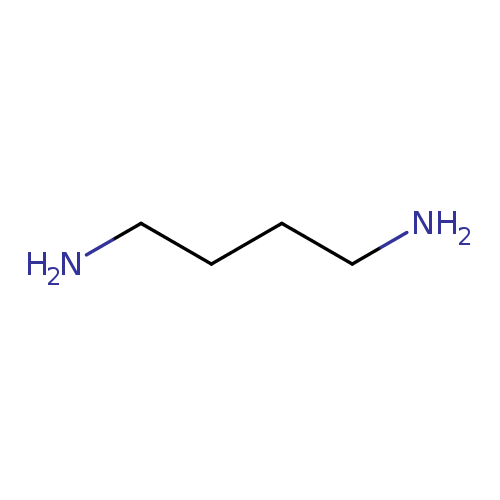
Chemical Structure
Thumb
Synonyms
ValueSource
1,4-ButanediamineChEBI
1,4-ButylenediamineChEBI
1,4-DIAMINOBUTANEChEBI
1,4-TetramethylenediamineChEBI
Butane-1,4-diamineChEBI
ButylenediamineChEBI
H2N(CH2)4nh2ChEBI
PutrescinChEBI
PutrescinaChEBI
PutreszinChEBI
TetramethylendiaminChEBI
TetramethylenediamineChEBI
1,4-ButanediammoniumHMDB
TetramethyldiamineHMDB
1,4 DiaminobutaneHMDB
1,4 ButanediamineHMDB
Chemical FormulaC4H12N2
Average Molecular Mass88.152 g/mol
Monoisotopic Mass88.100 g/mol
CAS Registry Number110-60-1
IUPAC Namebutane-1,4-diamine
Traditional Nameputrescine
SMILESNCCCCN
InChI IdentifierInChI=1S/C4H12N2/c5-3-1-2-4-6/h1-6H2
InChI KeyKIDHWZJUCRJVML-UHFFFAOYSA-N
Chemical Taxonomy
Description belongs to the class of organic compounds known as monoalkylamines. These are organic compounds containing an primary aliphatic amine group.
KingdomOrganic compounds
Super ClassOrganic nitrogen compounds
ClassOrganonitrogen compounds
Sub ClassAmines
Direct ParentMonoalkylamines
Alternative Parents
Substituents
  • Organopnictogen compound
  • Hydrocarbon derivative
  • Primary aliphatic amine
  • Aliphatic acyclic compound
Molecular FrameworkAliphatic acyclic compounds
External Descriptors
Biological Properties
StatusDetected and Not Quantified
OriginEndogenous
Cellular Locations
  • Cytoplasm
  • Extracellular
  • Mitochondria
Biofluid LocationsNot Available
Tissue Locations
  • Brain
  • Erythrocyte
  • Fibroblasts
  • Liver
  • Muscle
  • Neuron
  • Placenta
  • Platelet
  • Prostate
  • Skin
  • Testes
Pathways
NameSMPDB LinkKEGG Link
Methionine MetabolismSMP00033 map00270
Spermidine and Spermine BiosynthesisSMP00445 Not Available
ApplicationsNot Available
Biological Roles
Chemical RolesNot Available
Physical Properties
StateSolid
AppearanceWhite powder.
Experimental Properties
PropertyValue
Melting Point27.5°C
Boiling PointNot Available
SolubilityNot Available
Predicted Properties
PropertyValueSource
Water Solubility236 g/LALOGPS
logP-0.98ALOGPS
logP-0.85ChemAxon
logS0.43ALOGPS
pKa (Strongest Basic)10.51ChemAxon
Physiological Charge2ChemAxon
Hydrogen Acceptor Count2ChemAxon
Hydrogen Donor Count2ChemAxon
Polar Surface Area52.04 ŲChemAxon
Rotatable Bond Count3ChemAxon
Refractivity27.38 m³·mol⁻¹ChemAxon
Polarizability11.07 ųChemAxon
Number of Rings0ChemAxon
Bioavailability1ChemAxon
Rule of FiveYesChemAxon
Ghose FilterNoChemAxon
Veber's RuleNoChemAxon
MDDR-like RuleNoChemAxon
Spectra
Spectra
Spectrum TypeDescriptionSplash KeyView
GC-MSGC-MS Spectrum - GC-EI-TOF (Pegasus III TOF-MS system, Leco; GC 6890, Agilent Technologies) (4 TMS)splash10-00di-1910000000-5694141cafbe39951441Spectrum
GC-MSGC-MS Spectrum - GC-EI-TOF (Pegasus III TOF-MS system, Leco; GC 6890, Agilent Technologies) (Non-derivatized)splash10-00di-1900000000-eeb4354250406805ebe6Spectrum
GC-MSGC-MS Spectrum - GC-EI-TOF (Pegasus III TOF-MS system, Leco; GC 6890, Agilent Technologies) (4 TMS)splash10-00di-8910000000-af71049ab8358b0042ffSpectrum
GC-MSGC-MS Spectrum - GC-MS (2 TMS)splash10-00di-8900000000-0ba23327cabd9b2815f5Spectrum
GC-MSGC-MS Spectrum - GC-MS (3 TMS)splash10-00di-2900000000-234e1b62f4e830226779Spectrum
GC-MSGC-MS Spectrum - GC-MS (4 TMS)splash10-00di-1900000000-e29f1004e27fcb9cfe7bSpectrum
GC-MSGC-MS Spectrum - EI-B (Non-derivatized)splash10-001i-9000000000-224d3a5d3fbe7e1c6bd4Spectrum
GC-MSGC-MS Spectrum - EI-B (Non-derivatized)splash10-001i-9000000000-5759f91b24f2e27cc466Spectrum
GC-MSGC-MS Spectrum - CI-B (Non-derivatized)splash10-00di-9000000000-226a78b715ff64ec7067Spectrum
GC-MSGC-MS Spectrum - GC-EI-TOF (Non-derivatized)splash10-00di-1910000000-5694141cafbe39951441Spectrum
GC-MSGC-MS Spectrum - GC-EI-TOF (Non-derivatized)splash10-00di-1900000000-eeb4354250406805ebe6Spectrum
GC-MSGC-MS Spectrum - GC-EI-TOF (Non-derivatized)splash10-00di-8910000000-af71049ab8358b0042ffSpectrum
GC-MSGC-MS Spectrum - GC-MS (Non-derivatized)splash10-00di-8900000000-0ba23327cabd9b2815f5Spectrum
GC-MSGC-MS Spectrum - GC-MS (Non-derivatized)splash10-00di-2900000000-234e1b62f4e830226779Spectrum
GC-MSGC-MS Spectrum - GC-MS (Non-derivatized)splash10-00di-1900000000-e29f1004e27fcb9cfe7bSpectrum
GC-MSGC-MS Spectrum - GC-MS (Non-derivatized)splash10-00di-8900000000-0ba23327cabd9b2815f5Spectrum
GC-MSGC-MS Spectrum - GC-MS (Non-derivatized)splash10-00di-2900000000-234e1b62f4e830226779Spectrum
GC-MSGC-MS Spectrum - GC-MS (Non-derivatized)splash10-00di-1900000000-e29f1004e27fcb9cfe7bSpectrum
GC-MSGC-MS Spectrum - GC-EI-TOF (Non-derivatized)splash10-00di-1900000000-6861f65288867dab7690Spectrum
GC-MSGC-MS Spectrum - GC-EI-TOF (Non-derivatized)splash10-00di-2900000000-7923303f8f970b8d2dd6Spectrum
Predicted GC-MSPredicted GC-MS Spectrum - GC-MS (Non-derivatized) - 70eV, Positivesplash10-001i-9000000000-4d1729dd236ab6f44cd9Spectrum
Predicted GC-MSPredicted GC-MS Spectrum - GC-MS (Non-derivatized) - 70eV, PositiveNot AvailableSpectrum
LC-MS/MSLC-MS/MS Spectrum - Quattro_QQQ 10V, Positive (Annotated)splash10-00di-9000000000-f718a117761c1c7ea80dSpectrum
LC-MS/MSLC-MS/MS Spectrum - Quattro_QQQ 25V, Positive (Annotated)splash10-00di-9000000000-47752c8c65e2d83e78fbSpectrum
LC-MS/MSLC-MS/MS Spectrum - Quattro_QQQ 40V, Positive (Annotated)splash10-00du-9000000000-3603b20551e892ad6c5eSpectrum
LC-MS/MSLC-MS/MS Spectrum - EI-B (HITACHI RMU-6L) , Positivesplash10-001i-9000000000-224d3a5d3fbe7e1c6bd4Spectrum
LC-MS/MSLC-MS/MS Spectrum - EI-B (HITACHI RMU-6M) , Positivesplash10-001i-9000000000-5759f91b24f2e27cc466Spectrum
LC-MS/MSLC-MS/MS Spectrum - CI-B (HITACHI M-80) , Positivesplash10-00di-9000000000-226a78b715ff64ec7067Spectrum
LC-MS/MSLC-MS/MS Spectrum - LC-ESI-QQ (API3000, Applied Biosystems) 10V, Positivesplash10-00dr-9000000000-0b342438cba3ac71bccbSpectrum
LC-MS/MSLC-MS/MS Spectrum - LC-ESI-QQ (API3000, Applied Biosystems) 20V, Positivesplash10-00di-9000000000-8add450cd915232f7353Spectrum
LC-MS/MSLC-MS/MS Spectrum - LC-ESI-QQ (API3000, Applied Biosystems) 30V, Positivesplash10-00di-9000000000-7a496471bdf7e391fdc8Spectrum
LC-MS/MSLC-MS/MS Spectrum - LC-ESI-QQ (API3000, Applied Biosystems) 40V, Positivesplash10-00di-9000000000-84da87b521647b4f42abSpectrum
LC-MS/MSLC-MS/MS Spectrum - LC-ESI-QQ (API3000, Applied Biosystems) 50V, Positivesplash10-001l-9000000000-3ca1e2cd5a7e125ac52eSpectrum
LC-MS/MSLC-MS/MS Spectrum - LC-ESI-QTOF (UPLC Q-Tof Premier, Waters) , Positivesplash10-000i-9000000000-830221d5ea74a91c32e1Spectrum
LC-MS/MSLC-MS/MS Spectrum - LC-ESI-QQ , positivesplash10-00dr-9000000000-0b342438cba3ac71bccbSpectrum
LC-MS/MSLC-MS/MS Spectrum - LC-ESI-QQ , positivesplash10-00di-9000000000-8add450cd915232f7353Spectrum
LC-MS/MSLC-MS/MS Spectrum - LC-ESI-QQ , positivesplash10-00di-9000000000-7a496471bdf7e391fdc8Spectrum
LC-MS/MSLC-MS/MS Spectrum - LC-ESI-QQ , positivesplash10-00di-9000000000-84da87b521647b4f42abSpectrum
LC-MS/MSLC-MS/MS Spectrum - LC-ESI-QQ , positivesplash10-001l-9000000000-3ca1e2cd5a7e125ac52eSpectrum
LC-MS/MSLC-MS/MS Spectrum - LC-ESI-QTOF , positivesplash10-000i-9000000000-830221d5ea74a91c32e1Spectrum
LC-MS/MSLC-MS/MS Spectrum - 40V, Positivesplash10-00dl-9000000000-81dccfb50af8f3631f9bSpectrum
Predicted LC-MS/MSPredicted LC-MS/MS Spectrum - 10V, Positivesplash10-0079-9000000000-896934367d7bc245c8b3Spectrum
Predicted LC-MS/MSPredicted LC-MS/MS Spectrum - 20V, Positivesplash10-05g0-9000000000-96d51f0aa46b0ab332d0Spectrum
Predicted LC-MS/MSPredicted LC-MS/MS Spectrum - 40V, Positivesplash10-0a4l-9000000000-de02b50a4b8a279875e4Spectrum
Predicted LC-MS/MSPredicted LC-MS/MS Spectrum - 10V, Negativesplash10-000i-9000000000-73c448854a91ad5a9644Spectrum
Predicted LC-MS/MSPredicted LC-MS/MS Spectrum - 20V, Negativesplash10-000i-9000000000-c600a93b8d737a254884Spectrum
Predicted LC-MS/MSPredicted LC-MS/MS Spectrum - 40V, Negativesplash10-059f-9000000000-ce7ae61a17ef7cb9b2c2Spectrum
MSMass Spectrum (Electron Ionization)splash10-001i-9000000000-2b410aa72c9bb951a79dSpectrum
1D NMR13C NMR SpectrumNot AvailableSpectrum
1D NMR1H NMR SpectrumNot AvailableSpectrum
1D NMR13C NMR SpectrumNot AvailableSpectrum
1D NMR1H NMR SpectrumNot AvailableSpectrum
1D NMR13C NMR SpectrumNot AvailableSpectrum
1D NMR1H NMR SpectrumNot AvailableSpectrum
1D NMR13C NMR SpectrumNot AvailableSpectrum
1D NMR1H NMR SpectrumNot AvailableSpectrum
1D NMR13C NMR SpectrumNot AvailableSpectrum
1D NMR1H NMR SpectrumNot AvailableSpectrum
1D NMR13C NMR SpectrumNot AvailableSpectrum
1D NMR1H NMR SpectrumNot AvailableSpectrum
1D NMR13C NMR SpectrumNot AvailableSpectrum
1D NMR1H NMR SpectrumNot AvailableSpectrum
1D NMR13C NMR SpectrumNot AvailableSpectrum
1D NMR1H NMR SpectrumNot AvailableSpectrum
1D NMR13C NMR SpectrumNot AvailableSpectrum
1D NMR1H NMR SpectrumNot AvailableSpectrum
1D NMR13C NMR SpectrumNot AvailableSpectrum
1D NMR1H NMR SpectrumNot AvailableSpectrum
1D NMR13C NMR SpectrumNot AvailableSpectrum
2D NMR[1H,1H] 2D NMR SpectrumNot AvailableSpectrum
2D NMR[1H,13C] 2D NMR SpectrumNot AvailableSpectrum
Toxicity Profile
Route of ExposureEndogenous, Ingestion, Dermal (contact)
Mechanism of ToxicityUremic toxins such as putrescine are actively transported into the kidneys via organic ion transporters (especially OAT3). Increased levels of uremic toxins can stimulate the production of reactive oxygen species. This seems to be mediated by the direct binding or inhibition by uremic toxins of the enzyme NADPH oxidase (especially NOX4 which is abundant in the kidneys and heart) (6). Reactive oxygen species can induce several different DNA methyltransferases (DNMTs) which are involved in the silencing of a protein known as KLOTHO. KLOTHO has been identified as having important roles in anti-aging, mineral metabolism, and vitamin D metabolism. A number of studies have indicated that KLOTHO mRNA and protein levels are reduced during acute or chronic kidney diseases in response to high local levels of reactive oxygen species (7).
MetabolismUremic toxins tend to accumulate in the blood either through dietary excess or through poor filtration by the kidneys. Most uremic toxins are metabolic waste products and are normally excreted in the urine or feces.
Toxicity ValuesNot Available
Lethal DoseNot Available
Carcinogenicity (IARC Classification)Not listed by IARC.
Uses/SourcesNaturally produced by the body (endogenous).
Minimum Risk LevelNot Available
Health EffectsChronic exposure to uremic toxins can lead to a number of conditions including renal damage, chronic kidney disease and cardiovascular disease.
SymptomsAs a uremic toxin, this compound can cause uremic syndrome. Uremic syndrome may affect any part of the body and can cause nausea, vomiting, loss of appetite, and weight loss. It can also cause changes in mental status, such as confusion, reduced awareness, agitation, psychosis, seizures, and coma. Abnormal bleeding, such as bleeding spontaneously or profusely from a very minor injury can also occur. Heart problems, such as an irregular heartbeat, inflammation in the sac that surrounds the heart (pericarditis), and increased pressure on the heart can be seen in patients with uremic syndrome. Shortness of breath from fluid buildup in the space between the lungs and the chest wall (pleural effusion) can also be present.
TreatmentKidney dialysis is usually needed to relieve the symptoms of uremic syndrome until normal kidney function can be restored.
Concentrations
Not Available
DrugBank IDDB01917
HMDB IDHMDB0001414
FooDB IDFDB001494
Phenol Explorer IDNot Available
KNApSAcK IDC00001428
BiGG ID33980
BioCyc IDPUTRESCINE
METLIN ID3226
PDB IDNot Available
Wikipedia LinkPutrescine
Chemspider ID13837702
ChEBI ID17148
PubChem Compound ID1045
Kegg Compound IDC00134
YMDB IDYMDB00132
ECMDB IDECMDB01414
References
Synthesis Reference

Sang Yup Lee, Zhi Gang Qian, Xiaoxia Xia, Yong Jae Jeon, “MUTANT MICROORGANISMS HAVING A HIGH ABILITY TO PRODUCE PUTRESCINE AND METHOD FOR PRODUCING PUTRESCINE USING THE SAME.” U.S. Patent US20100203599, issued August 12, 2010.

MSDSNot Available
General References
1. Dudley, H. W.; Thorpe, W. V. Synthesis of N-methylputrescine and of putrescine. Biochemical Journal (1925), 19 845-9.
2. Sun HZ, Wang DM, Wang B, Wang JK, Liu HY, Guan le L, Liu JX: Metabolomics of four biofluids from dairy cows: potential biomarkers for milk production and quality. J Proteome Res. 2015 Feb 6;14(2):1287-98. doi: 10.1021/pr501305g. Epub 2015 Jan 28.
3. Dudley, H. W.; Thorpe, W. V. Synthesis of N-methylputrescine and of putrescine. Biochemical Journal (1925), 19 845-9.
4. Reeben M, Arbatova J, Palgi J, Miettinen R, Halmekyto M, Alhonen L, Janne J, Riekkinen P Sr, Saarma M: Induced expression of neurotrophins in transgenic mice overexpressing ornithine decarboxylase and overproducing putrescine. J Neurosci Res. 1996 Sep 1;45(5):542-8.
5. Takagi K, Tatsumi Y, Kitaichi K, Iwase M, Shibata E, Nakao M, Matsumoto T, Takagi K, Hasegawa T: A sensitive colorimetric assay for polyamines in erythrocytes using oat seedling polyamine oxidase. Clin Chim Acta. 2004 Feb;340(1-2):219-27.
6. Harik SI, Sutton CH: Putrescine as a biochemical marker of malignant brain tumors. Cancer Res. 1979 Dec;39(12):5010-5.
7. Gimelli G, Giglio S, Zuffardi O, Alhonen L, Suppola S, Cusano R, Lo Nigro C, Gatti R, Ravazzolo R, Seri M: Gene dosage of the spermidine/spermine N(1)-acetyltransferase ( SSAT) gene with putrescine accumulation in a patient with a Xp21.1p22.12 duplication and keratosis follicularis spinulosa decalvans (KFSD). Hum Genet. 2002 Sep;111(3):235-41. Epub 2002 Aug 1.
8. Venza M, Visalli M, Cicciu D, Teti D: Determination of polyamines in human saliva by high-performance liquid chromatography with fluorescence detection. J Chromatogr B Biomed Sci Appl. 2001 Jun 5;757(1):111-7.
9. Halmekyto M, Alhonen L, Alakuijala L, Janne J: Transgenic mice over-producing putrescine in their tissues do not convert the diamine into higher polyamines. Biochem J. 1993 Apr 15;291 ( Pt 2):505-8.
10. Goldman SS, Volkow ND, Brodie J, Flamm ES: Putrescine metabolism in human brain tumors. J Neurooncol. 1986;4(1):23-9.
11. El Baze P, Milano G, Verrando P, Renee N, Ortonne JP: Polyamine levels in normal human skin. A comparative study of pure epidermis, pure dermis, and suction blister fluid. Arch Dermatol Res. 1983;275(4):218-21.
12. Yamazaki H, Tsukahara T, Uki J, Matsuzaki S: Elevated levels of free putrescine and N1-acetylspermidine in cyst fluids of malignant brain tumours. J Neurol Neurosurg Psychiatry. 1986 Feb;49(2):209-10.
13. Sreekumar A, Poisson LM, Rajendiran TM, Khan AP, Cao Q, Yu J, Laxman B, Mehra R, Lonigro RJ, Li Y, Nyati MK, Ahsan A, Kalyana-Sundaram S, Han B, Cao X, Byun J, Omenn GS, Ghosh D, Pennathur S, Alexander DC, Berger A, Shuster JR, Wei JT, Varambally S, Beecher C, Chinnaiyan AM: Metabolomic profiles delineate potential role for sarcosine in prostate cancer progression. Nature. 2009 Feb 12;457(7231):910-4. doi: 10.1038/nature07762.
14. Janne J, Alhonen L, Pietila M, Keinanen TA: Genetic approaches to the cellular functions of polyamines in mammals. Eur J Biochem. 2004 Mar;271(5):877-94.
15. Janne J, Alhonen L, Keinanen TA, Pietila M, Uimari A, Pirinen E, Hyvonen MT, Jarvinen A: Animal disease models generated by genetic engineering of polyamine metabolism. J Cell Mol Med. 2005 Oct-Dec;9(4):865-82.
16. Thiele I, Swainston N, Fleming RM, Hoppe A, Sahoo S, Aurich MK, Haraldsdottir H, Mo ML, Rolfsson O, Stobbe MD, Thorleifsson SG, Agren R, Bolling C, Bordel S, Chavali AK, Dobson P, Dunn WB, Endler L, Hala D, Hucka M, Hull D, Jameson D, Jamshidi N, Jonsson JJ, Juty N, Keating S, Nookaew I, Le Novere N, Malys N, Mazein A, Papin JA, Price ND, Selkov E Sr, Sigurdsson MI, Simeonidis E, Sonnenschein N, Smallbone K, Sorokin A, van Beek JH, Weichart D, Goryanin I, Nielsen J, Westerhoff HV, Kell DB, Mendes P, Palsson BO: A community-driven global reconstruction of human metabolism. Nat Biotechnol. 2013 May;31(5):419-25. doi: 10.1038/nbt.2488. Epub 2013 Mar 3.
17. Wendisch VF: Microbial Production of Amino Acid-Related Compounds. Adv Biochem Eng Biotechnol. 2017;159:255-269. doi: 10.1007/10_2016_34.
18. Duranton F, Cohen G, De Smet R, Rodriguez M, Jankowski J, Vanholder R, Argiles A: Normal and pathologic concentrations of uremic toxins. J Am Soc Nephrol. 2012 Jul;23(7):1258-70. doi: 10.1681/ASN.2011121175. Epub 2012 May 24.
19. https://www.ncbi.nlm.nih.gov/pubmed/?term=12053479
20. https://www.ncbi.nlm.nih.gov/pubmed/?term=15453685
21. https://www.ncbi.nlm.nih.gov/pubmed/?term=16346523
22. https://www.ncbi.nlm.nih.gov/pubmed/?term=18721677
23. https://www.ncbi.nlm.nih.gov/pubmed/?term=22735334
24. https://www.ncbi.nlm.nih.gov/pubmed/?term=24331418
25. https://www.ncbi.nlm.nih.gov/pubmed/?term=24820075
26. https://www.ncbi.nlm.nih.gov/pubmed/?term=24864091