Record Information
Version1.0
Creation Date2014-08-29 05:48:44 UTC
Update Date2026-05-14 17:50:39 UTC
Accession NumberCHEM003127
Identification
Common NameSpermidine
ClassSmall Molecule
DescriptionSpermidine is a uremic toxin. Uremic toxins can be subdivided into three major groups based upon their chemical and physical characteristics: 1) small, water-soluble, non-protein-bound compounds, such as urea; 2) small, lipid-soluble and/or protein-bound compounds, such as the phenols and 3) larger so-called middle-molecules, such as beta2-microglobulin. Chronic exposure of uremic toxins can lead to a number of conditions including renal damage, chronic kidney disease and cardiovascular disease. Spermidine is a polyamine formed from putrescine. It is found in almost all tissues in association with nucleic acids. It is found as a cation at all pH values, and is thought to help stabilize some membranes and nucleic acid structures. It is a precursor of spermine.
Contaminant Sources
  • FooDB Chemicals
  • HMDB Contaminants - Feces
  • HMDB Contaminants - Urine
  • T3DB toxins
Contaminant Type
  • Amine
  • Food Toxin
  • Metabolite
  • Natural Compound
  • Organic Compound
  • Uremic Toxin
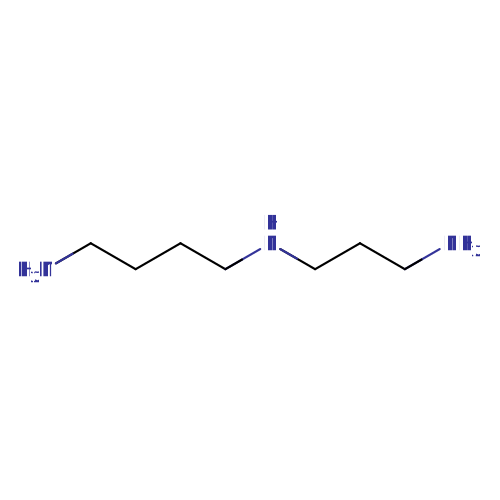
Chemical Structure
Thumb
Synonyms
ValueSource
1,5,10-TriazadecaneChEBI
4-AzaoctamethylenediamineChEBI
4-Azaoctane-1,8-diamineChEBI
N-(3-Aminopropyl)-1,4-butane-diamineChEBI
SpermidinChEBI
1,8-Diamino-4-azaoctaneHMDB
AminopropylbutandiamineHMDB
N-(3-Aminopropyl)-1,4-butanediamineHMDB
N-(3-Aminopropyl)-1,4-diamino-butaneHMDB
N-(3-Aminopropyl)-1,4-diaminobutaneHMDB
N-(3-Aminopropyl)-4-aminobutylamineHMDB
N-(4-Aminobutyl)-1,3-diaminopropaneHMDB
N-(gamma-Aminopropyl)tetramethylenediamineHMDB
SPDHMDB
Chemical FormulaC7H19N3
Average Molecular Mass145.246 g/mol
Monoisotopic Mass145.158 g/mol
CAS Registry Number124-20-9
IUPAC Name(4-aminobutyl)(3-aminopropyl)amine
Traditional Namespermidine
SMILESNCCCCNCCCN
InChI IdentifierInChI=1S/C7H19N3/c8-4-1-2-6-10-7-3-5-9/h10H,1-9H2
InChI KeyATHGHQPFGPMSJY-UHFFFAOYSA-N
Chemical Taxonomy
Description belongs to the class of organic compounds known as dialkylamines. These are organic compounds containing a dialkylamine group, characterized by two alkyl groups bonded to the amino nitrogen.
KingdomOrganic compounds
Super ClassOrganic nitrogen compounds
ClassOrganonitrogen compounds
Sub ClassAmines
Direct ParentDialkylamines
Alternative Parents
Substituents
  • Secondary aliphatic amine
  • Organopnictogen compound
  • Hydrocarbon derivative
  • Primary amine
  • Primary aliphatic amine
  • Aliphatic acyclic compound
Molecular FrameworkAliphatic acyclic compounds
External Descriptors
Biological Properties
StatusDetected and Not Quantified
OriginEndogenous
Cellular Locations
  • Cytoplasm
  • Extracellular
Biofluid LocationsNot Available
Tissue Locations
  • Brain
  • Erythrocyte
  • Fibroblasts
  • Intestine
  • Liver
  • Neuron
  • Platelet
  • Prostate
  • Skin
  • Testes
Pathways
NameSMPDB LinkKEGG Link
Methionine MetabolismSMP00033 map00270
Spermidine and Spermine BiosynthesisSMP00445 Not Available
ApplicationsNot Available
Biological Roles
Chemical RolesNot Available
Physical Properties
StateLiquid
AppearanceNot Available
Experimental Properties
PropertyValue
Melting Point< 25°C
Boiling PointNot Available
SolubilityNot Available
Predicted Properties
PropertyValueSource
Water Solubility32.7 g/LALOGPS
logP-0.62ALOGPS
logP-1.1ChemAxon
logS-0.65ALOGPS
pKa (Strongest Basic)10.68ChemAxon
Physiological Charge3ChemAxon
Hydrogen Acceptor Count3ChemAxon
Hydrogen Donor Count3ChemAxon
Polar Surface Area64.07 ŲChemAxon
Rotatable Bond Count7ChemAxon
Refractivity44.97 m³·mol⁻¹ChemAxon
Polarizability18.8 ųChemAxon
Number of Rings0ChemAxon
Bioavailability1ChemAxon
Rule of FiveYesChemAxon
Ghose FilterNoChemAxon
Veber's RuleNoChemAxon
MDDR-like RuleNoChemAxon
Spectra
Spectra
Spectrum TypeDescriptionSplash KeyView
GC-MSGC-MS Spectrum - GC-EI-TOF (Pegasus III TOF-MS system, Leco; GC 6890, Agilent Technologies) (5 TMS)splash10-00di-5910000000-48794a2dc9d682aab28fSpectrum
GC-MSGC-MS Spectrum - GC-EI-TOF (Pegasus III TOF-MS system, Leco; GC 6890, Agilent Technologies) (5 TMS)splash10-066u-1910000000-9fe6c1c8e8f166270be1Spectrum
GC-MSGC-MS Spectrum - GC-EI-TOF (Pegasus III TOF-MS system, Leco; GC 6890, Agilent Technologies) (Non-derivatized)splash10-00rf-1900000000-c88ed717e55f237cf01cSpectrum
GC-MSGC-MS Spectrum - GC-EI-TOF (Pegasus III TOF-MS system, Leco; GC 6890, Agilent Technologies) (5 TMS)splash10-00di-6900000000-56396208515d9020bfebSpectrum
GC-MSGC-MS Spectrum - GC-MS (4 TMS)splash10-0uki-5920000000-4aac8aba8d9635a96f1cSpectrum
GC-MSGC-MS Spectrum - GC-MS (5 TMS)splash10-00rf-1900000000-f4b7d8b055a8d5025036Spectrum
GC-MSGC-MS Spectrum - GC-MS (5 TMS)splash10-00di-1900000000-1be27daaf9f6d9e03752Spectrum
GC-MSGC-MS Spectrum - EI-B (Non-derivatized)splash10-05tf-0910000000-280a5c2a493fedd0e524Spectrum
GC-MSGC-MS Spectrum - GC-EI-TOF (Non-derivatized)splash10-00di-5910000000-48794a2dc9d682aab28fSpectrum
GC-MSGC-MS Spectrum - GC-EI-TOF (Non-derivatized)splash10-066u-1910000000-9fe6c1c8e8f166270be1Spectrum
GC-MSGC-MS Spectrum - GC-EI-TOF (Non-derivatized)splash10-00rf-1900000000-c88ed717e55f237cf01cSpectrum
GC-MSGC-MS Spectrum - GC-EI-TOF (Non-derivatized)splash10-00di-6900000000-56396208515d9020bfebSpectrum
GC-MSGC-MS Spectrum - GC-MS (Non-derivatized)splash10-0uki-5920000000-4aac8aba8d9635a96f1cSpectrum
GC-MSGC-MS Spectrum - GC-MS (Non-derivatized)splash10-00rf-1900000000-f4b7d8b055a8d5025036Spectrum
GC-MSGC-MS Spectrum - GC-MS (Non-derivatized)splash10-00di-1900000000-1be27daaf9f6d9e03752Spectrum
GC-MSGC-MS Spectrum - GC-EI-TOF (Non-derivatized)splash10-00rf-1900000000-866eda2dc91354bf795bSpectrum
GC-MSGC-MS Spectrum - GC-EI-TOF (Non-derivatized)splash10-0uki-3920000000-2165a698c4bf674e814bSpectrum
Predicted GC-MSPredicted GC-MS Spectrum - GC-MS (Non-derivatized) - 70eV, Positivesplash10-001r-9200000000-e6ccea992bf8aff10122Spectrum
Predicted GC-MSPredicted GC-MS Spectrum - GC-MS (Non-derivatized) - 70eV, PositiveNot AvailableSpectrum
LC-MS/MSLC-MS/MS Spectrum - Quattro_QQQ 10V, Positive (Annotated)splash10-00dj-9800000000-02b200749ad6548a5872Spectrum
LC-MS/MSLC-MS/MS Spectrum - Quattro_QQQ 25V, Positive (Annotated)splash10-00di-9000000000-c294fdb7876cfc47c089Spectrum
LC-MS/MSLC-MS/MS Spectrum - Quattro_QQQ 40V, Positive (Annotated)splash10-00di-9000000000-d3055c2a8763c8034bd2Spectrum
LC-MS/MSLC-MS/MS Spectrum - LC-ESI-ITFT (LTQ Orbitrap XL, Thermo Scientfic) , Positivesplash10-052b-0900000000-f08a2a9ba7333f5b725cSpectrum
LC-MS/MSLC-MS/MS Spectrum - LC-ESI-ITFT (LTQ Orbitrap XL, Thermo Scientfic) , Positivesplash10-00b9-7900000000-062e21e4525351cbd0d4Spectrum
LC-MS/MSLC-MS/MS Spectrum - LC-ESI-ITFT (LTQ Orbitrap XL, Thermo Scientfic) , Positivesplash10-014i-0900000000-31b90f68c9fde4e03f60Spectrum
LC-MS/MSLC-MS/MS Spectrum - LC-ESI-ITFT (LTQ Orbitrap XL, Thermo Scientfic) , Positivesplash10-0002-0920000000-28adf399f8ddd0affc22Spectrum
LC-MS/MSLC-MS/MS Spectrum - LC-ESI-ITFT (LTQ Orbitrap XL, Thermo Scientfic) , Positivesplash10-0udj-0930000000-3ac88b6d5c40c65f1314Spectrum
LC-MS/MSLC-MS/MS Spectrum - LC-ESI-ITFT (LTQ Orbitrap XL, Thermo Scientfic) , Positivesplash10-0006-9000000000-953c054969edecf62533Spectrum
LC-MS/MSLC-MS/MS Spectrum - LC-ESI-ITFT (LTQ Orbitrap XL, Thermo Scientfic) , Positivesplash10-00b9-7900000000-8b03c45141b38c718dacSpectrum
LC-MS/MSLC-MS/MS Spectrum - LC-ESI-ITFT (LTQ Orbitrap XL, Thermo Scientfic) , Positivesplash10-004i-0900000000-1e157eec324aa34dd64eSpectrum
LC-MS/MSLC-MS/MS Spectrum - LC-ESI-QQ (API3000, Applied Biosystems) 10V, Positivesplash10-0002-0900000000-f2ca6698501cf6a406dfSpectrum
LC-MS/MSLC-MS/MS Spectrum - LC-ESI-QQ (API3000, Applied Biosystems) 20V, Positivesplash10-00di-9300000000-2f23967aa87f8e5f5bc1Spectrum
LC-MS/MSLC-MS/MS Spectrum - LC-ESI-QQ (API3000, Applied Biosystems) 30V, Positivesplash10-00di-9000000000-91aef1c8b5a2507a16e9Spectrum
LC-MS/MSLC-MS/MS Spectrum - LC-ESI-QQ (API3000, Applied Biosystems) 40V, Positivesplash10-00di-9000000000-18cdaecf173b5d79902aSpectrum
LC-MS/MSLC-MS/MS Spectrum - LC-ESI-QQ (API3000, Applied Biosystems) 50V, Positivesplash10-00di-9000000000-f0b03de09cb13146e794Spectrum
LC-MS/MSLC-MS/MS Spectrum - LC-ESI-QTOF , positivesplash10-0092-5900000000-4bd537f0811cc264f2cbSpectrum
LC-MS/MSLC-MS/MS Spectrum - LC-ESI-QTOF , positivesplash10-00di-9200000000-75eacba217a63f3b8847Spectrum
LC-MS/MSLC-MS/MS Spectrum - LC-ESI-QTOF , positivesplash10-00di-9000000000-8a77bd9436d55b064332Spectrum
Predicted LC-MS/MSPredicted LC-MS/MS Spectrum - 10V, Positivesplash10-004j-1900000000-300fe40eb32167464ab8Spectrum
Predicted LC-MS/MSPredicted LC-MS/MS Spectrum - 20V, Positivesplash10-0729-9800000000-1a8be3c6776f3924c8b7Spectrum
Predicted LC-MS/MSPredicted LC-MS/MS Spectrum - 40V, Positivesplash10-0abc-9000000000-6401e12d220b44018fdfSpectrum
Predicted LC-MS/MSPredicted LC-MS/MS Spectrum - 10V, Negativesplash10-0006-1900000000-79940496e89b73bb1682Spectrum
Predicted LC-MS/MSPredicted LC-MS/MS Spectrum - 20V, Negativesplash10-0006-3900000000-eb4eaf0bb3e88f274a1dSpectrum
Predicted LC-MS/MSPredicted LC-MS/MS Spectrum - 40V, Negativesplash10-00du-9000000000-fe762fb3fcd81e27f9c7Spectrum
1D NMR1H NMR SpectrumNot AvailableSpectrum
1D NMR13C NMR SpectrumNot AvailableSpectrum
1D NMR1H NMR SpectrumNot AvailableSpectrum
1D NMR13C NMR SpectrumNot AvailableSpectrum
1D NMR1H NMR SpectrumNot AvailableSpectrum
1D NMR13C NMR SpectrumNot AvailableSpectrum
1D NMR1H NMR SpectrumNot AvailableSpectrum
1D NMR13C NMR SpectrumNot AvailableSpectrum
1D NMR1H NMR SpectrumNot AvailableSpectrum
1D NMR13C NMR SpectrumNot AvailableSpectrum
1D NMR1H NMR SpectrumNot AvailableSpectrum
1D NMR13C NMR SpectrumNot AvailableSpectrum
1D NMR1H NMR SpectrumNot AvailableSpectrum
1D NMR13C NMR SpectrumNot AvailableSpectrum
1D NMR1H NMR SpectrumNot AvailableSpectrum
1D NMR13C NMR SpectrumNot AvailableSpectrum
1D NMR1H NMR SpectrumNot AvailableSpectrum
1D NMR13C NMR SpectrumNot AvailableSpectrum
1D NMR1H NMR SpectrumNot AvailableSpectrum
1D NMR13C NMR SpectrumNot AvailableSpectrum
1D NMR1H NMR SpectrumNot AvailableSpectrum
2D NMR[1H,1H] 2D NMR SpectrumNot AvailableSpectrum
2D NMR[1H,13C] 2D NMR SpectrumNot AvailableSpectrum
Toxicity Profile
Route of ExposureEndogenous, Ingestion, Dermal (contact)
Mechanism of ToxicityUremic toxins such as spermidine are actively transported into the kidneys via organic ion transporters (especially OAT3). Increased levels of uremic toxins can stimulate the production of reactive oxygen species. This seems to be mediated by the direct binding or inhibition by uremic toxins of the enzyme NADPH oxidase (especially NOX4 which is abundant in the kidneys and heart) (3). Reactive oxygen species can induce several different DNA methyltransferases (DNMTs) which are involved in the silencing of a protein known as KLOTHO. KLOTHO has been identified as having important roles in anti-aging, mineral metabolism, and vitamin D metabolism. A number of studies have indicated that KLOTHO mRNA and protein levels are reduced during acute or chronic kidney diseases in response to high local levels of reactive oxygen species (4).
MetabolismUremic toxins tend to accumulate in the blood either through dietary excess or through poor filtration by the kidneys. Most uremic toxins are metabolic waste products and are normally excreted in the urine or feces.
Toxicity ValuesNot Available
Lethal DoseNot Available
Carcinogenicity (IARC Classification)No indication of carcinogenicity to humans (not listed by IARC).
Uses/SourcesNaturally produced by the body (endogenous).
Minimum Risk LevelNot Available
Health EffectsChronic exposure to uremic toxins can lead to a number of conditions including renal damage, chronic kidney disease and cardiovascular disease.
SymptomsAs a uremic toxin, this compound can cause uremic syndrome. Uremic syndrome may affect any part of the body and can cause nausea, vomiting, loss of appetite, and weight loss. It can also cause changes in mental status, such as confusion, reduced awareness, agitation, psychosis, seizures, and coma. Abnormal bleeding, such as bleeding spontaneously or profusely from a very minor injury can also occur. Heart problems, such as an irregular heartbeat, inflammation in the sac that surrounds the heart (pericarditis), and increased pressure on the heart can be seen in patients with uremic syndrome. Shortness of breath from fluid buildup in the space between the lungs and the chest wall (pleural effusion) can also be present.
TreatmentKidney dialysis is usually needed to relieve the symptoms of uremic syndrome until normal kidney function can be restored.
Concentrations
Not Available
DrugBank IDDB03566
HMDB IDHMDB0001257
FooDB IDFDB012039
Phenol Explorer IDNot Available
KNApSAcK IDC00001431
BiGG ID34593
BioCyc IDSPERMIDINE
METLIN ID254
PDB IDNot Available
Wikipedia LinkSpermidine
Chemspider ID1071
ChEBI ID16610
PubChem Compound ID1102
Kegg Compound IDC00315
YMDB IDYMDB00232
ECMDB IDECMDB01257
References
Synthesis Reference

Raymond J. Bergeron, Jr., “Methods and intermediates for the preparation of spermidine, homospermidine and norspermidine.” U.S. Patent US4505861, issued July, 1981.

MSDSLink
General References
1. Bergeron, Raymond J., Jr. Preparation and formulation spermidine analogues for pharmaceutical use as tumor growth inhibitors. U.S. (2001), 31 pp.
2. Motyl T, Ploszaj T, Wojtasik A, Kukulska W, Podgurniak M: Polyamines in cow's and sow's milk. Comp Biochem Physiol B Biochem Mol Biol. 1995 Jul;111(3):427-33.
3. Melzer N, Wittenburg D, Hartwig S, Jakubowski S, Kesting U, Willmitzer L, Lisec J, Reinsch N, Repsilber D: Investigating associations between milk metabolite profiles and milk traits of Holstein cows. J Dairy Sci. 2013 Mar;96(3):1521-34. doi: 10.3168/jds.2012-5743.
4. A. Foroutan et al. The Chemical Composition of Commercial Cow's Milk (in preparation)
5. Bergeron, Raymond J., Jr. Preparation and formulation spermidine analogues for pharmaceutical use as tumor growth inhibitors. U.S. (2001), 31 pp.
6. Venza M, Visalli M, Cicciu D, Teti D: Determination of polyamines in human saliva by high-performance liquid chromatography with fluorescence detection. J Chromatogr B Biomed Sci Appl. 2001 Jun 5;757(1):111-7.
7. Uehara N, Shirakawa S, Uchino H, Saeki Y: Elevated contents of spermidine and spermine in the erythrocytes of cancer patients. Cancer. 1980 Jan 1;45(1):108-11.
8. Proctor MS, Fletcher HV Jr, Shukla JB, Rennert OM: Elevated spermidine and spermine levels in the blood of psoriasis patients. J Invest Dermatol. 1975 Oct;65(4):409-11.
9. Mirzoian PA, Promyslov MSh: [Contents of putrescine, spermidine and spermine in tissue of the human brain glial tumors]. Ukr Biokhim Zh (1978). 1979 Sep-Oct;51(5):474-6.
10. Chaisiri P, Harper ME, Blamey RW, Peeling WB, Griffiths K: Plasma spermidine concentrations in patients with tumours of the breast or prostate or testis. Clin Chim Acta. 1980 Jul 1;104(3):367-75.
11. El Baze P, Milano G, Verrando P, Renee N, Ortonne JP: Polyamine levels in normal human skin. A comparative study of pure epidermis, pure dermis, and suction blister fluid. Arch Dermatol Res. 1983;275(4):218-21.
12. Martinet N, Beninati S, Nigra TP, Folk JE: N1N8-bis(gamma-glutamyl)spermidine cross-linking in epidermal-cell envelopes. Comparison of cross-link levels in normal and psoriatic cell envelopes. Biochem J. 1990 Oct 15;271(2):305-8.
13. Sreekumar A, Poisson LM, Rajendiran TM, Khan AP, Cao Q, Yu J, Laxman B, Mehra R, Lonigro RJ, Li Y, Nyati MK, Ahsan A, Kalyana-Sundaram S, Han B, Cao X, Byun J, Omenn GS, Ghosh D, Pennathur S, Alexander DC, Berger A, Shuster JR, Wei JT, Varambally S, Beecher C, Chinnaiyan AM: Metabolomic profiles delineate potential role for sarcosine in prostate cancer progression. Nature. 2009 Feb 12;457(7231):910-4. doi: 10.1038/nature07762.
14. Duranton F, Cohen G, De Smet R, Rodriguez M, Jankowski J, Vanholder R, Argiles A: Normal and pathologic concentrations of uremic toxins. J Am Soc Nephrol. 2012 Jul;23(7):1258-70. doi: 10.1681/ASN.2011121175. Epub 2012 May 24.
15. Elshenawy S, Pinney SE, Stuart T, Doulias PT, Zura G, Parry S, Elovitz MA, Bennett MJ, Bansal A, Strauss JF 3rd, Ischiropoulos H, Simmons RA: The Metabolomic Signature of the Placenta in Spontaneous Preterm Birth. Int J Mol Sci. 2020 Feb 4;21(3). pii: ijms21031043. doi: 10.3390/ijms21031043.
16. https://www.ncbi.nlm.nih.gov/pubmed/?term=22770225