Record Information
Version1.0
Creation Date2014-08-29 05:48:20 UTC
Update Date2026-04-17 19:01:35 UTC
Accession NumberCHEM003123
Identification
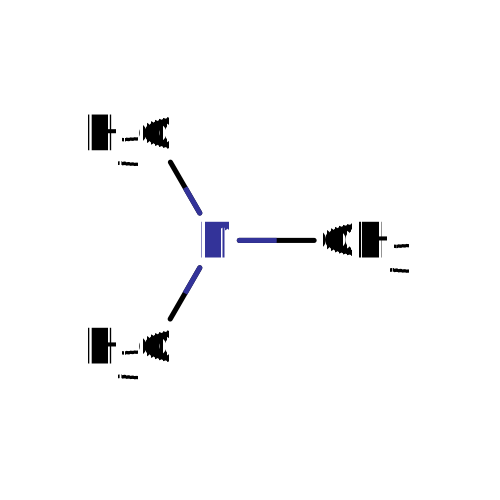
Common NameTrimethylamine
ClassSmall Molecule
Description Trimethylamine is a uremic toxin. Uremic toxins can be subdivided into three major groups based upon their chemical and physical characteristics: 1) small, water-soluble, non-protein-bound compounds, such as urea; 2) small, lipid-soluble and/or protein-bound compounds, such as the phenols and 3) larger so-called middle-molecules, such as beta2-microglobulin. Chronic exposure of uremic toxins can lead to a number of conditions including renal damage, chronic kidney disease and cardiovascular disease. Trimethylamine, also known as NMe3, N(CH3)3, and TMA, is a colorless, hygroscopic, and flammable simple amine with a typical fishy odor in low concentrations and an ammonia like odor in higher concentrations. Trimethylamine has a boiling point of 2.9 degree centigrade and is a gas at room temperature. Trimethylamine usually comes in pressurized gas cylinders or as a 40% solution in water. Trimethylamine is a nitrogenous base and its positively charged cation is called trimethylammonium cation. A common salt of trimethylamine is trimethylammonium chloride, a hygroscopic colorless solid. Trimethylamine is a product of decomposition of plants and animals. It is the substance mainly responsible for the fishy odor often associated with fouling fish, bacterial vagina infections, and bad breath. It is also associated with taking large doses of choline. Trimethylaminuria is a genetic disorder in which the body is unable to metabolize trimethylamine from food sources. Patients develop a characteristic fish odour of their sweat, urine, and breath after the consumption of choline-rich foods. Trimethylaminuria is an autosomal recessive disorder involving a trimethylamine oxidase deficiency. Trimethylaminuria has also been observed in a certain breed of Rhode Island Red chicken that produces eggs with a fishy smell.
Contaminant Sources
  • Clean Air Act Chemicals
  • EAFUS Chemicals
  • FooDB Chemicals
  • HMDB Contaminants - Feces
  • HMDB Contaminants - Urine
  • HPV EPA Chemicals
  • OECD HPV Chemicals
  • STOFF IDENT Compounds
  • T3DB toxins
  • ToxCast & Tox21 Chemicals
Contaminant Type
  • Food Toxin
  • Metabolite
  • Natural Compound
  • Organic Compound
  • Uremic Toxin
Chemical Structure
Thumb
Synonyms
ValueSource
(CH3)3NChEBI
N(CH3)3ChEBI
N,N,N-TrimethylamineChEBI
N,N-DimethylmethanamineChEBI
NMe3ChEBI
TMAChEBI
TridimethylaminomethaneChEBI
TrimethylaminChEBI
DimethylmethaneamineHMDB
N,N-Dimethyl-methanamineHMDB
N-TrimethylamineHMDB
Trimethylamine anhydrousHMDB
Trimethylamine aqueous solutionHMDB
HI OF trimethylamineHMDB
HCL OF TrimethylamineHMDB
HBR OF TrimethylamineHMDB
Chemical FormulaC3H9N
Average Molecular Mass59.110 g/mol
Monoisotopic Mass59.073 g/mol
CAS Registry Number75-50-3
IUPAC Nametrimethylamine
Traditional Nametrimethylamine
SMILESCN(C)C
InChI IdentifierInChI=1S/C3H9N/c1-4(2)3/h1-3H3
InChI KeyGETQZCLCWQTVFV-UHFFFAOYSA-N
Chemical Taxonomy
Description belongs to the class of organic compounds known as trialkylamines. These are organic compounds containing a trialkylamine group, characterized by exactly three alkyl groups bonded to the amino nitrogen.
KingdomOrganic compounds
Super ClassOrganic nitrogen compounds
ClassOrganonitrogen compounds
Sub ClassAmines
Direct ParentTrialkylamines
Alternative Parents
Substituents
  • Tertiary aliphatic amine
  • Organopnictogen compound
  • Hydrocarbon derivative
  • Aliphatic acyclic compound
Molecular FrameworkAliphatic acyclic compounds
External Descriptors
Biological Properties
StatusDetected and Not Quantified
OriginEndogenous
Cellular Locations
  • Cytoplasm
  • Extracellular
Biofluid LocationsNot Available
Tissue Locations
  • Epidermis
  • Muscle
PathwaysNot Available
ApplicationsNot Available
Biological Roles
Chemical RolesNot Available
Physical Properties
StateLiquid
AppearanceNot Available
Experimental Properties
PropertyValue
Melting Point-117.1°C
Boiling PointNot Available
Solubility890.0 mg/mL
Predicted Properties
PropertyValueSource
Water Solubility654 g/LALOGPS
logP-0.14ALOGPS
logP0.19ChemAxon
logS1.04ALOGPS
pKa (Strongest Basic)9.57ChemAxon
Physiological Charge1ChemAxon
Hydrogen Acceptor Count1ChemAxon
Hydrogen Donor Count0ChemAxon
Polar Surface Area3.24 ŲChemAxon
Rotatable Bond Count0ChemAxon
Refractivity19.99 m³·mol⁻¹ChemAxon
Polarizability7.64 ųChemAxon
Number of Rings0ChemAxon
Bioavailability1ChemAxon
Rule of FiveYesChemAxon
Ghose FilterNoChemAxon
Veber's RuleYesChemAxon
MDDR-like RuleNoChemAxon
Spectra
Spectra
Spectrum TypeDescriptionSplash KeyView
GC-MSGC-MS Spectrum - EI-B (Non-derivatized)splash10-0a4i-9000000000-55145d7583823742b4d0Spectrum
Predicted GC-MSPredicted GC-MS Spectrum - GC-MS (Non-derivatized) - 70eV, Positivesplash10-0a4l-9000000000-6aa19094223b203c2a43Spectrum
Predicted GC-MSPredicted GC-MS Spectrum - GC-MS (Non-derivatized) - 70eV, PositiveNot AvailableSpectrum
LC-MS/MSLC-MS/MS Spectrum - Quattro_QQQ 10V, Positive (Annotated)splash10-0a4i-9000000000-83029e23f5cbd6a60765Spectrum
LC-MS/MSLC-MS/MS Spectrum - Quattro_QQQ 25V, Positive (Annotated)splash10-0006-9000000000-ed35409515031a3b1b98Spectrum
LC-MS/MSLC-MS/MS Spectrum - Quattro_QQQ 40V, Positive (Annotated)splash10-0006-9000000000-902429fa0e6ccf9ef725Spectrum
LC-MS/MSLC-MS/MS Spectrum - EI-B (HITACHI M-80B) , Positivesplash10-0a4i-9000000000-55145d7583823742b4d0Spectrum
LC-MS/MSLC-MS/MS Spectrum - 40V, Positivesplash10-0006-9000000000-642dcafdbfe03e03d6d7Spectrum
LC-MS/MSLC-MS/MS Spectrum - 10V, Positivesplash10-03di-9000000000-72c88f801535e64a9a23Spectrum
LC-MS/MSLC-MS/MS Spectrum - 20V, Positivesplash10-0006-9000000000-af4658f148c840dcb767Spectrum
Predicted LC-MS/MSPredicted LC-MS/MS Spectrum - 10V, Positivesplash10-03di-9000000000-d06cd0ed0adb68499d85Spectrum
Predicted LC-MS/MSPredicted LC-MS/MS Spectrum - 20V, Positivesplash10-03di-9000000000-89bf02c9ad080630c967Spectrum
Predicted LC-MS/MSPredicted LC-MS/MS Spectrum - 40V, Positivesplash10-03di-9000000000-d9300b7bd734e223bf4dSpectrum
Predicted LC-MS/MSPredicted LC-MS/MS Spectrum - 10V, Negativesplash10-0a4i-9000000000-89bb141981944dac6e56Spectrum
Predicted LC-MS/MSPredicted LC-MS/MS Spectrum - 20V, Negativesplash10-0a4i-9000000000-89bb141981944dac6e56Spectrum
Predicted LC-MS/MSPredicted LC-MS/MS Spectrum - 40V, Negativesplash10-0a4i-9000000000-e49050d0297528d1845cSpectrum
Predicted LC-MS/MSPredicted LC-MS/MS Spectrum - 10V, Negativesplash10-0a4i-9000000000-d9608e4725a25c2900a2Spectrum
Predicted LC-MS/MSPredicted LC-MS/MS Spectrum - 20V, Negativesplash10-0a4i-9000000000-d9608e4725a25c2900a2Spectrum
Predicted LC-MS/MSPredicted LC-MS/MS Spectrum - 40V, Negativesplash10-0a4i-9000000000-166727f86b2d8ddfffc8Spectrum
Predicted LC-MS/MSPredicted LC-MS/MS Spectrum - 10V, Positivesplash10-03di-9000000000-12b588010b7079d36b5cSpectrum
Predicted LC-MS/MSPredicted LC-MS/MS Spectrum - 20V, Positivesplash10-03di-9000000000-12b588010b7079d36b5cSpectrum
Predicted LC-MS/MSPredicted LC-MS/MS Spectrum - 40V, Positivesplash10-03di-9000000000-668f5a2f2030e01e42dfSpectrum
MSMass Spectrum (Electron Ionization)splash10-0a4i-9000000000-909841d5aea15e062470Spectrum
1D NMR13C NMR SpectrumNot AvailableSpectrum
1D NMR1H NMR SpectrumNot AvailableSpectrum
1D NMR13C NMR SpectrumNot AvailableSpectrum
1D NMR1H NMR SpectrumNot AvailableSpectrum
1D NMR13C NMR SpectrumNot AvailableSpectrum
1D NMR1H NMR SpectrumNot AvailableSpectrum
1D NMR13C NMR SpectrumNot AvailableSpectrum
1D NMR1H NMR SpectrumNot AvailableSpectrum
1D NMR13C NMR SpectrumNot AvailableSpectrum
1D NMR1H NMR SpectrumNot AvailableSpectrum
1D NMR13C NMR SpectrumNot AvailableSpectrum
1D NMR1H NMR SpectrumNot AvailableSpectrum
1D NMR13C NMR SpectrumNot AvailableSpectrum
1D NMR1H NMR SpectrumNot AvailableSpectrum
1D NMR13C NMR SpectrumNot AvailableSpectrum
1D NMR1H NMR SpectrumNot AvailableSpectrum
1D NMR13C NMR SpectrumNot AvailableSpectrum
1D NMR1H NMR SpectrumNot AvailableSpectrum
1D NMR13C NMR SpectrumNot AvailableSpectrum
1D NMR1H NMR SpectrumNot AvailableSpectrum
1D NMR13C NMR SpectrumNot AvailableSpectrum
2D NMR[1H,1H] 2D NMR SpectrumNot AvailableSpectrum
2D NMR[1H,13C] 2D NMR SpectrumNot AvailableSpectrum
Toxicity Profile
Route of ExposureEndogenous, Ingestion, Dermal (contact)
Mechanism of ToxicityUremic toxins such as trimethylamine are actively transported into the kidneys via organic ion transporters (especially OAT3). Increased levels of uremic toxins can stimulate the production of reactive oxygen species. This seems to be mediated by the direct binding or inhibition by uremic toxins of the enzyme NADPH oxidase (especially NOX4 which is abundant in the kidneys and heart) (3). Reactive oxygen species can induce several different DNA methyltransferases (DNMTs) which are involved in the silencing of a protein known as KLOTHO. KLOTHO has been identified as having important roles in anti-aging, mineral metabolism, and vitamin D metabolism. A number of studies have indicated that KLOTHO mRNA and protein levels are reduced during acute or chronic kidney diseases in response to high local levels of reactive oxygen species (4).
MetabolismUremic toxins tend to accumulate in the blood either through dietary excess or through poor filtration by the kidneys. Most uremic toxins are metabolic waste products and are normally excreted in the urine or feces.
Toxicity ValuesNot Available
Lethal DoseNot Available
Carcinogenicity (IARC Classification)No indication of carcinogenicity to humans (not listed by IARC).
Uses/SourcesNaturally produced by the body (endogenous).
Minimum Risk LevelNot Available
Health EffectsChronic exposure to uremic toxins can lead to a number of conditions including renal damage, chronic kidney disease and cardiovascular disease.
SymptomsAs a uremic toxin, this compound can cause uremic syndrome. Uremic syndrome may affect any part of the body and can cause nausea, vomiting, loss of appetite, and weight loss. It can also cause changes in mental status, such as confusion, reduced awareness, agitation, psychosis, seizures, and coma. Abnormal bleeding, such as bleeding spontaneously or profusely from a very minor injury can also occur. Heart problems, such as an irregular heartbeat, inflammation in the sac that surrounds the heart (pericarditis), and increased pressure on the heart can be seen in patients with uremic syndrome. Shortness of breath from fluid buildup in the space between the lungs and the chest wall (pleural effusion) can also be present.
TreatmentKidney dialysis is usually needed to relieve the symptoms of uremic syndrome until normal kidney function can be restored.
Concentrations
Not Available
DrugBank IDNot Available
HMDB IDHMDB0000906
FooDB IDFDB011944
Phenol Explorer IDNot Available
KNApSAcK IDC00001433
BiGG IDNot Available
BioCyc IDTRIMETHYLAMINE
METLIN ID3772
PDB IDNot Available
Wikipedia LinkTrimethylamine
Chemspider ID1114
ChEBI ID18139
PubChem Compound ID1146
Kegg Compound IDC00565
YMDB IDNot Available
ECMDB IDECMDB00906
References
Synthesis ReferenceHirohata, Saneo; Tanba, Kiyonobu; Inoue, Kenichi. Preparation of trimethylamine by zeolite-catalyzed reaction of methanol and ammonia. Jpn. Kokai Tokkyo Koho (2006), 5pp.
MSDSLink
General References
1. https://www.ncbi.nlm.nih.gov/pubmed/?term=14047118
2. https://www.ncbi.nlm.nih.gov/pubmed/?term=15304308
3. https://www.ncbi.nlm.nih.gov/pubmed/?term=15752091
4. https://www.ncbi.nlm.nih.gov/pubmed/?term=17190852
5. https://www.ncbi.nlm.nih.gov/pubmed/?term=1801314
6. https://www.ncbi.nlm.nih.gov/pubmed/?term=24591617
7. https://www.ncbi.nlm.nih.gov/pubmed/?term=2501587
8. https://www.ncbi.nlm.nih.gov/pubmed/?term=5161463
9. Hirohata, Saneo; Tanba, Kiyonobu; Inoue, Kenichi. Preparation of trimethylamine by zeolite-catalyzed reaction of methanol and ammonia. Jpn. Kokai Tokkyo Koho (2006), 5pp.
10. Maher AD, Hayes B, Cocks B, Marett L, Wales WJ, Rochfort SJ: Latent biochemical relationships in the blood-milk metabolic axis of dairy cows revealed by statistical integration of 1H NMR spectroscopic data. J Proteome Res. 2013 Mar 1;12(3):1428-35. doi: 10.1021/pr301056q. Epub 2013 Feb 21.
11. Pan L, Yu J, Mi Z, Mo L, Jin H, Yao C, Ren D, Menghe B: A Metabolomics Approach Uncovers Differences between Traditional and Commercial Dairy Products in Buryatia (Russian Federation). Molecules. 2018 Mar 22;23(4). pii: molecules23040735. doi: 10.3390/molecules23040735.
12. Hirohata, Saneo; Tanba, Kiyonobu; Inoue, Kenichi. Preparation of trimethylamine by zeolite-catalyzed reaction of methanol and ammonia. Jpn. Kokai Tokkyo Koho (2006), 5pp.
13. Maschke S, Wahl A, Azaroual N, Boulet O, Crunelle V, Imbenotte M, Foulard M, Vermeersch G, Lhermitte M: 1H-NMR analysis of trimethylamine in urine for the diagnosis of fish-odour syndrome. Clin Chim Acta. 1997 Jul 25;263(2):139-46.
14. Hillier SL: Diagnostic microbiology of bacterial vaginosis. Am J Obstet Gynecol. 1993 Aug;169(2 Pt 2):455-9.
15. Chao CK, Zeisel SH: Formation of trimethylamine from dietary choline by Streptococcus sanguis I, which colonizes the mouth. J Nutr Biochem. 1990 Feb;1(2):89-97.
16. Dzik-Jurasz AS, Prescot AP, Leach MO, Collins DJ: Non-invasive study of human gall bladder bile in vivo using (1)H-MR spectroscopy. Br J Radiol. 2003 Jul;76(907):483-6.
17. Leys D, Basran J, Talfournier F, Chohan KK, Munro AW, Sutcliffe MJ, Scrutton NS: Flavin radicals, conformational sampling and robust design principles in interprotein electron transfer: the trimethylamine dehydrogenase-electron-transferring flavoprotein complex. Biochem Soc Symp. 2004;(71):1-14.
18. Zeisel SH, daCosta KA, LaMont JT: Mono-, di- and trimethylamine in human gastric fluid: potential substrates for nitrosodimethylamine formation. Carcinogenesis. 1988 Jan;9(1):179-81.
19. Mitchell SC, Zhang AQ, Barrett T, Ayesh R, Smith RL: Studies on the discontinuous N-oxidation of trimethylamine among Jordanian, Ecuadorian and New Guinean populations. Pharmacogenetics. 1997 Feb;7(1):45-50.
20. Silwood CJ, Lynch E, Claxson AW, Grootveld MC: 1H and (13)C NMR spectroscopic analysis of human saliva. J Dent Res. 2002 Jun;81(6):422-7.
21. Al-Waiz M, Ayesh R, Mitchell SC, Idle JR, Smith RL: A genetic polymorphism of the N-oxidation of trimethylamine in humans. Clin Pharmacol Ther. 1987 Nov;42(5):588-94.
22. Sweatman BC, Farrant RD, Holmes E, Ghauri FY, Nicholson JK, Lindon JC: 600 MHz 1H-NMR spectroscopy of human cerebrospinal fluid: effects of sample manipulation and assignment of resonances. J Pharm Biomed Anal. 1993 Aug;11(8):651-64.
23. Kenyon S, Carmichael PL, Khalaque S, Panchal S, Waring R, Harris R, Smith RL, Mitchell SC: The passage of trimethylamine across rat and human skin. Food Chem Toxicol. 2004 Oct;42(10):1619-28.
24. Nicholson JK, Foxall PJ, Spraul M, Farrant RD, Lindon JC: 750 MHz 1H and 1H-13C NMR spectroscopy of human blood plasma. Anal Chem. 1995 Mar 1;67(5):793-811.
25. Thithapandha A: A pharmacogenetic study of trimethylaminuria in Orientals. Pharmacogenetics. 1997 Dec;7(6):497-501.
26. Wang Z, Roberts AB, Buffa JA, Levison BS, Zhu W, Org E, Gu X, Huang Y, Zamanian-Daryoush M, Culley MK, DiDonato AJ, Fu X, Hazen JE, Krajcik D, DiDonato JA, Lusis AJ, Hazen SL: Non-lethal Inhibition of Gut Microbial Trimethylamine Production for the Treatment of Atherosclerosis. Cell. 2015 Dec 17;163(7):1585-95. doi: 10.1016/j.cell.2015.11.055.
27. Lam CW, Law CY, Sze KH, To KK: Quantitative metabolomics of urine for rapid etiological diagnosis of urinary tract infection: evaluation of a microbial-mammalian co-metabolite as a diagnostic biomarker. Clin Chim Acta. 2015 Jan 1;438:24-8. doi: 10.1016/j.cca.2014.07.038. Epub 2014 Aug 6.
28. Lam CW, Law CY, To KK, Cheung SK, Lee KC, Sze KH, Leung KF, Yuen KY: NMR-based metabolomic urinalysis: a rapid screening test for urinary tract infection. Clin Chim Acta. 2014 Sep 25;436:217-23. doi: 10.1016/j.cca.2014.05.014. Epub 2014 Jun 6.
29. Rath S, Heidrich B, Pieper DH, Vital M: Uncovering the trimethylamine-producing bacteria of the human gut microbiota. Microbiome. 2017 May 15;5(1):54. doi: 10.1186/s40168-017-0271-9.
30. Fennema D, Phillips IR, Shephard EA: Trimethylamine and Trimethylamine N-Oxide, a Flavin-Containing Monooxygenase 3 (FMO3)-Mediated Host-Microbiome Metabolic Axis Implicated in Health and Disease. Drug Metab Dispos. 2016 Nov;44(11):1839-1850. doi: 10.1124/dmd.116.070615. Epub 2016 May 17.
31. Duranton F, Cohen G, De Smet R, Rodriguez M, Jankowski J, Vanholder R, Argiles A: Normal and pathologic concentrations of uremic toxins. J Am Soc Nephrol. 2012 Jul;23(7):1258-70. doi: 10.1681/ASN.2011121175. Epub 2012 May 24.