Record Information
Version1.0
Creation Date2014-08-29 05:47:06 UTC
Update Date2026-05-14 18:50:04 UTC
Accession NumberCHEM003112
Identification
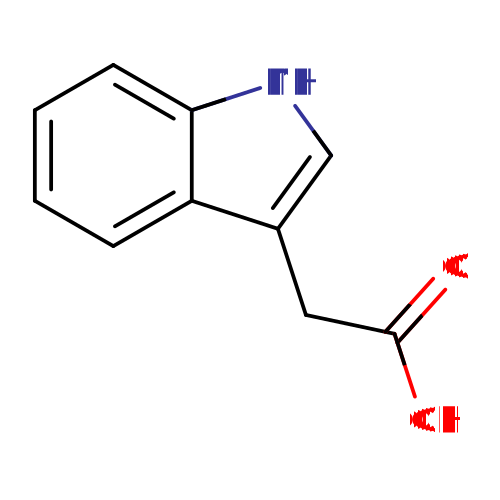
Common NameIndoleacetic acid
ClassSmall Molecule
DescriptionIndoleacetic acid is a uremic toxin. Uremic toxins can be subdivided into three major groups based upon their chemical and physical characteristics: 1) small, water-soluble, non-protein-bound compounds, such as urea; 2) small, lipid-soluble and/or protein-bound compounds, such as the phenols and 3) larger so-called middle-molecules, such as beta2-microglobulin. Chronic exposure of uremic toxins can lead to a number of conditions including renal damage, chronic kidney disease and cardiovascular disease. Indoleacetic acid (IAA) is a breakdown product of tryptophan metabolism and is often produced by the action of bacteria in the mammalian gut. Some endogenous production of IAA in mammalian tissues also occurs. It may be produced by the decarboxylation of tryptamine or the oxidative deamination of tryptophan. IAA frequently occurs at low levels in urine and has been found in elevated levels in the urine of patients with phenylketonuria ( Using material extracted from human urine, it was discovered by Kogl in 1933 that Indoleacetic acid is also an important plant hormone Specifically IAA is a member of the group of phytohormones called auxins. IAA is generally considered to be the most important native auxin. Plant cells synthesize IAA from tryptophan. IAA and some derivatives can be oxidised by horseradish peroxidase (HRP) to cytotoxic species. IAA is only toxic after oxidative decarboxylation; the effect of IAA/HRP is thought to be due in part to the formation of methylene-oxindole, which may conjugate with DNA bases and protein thiols. IAA/HRP could be used as the basis for targeted cancer therapy involving antibody-, polymer-, or gene-directed approaches, a potential new role for plant auxins in cancer therapy. (2, 3).
Contaminant Sources
  • FooDB Chemicals
  • HMDB Contaminants - Feces
  • HMDB Contaminants - Urine
  • T3DB toxins
  • ToxCast & Tox21 Chemicals
Contaminant Type
  • Food Toxin
  • Industrial/Workplace Toxin
  • Lachrymator
  • Metabolite
  • Natural Compound
  • Organic Compound
  • Uremic Toxin
Chemical Structure
Thumb
Synonyms
ValueSource
(indol-3-yl)AcetateChEBI
(indol-3-yl)Acetic acidChEBI
2-(indol-3-yl)Ethanoic acidChEBI
3-IndolylessigsaeureChEBI
HeteroauxinChEBI
IAAChEBI
IESChEBI
Indole-3-acetic acidKegg
IndoleacetateKegg
(1H-indol-3-yl)AcetateKegg
2-(indol-3-yl)EthanoateGenerator
Indole-3-acetateGenerator
(1H-indol-3-yl)Acetic acidGenerator
(1H-indol-3-yl)-AcetateHMDB
(1H-indol-3-yl)-Acetic acidHMDB
1H-indol-3-YlacetateHMDB
1H-indol-3-Ylacetic acidHMDB
1H-Indole-3-acetateHMDB
1H-Indole-3-acetic acidHMDB
2-(1H-indol-3-yl)AcetateHMDB
2-(1H-indol-3-yl)Acetic acidHMDB
2-(3-Indolyl)acetateHMDB
2-(3-Indolyl)acetic acidHMDB
3-(Carboxymethyl)indoleHMDB
3-IAAHMDB
3-Indole-acetic acidHMDB
3-IndoleacetateHMDB
3-Indoleacetic acidHMDB
3-IndolylacetateHMDB
3-Indolylacetic acidHMDB
alpha-indol-3-yl-Acetic acidHMDB
b-IndoleacetateHMDB
b-Indoleacetic acidHMDB
b-IndolylacetateHMDB
b-Indolylacetic acidHMDB
beta-Indole-3-acetic acidHMDB
beta-IndoleacetateHMDB
beta-Indoleacetic acidHMDB
beta-IndolylacetateHMDB
beta-Indolylacetic acidHMDB
indol-3-YlacetateHMDB
indol-3-Ylacetic acidHMDB
Indolyl-3-acetateHMDB
Indolyl-3-acetic acidHMDB
IndolylacetateHMDB
Indolylacetic acidHMDB
Kyselina 3-indolyloctovaHMDB
RhizopinHMDB
Rhizopon aHMDB
Skatole carboxylateHMDB
Skatole carboxylic acidHMDB
Indoleacetic acid, calcium saltHMDB
Indoleacetic acid, monopotassium saltHMDB
Indoleacetic acid, monosodium saltHMDB
IES CPDHMDB
Indole acetic acidHMDB
Indoleacetic acid, alpha-(14)C-labeledHMDB
(R,R)-3,3'-Dithiobis(2-aminopropanoic acid)HMDB
(R-(R*,r*))-3,3'-dithiobis(2-aminopropanoic acid)HMDB
3,3'-Dithiobis-L-alanineHMDB
beta,Beta'-diamino-beta,beta'-dicarboxydiethyl disulfideHMDB
beta,Beta'-dithiodialanineHMDB
Bis(beta-amino-beta-carboxyethyl) disulfideHMDB
e921HMDB
L-alpha-Diamino-beta-dithiolactic acidHMDB
L-DicysteineHMDB
Oxidized L-cysteineHMDB
(R,R)-3,3'-Dithiobis(2-aminopropanoate)HMDB
(R-(R*,r*))-3,3'-dithiobis(2-aminopropanoate)HMDB
b,Beta'-diamino-b,beta'-dicarboxydiethyl disulfideHMDB
b,Beta'-diamino-b,beta'-dicarboxydiethyl disulphideHMDB
beta,Beta'-diamino-beta,beta'-dicarboxydiethyl disulphideHMDB
Β,beta'-diamino-β,beta'-dicarboxydiethyl disulfideHMDB
Β,beta'-diamino-β,beta'-dicarboxydiethyl disulphideHMDB
b,Beta'-dithiodialanineHMDB
Β,beta'-dithiodialanineHMDB
Bis(b-amino-b-carboxyethyl) disulfideHMDB
Bis(b-amino-b-carboxyethyl) disulphideHMDB
Bis(beta-amino-beta-carboxyethyl) disulphideHMDB
Bis(β-amino-β-carboxyethyl) disulfideHMDB
Bis(β-amino-β-carboxyethyl) disulphideHMDB
L-a-Diamino-b-dithiolactateHMDB
L-a-Diamino-b-dithiolactic acidHMDB
L-alpha-Diamino-beta-dithiolactateHMDB
L-Α-diamino-β-dithiolactateHMDB
L-Α-diamino-β-dithiolactic acidHMDB
(-)-CystineHMDB
(R-(R*,r*))-3,3'-dithiobisHMDB
2-Amino-3-(2-amino-2-carboxy-ethyl)disulfanyl-propanoateHMDB
2-Amino-3-(2-amino-2-carboxy-ethyl)disulfanyl-propanoic acidHMDB
2-Amino-3-[(2-amino-2-carboxyethyl)dithio]propanoateHMDB
2-Amino-3-[(2-amino-2-carboxyethyl)dithio]propanoic acidHMDB
3,3'-DithiobisHMDB
3,3'-Dithiobis[2-amino-[R-(r*,r*)]-propanoateHMDB
3,3'-Dithiobis[2-amino-[R-(r*,r*)]-propanoic acidHMDB
3,3'-DithiodialanineHMDB
b,B'-diamino-b,b'-dicarboxydiethyl disulfideHMDB
b,B'-dithiodialanineHMDB
beta,Beta'-dithiobisalanineHMDB
Bis(b-amino-beta-carboxyethyl) disulfideHMDB
Cysteine disulfideHMDB
CystinHMDB
CystineHMDB
Cystine acidHMDB
D(+)-3,3'-Dithiobis(2-aminopropanoateHMDB
D(+)-3,3'-Dithiobis(2-aminopropanoic acidHMDB
DicysteineHMDB
GelucystineHMDB
L-(-)-CystineHMDB
L-Cysteine disulfideHMDB
L-CystinHMDB
[R-(R*,r*)]-3,3'-dithiobisHMDB
L CystineHMDB
Copper cystinateHMDB
(+)-Lactic acidHMDB
(S)-(+)-Lactic acidHMDB
(S)-2-Hydroxypropanoic acidHMDB
(S)-2-Hydroxypropionic acidHMDB
L-(+)-alpha-Hydroxypropionic acidHMDB
L-(+)-Lactic acidHMDB
L-MilchsaeureHMDB
L-LactateHMDB
(+)-LactateHMDB
(S)-(+)-LactateHMDB
(S)-2-HydroxypropanoateHMDB
(S)-2-HydroxypropionateHMDB
L-(+)-a-HydroxypropionateHMDB
L-(+)-a-Hydroxypropionic acidHMDB
L-(+)-alpha-HydroxypropionateHMDB
L-(+)-Α-hydroxypropionateHMDB
L-(+)-Α-hydroxypropionic acidHMDB
L-(+)-LactateHMDB
(alpha)-LactateHMDB
(alpha)-Lactic acidHMDB
(S)-(+)-2-HydroxypropanoateHMDB
(S)-(+)-2-Hydroxypropanoic acidHMDB
(S)-2-Hydroxy-propanoateHMDB
(S)-2-Hydroxy-propanoic acidHMDB
(S)-LactateHMDB
(S)-Lactic acidHMDB
1-Hydroxyethane 1-carboxylateHMDB
1-Hydroxyethane 1-carboxylic acidHMDB
1-HydroxyethanecarboxylateHMDB
1-Hydroxyethanecarboxylic acidHMDB
2-HydroxypropanoateHMDB
2-Hydroxypropanoic acidHMDB
2-HydroxypropionateHMDB
a-HydroxypropanoateHMDB
a-Hydroxypropanoic acidHMDB
a-HydroxypropionateHMDB
a-Hydroxypropionic acidHMDB
alpha-HydroxypropanoateHMDB
alpha-Hydroxypropanoic acidHMDB
alpha-HydroxypropionateHMDB
alpha-Hydroxypropionic acidHMDB
L-(+)- Lactic acidHMDB
L-2-HydroxypropanoateHMDB
L-2-Hydroxypropanoic acidHMDB
LactateHMDB
Lactic acidHMDB
Milk acidHMDB
Sarcolactic acidHMDB
2-Hydroxypropionic acidHMDB
D-Lactic acidHMDB
D Lactic acidHMDB
Lactate, ammoniumHMDB
2 Hydroxypropanoic acidHMDB
2 Hydroxypropionic acidHMDB
Ammonium lactateHMDB
L Lactic acidHMDB
9-beta-D-Ribofuranosyl-9H-purin-6-olHMDB
9-beta-D-RibofuranosylhypoxanthineHMDB
Hypoxanthine D-ribosideHMDB
HypoxanthosineHMDB
iHMDB
InosinHMDB
InosinaHMDB
InosinumHMDB
InotinHMDB
9-b-D-Ribofuranosyl-9H-purin-6-olHMDB
9-Β-D-ribofuranosyl-9H-purin-6-olHMDB
9-b-D-RibofuranosylhypoxanthineHMDB
9-Β-D-ribofuranosylhypoxanthineHMDB
(-)-InosineHMDB
1,9-Dihydro-9-b-D-ribofuranosyl-6H-purin-6-oneHMDB
1,9-Dihydro-9-beta-D-ribofuranosyl-6H-purin-6-oneHMDB
1,9-Dihydro-9-beta-delta-ribofuranosyl-6H-purin-6-oneHMDB
9-b-D-Ribofuranosyl-hypoxanthineHMDB
9-beta-D-Ribofuranosyl-hypoxanthineHMDB
9-beta-delta-Ribofuranosyl-hypoxanthineHMDB
9-beta-delta-RibofuranosylhypoxanthineHMDB
9beta-D-RibofuranosylhypoxanthineHMDB
9beta-delta-RibofuranosylhypoxanthineHMDB
AtorelHMDB
beta-D-Ribofuranoside hypoxanthine-9HMDB
beta-delta-Ribofuranoside hypoxanthine-9HMDB
beta-InosineHMDB
HXRHMDB
Hypoxanthine 9-beta-D-ribofuranosideHMDB
Hypoxanthine 9-beta-delta-ribofuranosideHMDB
Hypoxanthine nucleosideHMDB
Hypoxanthine ribonucleosideHMDB
Hypoxanthine ribosideHMDB
Hypoxanthine-9 beta-D-ribofuranosideHMDB
Hypoxanthine-9 beta-delta-ribofuranosideHMDB
Hypoxanthine-9-beta-D-ribofuranosideHMDB
Hypoxanthine-9-beta-delta-ribofuranosideHMDB
Hypoxanthine-9-D-ribofuranosideHMDB
Hypoxanthine-9-delta-ribofuranosideHMDB
Hypoxanthine-riboseHMDB
Indole-3-carboxaldehydeHMDB
InoHMDB
InosieHMDB
Iso-prinosineHMDB
OxiaminHMDB
Panholic-LHMDB
Pantholic-LHMDB
RibonosineHMDB
SelferHMDB
TrophicardylHMDB
(2S)-6-(Acetylamino)-2-aminohexanoic acidHMDB
N(6)-ACETYLLYSINEHMDB
N(zeta)-AcetyllysineHMDB
N-epsilon-Acetyl-L-lysineHMDB
N-Epsilon-AcetyllysineHMDB
N(epsilon)-Acetyl-L-lysineHMDB
N(zeta)-Acetyl-L-lysineHMDB
(2S)-6-(Acetylamino)-2-aminohexanoateHMDB
N(Z)-AcetyllysineHMDB
N(Ζ)-acetyllysineHMDB
N(Z)-Acetyl-L-lysineHMDB
N(Ζ)-acetyl-L-lysineHMDB
e-Acetyl-L-lysineHMDB
e-N-Acetyl-L-lysineHMDB
e-N-AcetyllysineHMDB
epsilon-Acetyl-L-lysineHMDB
epsilon-N-Acetyl-L-lysineHMDB
epsilon-N-AcetyllysineHMDB
L-e-N-AcetyllysineHMDB
L-epsilon-N-AcetyllysineHMDB
N-e-Acetyl-L-lysineHMDB
N-e-AcetyllysineHMDB
N6-AcetyllysineHMDB
Ne-acetyl-L-lysineHMDB
Ne-acetyllysineHMDB
Omega-N-acetyl-L-lysineHMDB
W-N-Acetyl-L-lysineHMDB
N(6)-AcetyllsineHMDB
Omega-acetyllsineHMDB
beta-Alanyl-3-methyl-L-histidineHMDB
beta-Alanyl-N(pai)-methyl-L-histidineHMDB
b-Alanyl-3-methyl-L-histidineHMDB
Β-alanyl-3-methyl-L-histidineHMDB
b-Alanyl-N(pai)-methyl-L-histidineHMDB
Β-alanyl-N(pai)-methyl-L-histidineHMDB
L-AnserineHMDB
L-N-b-Alanyl-3-methyl-histidineHMDB
L-N-beta-Alanyl-3-methyl-histidineHMDB
N-b-Alanyl-3-methyl-L-histidineHMDB
N-beta-Alanyl-3-methyl-L-histidineHMDB
BalanineHMDB
Beta Alanyl 3 methylhistidineHMDB
Beta-Alanyl-3-methylhistidineHMDB
OphidineHMDB
Indoleacetic acidChEBI
3-(Carboxymethyl)-1H-indolePhytoBank
3-Indolylmethylcarboxylic acidPhytoBank
alpha-IAAPhytoBank
α-IAAPhytoBank
beta-IAAPhytoBank
β-IAAPhytoBank
β-Indoleacetic acidPhytoBank
Chemical FormulaC10H9NO2
Average Molecular Mass175.184 g/mol
Monoisotopic Mass175.063 g/mol
CAS Registry Number87-51-4
IUPAC Name2-(1H-indol-3-yl)acetic acid
Traditional Nameβ-indole-3-acetic acid
SMILESOC(=O)CC1=CNC2=C1C=CC=C2
InChI IdentifierInChI=1S/C10H9NO2/c12-10(13)5-7-6-11-9-4-2-1-3-8(7)9/h1-4,6,11H,5H2,(H,12,13)
InChI KeySEOVTRFCIGRIMH-UHFFFAOYSA-N
Chemical Taxonomy
Description belongs to the class of organic compounds known as indole-3-acetic acid derivatives. Indole-3-acetic acid derivatives are compounds containing an acetic acid (or a derivative) linked to the C3 carbon atom of an indole.
KingdomOrganic compounds
Super ClassOrganoheterocyclic compounds
ClassIndoles and derivatives
Sub ClassIndolyl carboxylic acids and derivatives
Direct ParentIndole-3-acetic acid derivatives
Alternative Parents
Substituents
  • Indole-3-acetic acid derivative
  • 3-alkylindole
  • Indole
  • Substituted pyrrole
  • Benzenoid
  • Heteroaromatic compound
  • Pyrrole
  • Azacycle
  • Monocarboxylic acid or derivatives
  • Carboxylic acid
  • Carboxylic acid derivative
  • Carbonyl group
  • Organopnictogen compound
  • Organooxygen compound
  • Organonitrogen compound
  • Organic oxygen compound
  • Organic nitrogen compound
  • Hydrocarbon derivative
  • Organic oxide
  • Aromatic heteropolycyclic compound
Molecular FrameworkAromatic heteropolycyclic compounds
External Descriptors
Biological Properties
StatusDetected and Not Quantified
OriginEndogenous
Cellular Locations
  • Cytoplasm
  • Extracellular
  • Mitochondria
Biofluid LocationsNot Available
Tissue Locations
  • Brain
  • Central Nervous System
  • Fibroblasts
  • Hippocampus
  • Hypothalamus
  • Kidney
  • Liver
  • Platelet
  • Spinal Cord
  • Striatum
Pathways
NameSMPDB LinkKEGG Link
Tryptophan MetabolismSMP00063 map00380
Hartnup DisorderSMP00189 Not Available
ApplicationsNot Available
Biological Roles
Chemical RolesNot Available
Physical Properties
StateSolid
AppearanceWhite powder.
Experimental Properties
PropertyValue
Melting Point168.5°C
Boiling PointNot Available
Solubility1.5 mg/mL
Predicted Properties
PropertyValueSource
Water Solubility1.38 g/LALOGPS
logP1.87ALOGPS
logP1.71ChemAxon
logS-2.1ALOGPS
pKa (Strongest Acidic)4.66ChemAxon
Physiological Charge-1ChemAxon
Hydrogen Acceptor Count2ChemAxon
Hydrogen Donor Count2ChemAxon
Polar Surface Area53.09 ŲChemAxon
Rotatable Bond Count2ChemAxon
Refractivity48.45 m³·mol⁻¹ChemAxon
Polarizability17.74 ųChemAxon
Number of Rings2ChemAxon
Bioavailability1ChemAxon
Rule of FiveYesChemAxon
Ghose FilterYesChemAxon
Veber's RuleNoChemAxon
MDDR-like RuleNoChemAxon
Spectra
Spectra
Spectrum TypeDescriptionSplash KeyView
GC-MSGC-MS Spectrum - GC-EI-TOF (Pegasus III TOF-MS system, Leco; GC 6890, Agilent Technologies) (2 TMS)splash10-0udi-0391000000-7581f14fe5be5b2b2954Spectrum
GC-MSGC-MS Spectrum - GC-EI-TOF (Pegasus III TOF-MS system, Leco; GC 6890, Agilent Technologies) (2 TMS)splash10-0udi-0691000000-de9ac4f748d50db109eaSpectrum
GC-MSGC-MS Spectrum - GC-EI-TOF (Pegasus III TOF-MS system, Leco; GC 6890, Agilent Technologies) (2 TMS)splash10-0udi-0591000000-9687f83d1372abe23c3cSpectrum
GC-MSGC-MS Spectrum - GC-EI-TOF (Pegasus III TOF-MS system, Leco; GC 6890, Agilent Technologies) (2 TMS)splash10-0udi-1793100000-7c78003038436ec5a902Spectrum
GC-MSGC-MS Spectrum - GC-EI-TOF (Pegasus III TOF-MS system, Leco; GC 6890, Agilent Technologies) (1 TMS)splash10-00ai-7910000000-4aa7b8244f32048c76bcSpectrum
GC-MSGC-MS Spectrum - GC-EI-TOF (Pegasus III TOF-MS system, Leco; GC 6890, Agilent Technologies) (2 TMS)splash10-0fk9-9250000000-a5f931fc3292056dba65Spectrum
GC-MSGC-MS Spectrum - GC-MS (1 TMS)splash10-001i-1920000000-f0ecee61454a589493afSpectrum
GC-MSGC-MS Spectrum - GC-MS (2 TMS)splash10-0udi-1692000000-ce863a1ca2a657cb41d5Spectrum
GC-MSGC-MS Spectrum - EI-B (Non-derivatized)splash10-003r-0900000000-1edcb4977a52155bc130Spectrum
GC-MSGC-MS Spectrum - GC-EI-TOF (Non-derivatized)splash10-0udi-0391000000-7581f14fe5be5b2b2954Spectrum
GC-MSGC-MS Spectrum - GC-EI-TOF (Non-derivatized)splash10-0udi-0691000000-de9ac4f748d50db109eaSpectrum
GC-MSGC-MS Spectrum - GC-EI-TOF (Non-derivatized)splash10-0udi-0591000000-9687f83d1372abe23c3cSpectrum
GC-MSGC-MS Spectrum - GC-EI-TOF (Non-derivatized)splash10-0udi-1793100000-7c78003038436ec5a902Spectrum
GC-MSGC-MS Spectrum - GC-EI-TOF (Non-derivatized)splash10-00ai-7910000000-4aa7b8244f32048c76bcSpectrum
GC-MSGC-MS Spectrum - GC-EI-TOF (Non-derivatized)splash10-0fk9-9250000000-a5f931fc3292056dba65Spectrum
GC-MSGC-MS Spectrum - GC-MS (Non-derivatized)splash10-001i-1920000000-f0ecee61454a589493afSpectrum
GC-MSGC-MS Spectrum - GC-MS (Non-derivatized)splash10-0udi-1692000000-ce863a1ca2a657cb41d5Spectrum
GC-MSGC-MS Spectrum - GC-EI-TOF (Non-derivatized)splash10-0udi-0691000000-f6073f8f35a6930b5aacSpectrum
Predicted GC-MSPredicted GC-MS Spectrum - GC-MS (Non-derivatized) - 70eV, Positivesplash10-0059-1900000000-ab74ec83b16ac0b97d12Spectrum
Predicted GC-MSPredicted GC-MS Spectrum - GC-MS (1 TMS) - 70eV, Positivesplash10-001i-7920000000-8dab2ad22251c9fbd21cSpectrum
Predicted GC-MSPredicted GC-MS Spectrum - GC-MS (Non-derivatized) - 70eV, PositiveNot AvailableSpectrum
Predicted GC-MSPredicted GC-MS Spectrum - GC-MS (TMS_1_2) - 70eV, PositiveNot AvailableSpectrum
Predicted GC-MSPredicted GC-MS Spectrum - GC-MS (TBDMS_1_1) - 70eV, PositiveNot AvailableSpectrum
Predicted GC-MSPredicted GC-MS Spectrum - GC-MS (TBDMS_1_2) - 70eV, PositiveNot AvailableSpectrum
LC-MS/MSLC-MS/MS Spectrum - Quattro_QQQ 10V, Positive (Annotated)splash10-004i-0900000000-f6dbb01a35af3042d126Spectrum
LC-MS/MSLC-MS/MS Spectrum - Quattro_QQQ 25V, Positive (Annotated)splash10-004i-0900000000-2ae231b7d0e2cd50aed8Spectrum
LC-MS/MSLC-MS/MS Spectrum - Quattro_QQQ 40V, Positive (Annotated)splash10-004i-6900000000-9eae14faa16b8f8259daSpectrum
LC-MS/MSLC-MS/MS Spectrum - EI-B (HITACHI M-80) , Positivesplash10-003r-0900000000-1edcb4977a52155bc130Spectrum
LC-MS/MSLC-MS/MS Spectrum - LC-ESI-QQ (API3000, Applied Biosystems) 10V, Negativesplash10-00e9-0900000000-187b48f2258823cbc6a2Spectrum
LC-MS/MSLC-MS/MS Spectrum - LC-ESI-QQ (API3000, Applied Biosystems) 20V, Negativesplash10-001i-0900000000-30b7a73fa446d0e3c8d3Spectrum
LC-MS/MSLC-MS/MS Spectrum - LC-ESI-QQ (API3000, Applied Biosystems) 30V, Negativesplash10-004i-0900000000-bbe0fb5a48f89ea6e383Spectrum
LC-MS/MSLC-MS/MS Spectrum - LC-ESI-QQ (API3000, Applied Biosystems) 40V, Negativesplash10-004i-0900000000-97850f400d80de278334Spectrum
LC-MS/MSLC-MS/MS Spectrum - LC-ESI-QQ (API3000, Applied Biosystems) 50V, Negativesplash10-004i-0900000000-600545759ef108827b9eSpectrum
LC-MS/MSLC-MS/MS Spectrum - LC-ESI-QQ (API3000, Applied Biosystems) 10V, Positivesplash10-0kxr-5900000000-ba2eed29832f9ee48921Spectrum
LC-MS/MSLC-MS/MS Spectrum - LC-ESI-QQ (API3000, Applied Biosystems) 20V, Positivesplash10-004l-5900000000-a0b30710f83e53b6f3dbSpectrum
LC-MS/MSLC-MS/MS Spectrum - LC-ESI-QQ (API3000, Applied Biosystems) 30V, Positivesplash10-001i-9500000000-146ac0a20f9d53e76291Spectrum
LC-MS/MSLC-MS/MS Spectrum - LC-ESI-QQ (API3000, Applied Biosystems) 40V, Positivesplash10-053r-9600000000-d9258b3c6b5c6f748f6eSpectrum
LC-MS/MSLC-MS/MS Spectrum - LC-ESI-QQ (API3000, Applied Biosystems) 50V, Positivesplash10-004i-9300000000-b59628beb41b424daf4aSpectrum
LC-MS/MSLC-MS/MS Spectrum - LC-ESI-QQ (UPLC Waters, Quattro Ultima Pt Micromass) , Positive (Annotated)splash10-004i-0900000000-755373c9248cfb6425fcSpectrum
LC-MS/MSLC-MS/MS Spectrum - LC-ESI-QTOF (UPLC Q-Tof Premier, Waters) , Positivesplash10-004i-0900000000-2b3df7a1dd85faea6705Spectrum
LC-MS/MSLC-MS/MS Spectrum - LC-ESI-QTOF (UPLC Q-Tof Premier, Waters) 30V, Positivesplash10-003r-0900000000-9522ab089ab89b64f96aSpectrum
LC-MS/MSLC-MS/MS Spectrum - LC-ESI-QTOF (UPLC Q-Tof Premier, Waters) , Negativesplash10-001i-0900000000-b735e95cb23091491c2eSpectrum
Predicted LC-MS/MSPredicted LC-MS/MS Spectrum - 10V, Positivesplash10-0a4i-0900000000-2a3dd24f136523e6ce1eSpectrum
Predicted LC-MS/MSPredicted LC-MS/MS Spectrum - 20V, Positivesplash10-053r-0900000000-77436493836245345cb8Spectrum
Predicted LC-MS/MSPredicted LC-MS/MS Spectrum - 40V, Positivesplash10-00lr-1900000000-4e0b6f24d03c0b25800fSpectrum
Predicted LC-MS/MSPredicted LC-MS/MS Spectrum - 10V, Negativesplash10-00e9-0900000000-1d045a56f3669a1c9391Spectrum
Predicted LC-MS/MSPredicted LC-MS/MS Spectrum - 20V, Negativesplash10-05ai-0900000000-518778c36bacbf77b901Spectrum
Predicted LC-MS/MSPredicted LC-MS/MS Spectrum - 40V, Negativesplash10-0a5c-3900000000-323fc64084836756be30Spectrum
Predicted LC-MS/MSPredicted LC-MS/MS Spectrum - 10V, Positivesplash10-0a4i-0900000000-2a3dd24f136523e6ce1eSpectrum
MSMass Spectrum (Electron Ionization)splash10-001i-1900000000-3ffc47eb6c977956ad93Spectrum
1D NMR1H NMR SpectrumNot AvailableSpectrum
1D NMR13C NMR SpectrumNot AvailableSpectrum
1D NMR1H NMR SpectrumNot AvailableSpectrum
1D NMR13C NMR SpectrumNot AvailableSpectrum
2D NMR[1H,1H] 2D NMR SpectrumNot AvailableSpectrum
2D NMR[1H,13C] 2D NMR SpectrumNot AvailableSpectrum
Toxicity Profile
Route of ExposureEndogenous, Ingestion, Dermal (contact)
Mechanism of ToxicityUremic toxins such as indole-3-acetic acid are actively transported into the kidneys via organic ion transporters (especially OAT3). Increased levels of uremic toxins can stimulate the production of reactive oxygen species. This seems to be mediated by the direct binding or inhibition by uremic toxins of the enzyme NADPH oxidase (especially NOX4 which is abundant in the kidneys and heart) (5). Reactive oxygen species can induce several different DNA methyltransferases (DNMTs) which are involved in the silencing of a protein known as KLOTHO. KLOTHO has been identified as having important roles in anti-aging, mineral metabolism, and vitamin D metabolism. A number of studies have indicated that KLOTHO mRNA and protein levels are reduced during acute or chronic kidney diseases in response to high local levels of reactive oxygen species (6)
MetabolismIndoleacetic acid (IAA) is a breakdown product of tryptophan metabolism and is often produced by the action of bacteria in the mammalian gut. Some endogenous production of IAA in mammalian tissues also occurs. It may be produced by the decarboxylation of tryptamine or the oxidative deamination of tryptophan.
Toxicity ValuesNot Available
Lethal DoseNot Available
Carcinogenicity (IARC Classification)No indication of carcinogenicity to humans (not listed by IARC).
Uses/SourcesNaturally produced by the body (endogenous). Also a plant growth hormone (auxin).
Minimum Risk LevelNot Available
Health EffectsIndoleacetic acid is listed in its MSDS as potentially mutagenic to mammalian somatic cells. It is also identified as a potential skin, eye, and respiratory irritant, and users are warned not to ingest it. Acute exposure to Indoleacetic acid can lead to some mild skin and eye irritation. Chronic exposure to uremic toxins can lead to a number of conditions including renal damage, chronic kidney disease and cardiovascular disease. Chronically high levels of Indoleacetic acid are associated with the inborn error of metabolism known as Hartnup disease.
SymptomsAs a uremic toxin, this compound can cause uremic syndrome. Uremic syndrome may affect any part of the body and can cause nausea, vomiting, loss of appetite, and weight loss. It can also cause changes in mental status, such as confusion, reduced awareness, agitation, psychosis, seizures, and coma. Abnormal bleeding, such as bleeding spontaneously or profusely from a very minor injury can also occur. Heart problems, such as an irregular heartbeat, inflammation in the sac that surrounds the heart (pericarditis), and increased pressure on the heart can be seen in patients with uremic syndrome. Shortness of breath from fluid buildup in the space between the lungs and the chest wall (pleural effusion) can also be present.
TreatmentChronic Exposure: Kidney dialysis is usually needed to relieve the symptoms of uremic syndrome until normal kidney function can be restored. Acute Exposure: EYES: irrigate opened eyes for several minutes under running water. INGESTION: do not induce vomiting. Rinse mouth with water (never give anything by mouth to an unconscious person). Seek immediate medical advice.
Concentrations
Not Available
DrugBank IDDB07950
HMDB IDHMDB0000197
FooDB IDFDB030920
Phenol Explorer IDNot Available
KNApSAcK IDC00000100
BiGG IDNot Available
BioCyc IDINDOLE_ACETATE_AUXIN
METLIN IDNot Available
PDB IDNot Available
Wikipedia LinkIndole-3-acetic_acid
Chemspider ID780
ChEBI ID16411
PubChem Compound ID802
Kegg Compound IDC00954
YMDB IDYMDB00576
ECMDB IDECMDB24021
References
Synthesis ReferenceNot Available
MSDSLink
General References
1. Snyder, H. R.; Pilgrim, Frederick J. Preparation of 3-indoleacetic acid; new synthesis of tryptophol. Journal of the American Chemical Society (1948), 70 3770-1.
2. Carpenter LL, Anderson GM, Siniscalchi JM, Chappell PB, Price LH: Acute changes in cerebrospinal fluid 5-HIAA following oral paroxetine challenge in healthy humans. Neuropsychopharmacology. 2003 Feb;28(2):339-47.
3. Owens MJ, Nemeroff CB: Role of serotonin in the pathophysiology of depression: focus on the serotonin transporter. Clin Chem. 1994 Feb;40(2):288-95.
4. Tu JB, Wong CY: Serotonin metabolism in normal and abnormal infants during the perinatal period. Biol Neonate. 1976;29(3-4):187-93.
5. Blennow K, Wallin A, Gottfries CG, Mansson JE, Svennerholm L: Concentration gradients for monoamine metabolites in lumbar cerebrospinal fluid. J Neural Transm Park Dis Dement Sect. 1993;5(1):5-15.
6. Guneral F, Bachmann C: Age-related reference values for urinary organic acids in a healthy Turkish pediatric population. Clin Chem. 1994 Jun;40(6):862-6.
7. Morgan WW, Grant RW: Increased rate of disappearance of serum probenecid in barbital dependent rats. Eur J Pharmacol. 1976 Dec;40(2):349-57.
8. Jellinger K, Riederer P: Brain monoamines in metabolic (endotoxic) coma. A preliminary biochemical study in human postmortem material. J Neural Transm. 1977;41(4):275-86.
9. Sarrias MJ, Cabre P, Martinez E, Artigas F: Relationship between serotoninergic measures in blood and cerebrospinal fluid simultaneously obtained in humans. J Neurochem. 1990 Mar;54(3):783-6.
10. Kema IP, Meijer WG, Meiborg G, Ooms B, Willemse PH, de Vries EG: Profiling of tryptophan-related plasma indoles in patients with carcinoid tumors by automated, on-line, solid-phase extraction and HPLC with fluorescence detection. Clin Chem. 2001 Oct;47(10):1811-20.
11. Bai F, Jones DC, Lau SS, Monks TJ: Serotonergic neurotoxicity of 3,4-(+/-)-methylenedioxyamphetamine and 3,4-(+/-)-methylendioxymethamphetamine (ecstasy) is potentiated by inhibition of gamma-glutamyl transpeptidase. Chem Res Toxicol. 2001 Jul;14(7):863-70.
12. Ridges AP, Bishop FM, Lawton K, Goldberg IJ: Amine metabolism, thyroid function and response to clomipramine and maprotiline medication in depression. Postgrad Med J. 1980;56 Suppl 1:37-41.
13. Raghuram TC, Krishnaswamy K: Serotonin metabolism is pellagra. Arch Neurol. 1975 Oct;32(10):708-10.
14. Carling RS, Degg TJ, Allen KR, Bax ND, Barth JH: Evaluation of whole blood serotonin and plasma and urine 5-hydroxyindole acetic acid in diagnosis of carcinoid disease. Ann Clin Biochem. 2002 Nov;39(Pt 6):577-82.
15. Taniguchi K, Okatani Y, Sagara Y: Serotonin metabolism in the fetus in preeclampsia. Asia Oceania J Obstet Gynaecol. 1994 Mar;20(1):77-86.
16. Russo S, Boon JC, Kema IP, Willemse PH, den Boer JA, Korf J, de Vries EG: Patients with carcinoid syndrome exhibit symptoms of aggressive impulse dysregulation. Psychosom Med. 2004 May-Jun;66(3):422-5.
17. Igari T, Shimamura T: Serotonin metabolism and its enzymic activities in joint diseases. Clin Orthop Relat Res. 1979 Mar-Apr;(139):232-49.
18. Bearcroft CP, Perrett D, Farthing MJ: Postprandial plasma 5-hydroxytryptamine in diarrhoea predominant irritable bowel syndrome: a pilot study. Gut. 1998 Jan;42(1):42-6.
19. Ilkhanizadeh B, Owji AA, Tavangar SM, Vasei M, Tabei SM: Spot urine 5-hydroxy indole acetic acid and acute appendicitis. Hepatogastroenterology. 2001 May-Jun;48(39):609-13.
20. Igari T, Tsuchizawa M, Shimamura T: Alteration of tryptophan metabolism in the synovial fluid of patients with rheumatoid arthritis and osteoarthritis. Tohoku J Exp Med. 1987 Oct;153(2):79-86.
21. Apak S, Kazez A, Ozel SK, Ustundag B, Akpolat N, Kizirgil A: Spot urine 5-hydroxyindoleacetic acid levels in the early diagnosis of acute appendicitis. J Pediatr Surg. 2005 Sep;40(9):1436-9.
22. WEISSBACH H, KING W, SJOERDSMA A, UDENFRIEND S: Formation of indole-3-acetic acid and tryptamine in animals: a method for estimation of indole-3-acetic acid in tissues. J Biol Chem. 1959 Jan;234(1):81-6.
23. Folkes LK, Wardman P: Oxidative activation of indole-3-acetic acids to cytotoxic species- a potential new role for plant auxins in cancer therapy. Biochem Pharmacol. 2001 Jan 15;61(2):129-36.
24. Finegold SM, Molitoris D, Song Y, Liu C, Vaisanen ML, Bolte E, McTeague M, Sandler R, Wexler H, Marlowe EM, Collins MD, Lawson PA, Summanen P, Baysallar M, Tomzynski TJ, Read E, Johnson E, Rolfe R, Nasir P, Shah H, Haake DA, Manning P, Kaul A: Gastrointestinal microflora studies in late-onset autism. Clin Infect Dis. 2002 Sep 1;35(Suppl 1):S6-S16. doi: 10.1086/341914.
25. Idris EE, Iglesias DJ, Talon M, Borriss R: Tryptophan-dependent production of indole-3-acetic acid (IAA) affects level of plant growth promotion by Bacillus amyloliquefaciens FZB42. Mol Plant Microbe Interact. 2007 Jun;20(6):619-26. doi: 10.1094/MPMI-20-6-0619.
26. Patten CL, Glick BR: Role of Pseudomonas putida indoleacetic acid in development of the host plant root system. Appl Environ Microbiol. 2002 Aug;68(8):3795-801.
27. Barash I, Manulis-Sasson S: Recent evolution of bacterial pathogens: the gall-forming Pantoea agglomerans case. Annu Rev Phytopathol. 2009;47:133-52. doi: 10.1146/annurev-phyto-080508-081803.
28. Glickmann E, Gardan L, Jacquet S, Hussain S, Elasri M, Petit A, Dessaux Y: Auxin production is a common feature of most pathovars of Pseudomonas syringae. Mol Plant Microbe Interact. 1998 Feb;11(2):156-62. doi: 10.1094/MPMI.1998.11.2.156.
29. Kochar M, Upadhyay A, Srivastava S: Indole-3-acetic acid biosynthesis in the biocontrol strain Pseudomonas fluorescens Psd and plant growth regulation by hormone overexpression. Res Microbiol. 2011 May;162(4):426-35. doi: 10.1016/j.resmic.2011.03.006. Epub 2011 Mar 23.
30. Duranton F, Cohen G, De Smet R, Rodriguez M, Jankowski J, Vanholder R, Argiles A: Normal and pathologic concentrations of uremic toxins. J Am Soc Nephrol. 2012 Jul;23(7):1258-70. doi: 10.1681/ASN.2011121175. Epub 2012 May 24.
31. Elshenawy S, Pinney SE, Stuart T, Doulias PT, Zura G, Parry S, Elovitz MA, Bennett MJ, Bansal A, Strauss JF 3rd, Ischiropoulos H, Simmons RA: The Metabolomic Signature of the Placenta in Spontaneous Preterm Birth. Int J Mol Sci. 2020 Feb 4;21(3). pii: ijms21031043. doi: 10.3390/ijms21031043.
32. https://www.ncbi.nlm.nih.gov/pubmed/?term=13610897
33. https://www.ncbi.nlm.nih.gov/pubmed/?term=23545355
34. https://www.ncbi.nlm.nih.gov/pubmed/?term=24285754