Record Information
Version1.0
Creation Date2014-08-29 05:46:47 UTC
Update Date2016-11-09 01:09:02 UTC
Accession NumberCHEM003109
Identification
Common NameGuanidoacetic acid
ClassSmall Molecule
DescriptionGuanidinoacetic acid is a uremic toxin. Uremic toxins can be subdivided into three major groups based upon their chemical and physical characteristics: 1) small, water-soluble, non-protein-bound compounds, such as urea; 2) small, lipid-soluble and/or protein-bound compounds, such as the phenols and 3) larger so-called middle-molecules, such as beta2-microglobulin. Chronic exposure of uremic toxins can lead to a number of conditions including renal damage, chronic kidney disease and cardiovascular disease. Guanidoacetic acid is a metabolite in the Urea cycle and metabolism of amino groups, and in the metabolic pathways of several amino acids. This includes glycine, serine, threonine, arginine and proline metabolism. Guanidinoacetic acid is also a precursor of creatine, an essential substrate for muscle energy metabolism.
Contaminant Sources
  • FooDB Chemicals
  • HMDB Contaminants - Urine
  • STOFF IDENT Compounds
  • T3DB toxins
Contaminant Type
  • Affinity Label
  • Amide
  • Amine
  • Food Toxin
  • Lachrymator
  • Metabolite
  • Natural Compound
  • Organic Compound
  • Uremic Toxin
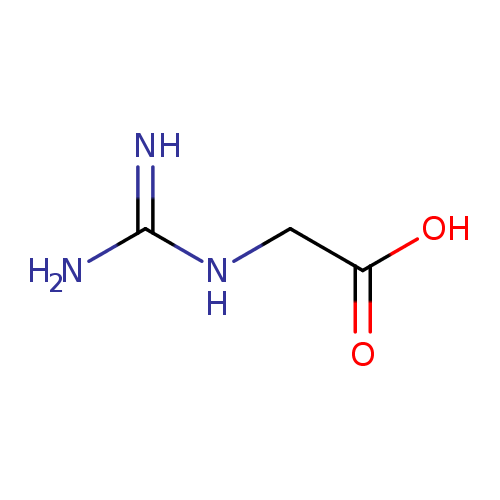
Chemical Structure
Thumb
Synonyms
ValueSource
GlycocyamineChEBI
GuanidinoacetateChEBI
N-(Carbamimidoyl)glycineChEBI
N-[Amino(imino)methyl]glycineChEBI
N-AmidinoglycineChEBI
Guanidinoacetic acidKegg
GuanidoacetateGenerator
(Carboxymethyl)-guanidineHMDB
2-[[Amino(imino)methyl]amino]acetateHMDB
2-[[Amino(imino)methyl]amino]acetic acidHMDB
a-GuanidinoacetateHMDB
a-Guanidinoacetic acidHMDB
alpha-GuanidinoacetateHMDB
alpha-Guanidinoacetic acidHMDB
b-GuanidinoacetateHMDB
b-Guanidinoacetic acidHMDB
beta-GuanidinoacetateHMDB
beta-Guanidinoacetic acidHMDB
BetacyamineHMDB
BetasyamineHMDB
GuanidineacetateHMDB
Guanidineacetic acidHMDB
GuanidylacetateHMDB
Guanidylacetic acidHMDB
Guanyl glycineHMDB
N-Amidino-glycineHMDB
[(Aminoiminomethyl)amino]-acetateHMDB
[(Aminoiminomethyl)amino]-acetic acidHMDB
Glycocyamine, 2-(14)C-labeledHMDB
Glycocyamine, ion (1-)HMDB
Glycocyamine monohydrochlorideHMDB
Chemical FormulaC3H7N3O2
Average Molecular Mass117.107 g/mol
Monoisotopic Mass117.054 g/mol
CAS Registry Number352-97-6
IUPAC Name2-carbamimidamidoacetic acid
Traditional Nameglycocyamine
SMILESNC(=N)NCC(O)=O
InChI IdentifierInChI=1S/C3H7N3O2/c4-3(5)6-1-2(7)8/h1H2,(H,7,8)(H4,4,5,6)
InChI KeyBPMFZUMJYQTVII-UHFFFAOYSA-N
Chemical Taxonomy
Description belongs to the class of organic compounds known as alpha amino acids and derivatives. These are amino acids in which the amino group is attached to the carbon atom immediately adjacent to the carboxylate group (alpha carbon), or a derivative thereof.
KingdomOrganic compounds
Super ClassOrganic acids and derivatives
ClassCarboxylic acids and derivatives
Sub ClassAmino acids, peptides, and analogues
Direct ParentAlpha amino acids and derivatives
Alternative Parents
Substituents
  • Alpha-amino acid or derivatives
  • Guanidine
  • Carboximidamide
  • Monocarboxylic acid or derivatives
  • Carboxylic acid
  • Organic nitrogen compound
  • Organic oxygen compound
  • Organopnictogen compound
  • Organic oxide
  • Hydrocarbon derivative
  • Organooxygen compound
  • Organonitrogen compound
  • Imine
  • Carbonyl group
  • Aliphatic acyclic compound
Molecular FrameworkAliphatic acyclic compounds
External Descriptors
Biological Properties
StatusDetected and Not Quantified
OriginEndogenous
Cellular Locations
  • Cytoplasm
  • Membrane
Biofluid LocationsNot Available
Tissue Locations
  • Brain
  • Kidney
  • Liver
Pathways
NameSMPDB LinkKEGG Link
Arginine and Proline MetabolismSMP00020 map00330
Glycine and Serine MetabolismSMP00004 map00260
ArgininemiaSMP00357 Not Available
Creatine deficiency, guanidinoacetate methyltransferase deficiencySMP00504 Not Available
Guanidinoacetate Methyltransferase Deficiency (GAMT Deficiency)SMP00188 Not Available
S-Adenosylhomocysteine (SAH) Hydrolase DeficiencySMP00214 Not Available
ApplicationsNot Available
Biological Roles
Chemical RolesNot Available
Physical Properties
StateSolid
AppearanceWhite powder.
Experimental Properties
PropertyValue
Melting PointNot Available
Boiling PointNot Available
Solubility3.6 mg/mL at 15°C
Predicted Properties
PropertyValueSource
Water Solubility4.19 g/LALOGPS
logP-1.8ALOGPS
logP-3.1ChemAxon
logS-1.4ALOGPS
pKa (Strongest Acidic)3.37ChemAxon
pKa (Strongest Basic)12.24ChemAxon
Physiological Charge0ChemAxon
Hydrogen Acceptor Count5ChemAxon
Hydrogen Donor Count4ChemAxon
Polar Surface Area99.2 ŲChemAxon
Rotatable Bond Count2ChemAxon
Refractivity36.72 m³·mol⁻¹ChemAxon
Polarizability10.54 ųChemAxon
Number of Rings0ChemAxon
Bioavailability1ChemAxon
Rule of FiveYesChemAxon
Ghose FilterNoChemAxon
Veber's RuleNoChemAxon
MDDR-like RuleNoChemAxon
Spectra
Spectra
Spectrum TypeDescriptionSplash KeyView
GC-MSGC-MS Spectrum - GC-EI-TOF (Non-derivatized)splash10-00di-0901000000-4a89fe463d29379e6339Spectrum
GC-MSGC-MS Spectrum - GC-EI-TOF (Non-derivatized)splash10-00di-0911000000-542baca9dcca73225bf0Spectrum
GC-MSGC-MS Spectrum - GC-EI-TOF (Non-derivatized)splash10-006t-0911200000-bb7ea068f193f39c283bSpectrum
GC-MSGC-MS Spectrum - GC-EI-TOF (Non-derivatized)splash10-00di-0901000000-4a89fe463d29379e6339Spectrum
GC-MSGC-MS Spectrum - GC-EI-TOF (Non-derivatized)splash10-00di-0911000000-542baca9dcca73225bf0Spectrum
GC-MSGC-MS Spectrum - GC-EI-TOF (Non-derivatized)splash10-006t-0911200000-bb7ea068f193f39c283bSpectrum
Predicted GC-MSPredicted GC-MS Spectrum - GC-MS (Non-derivatized) - 70eV, Positivesplash10-0006-9100000000-c703c631a81e400681bdSpectrum
Predicted GC-MSPredicted GC-MS Spectrum - GC-MS (1 TMS) - 70eV, Positivesplash10-00dl-9700000000-1dae820000c4f9ec1662Spectrum
Predicted GC-MSPredicted GC-MS Spectrum - GC-MS (Non-derivatized) - 70eV, PositiveNot AvailableSpectrum
Predicted GC-MSPredicted GC-MS Spectrum - GC-MS (TMS_1_2) - 70eV, PositiveNot AvailableSpectrum
Predicted GC-MSPredicted GC-MS Spectrum - GC-MS (TMS_1_3) - 70eV, PositiveNot AvailableSpectrum
Predicted GC-MSPredicted GC-MS Spectrum - GC-MS (TMS_1_4) - 70eV, PositiveNot AvailableSpectrum
Predicted GC-MSPredicted GC-MS Spectrum - GC-MS (TBDMS_1_1) - 70eV, PositiveNot AvailableSpectrum
Predicted GC-MSPredicted GC-MS Spectrum - GC-MS (TBDMS_1_2) - 70eV, PositiveNot AvailableSpectrum
Predicted GC-MSPredicted GC-MS Spectrum - GC-MS (TBDMS_1_3) - 70eV, PositiveNot AvailableSpectrum
Predicted GC-MSPredicted GC-MS Spectrum - GC-MS (TBDMS_1_4) - 70eV, PositiveNot AvailableSpectrum
LC-MS/MSLC-MS/MS Spectrum - Quattro_QQQ 10V, Positive (Annotated)splash10-016r-7900000000-4777d20e1ab29262427eSpectrum
LC-MS/MSLC-MS/MS Spectrum - Quattro_QQQ 25V, Positive (Annotated)splash10-00dl-9000000000-a1b5501bf0f7a9b0489dSpectrum
LC-MS/MSLC-MS/MS Spectrum - Quattro_QQQ 40V, Positive (Annotated)splash10-0006-9100000000-b61a48cf749b57a2c77eSpectrum
LC-MS/MSLC-MS/MS Spectrum - LC-ESI-QTOF (UPLC Q-Tof Premier, Waters) , Positivesplash10-0gk9-7900000000-5ba298286886c1fabdf5Spectrum
LC-MS/MSLC-MS/MS Spectrum - LC-ESI-QTOF (UPLC Q-Tof Premier, Waters) , Negativesplash10-00di-9100000000-a5b77a913821d637210fSpectrum
LC-MS/MSLC-MS/MS Spectrum - LC-ESI-QTOF , negativesplash10-00di-9100000000-a5b77a913821d637210fSpectrum
LC-MS/MSLC-MS/MS Spectrum - LC-ESI-QTOF , positivesplash10-0gk9-7900000000-5ba298286886c1fabdf5Spectrum
LC-MS/MSLC-MS/MS Spectrum - , positivesplash10-014i-6900000000-4d655a894c702bdfdb59Spectrum
LC-MS/MSLC-MS/MS Spectrum - 40V, Negativesplash10-0006-9000000000-23d5c2795ed49f043127Spectrum
LC-MS/MSLC-MS/MS Spectrum - 20V, Negativesplash10-00di-9000000000-ae360cd8919c8fbce3eeSpectrum
LC-MS/MSLC-MS/MS Spectrum - 10V, Negativesplash10-014i-0900000000-93406e2cdb79770abc7dSpectrum
LC-MS/MSLC-MS/MS Spectrum - 10V, Negativesplash10-00di-9000000000-c6bd00733ea6fa3f6e5dSpectrum
LC-MS/MSLC-MS/MS Spectrum - 20V, Positivesplash10-0ab9-9000000000-2667e0007de6a723415eSpectrum
LC-MS/MSLC-MS/MS Spectrum - 10V, Positivesplash10-0100-9400000000-c5561d5ccaf260c048ecSpectrum
LC-MS/MSLC-MS/MS Spectrum - 10V, Positivesplash10-0g29-9400000000-421d076c4b6868ca69faSpectrum
LC-MS/MSLC-MS/MS Spectrum - 20V, Negativesplash10-014i-0900000000-53db4bf2729a2990a938Spectrum
LC-MS/MSLC-MS/MS Spectrum - 20V, Positivesplash10-05fu-9000000000-2cad7322e574eb992175Spectrum
LC-MS/MSLC-MS/MS Spectrum - 35V, Positivesplash10-01di-9800000000-967331a78fe4a7917408Spectrum
LC-MS/MSLC-MS/MS Spectrum - 20V, Positivesplash10-00dl-9000000000-7b281fae734baaa2695dSpectrum
Predicted LC-MS/MSPredicted LC-MS/MS Spectrum - 10V, Positivesplash10-014i-4900000000-1b831140a3071dd98e0cSpectrum
Predicted LC-MS/MSPredicted LC-MS/MS Spectrum - 20V, Positivesplash10-00di-9300000000-b27aea734be08f5d2ddcSpectrum
Predicted LC-MS/MSPredicted LC-MS/MS Spectrum - 40V, Positivesplash10-00dl-9000000000-dea2f28faa5430d7e56fSpectrum
Predicted LC-MS/MSPredicted LC-MS/MS Spectrum - 10V, Negativesplash10-00xr-9500000000-1ba345c7064e9cb70f9cSpectrum
Predicted LC-MS/MSPredicted LC-MS/MS Spectrum - 20V, Negativesplash10-00di-9000000000-6864d4355d3462fbc69fSpectrum
Predicted LC-MS/MSPredicted LC-MS/MS Spectrum - 40V, Negativesplash10-0006-9000000000-1c36299ab8746bbf67a5Spectrum
1D NMR1H NMR SpectrumNot AvailableSpectrum
1D NMR13C NMR SpectrumNot AvailableSpectrum
1D NMR1H NMR SpectrumNot AvailableSpectrum
1D NMR13C NMR SpectrumNot AvailableSpectrum
1D NMR1H NMR SpectrumNot AvailableSpectrum
1D NMR13C NMR SpectrumNot AvailableSpectrum
1D NMR1H NMR SpectrumNot AvailableSpectrum
1D NMR13C NMR SpectrumNot AvailableSpectrum
1D NMR1H NMR SpectrumNot AvailableSpectrum
1D NMR13C NMR SpectrumNot AvailableSpectrum
1D NMR1H NMR SpectrumNot AvailableSpectrum
1D NMR13C NMR SpectrumNot AvailableSpectrum
1D NMR1H NMR SpectrumNot AvailableSpectrum
1D NMR13C NMR SpectrumNot AvailableSpectrum
1D NMR1H NMR SpectrumNot AvailableSpectrum
1D NMR13C NMR SpectrumNot AvailableSpectrum
1D NMR1H NMR SpectrumNot AvailableSpectrum
1D NMR13C NMR SpectrumNot AvailableSpectrum
1D NMR1H NMR SpectrumNot AvailableSpectrum
1D NMR13C NMR SpectrumNot AvailableSpectrum
1D NMR1H NMR SpectrumNot AvailableSpectrum
2D NMR[1H,13C] 2D NMR SpectrumNot AvailableSpectrum
Toxicity Profile
Route of ExposureEndogenous, Ingestion, Dermal (contact)
Mechanism of ToxicityUremic toxins such as guanidinoacetic acid are actively transported into the kidneys via organic ion transporters (especially OAT3). Increased levels of uremic toxins can stimulate the production of reactive oxygen species. This seems to be mediated by the direct binding or inhibition by uremic toxins of the enzyme NADPH oxidase (especially NOX4 which is abundant in the kidneys and heart) (2). Reactive oxygen species can induce several different DNA methyltransferases (DNMTs) which are involved in the silencing of a protein known as KLOTHO. KLOTHO has been identified as having important roles in anti-aging, mineral metabolism, and vitamin D metabolism. A number of studies have indicated that KLOTHO mRNA and protein levels are reduced during acute or chronic kidney diseases in response to high local levels of reactive oxygen species (3)
MetabolismGuanidino acetic acid (GAA) is synthesized in the liver and kidney from Arg and Gly and subsequently methylated by S-adenosylmethionine to form creatine. The conversion of guaniodacetate to creatinine in the liver causes a depletion of methyl groups. This causes homocysteine levels to rise, which has been shown to produce cardiovascular and skeletal problems.
Toxicity ValuesNot Available
Lethal DoseNot Available
Carcinogenicity (IARC Classification)No indication of carcinogenicity to humans (not listed by IARC).
Uses/SourcesNaturally produced by the body (endogenous). Is used as a supplement to enhance athletic performance.
Minimum Risk LevelNot Available
Health EffectsAcute exposure to guanidoacetic acid can lead to some mild skin and eye irritation. Chronic exposure to uremic toxins can lead to a number of conditions including renal damage, chronic kidney disease and cardiovascular disease. Chronically high levels of guanidoacetic acid are associated with at least 4 inborn errors of metabolism including: Argininemia, Guanidinoacetate methyltransferase deficiency, Guanidinoacetate Methyltransferase Deficiency (GAMT Deficiency) and S-Adenosylhomocysteine (SAH) Hydrolase Deficiency.
SymptomsAs a uremic toxin, this compound can cause uremic syndrome. Uremic syndrome may affect any part of the body and can cause nausea, vomiting, loss of appetite, and weight loss. It can also cause changes in mental status, such as confusion, reduced awareness, agitation, psychosis, seizures, and coma. Abnormal bleeding, such as bleeding spontaneously or profusely from a very minor injury can also occur. Heart problems, such as an irregular heartbeat, inflammation in the sac that surrounds the heart (pericarditis), and increased pressure on the heart can be seen in patients with uremic syndrome. Shortness of breath from fluid buildup in the space between the lungs and the chest wall (pleural effusion) can also be present.
TreatmentChronic Exposure: Kidney dialysis is usually needed to relieve the symptoms of uremic syndrome until normal kidney function can be restored. Acute Exposure: EYES: irrigate opened eyes for several minutes under running water. INGESTION: do not induce vomiting. Rinse mouth with water (never give anything by mouth to an unconscious person). Seek immediate medical advice.
Concentrations
Not Available
DrugBank IDDB02751
HMDB IDHMDB0000128
FooDB IDFDB005417
Phenol Explorer IDNot Available
KNApSAcK IDNot Available
BiGG ID1594816
BioCyc IDGUANIDOACETIC_ACID
METLIN ID5163
PDB IDNot Available
Wikipedia LinkGlycocyamine
Chemspider ID743
ChEBI ID16344
PubChem Compound ID763
Kegg Compound IDC00581
YMDB IDNot Available
ECMDB IDM2MDB005216
References
Synthesis ReferenceNot Available
MSDSNot Available
General References
1. Thalhammer, Franz; Gastner, Thomas. Preparation of creatine, creatine monohydrate and guanidinoacetic acid. Ger. Offen. (2007), 5pp.
2. Thalhammer, Franz; Gastner, Thomas. Preparation of creatine, creatine monohydrate and guanidinoacetic acid. Ger. Offen. (2007), 5pp.
3. Schulze A: Creatine deficiency syndromes. Mol Cell Biochem. 2003 Feb;244(1-2):143-50.
4. Mercimek-Mahmutoglu S, Stoeckler-Ipsiroglu S, Adami A, Appleton R, Araujo HC, Duran M, Ensenauer R, Fernandez-Alvarez E, Garcia P, Grolik C, Item CB, Leuzzi V, Marquardt I, Muhl A, Saelke-Kellermann RA, Salomons GS, Schulze A, Surtees R, van der Knaap MS, Vasconcelos R, Verhoeven NM, Vilarinho L, Wilichowski E, Jakobs C: GAMT deficiency: features, treatment, and outcome in an inborn error of creatine synthesis. Neurology. 2006 Aug 8;67(3):480-4. Epub 2006 Jul 19.
5. Isbrandt D, von Figura K: Cloning and sequence analysis of human guanidinoacetate N-methyltransferase cDNA. Biochim Biophys Acta. 1995 Dec 27;1264(3):265-7.
6. Ensenauer R, Thiel T, Schwab KO, Tacke U, Stockler-Ipsiroglu S, Schulze A, Hennig J, Lehnert W: Guanidinoacetate methyltransferase deficiency: differences of creatine uptake in human brain and muscle. Mol Genet Metab. 2004 Jul;82(3):208-13.
7. Yasuda M, Sugahara K, Zhang J, Ageta T, Nakayama K, Shuin T, Kodama H: Simultaneous determination of creatinine, creatine, and guanidinoacetic acid in human serum and urine using liquid chromatography-atmospheric pressure chemical ionization mass spectrometry. Anal Biochem. 1997 Nov 15;253(2):231-5.
8. Sijens PE, Reijngoud DJ, Soorani-Lunsing RJ, Oudkerk M, van Spronsen FJ: Cerebral 1H MR spectroscopy showing elevation of brain guanidinoacetate in argininosuccinate lyase deficiency. Mol Genet Metab. 2006 May;88(1):100-2. Epub 2005 Dec 15.
9. Valongo C, Cardoso ML, Domingues P, Almeida L, Verhoeven N, Salomons G, Jakobs C, Vilarinho L: Age related reference values for urine creatine and guanidinoacetic acid concentration in children and adolescents by gas chromatography-mass spectrometry. Clin Chim Acta. 2004 Oct;348(1-2):155-61.
10. Fingerhut R: Stable isotope dilution method for the determination of guanidinoacetic acid by gas chromatography/mass spectrometry. Rapid Commun Mass Spectrom. 2003;17(7):717-22.
11. Schmidt A, Marescau B, Boehm EA, Renema WK, Peco R, Das A, Steinfeld R, Chan S, Wallis J, Davidoff M, Ullrich K, Waldschutz R, Heerschap A, De Deyn PP, Neubauer S, Isbrandt D: Severely altered guanidino compound levels, disturbed body weight homeostasis and impaired fertility in a mouse model of guanidinoacetate N-methyltransferase (GAMT) deficiency. Hum Mol Genet. 2004 May 1;13(9):905-21. Epub 2004 Mar 17.
12. Stockler S, Isbrandt D, Hanefeld F, Schmidt B, von Figura K: Guanidinoacetate methyltransferase deficiency: the first inborn error of creatine metabolism in man. Am J Hum Genet. 1996 May;58(5):914-22.
13. Shirokane Y, Utsushikawa M, Nakajima M: A new enzymic determination of guanidinoacetic acid in urine. Clin Chem. 1987 Mar;33(3):394-7.
14. Mizutani N, Hayakawa C, Ohya Y, Watanabe K, Watanabe Y, Mori A: Guanidino compounds in hyperargininemia. Tohoku J Exp Med. 1987 Nov;153(3):197-205.
15. Schulze A, Ebinger F, Rating D, Mayatepek E: Improving treatment of guanidinoacetate methyltransferase deficiency: reduction of guanidinoacetic acid in body fluids by arginine restriction and ornithine supplementation. Mol Genet Metab. 2001 Dec;74(4):413-9.
16. Stockler S, Holzbach U, Hanefeld F, Marquardt I, Helms G, Requart M, Hanicke W, Frahm J: Creatine deficiency in the brain: a new, treatable inborn error of metabolism. Pediatr Res. 1994 Sep;36(3):409-13.
17. Duranton F, Cohen G, De Smet R, Rodriguez M, Jankowski J, Vanholder R, Argiles A: Normal and pathologic concentrations of uremic toxins. J Am Soc Nephrol. 2012 Jul;23(7):1258-70. doi: 10.1681/ASN.2011121175. Epub 2012 May 24.
18. Elshenawy S, Pinney SE, Stuart T, Doulias PT, Zura G, Parry S, Elovitz MA, Bennett MJ, Bansal A, Strauss JF 3rd, Ischiropoulos H, Simmons RA: The Metabolomic Signature of the Placenta in Spontaneous Preterm Birth. Int J Mol Sci. 2020 Feb 4;21(3). pii: ijms21031043. doi: 10.3390/ijms21031043.
19. https://www.ncbi.nlm.nih.gov/pubmed/?term=15462098
20. https://www.ncbi.nlm.nih.gov/pubmed/?term=16538977
21. https://www.ncbi.nlm.nih.gov/pubmed/?term=22770225
22. https://www.ncbi.nlm.nih.gov/pubmed/?term=23329885
23. https://www.ncbi.nlm.nih.gov/pubmed/?term=24103317
24. https://www.ncbi.nlm.nih.gov/pubmed/?term=25460748
25. https://www.ncbi.nlm.nih.gov/pubmed/?term=25468046
26. https://www.ncbi.nlm.nih.gov/pubmed/?term=25622538
27. https://www.ncbi.nlm.nih.gov/pubmed/?term=25680689
28. https://www.ncbi.nlm.nih.gov/pubmed/?term=25896543
29. https://www.ncbi.nlm.nih.gov/pubmed/?term=26079223
30. https://www.ncbi.nlm.nih.gov/pubmed/?term=26216477
31. https://www.ncbi.nlm.nih.gov/pubmed/?term=26255041
32. https://www.ncbi.nlm.nih.gov/pubmed/?term=26311810
33. https://www.ncbi.nlm.nih.gov/pubmed/?term=26376857
34. https://www.ncbi.nlm.nih.gov/pubmed/?term=26411433
35. https://www.ncbi.nlm.nih.gov/pubmed/?term=26445773
36. https://www.ncbi.nlm.nih.gov/pubmed/?term=26485404
37. https://www.ncbi.nlm.nih.gov/pubmed/?term=26684475