Record Information
Version1.0
Creation Date2014-08-29 05:46:40 UTC
Update Date2026-04-16 22:35:49 UTC
Accession NumberCHEM003108
Identification
Common NameDimethylamine
ClassSmall Molecule
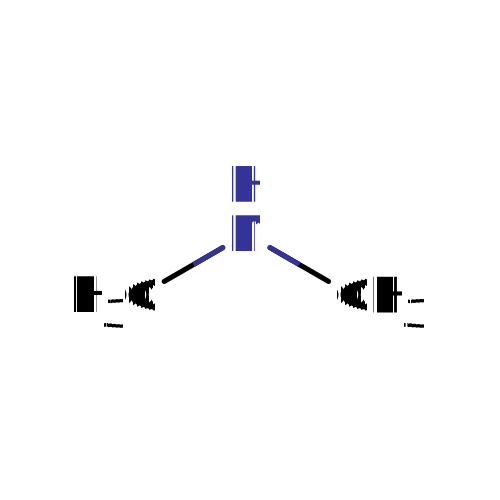
DescriptionDimethylamine is a uremic toxin. Uremic toxins can be subdivided into three major groups based upon their chemical and physical characteristics: 1) small, water-soluble, non-protein-bound compounds, such as urea; 2) small, lipid-soluble and/or protein-bound compounds, such as the phenols and 3) larger so-called middle-molecules, such as beta2-microglobulin. Chronic exposure of uremic toxins can lead to a number of conditions including renal damage, chronic kidney disease and cardiovascular disease. Dimethylamine (DMA) is an organic secondary amine. It is a colorless, liquefied and flammable gas with an ammonia and fish-like odor. Dimethylamine is abundantly present in human urine. Main sources of urinary DMA have been reported to include trimethylamine N-oxide, a common food component, and asymmetric dimethylarginine (ADMA), an endogenous inhibitor of nitric oxide (NO) synthesis. ADMA is excreted in the urine in part unmetabolized and in part after hydrolysis to DMA by dimethylarginine dimethylaminohydrolase (DDAH). Statistically significant increases in urinary DMA have been found in individuals after the consumption of fish and seafoods. The highest values were obtained for individuals that consumed coley, squid and whiting with cod, haddock, sardine, skate and swordfish As a pure chemical substance Dimethylamine is used as dehairing agent in tanning, in dyes, in rubber accelerators, in soaps and cleaning compounds and as an agricultural fungicide. In the body, DMA also undergoes nitrosation under weak acid conditions to give dimethlynitrosamine.
Contaminant Sources
  • Clean Air Act Chemicals
  • EAFUS Chemicals
  • FooDB Chemicals
  • HMDB Contaminants - Feces
  • HMDB Contaminants - Urine
  • HPV EPA Chemicals
  • OECD HPV Chemicals
  • OSHA Hazardous Chemicals
  • STOFF IDENT Compounds
  • T3DB toxins
  • ToxCast & Tox21 Chemicals
Contaminant Type
  • Dye
  • Food Toxin
  • Fungicide
  • Household Toxin
  • Metabolite
  • Natural Compound
  • Organic Compound
  • Pesticide
  • Uremic Toxin
Chemical Structure
Thumb
Synonyms
ValueSource
DMAChEBI
HNMe2ChEBI
Me2nhChEBI
N,N-DimethylamineChEBI
(CH3)2nhKegg
Dimethylamine anhydrousHMDB
Dimethylamine anhydrous (dot)HMDB
Dimethylamine aqueous solutionHMDB
Dimethylamine hydrobromideHMDB
Dimethylamine solutionHMDB
N-Methyl-methanamineHMDB
N-MethylmethanamineHMDB
N-Methylmethanamine (acd/name 4.0)HMDB
Dimethylamine nitrateHMDB
Dimethylamine perchlorateHMDB
Dimethylamine sulfateHMDB
Dimethylamine hydrochlorideHMDB
Dimethylamine phosphate (3:1)HMDB
Dimethylamine, conjugate acidHMDB
Dimethylammonium chlorideHMDB
Dimethylamine sulfate (1:1)HMDB
Dimethylammonium formateHMDB
Dimethylamine monosulfateHMDB
Chemical FormulaC2H7N
Average Molecular Mass45.084 g/mol
Monoisotopic Mass45.058 g/mol
CAS Registry Number124-40-3
IUPAC Namedimethylamine
Traditional Namedimethylamine
SMILESCNC
InChI IdentifierInChI=1S/C2H7N/c1-3-2/h3H,1-2H3
InChI KeyROSDSFDQCJNGOL-UHFFFAOYSA-N
Chemical Taxonomy
Description belongs to the class of organic compounds known as dialkylamines. These are organic compounds containing a dialkylamine group, characterized by two alkyl groups bonded to the amino nitrogen.
KingdomOrganic compounds
Super ClassOrganic nitrogen compounds
ClassOrganonitrogen compounds
Sub ClassAmines
Direct ParentDialkylamines
Alternative Parents
Substituents
  • Secondary aliphatic amine
  • Organopnictogen compound
  • Hydrocarbon derivative
  • Aliphatic acyclic compound
Molecular FrameworkAliphatic acyclic compounds
External Descriptors
Biological Properties
StatusDetected and Not Quantified
OriginEndogenous
Cellular Locations
  • Cytoplasm
  • Extracellular
Biofluid LocationsNot Available
Tissue Locations
  • Fibroblasts
  • Neuron
PathwaysNot Available
ApplicationsNot Available
Biological Roles
Chemical RolesNot Available
Physical Properties
StateLiquid
AppearanceNot Available
Experimental Properties
PropertyValue
Melting Point-92.2°C
Boiling PointNot Available
Solubility1630 mg/mL at 40°C
Predicted Properties
PropertyValueSource
Water Solubility516 g/LALOGPS
logP-0.53ALOGPS
logP-0.19ChemAxon
logS1.06ALOGPS
pKa (Strongest Basic)10.52ChemAxon
Physiological Charge1ChemAxon
Hydrogen Acceptor Count1ChemAxon
Hydrogen Donor Count1ChemAxon
Polar Surface Area12.03 ŲChemAxon
Rotatable Bond Count0ChemAxon
Refractivity14.69 m³·mol⁻¹ChemAxon
Polarizability5.75 ųChemAxon
Number of Rings0ChemAxon
Bioavailability1ChemAxon
Rule of FiveYesChemAxon
Ghose FilterNoChemAxon
Veber's RuleYesChemAxon
MDDR-like RuleNoChemAxon
Spectra
Spectra
Spectrum TypeDescriptionSplash KeyView
GC-MSGC-MS Spectrum - EI-B (Non-derivatized)splash10-0006-9000000000-cfb8e10b3b28eba99793Spectrum
Predicted GC-MSPredicted GC-MS Spectrum - GC-MS (Non-derivatized) - 70eV, Positivesplash10-0002-9000000000-398c710ba4ea34342a91Spectrum
Predicted GC-MSPredicted GC-MS Spectrum - GC-MS (Non-derivatized) - 70eV, PositiveNot AvailableSpectrum
LC-MS/MSLC-MS/MS Spectrum - EI-B (HITACHI M-80B) , Positivesplash10-0006-9000000000-8b085007dc085a460422Spectrum
LC-MS/MSLC-MS/MS Spectrum - LC-ESI-QQ (API3000, Applied Biosystems) 10V, Positivesplash10-0002-9000000000-103f1d373ec0d015b807Spectrum
LC-MS/MSLC-MS/MS Spectrum - LC-ESI-QQ (API3000, Applied Biosystems) 20V, Positivesplash10-0002-9000000000-df28f146170e28bfcb5eSpectrum
LC-MS/MSLC-MS/MS Spectrum - LC-ESI-QQ (API3000, Applied Biosystems) 30V, Positivesplash10-0002-9000000000-cd82fdde4d83a74d83f1Spectrum
LC-MS/MSLC-MS/MS Spectrum - LC-ESI-QQ (API3000, Applied Biosystems) 40V, Positivesplash10-00wc-9100000000-aeb1521c62f5010e11aaSpectrum
LC-MS/MSLC-MS/MS Spectrum - LC-ESI-QQ (API3000, Applied Biosystems) 50V, Positivesplash10-017i-9101000000-c269a0887eed5daf0e28Spectrum
LC-MS/MSLC-MS/MS Spectrum - LC-ESI-QQ , positivesplash10-0002-9000000000-103f1d373ec0d015b807Spectrum
LC-MS/MSLC-MS/MS Spectrum - LC-ESI-QQ , positivesplash10-0002-9000000000-df28f146170e28bfcb5eSpectrum
LC-MS/MSLC-MS/MS Spectrum - LC-ESI-QQ , positivesplash10-0002-9000000000-17646ed4f7c44ba14045Spectrum
LC-MS/MSLC-MS/MS Spectrum - LC-ESI-QQ , positivesplash10-00wc-9100000000-aeb1521c62f5010e11aaSpectrum
LC-MS/MSLC-MS/MS Spectrum - LC-ESI-QQ , positivesplash10-017i-9101000000-c269a0887eed5daf0e28Spectrum
Predicted LC-MS/MSPredicted LC-MS/MS Spectrum - 10V, Positivesplash10-0002-9000000000-933c4b104db02265ac4aSpectrum
Predicted LC-MS/MSPredicted LC-MS/MS Spectrum - 20V, Positivesplash10-0002-9000000000-e85cf853d2e7110d18c1Spectrum
Predicted LC-MS/MSPredicted LC-MS/MS Spectrum - 40V, Positivesplash10-014j-9000000000-2032c41c4ca525ff4e1cSpectrum
Predicted LC-MS/MSPredicted LC-MS/MS Spectrum - 10V, Negativesplash10-0006-9000000000-32c57cc32d61a2feae23Spectrum
Predicted LC-MS/MSPredicted LC-MS/MS Spectrum - 20V, Negativesplash10-0006-9000000000-36fe99d2cc96e560f509Spectrum
Predicted LC-MS/MSPredicted LC-MS/MS Spectrum - 40V, Negativesplash10-0006-9000000000-8914e111239eacc36328Spectrum
Predicted LC-MS/MSPredicted LC-MS/MS Spectrum - 10V, Negativesplash10-0006-9000000000-46fb6b0f3d2dcd71d159Spectrum
Predicted LC-MS/MSPredicted LC-MS/MS Spectrum - 20V, Negativesplash10-0006-9000000000-46fb6b0f3d2dcd71d159Spectrum
Predicted LC-MS/MSPredicted LC-MS/MS Spectrum - 40V, Negativesplash10-0006-9000000000-46fb6b0f3d2dcd71d159Spectrum
Predicted LC-MS/MSPredicted LC-MS/MS Spectrum - 10V, Positivesplash10-0002-9000000000-e97e92727205304cdb09Spectrum
Predicted LC-MS/MSPredicted LC-MS/MS Spectrum - 20V, Positivesplash10-0002-9000000000-e97e92727205304cdb09Spectrum
Predicted LC-MS/MSPredicted LC-MS/MS Spectrum - 40V, Positivesplash10-0006-9000000000-9cf36baccac69593c69fSpectrum
MSMass Spectrum (Electron Ionization)splash10-0006-9000000000-8ae4e0d1cb5c91c730c0Spectrum
1D NMR1H NMR SpectrumNot AvailableSpectrum
1D NMR13C NMR SpectrumNot AvailableSpectrum
1D NMR1H NMR SpectrumNot AvailableSpectrum
1D NMR13C NMR SpectrumNot AvailableSpectrum
1D NMR1H NMR SpectrumNot AvailableSpectrum
1D NMR13C NMR SpectrumNot AvailableSpectrum
1D NMR1H NMR SpectrumNot AvailableSpectrum
1D NMR13C NMR SpectrumNot AvailableSpectrum
1D NMR1H NMR SpectrumNot AvailableSpectrum
1D NMR13C NMR SpectrumNot AvailableSpectrum
1D NMR1H NMR SpectrumNot AvailableSpectrum
1D NMR13C NMR SpectrumNot AvailableSpectrum
1D NMR1H NMR SpectrumNot AvailableSpectrum
1D NMR13C NMR SpectrumNot AvailableSpectrum
1D NMR1H NMR SpectrumNot AvailableSpectrum
1D NMR13C NMR SpectrumNot AvailableSpectrum
1D NMR1H NMR SpectrumNot AvailableSpectrum
1D NMR13C NMR SpectrumNot AvailableSpectrum
1D NMR1H NMR SpectrumNot AvailableSpectrum
1D NMR13C NMR SpectrumNot AvailableSpectrum
1D NMR1H NMR SpectrumNot AvailableSpectrum
1D NMR13C NMR SpectrumNot AvailableSpectrum
2D NMR[1H,13C] 2D NMR SpectrumNot AvailableSpectrum
Toxicity Profile
Route of ExposureEndogenous, Ingestion, Dermal (contact)
Mechanism of ToxicityUremic toxins such as dimethylamine are actively transported into the kidneys via organic ion transporters (especially OAT3). Increased levels of uremic toxins can stimulate the production of reactive oxygen species. This seems to be mediated by the direct binding or inhibition by uremic toxins of the enzyme NADPH oxidase (especially NOX4 which is abundant in the kidneys and heart) (4). Reactive oxygen species can induce several different DNA methyltransferases (DNMTs) which are involved in the silencing of a protein known as KLOTHO. KLOTHO has been identified as having important roles in anti-aging, mineral metabolism, and vitamin D metabolism. A number of studies have indicated that KLOTHO mRNA and protein levels are reduced during acute or chronic kidney diseases in response to high local levels of reactive oxygen species (5)
MetabolismUremic toxins tend to accumulate in the blood either through dietary excess or through poor filtration by the kidneys. Most uremic toxins are metabolic waste products and are normally excreted in the urine or feces.
Toxicity ValuesNot Available
Lethal DoseNot Available
Carcinogenicity (IARC Classification)No indication of carcinogenicity to humans (not listed by IARC).
Uses/SourcesNaturally produced by the body (endogenous).
Minimum Risk LevelNot Available
Health EffectsChronic exposure to uremic toxins can lead to a number of conditions including renal damage, chronic kidney disease and cardiovascular disease.
SymptomsAs a uremic toxin, this compound can cause uremic syndrome. Uremic syndrome may affect any part of the body and can cause nausea, vomiting, loss of appetite, and weight loss. It can also cause changes in mental status, such as confusion, reduced awareness, agitation, psychosis, seizures, and coma. Abnormal bleeding, such as bleeding spontaneously or profusely from a very minor injury can also occur. Heart problems, such as an irregular heartbeat, inflammation in the sac that surrounds the heart (pericarditis), and increased pressure on the heart can be seen in patients with uremic syndrome. Shortness of breath from fluid buildup in the space between the lungs and the chest wall (pleural effusion) can also be present.
TreatmentKidney dialysis is usually needed to relieve the symptoms of uremic syndrome until normal kidney function can be restored.
Concentrations
Not Available
DrugBank IDNot Available
HMDB IDHMDB0000087
FooDB IDFDB012589
Phenol Explorer IDNot Available
KNApSAcK IDNot Available
BiGG IDNot Available
BioCyc IDDIMETHYLAMINE
METLIN ID3758
PDB IDNot Available
Wikipedia LinkDimethylamine
Chemspider ID654
ChEBI ID17170
PubChem Compound ID674
Kegg Compound IDC00543
YMDB IDNot Available
ECMDB IDM2MDB004682
References
Synthesis ReferenceZones, Stacey I.; Burton, Allen W. Production of methylamine and dimethylamine using STI zeolite catalysts. U.S. Pat. Appl. Publ. (2007), 6pp.
MSDSLink
General References
1. Zones, Stacey I.; Burton, Allen W. Production of methylamine and dimethylamine using STI zeolite catalysts. U.S. Pat. Appl. Publ. (2007), 6pp.
2. Maher AD, Hayes B, Cocks B, Marett L, Wales WJ, Rochfort SJ: Latent biochemical relationships in the blood-milk metabolic axis of dairy cows revealed by statistical integration of 1H NMR spectroscopic data. J Proteome Res. 2013 Mar 1;12(3):1428-35. doi: 10.1021/pr301056q. Epub 2013 Feb 21.
3. O'Callaghan TF, Vazquez-Fresno R, Serra-Cayuela A, Dong E, Mandal R, Hennessy D, McAuliffe S, Dillon P, Wishart DS, Stanton C, Ross RP: Pasture Feeding Changes the Bovine Rumen and Milk Metabolome. Metabolites. 2018 Apr 6;8(2). pii: metabo8020027. doi: 10.3390/metabo8020027.
4. A. Foroutan et al. The Chemical Composition of Commercial Cow's Milk (in preparation)
5. Zones, Stacey I.; Burton, Allen W. Production of methylamine and dimethylamine using STI zeolite catalysts. U.S. Pat. Appl. Publ. (2007), 6pp.
6. Silwood CJ, Lynch E, Claxson AW, Grootveld MC: 1H and (13)C NMR spectroscopic analysis of human saliva. J Dent Res. 2002 Jun;81(6):422-7.
7. Zeisel SH, daCosta KA, Youssef M, Hensey S: Conversion of dietary choline to trimethylamine and dimethylamine in rats: dose-response relationship. J Nutr. 1989 May;119(5):800-4.
8. Lee L, Archer MC, Bruce WR: Absence of volatile nitrosamines in human feces. Cancer Res. 1981 Oct;41(10):3992-4.
9. Sharif NA, Crider JY, Davis TL: AL-3138 antagonizes FP prostanoid receptor-mediated inositol phosphates generation: comparison with some purported FP antagonists. J Pharm Pharmacol. 2000 Dec;52(12):1529-39.
10. Hughes R, Dart J, Kilvington S: Activity of the amidoamine myristamidopropyl dimethylamine against keratitis pathogens. J Antimicrob Chemother. 2003 Jun;51(6):1415-8. Epub 2003 Apr 25.
11. Le Moyec L, Racine S, Le Toumelin P, Adnet F, Larue V, Cohen Y, Leroux Y, Cupa M, Hantz E: Aminoglycoside and glycopeptide renal toxicity in intensive care patients studied by proton magnetic resonance spectroscopy of urine. Crit Care Med. 2002 Jun;30(6):1242-5.
12. Lee SH, Kim SO, Chung BC: Gas chromatographic-mass spectrometric determination of urinary oxoacids using O-(2,3,4,5,6-pentafluorobenzyl)oxime-trimethylsilyl ester derivatization and cation-exchange chromatography. J Chromatogr B Biomed Sci Appl. 1998 Nov 20;719(1-2):1-7.
13. Mulder C, Wahlund LO, Blomberg M, de Jong S, van Kamp GJ, Scheltens P, Teerlink T: Alzheimer's disease is not associated with altered concentrations of the nitric oxide synthase inhibitor asymmetric dimethylarginine in cerebrospinal fluid. J Neural Transm (Vienna). 2002 Sep;109(9):1203-8.
14. Sweatman BC, Farrant RD, Holmes E, Ghauri FY, Nicholson JK, Lindon JC: 600 MHz 1H-NMR spectroscopy of human cerebrospinal fluid: effects of sample manipulation and assignment of resonances. J Pharm Biomed Anal. 1993 Aug;11(8):651-64.
15. Messana I, Forni F, Ferrari F, Rossi C, Giardina B, Zuppi C: Proton nuclear magnetic resonance spectral profiles of urine in type II diabetic patients. Clin Chem. 1998 Jul;44(7):1529-34.
16. Nicholson JK, Foxall PJ, Spraul M, Farrant RD, Lindon JC: 750 MHz 1H and 1H-13C NMR spectroscopy of human blood plasma. Anal Chem. 1995 Mar 1;67(5):793-811.
17. Lichtenberger LM, Gardner JW, Barreto JC, Morriss FH Jr: Evidence for a role of volatile amines in the development of neonatal hypergastrinemia. J Pediatr Gastroenterol Nutr. 1991 Nov;13(4):342-6.
18. Zhang AQ, Mitchell SC, Smith RL: Dimethylamine in human urine. Clin Chim Acta. 1995 Jan 16;233(1-2):81-8.
19. Choi SY, Chung MJ, Sung NJ: Volatile N-nitrosamine inhibition after intake Korean green tea and Maesil (Prunus mume SIEB. et ZACC.) extracts with an amine-rich diet in subjects ingesting nitrate. Food Chem Toxicol. 2002 Jul;40(7):949-57.
20. Kilvington S, Hughes R, Byas J, Dart J: Activities of therapeutic agents and myristamidopropyl dimethylamine against Acanthamoeba isolates. Antimicrob Agents Chemother. 2002 Jun;46(6):2007-9.
21. Mitchell SC, Zhang AQ, Smith RL: Dimethylamine and diet. Food Chem Toxicol. 2008 May;46(5):1734-8. doi: 10.1016/j.fct.2008.01.010. Epub 2008 Jan 15.
22. Meskys R, Harris RJ, Casaite V, Basran J, Scrutton NS: Organization of the genes involved in dimethylglycine and sarcosine degradation in Arthrobacter spp.: implications for glycine betaine catabolism. Eur J Biochem. 2001 Jun;268(12):3390-8.
23. Tate RL 3rd, Alexander M: Microbial formation and degradation of dimethylamine. Appl Environ Microbiol. 1976 Mar;31(3):399-403.
24. Duranton F, Cohen G, De Smet R, Rodriguez M, Jankowski J, Vanholder R, Argiles A: Normal and pathologic concentrations of uremic toxins. J Am Soc Nephrol. 2012 Jul;23(7):1258-70. doi: 10.1681/ASN.2011121175. Epub 2012 May 24.
25. https://www.ncbi.nlm.nih.gov/pubmed/?term=17190852
26. https://www.ncbi.nlm.nih.gov/pubmed/?term=18282650
27. https://www.ncbi.nlm.nih.gov/pubmed/?term=22074457