Record Information
Version1.0
Creation Date2014-08-29 05:25:15 UTC
Update Date2026-05-21 00:19:44 UTC
Accession NumberCHEM003090
Identification
Common NameGambieric acid B
ClassSmall Molecule
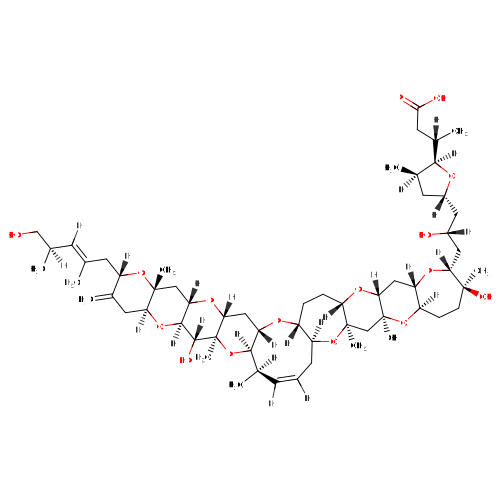
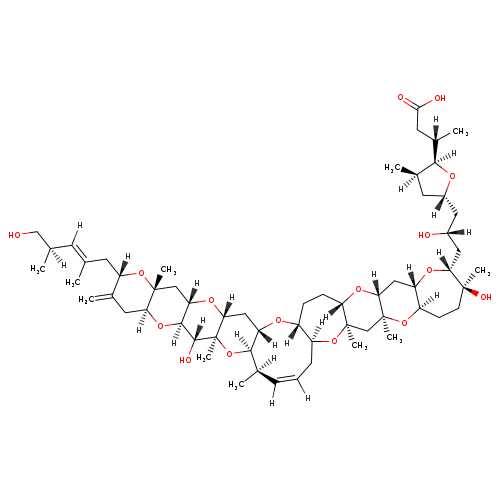
DescriptionGambieric acid B is an antifungal compound isolated from the marine dinoflagellate Gambierdiscus toxicus that produces ciguatoxin precursors and maitotoxin. The skeletal structure of gambieric acids (GAs) consists of a nonacrylic polyether core involuving six-, seven-, and nine- membered cyclic ethers, arranged with an isolated tetrahydrofuran ring (A-ring). GAs share the structural characteristics common to those of polycyclic ether neurotoxins, which are produced by G. toxicus, for example, ciguatoxin, maitotoxin, and gambierol (1).

Contaminant Sources
  • T3DB toxins
Contaminant Type
  • Animal Toxin
  • Ether
  • Marine Toxin
  • Natural Compound
  • Organic Compound
  • PFAS
Chemical Structure
Thumb
Synonyms
ValueSource
(3S)-3-[(2S,3R,5S)-5-[(2R)-3-[(1R,3S,5R,7S,9R,11S,14S,16R,17R,18S,20R,21R,22Z,25S,27R,29S,31R,34S,35R,37S,39R,41S)-17,34-Dihydroxy-11-[(4R)-5-hydroxy-2,4-dimethylpent-2-en-1-yl]-9,18,21,27,29,34-hexamethyl-12-methylidene-2,6,10,15,19,26,30,36,40-nonaoxanonacyclo[23.18.0.0,.0,.0,.0,.0,.0,.0,]tritetracont-22-en-35-yl]-2-hydroxypropyl]-3-methyloxolan-2-yl]butanoateGenerator
(3S)-3-[(2S,3R,5S)-5-[(2R)-3-[(1R,3S,5R,7S,9R,11S,14S,16R,17R,18S,20R,21R,22Z,25S,27R,29S,31R,34S,35R,37S,39R,41S)-17,34-Dihydroxy-11-[(4R)-5-hydroxy-2,4-dimethylpent-2-en-1-yl]-9,18,21,27,29,34-hexamethyl-12-methylidene-2,6,10,15,19,26,30,36,40-nonaoxanonacyclo[23.18.0.0³,²⁰.0⁵,¹⁸.0⁷,¹⁶.0⁹,¹⁴.0²⁷,⁴¹.0²⁹,³⁹.0³¹,³⁷]tritetracont-22-en-35-yl]-2-hydroxypropyl]-3-methyloxolan-2-yl]butanoateGenerator
Gambieric acid bMeSH
Chemical FormulaC60H94O16
Average Molecular Mass1071.379 g/mol
Monoisotopic Mass1070.654 g/mol
CAS Registry Number141363-65-7
IUPAC NameNot Available
Traditional Name(3S)-3-[(2S,3R,5S)-5-[(2R)-3-[(1R,3S,5R,7S,9R,11S,14S,16R,17R,18S,20R,21R,22Z,25S,27R,29S,31R,34S,35R,37S,39R,41S)-17,34-dihydroxy-11-[(4R)-5-hydroxy-2,4-dimethylpent-2-en-1-yl]-9,18,21,27,29,34-hexamethyl-12-methylidene-2,6,10,15,19,26,30,36,40-nonaoxanonacyclo[23.18.0.0³,²⁰.0⁵,¹⁸.0⁷,¹⁶.0⁹,¹⁴.0²⁷,⁴¹.0²⁹,³⁹.0³¹,³⁷]tritetracont-22-en-35-yl]-2-hydroxypropyl]-3-methyloxolan-2-yl]butanoic acid
SMILES[H]C(=C(C)C[C@]1([H])O[C@]2(C)C[C@]3([H])O[C@]4([H])C[C@]5([H])O[C@]6([H])CC[C@]7([H])O[C@]8([H])C[C@]9([H])O[C@]([H])(C[C@]([H])(O)C[C@]%10([H])C[C@@]([H])(C)[C@]([H])(O%10)[C@@]([H])(C)CC(O)=O)[C@@](C)(O)CC[C@@]9([H])O[C@@]8(C)C[C@@]7(C)O[C@@]6([H])C\C([H])=C([H])/[C@@]([H])(C)[C@@]5([H])O[C@@]4(C)[C@]([H])(O)[C@@]3([H])O[C@@]2([H])CC1=C)[C@@]([H])(C)CO
InChI IdentifierInChI=1S/C60H94O16/c1-31(19-32(2)29-61)20-42-34(4)22-48-57(8,75-42)28-45-54(72-48)55(65)60(11)50(70-45)27-44-53(76-60)33(3)13-12-14-40-39(68-44)15-16-46-58(9,73-40)30-59(10)49(71-46)26-43-41(74-59)17-18-56(7,66)47(69-43)25-37(62)24-38-21-35(5)52(67-38)36(6)23-51(63)64/h12-13,19,32-33,35-50,52-55,61-62,65-66H,4,14-18,20-30H2,1-3,5-11H3,(H,63,64)/b13-12-,31-19+/t32-,33-,35-,36+,37-,38+,39-,40+,41-,42+,43+,44+,45+,46+,47-,48+,49-,50-,52+,53-,54+,55-,56+,57-,58-,59+,60-/m1/s1
InChI KeyPLNXKBYHTXJJIY-ISIUNFMJSA-N
Chemical Taxonomy
Description belongs to the class of organic compounds known as fatty alcohols. These are aliphatic alcohols consisting of a chain of a least six carbon atoms.
KingdomOrganic compounds
Super ClassLipids and lipid-like molecules
ClassFatty Acyls
Sub ClassFatty alcohols
Direct ParentFatty alcohols
Alternative Parents
Substituents
  • Fatty alcohol
  • Branched fatty acid
  • Heterocyclic fatty acid
  • Hydroxy fatty acid
  • Methyl-branched fatty acid
  • Oxepane
  • Monosaccharide
  • Oxane
  • Tetrahydrofuran
  • Tertiary alcohol
  • Secondary alcohol
  • Carboxylic acid derivative
  • Carboxylic acid
  • Dialkyl ether
  • Ether
  • Oxacycle
  • Monocarboxylic acid or derivatives
  • Organoheterocyclic compound
  • Carbonyl group
  • Organic oxide
  • Hydrocarbon derivative
  • Alcohol
  • Organic oxygen compound
  • Organooxygen compound
  • Primary alcohol
  • Aliphatic heteropolycyclic compound
Molecular FrameworkAliphatic heteropolycyclic compounds
External Descriptors
Biological Properties
StatusDetected and Not Quantified
OriginExogenous
Cellular Locations
  • Membrane
Biofluid LocationsNot Available
Tissue LocationsNot Available
PathwaysNot Available
ApplicationsNot Available
Biological RolesNot Available
Chemical RolesNot Available
Physical Properties
StateSolid
AppearanceWhite powder.
Experimental Properties
PropertyValue
Melting PointNot Available
Boiling PointNot Available
SolubilityNot Available
Predicted Properties
PropertyValueSource
Water Solubility0.0028 g/LALOGPS
logP3.75ALOGPS
logP4.68ChemAxon
logS-5.6ALOGPS
pKa (Strongest Acidic)4.55ChemAxon
pKa (Strongest Basic)-1.8ChemAxon
Physiological Charge-1ChemAxon
Hydrogen Acceptor Count16ChemAxon
Hydrogen Donor Count5ChemAxon
Polar Surface Area210.52 ŲChemAxon
Rotatable Bond Count11ChemAxon
Refractivity282.26 m³·mol⁻¹ChemAxon
Polarizability122.88 ųChemAxon
Number of Rings10ChemAxon
Bioavailability0ChemAxon
Rule of FiveNoChemAxon
Ghose FilterNoChemAxon
Veber's RuleNoChemAxon
MDDR-like RuleYesChemAxon
Spectra
Spectra
Spectrum TypeDescriptionSplash KeyView
Predicted LC-MS/MSPredicted LC-MS/MS Spectrum - 10V, Positivesplash10-0udr-9110000000-cfd88b93c41d401d6456Spectrum
Predicted LC-MS/MSPredicted LC-MS/MS Spectrum - 20V, Positivesplash10-052o-9410001225-889d4baa1875fc11a7f9Spectrum
Predicted LC-MS/MSPredicted LC-MS/MS Spectrum - 40V, Positivesplash10-067i-9330006051-2ede141d99b73ff45087Spectrum
Predicted LC-MS/MSPredicted LC-MS/MS Spectrum - 10V, Negativesplash10-00or-9080104600-60975f61ca35a8fe8ab9Spectrum
Predicted LC-MS/MSPredicted LC-MS/MS Spectrum - 20V, Negativesplash10-03di-5619130160-76aa7729e0892dc0c546Spectrum
Predicted LC-MS/MSPredicted LC-MS/MS Spectrum - 40V, Negativesplash10-0400-1397221000-b29cb9a6b7a7f8f5b9f4Spectrum
Toxicity Profile
Route of ExposureNot Available
Mechanism of ToxicityNot Available
MetabolismNot Available
Toxicity ValuesNot Available
Lethal DoseNot Available
Carcinogenicity (IARC Classification)No indication of carcinogenicity to humans (not listed by IARC).
Uses/SourcesGambieric acid B is an antifungal compound isolated from the marine dinoflagellate Gambierdiscus toxicus that produces ciguatoxin precursors and maitotoxin. The skeletal structure of gambieric acids (GAs) consists of a nonacrylic polyether core involuving six-, seven-, and nine- membered cyclic ethers, arranged with an isolated tetrahydrofuran ring (A-ring). GAs share the structural characteristics common to those of polycyclic ether neurotoxins, which are produced by G. toxicus, for example, ciguatoxin, maitotoxin, and gambierol (1).
Minimum Risk LevelNot Available
Health EffectsNot Available
SymptomsNot Available
TreatmentNot Available
Concentrations
Not Available
DrugBank IDNot Available
HMDB IDNot Available
FooDB IDNot Available
Phenol Explorer IDNot Available
KNApSAcK IDC00016807
BiGG IDNot Available
BioCyc IDNot Available
METLIN IDNot Available
PDB IDNot Available
Wikipedia LinkNot Available
Chemspider IDNot Available
ChEBI ID80778
PubChem Compound ID46173843
Kegg Compound IDC16886
YMDB IDNot Available
ECMDB IDNot Available
References
Synthesis ReferenceNot Available
MSDSNot Available
General ReferencesNot Available