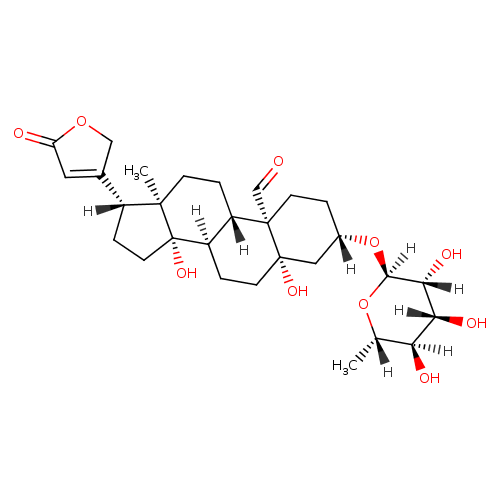
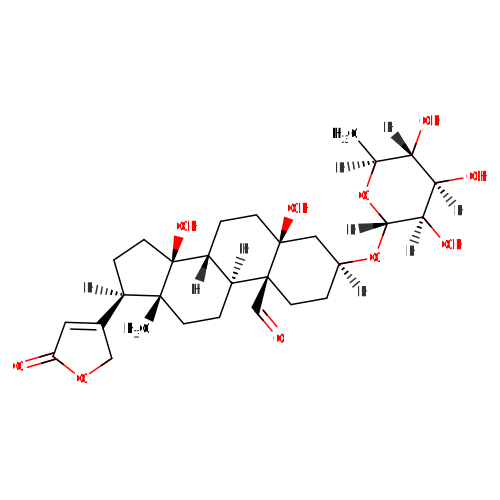
Convallatoxin is a solid compound with the chemical formula C29H42O10. Convallatoxin belongs to the steroid lactones, a subclass of steroids and steroid derivatives within the organic compounds. With an average molecular weight of 550.64 g/mol, Convallatoxin is a heavy molecule. This exogenous substance functions biologically as a metabolite and is applied as a vasodilator agent.
The compound is found in 13 recorded sources across multiple sectors. Within healthcare, pharmaceuticals, and veterinary products, it is associated with medical devices. In the energy, oil, and gas sector, as well as industrial manufacturing and chemical processing, it is found in lubricants. It is also recorded in food packaging within the food, food processing, and cookware sector. Additionally, it appears in textiles, leather, and furnishings, specifically in carpets, rugs, and synthetic textiles. Its presence is further noted in electrical and electronic equipment, including batteries, capacitors, cell phones, printed circuit boards, wires, and cables, among one other sector. Recorded exposure routes for Convallatoxin include oral, inhalation, and touch.
belongs to the class of organic compounds known as cardenolide glycosides and derivatives. Cardenolide glycosides and derivatives are compounds containing a carbohydrate glycosidically bound to the cardenolide moiety.
Convallatoxin (CNT) is classified as a cardiac glycoside. Cardiac glycosides are well known Na+/K+-ATPase inhibitors, and some of them are used to treat congestive heart failure and atrial arrhythmias. Recent studies have reported that cardiac glycosides have potential as anticancer agents. CNT exerts cytotoxic effects on a number of cancer and normal cell lines and induces apoptosis by increasing caspase-3 and poly ADP ribose polymerase (PARP) cleavage. Moreover, dose- and time-dependent autophagic activity was detected in CNT-treated cells, and mammalian target of rapamycin (mTOR)/p70S6K signal pathway inhibition was observed. Notably, CNT inhibits human umbilical vein endothelial cell (HUVEC) growth and exerts anti-angiogenic activity in vitro and in vivo. (1)