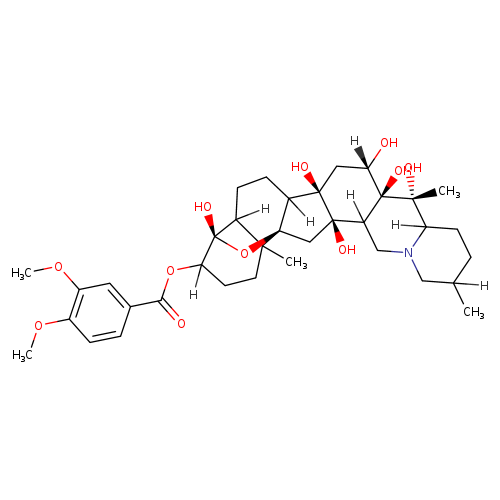
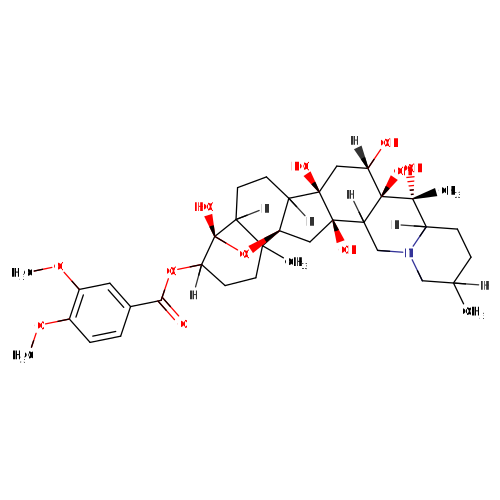
Veratridine belongs to the steroidal alkaloids, a subclass of steroids and steroid derivatives within the organic compounds. With an average molecular weight of 673.79 g/mol, Veratridine is a heavy molecule. This exogenous compound has the chemical formula C36H51NO11 and exists as a solid at room temperature. Biologically, it functions as a sodium channel modulator.
belongs to the class of organic compounds known as cerveratrum-type alkaloids. These are steroidal alkaloids containing the cevane (23-methyl-4- azahexacyclo[12.11.0.0^{2,11}.0^{4,9}.0^{15,24}.0^{18,23}]pentacosane) moiety, which is a six ring system. Cerveratrum alkaloids have 7-9 oxygen atoms and occur as free alkamines or esters of simple aliphatic or aromatic acids.
Veratridine is a steroid-derived alkaloid from plants in the Liliaceae family that functions as a neurotoxin by abolishing inactivation of sodium ion channels. It binds to intramembrane receptor site 2 and increases intracellular Ca2+ concentration. It acts by preferentially binding to activated Na+ channels causing persistent activation that leads to increased nerve excitability. (Wikipedia) The activation of the action potential Na+ ionophore by veratridine is time- and concentrationdependent and completely reversible. (1)