Record Information
Version1.0
Creation Date2014-08-29 04:58:55 UTC
Update Date2026-05-20 22:33:18 UTC
Accession NumberCHEM003014
Identification
Common NameProtoanemonin
ClassSmall Molecule
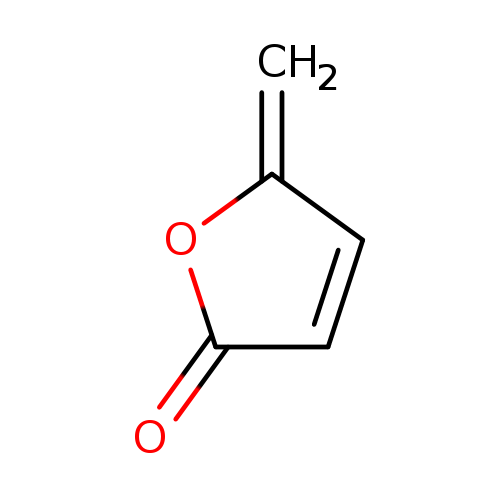
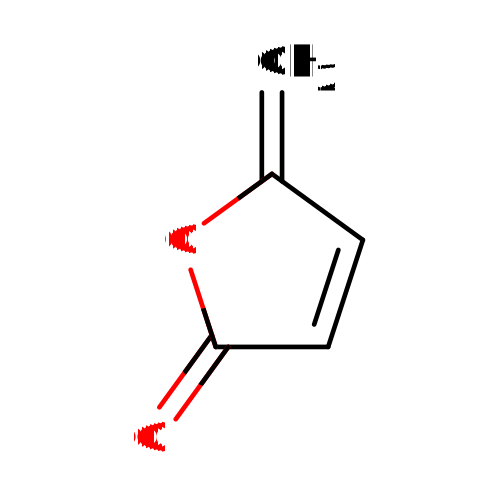
DescriptionProtoanemonin (sometimes called anemonol or ranunculol) is a toxin found in all plants of the buttercup family (Ranunculaceae). On maceration, for example when the plant is wounded, it is produced by an enzymatic process from the glucoside ranunculin. It is the lactone of 4-hydroxy-2,4-pentadienoic acid. A wounded plant releases the substance, causing itch, rashes or blistering on contact with the skin or mucosa.
Contaminant Sources
  • T3DB toxins
Contaminant Type
  • Ester
  • Metabolite
  • Natural Compound
  • Organic Compound
  • PFAS
  • Phytotoxin
  • Plant Toxin
Chemical Structure
Thumb
Synonyms
ValueSource
4-Methylenebut-2-en-4-olideChEBI
5-Methylene-2(5H)-furanoneChEBI
cis-4-Methylenebut-2-en-4-olideChEBI
5-Methylene-2-furanoneHMDB
Chemical FormulaC5H4O2
Average Molecular Mass96.084 g/mol
Monoisotopic Mass96.021 g/mol
CAS Registry Number108-28-1
IUPAC NameNot Available
Traditional Nameprotoanemonin
SMILESC=C1OC(=O)C=C1
InChI IdentifierInChI=1S/C5H4O2/c1-4-2-3-5(6)7-4/h2-3H,1H2
InChI KeyRNYZJZKPGHQTJR-UHFFFAOYSA-N
Chemical Taxonomy
Description belongs to the class of organic compounds known as butenolides. These are dihydrofurans with a carbonyl group at the C2 carbon atom.
KingdomOrganic compounds
Super ClassOrganoheterocyclic compounds
ClassDihydrofurans
Sub ClassFuranones
Direct ParentButenolides
Alternative Parents
Substituents
  • 2-furanone
  • Alpha,beta-unsaturated carboxylic ester
  • Enoate ester
  • Enol ester
  • Lactone
  • Carboxylic acid ester
  • Oxacycle
  • Monocarboxylic acid or derivatives
  • Carboxylic acid derivative
  • Organic oxygen compound
  • Organic oxide
  • Hydrocarbon derivative
  • Organooxygen compound
  • Carbonyl group
  • Aliphatic heteromonocyclic compound
Molecular FrameworkAliphatic heteromonocyclic compounds
External Descriptors
Biological Properties
StatusDetected and Not Quantified
OriginExogenous
Cellular Locations
  • Cytoplasm
  • Extracellular
Biofluid LocationsNot Available
Tissue LocationsNot Available
PathwaysNot Available
ApplicationsNot Available
Biological RolesNot Available
Chemical RolesNot Available
Physical Properties
StateSolid
AppearanceWhite powder.
Experimental Properties
PropertyValue
Melting PointNot Available
Boiling PointNot Available
SolubilityNot Available
Predicted Properties
PropertyValueSource
Water Solubility61.8 g/LALOGPS
logP0.7ALOGPS
logP0.76ChemAxon
logS-0.19ALOGPS
pKa (Strongest Basic)-6.9ChemAxon
Physiological Charge0ChemAxon
Hydrogen Acceptor Count1ChemAxon
Hydrogen Donor Count0ChemAxon
Polar Surface Area26.3 ŲChemAxon
Rotatable Bond Count0ChemAxon
Refractivity26.01 m³·mol⁻¹ChemAxon
Polarizability8.82 ųChemAxon
Number of Rings1ChemAxon
Bioavailability1ChemAxon
Rule of FiveYesChemAxon
Ghose FilterNoChemAxon
Veber's RuleYesChemAxon
MDDR-like RuleNoChemAxon
Spectra
Spectra
Spectrum TypeDescriptionSplash KeyView
Predicted GC-MSPredicted GC-MS Spectrum - GC-MS (Non-derivatized) - 70eV, Positivesplash10-0udi-9000000000-ef6687a610aaecacb239Spectrum
Predicted GC-MSPredicted GC-MS Spectrum - GC-MS (Non-derivatized) - 70eV, PositiveNot AvailableSpectrum
Predicted LC-MS/MSPredicted LC-MS/MS Spectrum - 10V, Positivesplash10-0002-9000000000-b6ec422705a7e5123bd4Spectrum
Predicted LC-MS/MSPredicted LC-MS/MS Spectrum - 20V, Positivesplash10-0002-9000000000-eb44835609142e75cd73Spectrum
Predicted LC-MS/MSPredicted LC-MS/MS Spectrum - 40V, Positivesplash10-0udi-9000000000-48eb1e104da3a0781110Spectrum
Predicted LC-MS/MSPredicted LC-MS/MS Spectrum - 10V, Negativesplash10-0002-9000000000-267c360d9734babaaf71Spectrum
Predicted LC-MS/MSPredicted LC-MS/MS Spectrum - 20V, Negativesplash10-0f6t-9000000000-b5df9916b5d89d825827Spectrum
Predicted LC-MS/MSPredicted LC-MS/MS Spectrum - 40V, Negativesplash10-0udj-9000000000-b10e731dcce77040411cSpectrum
Predicted LC-MS/MSPredicted LC-MS/MS Spectrum - 10V, Positivesplash10-014j-9000000000-0468df05f34781217bbeSpectrum
Predicted LC-MS/MSPredicted LC-MS/MS Spectrum - 20V, Positivesplash10-0udi-9000000000-2554939f5adee81a5d0dSpectrum
Predicted LC-MS/MSPredicted LC-MS/MS Spectrum - 40V, Positivesplash10-0udi-9000000000-7c59f5639a0b7186edf0Spectrum
Predicted LC-MS/MSPredicted LC-MS/MS Spectrum - 10V, Negativesplash10-0002-9000000000-53fba820360e0c7016f3Spectrum
Predicted LC-MS/MSPredicted LC-MS/MS Spectrum - 20V, Negativesplash10-0udj-9000000000-584b27ea4de09075451cSpectrum
Predicted LC-MS/MSPredicted LC-MS/MS Spectrum - 40V, Negativesplash10-0007-9000000000-3d945f0594de6c0d8fc9Spectrum
1D NMR1H NMR SpectrumNot AvailableSpectrum
1D NMR13C NMR SpectrumNot AvailableSpectrum
1D NMR1H NMR SpectrumNot AvailableSpectrum
1D NMR13C NMR SpectrumNot AvailableSpectrum
1D NMR1H NMR SpectrumNot AvailableSpectrum
1D NMR13C NMR SpectrumNot AvailableSpectrum
1D NMR1H NMR SpectrumNot AvailableSpectrum
1D NMR13C NMR SpectrumNot AvailableSpectrum
1D NMR1H NMR SpectrumNot AvailableSpectrum
1D NMR13C NMR SpectrumNot AvailableSpectrum
1D NMR1H NMR SpectrumNot AvailableSpectrum
1D NMR13C NMR SpectrumNot AvailableSpectrum
1D NMR1H NMR SpectrumNot AvailableSpectrum
1D NMR13C NMR SpectrumNot AvailableSpectrum
1D NMR1H NMR SpectrumNot AvailableSpectrum
1D NMR13C NMR SpectrumNot AvailableSpectrum
1D NMR1H NMR SpectrumNot AvailableSpectrum
1D NMR13C NMR SpectrumNot AvailableSpectrum
1D NMR1H NMR SpectrumNot AvailableSpectrum
1D NMR13C NMR SpectrumNot AvailableSpectrum
Toxicity Profile
Route of ExposureNot Available
Mechanism of ToxicityNot Available
MetabolismNot Available
Toxicity ValuesNot Available
Lethal DoseNot Available
Carcinogenicity (IARC Classification)No indication of carcinogenicity to humans (not listed by IARC).
Uses/SourcesProtoanemonin (sometimes called anemonol or ranunculol) is a toxin found in all plants of the buttercup family (Ranunculaceae). On maceration, for example when the plant is wounded, it is produced by an enzymatic process from the glucoside ranunculin.
Minimum Risk LevelNot Available
Health EffectsNot Available
SymptomsNot Available
TreatmentNot Available
Concentrations
Not Available
DrugBank IDNot Available
HMDB IDHMDB0060503
FooDB IDNot Available
Phenol Explorer IDNot Available
KNApSAcK IDC00000301
BiGG IDNot Available
BioCyc IDNot Available
METLIN IDNot Available
PDB IDNot Available
Wikipedia LinkProtoanemonin
Chemspider IDNot Available
ChEBI ID28906
PubChem Compound ID66948
Kegg Compound IDC07090
YMDB IDNot Available
ECMDB IDECMDB20185
References
Synthesis ReferenceNot Available
MSDSNot Available
General References
1. Magrane M: UniProt Knowledgebase: a hub of integrated protein data. Database (Oxford). 2011 Mar 29;2011:bar009. doi: 10.1093/database/bar009. Print 2011.