Record Information
Version1.0
Creation Date2014-08-29 04:57:13 UTC
Update Date2026-05-21 00:19:37 UTC
Accession NumberCHEM003007
Identification
Common NameHomoyessotoxin
ClassSmall Molecule
DescriptionHomoyessotoxin is found in mollusks. Homoyessotoxin is isolated from mussels.
Contaminant Sources
  • FooDB Chemicals
  • T3DB toxins
Contaminant Type
  • Animal Toxin
  • Ester
  • Ether
  • Food Toxin
  • Metabolite
  • Natural Compound
  • Organic Compound
  • PFAS
Chemical Structure
Thumb
Synonyms
ValueSource
3-De(2-(sulfooxy)ethyl)-3-(3-(sulfooxy)propyl)-yessotoxinHMDB
3-De(2-(sulfooxy)ethyl)-3-(3-(sulfooxy)propyl)yessotoxinHMDB
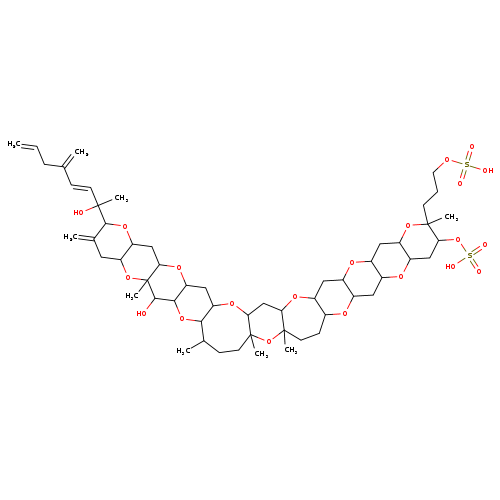
{34-hydroxy-40-[(3E)-2-hydroxy-5-methylideneocta-3,7-dien-2-yl]-13,25,27,30,35-pentamethyl-39-methylidene-13-[3-(sulfooxy)propyl]-4,8,12,17,21,26,32,36,41,45,49-undecaoxaundecacyclo[25.22.0.0³,²⁵.0⁵,²².0⁷,²⁰.0⁹,¹⁸.0¹¹,¹⁶.0³¹,⁴⁸.0³³,⁴⁶.0³⁵,⁴⁴.0³⁷,⁴²]nonatetracontan-14-yl}oxidanesulfonateGenerator
{34-hydroxy-40-[(3E)-2-hydroxy-5-methylideneocta-3,7-dien-2-yl]-13,25,27,30,35-pentamethyl-39-methylidene-13-[3-(sulphooxy)propyl]-4,8,12,17,21,26,32,36,41,45,49-undecaoxaundecacyclo[25.22.0.0³,²⁵.0⁵,²².0⁷,²⁰.0⁹,¹⁸.0¹¹,¹⁶.0³¹,⁴⁸.0³³,⁴⁶.0³⁵,⁴⁴.0³⁷,⁴²]nonatetracontan-14-yl}oxidanesulphonateGenerator
{34-hydroxy-40-[(3E)-2-hydroxy-5-methylideneocta-3,7-dien-2-yl]-13,25,27,30,35-pentamethyl-39-methylidene-13-[3-(sulphooxy)propyl]-4,8,12,17,21,26,32,36,41,45,49-undecaoxaundecacyclo[25.22.0.0³,²⁵.0⁵,²².0⁷,²⁰.0⁹,¹⁸.0¹¹,¹⁶.0³¹,⁴⁸.0³³,⁴⁶.0³⁵,⁴⁴.0³⁷,⁴²]nonatetracontan-14-yl}oxidanesulphonic acidGenerator
Chemical FormulaC56H84O21S2
Average Molecular Mass1157.384 g/mol
Monoisotopic Mass1156.495 g/mol
CAS Registry Number196309-94-1
IUPAC NameNot Available
Traditional Name{34-hydroxy-40-[(3E)-2-hydroxy-5-methylideneocta-3,7-dien-2-yl]-13,25,27,30,35-pentamethyl-39-methylidene-13-[3-(sulfooxy)propyl]-4,8,12,17,21,26,32,36,41,45,49-undecaoxaundecacyclo[25.22.0.0³,²⁵.0⁵,²².0⁷,²⁰.0⁹,¹⁸.0¹¹,¹⁶.0³¹,⁴⁸.0³³,⁴⁶.0³⁵,⁴⁴.0³⁷,⁴²]nonatetracontan-14-yl}oxidanesulfonic acid
SMILESCC1CCC2(C)OC3(C)CCC4OC5CC6OC7CC(OS(O)(=O)=O)C(C)(CCCOS(O)(=O)=O)OC7CC6OC5CC4OC3CC2OC2CC3OC4CC5OC(C(=C)CC5OC4(C)C(O)C3OC12)C(C)(O)\C=C\C(=C)CC=C
InChI IdentifierInChI=1S/C56H84O21S2/c1-10-12-29(2)13-17-52(5,58)51-31(4)21-40-39(72-51)27-47-56(9,75-40)50(57)49-43(71-47)25-42-48(73-49)30(3)14-18-54(7)45(70-42)28-44-55(8,77-54)19-15-32-33(69-44)22-35-34(66-32)23-36-37(67-35)24-41-38(68-36)26-46(76-79(62,63)64)53(6,74-41)16-11-20-65-78(59,60)61/h10,13,17,30,32-51,57-58H,1-2,4,11-12,14-16,18-28H2,3,5-9H3,(H,59,60,61)(H,62,63,64)/b17-13+
InChI KeyRVOXLHZDVJPIKK-GHRIWEEISA-N
Chemical Taxonomy
Description belongs to the class of organic compounds known as ciguatera toxins. These are lipid-soluble polyether compounds consisting of 13 to 14 rings fused by ether linkages into a most rigid ladder-like structure.
KingdomOrganic compounds
Super ClassPhenylpropanoids and polyketides
ClassCiguatera toxins
Sub ClassNot Available
Direct ParentCiguatera toxins
Alternative Parents
Substituents
  • Ciguatera toxin fragment
  • Oxepane
  • Monosaccharide
  • Oxane
  • Sulfuric acid monoester
  • Sulfate-ester
  • Alkyl sulfate
  • Sulfuric acid ester
  • Organic sulfuric acid or derivatives
  • Tertiary alcohol
  • Secondary alcohol
  • Dialkyl ether
  • Ether
  • Organoheterocyclic compound
  • Oxacycle
  • Organic oxygen compound
  • Organic oxide
  • Organooxygen compound
  • Alcohol
  • Hydrocarbon derivative
  • Aliphatic heteropolycyclic compound
Molecular FrameworkAliphatic heteropolycyclic compounds
External DescriptorsNot Available
Biological Properties
StatusDetected and Not Quantified
OriginExogenous
Cellular Locations
  • Cytoplasm
  • Extracellular
  • Membrane
Biofluid LocationsNot Available
Tissue LocationsNot Available
PathwaysNot Available
ApplicationsNot Available
Biological RolesNot Available
Chemical RolesNot Available
Physical Properties
StateSolid
AppearanceWhite powder.
Experimental Properties
PropertyValue
Melting PointNot Available
Boiling PointNot Available
SolubilityNot Available
Predicted Properties
PropertyValueSource
Water Solubility0.027 g/LALOGPS
logP0.58ALOGPS
logP0.15ChemAxon
logS-4.6ALOGPS
pKa (Strongest Acidic)-2.2ChemAxon
pKa (Strongest Basic)-3.4ChemAxon
Physiological Charge-2ChemAxon
Hydrogen Acceptor Count19ChemAxon
Hydrogen Donor Count4ChemAxon
Polar Surface Area269.19 ŲChemAxon
Rotatable Bond Count12ChemAxon
Refractivity280.24 m³·mol⁻¹ChemAxon
Polarizability122.97 ųChemAxon
Number of Rings11ChemAxon
Bioavailability0ChemAxon
Rule of FiveNoChemAxon
Ghose FilterNoChemAxon
Veber's RuleNoChemAxon
MDDR-like RuleYesChemAxon
Spectra
Spectra
Spectrum TypeDescriptionSplash KeyView
Predicted LC-MS/MSPredicted LC-MS/MS Spectrum - 10V, Positivesplash10-0a4r-7911000020-f56511ff29f98426bdc6Spectrum
Predicted LC-MS/MSPredicted LC-MS/MS Spectrum - 20V, Positivesplash10-0006-9100100001-c5c0047929f57a09549dSpectrum
Predicted LC-MS/MSPredicted LC-MS/MS Spectrum - 40V, Positivesplash10-0gba-9211120101-d5bed99e415962114f7fSpectrum
Predicted LC-MS/MSPredicted LC-MS/MS Spectrum - 10V, Negativesplash10-0a4i-1728031291-75e2afd6fe0c42bbefeeSpectrum
Predicted LC-MS/MSPredicted LC-MS/MS Spectrum - 20V, Negativesplash10-08i3-8916002085-1301b1593d87f4bc84ceSpectrum
Predicted LC-MS/MSPredicted LC-MS/MS Spectrum - 40V, Negativesplash10-001u-0774894312-23ae7a34816be4d66c64Spectrum
Predicted LC-MS/MSPredicted LC-MS/MS Spectrum - 10V, Negativesplash10-0a4i-0900000000-231677dc0bab0cf69047Spectrum
Predicted LC-MS/MSPredicted LC-MS/MS Spectrum - 20V, Negativesplash10-0a4j-4900000000-8f513dbfb65ce129a80cSpectrum
Predicted LC-MS/MSPredicted LC-MS/MS Spectrum - 40V, Negativesplash10-0f6t-9500000500-ee04d299b89067000c7bSpectrum
Predicted LC-MS/MSPredicted LC-MS/MS Spectrum - 10V, Positivesplash10-0a6r-9800000000-0b7352b93e1618e55ad5Spectrum
Predicted LC-MS/MSPredicted LC-MS/MS Spectrum - 20V, Positivesplash10-0ar9-9400000001-0de49cd8e4f1598dd5a4Spectrum
Predicted LC-MS/MSPredicted LC-MS/MS Spectrum - 40V, Positivesplash10-016u-9100000000-c4477bdf4e1606a5307bSpectrum
Toxicity Profile
Route of ExposureNot Available
Mechanism of ToxicityNot Available
MetabolismNot Available
Toxicity ValuesNot Available
Lethal DoseNot Available
Carcinogenicity (IARC Classification)No indication of carcinogenicity to humans (not listed by IARC).
Uses/SourcesHomoyessotoxin is found in mollusks. Homoyessotoxin is isolated from mussels.
Minimum Risk LevelNot Available
Health EffectsNot Available
SymptomsNot Available
TreatmentNot Available
Concentrations
Not Available
DrugBank IDNot Available
HMDB IDHMDB0036615
FooDB IDFDB015531
Phenol Explorer IDNot Available
KNApSAcK IDNot Available
BiGG IDNot Available
BioCyc IDNot Available
METLIN IDNot Available
PDB IDNot Available
Wikipedia LinkNot Available
Chemspider ID35014170
ChEBI IDNot Available
PubChem Compound ID131752017
Kegg Compound IDNot Available
YMDB IDNot Available
ECMDB IDNot Available
References
Synthesis ReferenceNot Available
MSDSNot Available
General References
1. Yannai, Shmuel. (2004) Dictionary of food compounds with CD-ROM: Additives, flavors, and ingredients. Boca Raton: Chapman & Hall/CRC.