Record Information
Version1.0
Creation Date2014-08-29 04:54:45 UTC
Update Date2026-05-14 17:46:46 UTC
Accession NumberCHEM003000
Identification
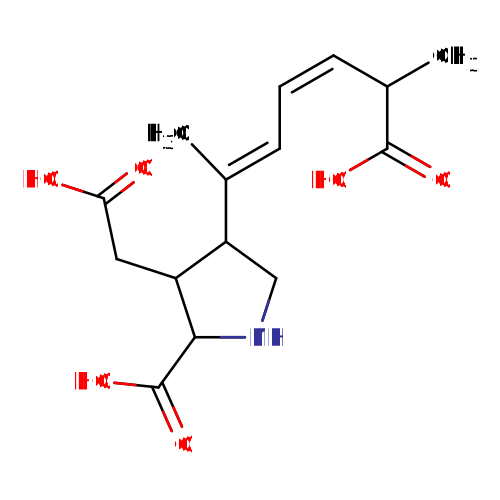
Common NameDomoic acid
ClassSmall Molecule
DescriptionIsodomoic acid F is found in mollusks. Isodomoic acid F is isolated from mussels.
Contaminant Sources
  • FooDB Chemicals
  • STOFF IDENT Compounds
  • T3DB toxins
Contaminant Type
  • Amine
  • Animal Toxin
  • Food Toxin
  • Marine Toxin
  • Metabolite
  • Natural Compound
  • Organic Compound
Chemical Structure
Thumb
Synonyms
ValueSource
DomoateGenerator
2-Carboxy-4-(5-carboxy-1-methyl-1,3-hexadienyl)-3-pyrrolidineacetic acid, 9ciHMDB
4-[(4Z)-6-Carboxy-6-methylhexa-2,4-dien-2-yl]-3-(carboxymethyl)pyrrolidine-2-carboxylateHMDB
Domoic acid, sodium saltHMDB
2 alpha-Carboxy-4 beta-(5-carboxy-1-methyl-1,3 beta-hexadienyl)-3-pyrrolidineacetic acidHMDB
Chemical FormulaC15H21NO6
Average Molecular Mass311.330 g/mol
Monoisotopic Mass311.137 g/mol
CAS Registry Number14277-97-5
IUPAC Name(2S,3S,4S)-4-[(2Z,4E,6R)-6-carboxy-6-methylhexa-2,4-dien-2-yl]-3-(carboxymethyl)pyrrolidine-2-carboxylic acid
Traditional Name4-[(2E,4Z)-6-carboxy-6-methylhexa-2,4-dien-2-yl]-3-(carboxymethyl)pyrrolidine-2-carboxylic acid
SMILESCC(\C=C/C=C(\C)C1CNC(C1CC(O)=O)C(O)=O)C(O)=O
InChI IdentifierInChI=1S/C15H21NO6/c1-8(4-3-5-9(2)14(19)20)11-7-16-13(15(21)22)10(11)6-12(17)18/h3-5,9-11,13,16H,6-7H2,1-2H3,(H,17,18)(H,19,20)(H,21,22)/b5-3-,8-4+
InChI KeyVZFRNCSOCOPNDB-VOGDQUTBSA-N
Chemical Taxonomy
Description belongs to the class of organic compounds known as kainoids. These are non-proteigenous amino acids with a structure characterized by the presence of a pyrrolidine ring bearing two dicarboxylic acid groups.
KingdomOrganic compounds
Super ClassOrganic acids and derivatives
ClassCarboxylic acids and derivatives
Sub ClassAmino acids, peptides, and analogues
Direct ParentKainoids
Alternative Parents
Substituents
  • Kainoid skeleton
  • Proline or derivatives
  • Alpha-amino acid
  • Alpha-amino acid or derivatives
  • Tricarboxylic acid or derivatives
  • Pyrrolidine carboxylic acid
  • Pyrrolidine carboxylic acid or derivatives
  • Pyrrolidine
  • Amino acid
  • Azacycle
  • Secondary amine
  • Secondary aliphatic amine
  • Carboxylic acid
  • Organoheterocyclic compound
  • Hydrocarbon derivative
  • Organic oxide
  • Organooxygen compound
  • Organonitrogen compound
  • Organopnictogen compound
  • Carbonyl group
  • Amine
  • Organic oxygen compound
  • Organic nitrogen compound
  • Aliphatic heteromonocyclic compound
Molecular FrameworkAliphatic heteromonocyclic compounds
External DescriptorsNot Available
Biological Properties
StatusDetected and Not Quantified
OriginExogenous
Cellular Locations
  • Cytoplasm
  • Extracellular
Biofluid LocationsNot Available
Tissue LocationsNot Available
PathwaysNot Available
ApplicationsNot Available
Biological Roles
Chemical RolesNot Available
Physical Properties
StateSolid
AppearanceWhite powder.
Experimental Properties
PropertyValue
Melting Point213°C
Boiling PointNot Available
SolubilityNot Available
Predicted Properties
PropertyValueSource
Water Solubility0.76 g/LALOGPS
logP-0.23ALOGPS
logP-1.8ChemAxon
logS-2.6ALOGPS
pKa (Strongest Acidic)1.68ChemAxon
pKa (Strongest Basic)11.59ChemAxon
Physiological Charge-2ChemAxon
Hydrogen Acceptor Count7ChemAxon
Hydrogen Donor Count4ChemAxon
Polar Surface Area123.93 ŲChemAxon
Rotatable Bond Count7ChemAxon
Refractivity79.03 m³·mol⁻¹ChemAxon
Polarizability31.37 ųChemAxon
Number of Rings1ChemAxon
Bioavailability1ChemAxon
Rule of FiveYesChemAxon
Ghose FilterNoChemAxon
Veber's RuleNoChemAxon
MDDR-like RuleNoChemAxon
Spectra
Spectra
Spectrum TypeDescriptionSplash KeyView
Predicted GC-MSPredicted GC-MS Spectrum - GC-MS (Non-derivatized) - 70eV, Positivesplash10-014i-1190000000-0f032ae6ba67e85569d1Spectrum
Predicted GC-MSPredicted GC-MS Spectrum - GC-MS (3 TMS) - 70eV, Positivesplash10-03dr-7022930000-d481676ec3cd8f81e0f2Spectrum
Predicted GC-MSPredicted GC-MS Spectrum - GC-MS (Non-derivatized) - 70eV, PositiveNot AvailableSpectrum
Predicted LC-MS/MSPredicted LC-MS/MS Spectrum - 10V, Positivesplash10-02td-0091000000-5c1af032e2a414093d32Spectrum
Predicted LC-MS/MSPredicted LC-MS/MS Spectrum - 20V, Positivesplash10-00xv-0290000000-3132996b9c637bd2d17cSpectrum
Predicted LC-MS/MSPredicted LC-MS/MS Spectrum - 40V, Positivesplash10-00fu-2950000000-da1336086e7683eca375Spectrum
Predicted LC-MS/MSPredicted LC-MS/MS Spectrum - 10V, Negativesplash10-03xr-0095000000-a9ef2070f6c85aca77f8Spectrum
Predicted LC-MS/MSPredicted LC-MS/MS Spectrum - 20V, Negativesplash10-0300-0091000000-a75b1fa12139c14df40aSpectrum
Predicted LC-MS/MSPredicted LC-MS/MS Spectrum - 40V, Negativesplash10-00di-8090000000-2a54baf57b36bcd8bc7bSpectrum
Predicted LC-MS/MSPredicted LC-MS/MS Spectrum - 10V, Positivesplash10-03di-0397000000-b7d0fe55c6c974e1f0c9Spectrum
Predicted LC-MS/MSPredicted LC-MS/MS Spectrum - 20V, Positivesplash10-014i-0490000000-13675d00d78272887b6fSpectrum
Predicted LC-MS/MSPredicted LC-MS/MS Spectrum - 40V, Positivesplash10-0kdl-8960000000-ec13c78f91642fefe9f1Spectrum
Predicted LC-MS/MSPredicted LC-MS/MS Spectrum - 10V, Negativesplash10-03di-0049000000-c759361a83dda185d403Spectrum
Predicted LC-MS/MSPredicted LC-MS/MS Spectrum - 20V, Negativesplash10-0aba-4090000000-178917029ca95263d8aeSpectrum
Predicted LC-MS/MSPredicted LC-MS/MS Spectrum - 40V, Negativesplash10-0006-9420000000-8ba7cd4addebc77d8fbcSpectrum
1D NMR13C NMR SpectrumNot AvailableSpectrum
1D NMR1H NMR SpectrumNot AvailableSpectrum
1D NMR13C NMR SpectrumNot AvailableSpectrum
1D NMR1H NMR SpectrumNot AvailableSpectrum
1D NMR13C NMR SpectrumNot AvailableSpectrum
1D NMR1H NMR SpectrumNot AvailableSpectrum
1D NMR13C NMR SpectrumNot AvailableSpectrum
1D NMR1H NMR SpectrumNot AvailableSpectrum
1D NMR13C NMR SpectrumNot AvailableSpectrum
1D NMR1H NMR SpectrumNot AvailableSpectrum
1D NMR13C NMR SpectrumNot AvailableSpectrum
1D NMR1H NMR SpectrumNot AvailableSpectrum
1D NMR13C NMR SpectrumNot AvailableSpectrum
1D NMR1H NMR SpectrumNot AvailableSpectrum
1D NMR13C NMR SpectrumNot AvailableSpectrum
1D NMR1H NMR SpectrumNot AvailableSpectrum
1D NMR13C NMR SpectrumNot AvailableSpectrum
1D NMR1H NMR SpectrumNot AvailableSpectrum
1D NMR13C NMR SpectrumNot AvailableSpectrum
1D NMR1H NMR SpectrumNot AvailableSpectrum
Toxicity Profile
Route of ExposureIngestion
Mechanism of ToxicityDomoic acid acts as a neurotoxin. It induces excitotoxicity by an integrative action on ionotropic glutamate receptors at both sides of the synapse for which it has high affinity, preferentially the KA subtype, coupled with an effect that prevents the channel from rapid desensitization. DOM crosses the placenta and can be detected in milk, opening the possibility of a risk for fetal and neonatal exposure.
MetabolismNot Available
Toxicity ValuesNot Available
Lethal DoseNot Available
Carcinogenicity (IARC Classification)No indication of carcinogenicity to humans (not listed by IARC).
Uses/SourcesIsodomoic acid F is found in mollusks. Isodomoic acid F is isolated from mussels.
Minimum Risk LevelNot Available
Health EffectsExposure to domoic acid causes short-term memory loss, brain damage (including epilepsy), in severe cases, death. It may also cause kidney damage – even at levels considered safe for human consumption.
SymptomsNot Available
TreatmentNot Available
Concentrations
Not Available
DrugBank IDNot Available
HMDB IDHMDB0033939
FooDB IDFDB017959
Phenol Explorer IDNot Available
KNApSAcK IDC00034487
BiGG IDNot Available
BioCyc IDNot Available
METLIN IDNot Available
PDB IDNot Available
Wikipedia LinkDomoic acid
Chemspider ID32772177
ChEBI IDNot Available
PubChem Compound ID54601877
Kegg Compound IDC13732
YMDB IDNot Available
ECMDB IDNot Available
References
Synthesis ReferenceNot Available
MSDSNot Available
General References
1. Yannai, Shmuel. (2004) Dictionary of food compounds with CD-ROM: Additives, flavors, and ingredients. Boca Raton: Chapman & Hall/CRC.