Record Information
Version1.0
Creation Date2014-08-29 04:49:35 UTC
Update Date2026-05-21 00:19:29 UTC
Accession NumberCHEM002994
Identification
Common NameBrevetoxin B2
ClassSmall Molecule
DescriptionBrevetoxin (PbTx), or brevetoxins, are a suite of cyclic polyether compounds produced naturally by a species of dinoflagellate known as Karenia brevis. Brevetoxins are neurotoxins that bind to voltage-gated sodium channels in nerve cells, leading to disruption of normal neurological processes and causing the illness clinically described as neurotoxic shellfish poisoning (NSP).

Contaminant Sources
  • FooDB Chemicals
  • T3DB toxins
Contaminant Type
  • Aldehyde
  • Animal Toxin
  • Ester
  • Ether
  • Food Toxin
  • Marine Toxin
  • Natural Compound
  • Organic Compound
  • PFAS
Chemical Structure
Thumb
SynonymsNot Available
Chemical FormulaC50H70O14
Average Molecular Mass895.082 g/mol
Monoisotopic Mass894.477 g/mol
CAS Registry NumberNot Available
IUPAC NameNot Available
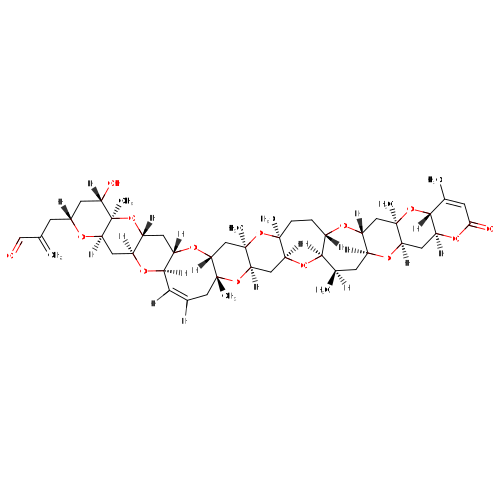
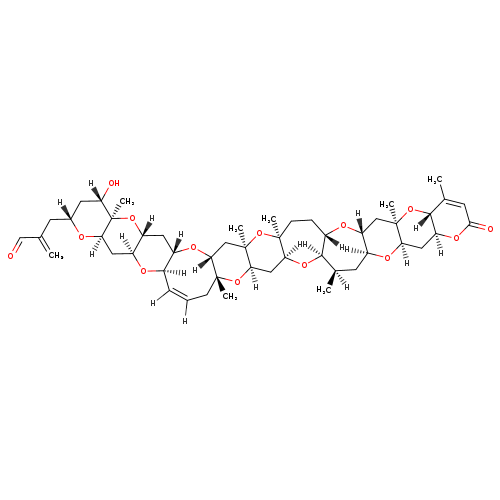
Traditional Name2-{[(1R,3S,5R,7S,9R,11S,12S,14R,16R,18S,20R,21Z,24S,26R,28S,30R,31R,33S,35R,37S,42R,44S,46R,48S)-12-hydroxy-1,3,11,24,31,41,44-heptamethyl-39-oxo-2,6,10,15,19,25,29,34,38,43,47-undecaoxaundecacyclo[26.22.0.0³,²⁶.0⁵,²⁴.0⁷,²⁰.0⁹,¹⁸.0¹¹,¹⁶.0³⁰,⁴⁸.0³³,⁴⁶.0³⁵,⁴⁴.0³⁷,⁴²]pentaconta-21,40-dien-14-yl]methyl}prop-2-enal
SMILESC[C@@H]1C[C@@H]2O[C@@H]3C[C@@H]4OC(=O)C=C(C)[C@H]4O[C@@]3(C)C[C@H]2O[C@H]2CC[C@@]3(C)O[C@@]4(C)C[C@H]5O[C@H]6C[C@H]7O[C@@]8(C)[C@@H](O)C[C@@H](CC(=C)C=O)O[C@@H]8C[C@@H]7O[C@@H]6\C=C/C[C@]5(C)O[C@@H]4C[C@@H]3O[C@H]12
InChI IdentifierInChI=1S/C50H70O14/c1-25(24-51)14-28-17-37(52)50(8)41(54-28)19-33-34(61-50)18-32-29(55-33)10-9-12-46(4)42(58-32)23-49(7)40(62-46)21-39-47(5,64-49)13-11-30-44(60-39)26(2)15-31-36(56-30)22-48(6)38(57-31)20-35-45(63-48)27(3)16-43(53)59-35/h9-10,16,24,26,28-42,44-45,52H,1,11-15,17-23H2,2-8H3/b10-9-/t26-,28-,29-,30+,31+,32+,33+,34-,35+,36-,37+,38-,39+,40-,41-,42-,44-,45-,46+,47-,48+,49+,50+/m1/s1
InChI KeyLYTCVQQGCSNFJU-FGRVLNGBSA-N
Chemical Taxonomy
Description belongs to the class of organic compounds known as brevetoxins and derivatives. These are a group of cyclic polyether compounds produced naturally by a species of dinoflagellate known as Karenia brevis. They contain a Pentaoxapentacycloheptacos- 23-en-7-one derivative (type a brevetoxin) or a pentaoxapentacyclotetracosa- 8,23-dien-7-one derivative (type b brevetoxin).
KingdomOrganic compounds
Super ClassPhenylpropanoids and polyketides
ClassBrevetoxins and derivatives
Sub ClassNot Available
Direct ParentBrevetoxins and derivatives
Alternative Parents
Substituents
  • Brevetoxin type b fragment
  • Dihydropyranone
  • Oxepane
  • Pyran
  • Oxane
  • Monosaccharide
  • Alpha,beta-unsaturated aldehyde
  • Enal
  • Alpha,beta-unsaturated carboxylic ester
  • Enoate ester
  • Carboxylic acid ester
  • Secondary alcohol
  • Lactone
  • Carboxylic acid derivative
  • Dialkyl ether
  • Oxacycle
  • Organoheterocyclic compound
  • Ether
  • Monocarboxylic acid or derivatives
  • Hydrocarbon derivative
  • Alcohol
  • Aldehyde
  • Organic oxygen compound
  • Organic oxide
  • Organooxygen compound
  • Carbonyl group
  • Aliphatic heteropolycyclic compound
Molecular FrameworkAliphatic heteropolycyclic compounds
External Descriptors
Biological Properties
StatusDetected and Not Quantified
OriginExogenous
Cellular Locations
  • Membrane
Biofluid LocationsNot Available
Tissue LocationsNot Available
PathwaysNot Available
ApplicationsNot Available
Biological RolesNot Available
Chemical RolesNot Available
Physical Properties
StateSolid
AppearanceWhite powder.
Experimental Properties
PropertyValue
Melting PointNot Available
Boiling PointNot Available
SolubilityNot Available
Predicted Properties
PropertyValueSource
Water Solubility0.0033 g/LALOGPS
logP3.41ALOGPS
logP3.67ChemAxon
logS-5.4ALOGPS
pKa (Strongest Acidic)13.84ChemAxon
pKa (Strongest Basic)-3.3ChemAxon
Physiological Charge0ChemAxon
Hydrogen Acceptor Count13ChemAxon
Hydrogen Donor Count1ChemAxon
Polar Surface Area155.9 ŲChemAxon
Rotatable Bond Count3ChemAxon
Refractivity230.12 m³·mol⁻¹ChemAxon
Polarizability101.87 ųChemAxon
Number of Rings11ChemAxon
Bioavailability0ChemAxon
Rule of FiveNoChemAxon
Ghose FilterNoChemAxon
Veber's RuleNoChemAxon
MDDR-like RuleNoChemAxon
Spectra
Spectra
Spectrum TypeDescriptionSplash KeyView
Predicted LC-MS/MSPredicted LC-MS/MS Spectrum - 10V, Positivesplash10-002b-0110010090-d919bb0c63959e0dda4dSpectrum
Predicted LC-MS/MSPredicted LC-MS/MS Spectrum - 20V, Positivesplash10-0a6r-7313013690-bf4eaffd730af40cdc08Spectrum
Predicted LC-MS/MSPredicted LC-MS/MS Spectrum - 40V, Positivesplash10-0g29-9510506130-6e37de3b946033c4a676Spectrum
Predicted LC-MS/MSPredicted LC-MS/MS Spectrum - 10V, Negativesplash10-0005-3021212190-40f878539715fc388edfSpectrum
Predicted LC-MS/MSPredicted LC-MS/MS Spectrum - 20V, Negativesplash10-057i-1900013010-3acd361008437ff4ab57Spectrum
Predicted LC-MS/MSPredicted LC-MS/MS Spectrum - 40V, Negativesplash10-067j-2962100100-1e4752eb5fb9c90c65ecSpectrum
Toxicity Profile
Route of ExposureNot Available
Mechanism of ToxicityNot Available
MetabolismNot Available
Toxicity ValuesNot Available
Lethal DoseNot Available
Carcinogenicity (IARC Classification)No indication of carcinogenicity to humans (not listed by IARC).
Uses/SourcesBrevetoxin (PbTx), or brevetoxins, are a suite of cyclic polyether compounds produced naturally by a species of dinoflagellate known as Karenia brevis. Brevetoxins are neurotoxins that bind to voltage-gated sodium channels in nerve cells, leading to disruption of normal neurological processes and causing the illness clinically described as neurotoxic shellfish poisoning (NSP).
Minimum Risk LevelNot Available
Health EffectsNot Available
SymptomsNot Available
TreatmentNot Available
Concentrations
Not Available
DrugBank IDNot Available
HMDB IDNot Available
FooDB IDNot Available
Phenol Explorer IDNot Available
KNApSAcK IDC00042301
BiGG IDNot Available
BioCyc IDNot Available
METLIN IDNot Available
PDB IDNot Available
Wikipedia LinkBrevetoxin
Chemspider IDNot Available
ChEBI IDNot Available
PubChem Compound ID10865865
Kegg Compound IDC16857
YMDB IDNot Available
ECMDB IDNot Available
References
Synthesis ReferenceNot Available
MSDSNot Available
General ReferencesNot Available