Record Information
Version1.0
Creation Date2014-08-29 04:49:33 UTC
Update Date2026-04-06 12:42:49 UTC
Accession NumberCHEM002992
Identification
Common NameCyclochlorotine
ClassSmall Molecule
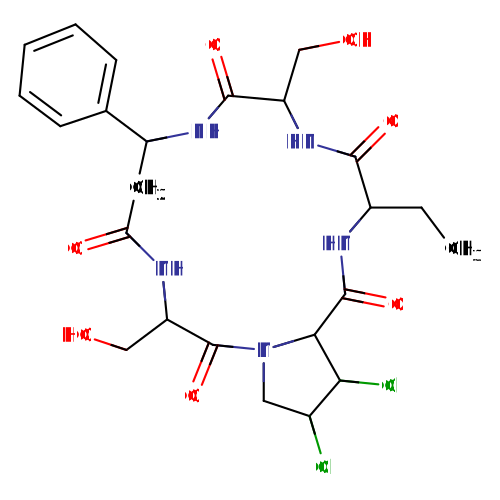
DescriptionCyclochlorotine is a mycotoxin produced by the common food storage mould Penicillium islandicum. Cyclochlorotine belongs to the family of Hybrid Peptides. These are compounds containing at least two different types of amino acids (alpha, beta, gamma, delta).
Contaminant Sources
  • FooDB Chemicals
  • IARC Carcinogens Group 3
  • T3DB toxins
Contaminant Type
  • Amide
  • Amine
  • Food Toxin
  • Fungal Toxin
  • Metabolite
  • Natural Compound
  • Organic Compound
  • Organochloride
Chemical Structure
Thumb
Synonyms
ValueSource
Cyclic[3-phenyl-b-alanylseryl-3,4-dichloroprolylaminobutyrylseryl], 9ciHMDB
ChloropeptideHMDB
CyclochlorotineMeSH
Chemical FormulaC24H31Cl2N5O7
Average Molecular Mass572.438 g/mol
Monoisotopic Mass571.160 g/mol
CAS Registry Number12663-46-6
IUPAC Name17,18-dichloro-3-ethyl-6,13-bis(hydroxymethyl)-9-phenyl-octadecahydropyrrolo[1,2-d]1,4,7,10,13-pentaazacyclohexadecane-1,4,7,11,14-pentone
Traditional Namechloropeptide
SMILESCCC1NC(=O)C2C(Cl)C(Cl)CN2C(=O)C(CO)NC(=O)CC(NC(=O)C(CO)NC1=O)C1=CC=CC=C1
InChI IdentifierInChI=1S/C24H31Cl2N5O7/c1-2-14-21(35)30-16(10-32)22(36)29-15(12-6-4-3-5-7-12)8-18(34)27-17(11-33)24(38)31-9-13(25)19(26)20(31)23(37)28-14/h3-7,13-17,19-20,32-33H,2,8-11H2,1H3,(H,27,34)(H,28,37)(H,29,36)(H,30,35)
InChI KeyPMBVHCCVEPYDSN-UHFFFAOYSA-N
Chemical Taxonomy
Description belongs to the class of organic compounds known as hybrid peptides. Hybrid peptides are compounds containing at least two different types of amino acids (alpha, beta, gamma, delta) linked to each other through a peptide bond.
KingdomOrganic compounds
Super ClassOrganic acids and derivatives
ClassPeptidomimetics
Sub ClassHybrid peptides
Direct ParentHybrid peptides
Alternative Parents
Substituents
  • Cyclic hybrid peptide
  • Alpha-oligopeptide
  • Macrolactam
  • Beta amino acid or derivatives
  • Alpha-amino acid or derivatives
  • Nitrogen mustard
  • Monocyclic benzene moiety
  • Benzenoid
  • Tertiary carboxylic acid amide
  • Pyrrolidine
  • Carboxamide group
  • Secondary carboxylic acid amide
  • Lactam
  • Carboxylic acid derivative
  • Azacycle
  • Organoheterocyclic compound
  • Alcohol
  • Organohalogen compound
  • Organochloride
  • Organonitrogen compound
  • Organooxygen compound
  • Primary alcohol
  • Hydrocarbon derivative
  • Organic oxide
  • Carbonyl group
  • Organopnictogen compound
  • Organic oxygen compound
  • Organic nitrogen compound
  • Alkyl halide
  • Alkyl chloride
  • Aromatic heteropolycyclic compound
Molecular FrameworkAromatic heteropolycyclic compounds
External DescriptorsNot Available
Biological Properties
StatusDetected and Not Quantified
OriginExogenous
Cellular Locations
  • Cytoplasm
  • Extracellular
  • Membrane
Biofluid LocationsNot Available
Tissue LocationsNot Available
PathwaysNot Available
ApplicationsNot Available
Biological RolesNot Available
Chemical RolesNot Available
Physical Properties
StateSolid
AppearanceWhite powder.
Experimental Properties
PropertyValue
Melting Point255°C
Boiling PointNot Available
SolubilityNot Available
Predicted Properties
PropertyValueSource
Water Solubility0.4 g/LALOGPS
logP0.05ALOGPS
logP-1.7ChemAxon
logS-3.2ALOGPS
pKa (Strongest Acidic)8.85ChemAxon
pKa (Strongest Basic)-2.8ChemAxon
Physiological Charge0ChemAxon
Hydrogen Acceptor Count7ChemAxon
Hydrogen Donor Count6ChemAxon
Polar Surface Area177.17 ŲChemAxon
Rotatable Bond Count4ChemAxon
Refractivity134.79 m³·mol⁻¹ChemAxon
Polarizability54.8 ųChemAxon
Number of Rings3ChemAxon
Bioavailability0ChemAxon
Rule of FiveNoChemAxon
Ghose FilterNoChemAxon
Veber's RuleNoChemAxon
MDDR-like RuleNoChemAxon
Spectra
Spectra
Spectrum TypeDescriptionSplash KeyView
Predicted GC-MSPredicted GC-MS Spectrum - GC-MS (Non-derivatized) - 70eV, Positivesplash10-023d-9000160000-05dc6df5777fee0cb88fSpectrum
Predicted GC-MSPredicted GC-MS Spectrum - GC-MS (1 TMS) - 70eV, Positivesplash10-0229-9200011000-e09fa16eb7d0721f1338Spectrum
Predicted GC-MSPredicted GC-MS Spectrum - GC-MS ("Cyclochlorotine,1TMS,#1" TMS) - 70eV, PositiveNot AvailableSpectrum
Predicted GC-MSPredicted GC-MS Spectrum - GC-MS (TMS_1_2) - 70eV, PositiveNot AvailableSpectrum
Predicted GC-MSPredicted GC-MS Spectrum - GC-MS (TMS_1_3) - 70eV, PositiveNot AvailableSpectrum
Predicted GC-MSPredicted GC-MS Spectrum - GC-MS (TMS_1_4) - 70eV, PositiveNot AvailableSpectrum
Predicted GC-MSPredicted GC-MS Spectrum - GC-MS (TMS_1_5) - 70eV, PositiveNot AvailableSpectrum
Predicted GC-MSPredicted GC-MS Spectrum - GC-MS (TMS_1_6) - 70eV, PositiveNot AvailableSpectrum
Predicted GC-MSPredicted GC-MS Spectrum - GC-MS (TMS_2_1) - 70eV, PositiveNot AvailableSpectrum
Predicted GC-MSPredicted GC-MS Spectrum - GC-MS (TMS_2_2) - 70eV, PositiveNot AvailableSpectrum
Predicted GC-MSPredicted GC-MS Spectrum - GC-MS (TMS_2_3) - 70eV, PositiveNot AvailableSpectrum
Predicted GC-MSPredicted GC-MS Spectrum - GC-MS (TMS_2_4) - 70eV, PositiveNot AvailableSpectrum
Predicted GC-MSPredicted GC-MS Spectrum - GC-MS (TMS_2_5) - 70eV, PositiveNot AvailableSpectrum
Predicted GC-MSPredicted GC-MS Spectrum - GC-MS (TMS_2_6) - 70eV, PositiveNot AvailableSpectrum
Predicted GC-MSPredicted GC-MS Spectrum - GC-MS (TMS_2_7) - 70eV, PositiveNot AvailableSpectrum
Predicted GC-MSPredicted GC-MS Spectrum - GC-MS (TMS_2_8) - 70eV, PositiveNot AvailableSpectrum
Predicted GC-MSPredicted GC-MS Spectrum - GC-MS (TMS_2_9) - 70eV, PositiveNot AvailableSpectrum
Predicted GC-MSPredicted GC-MS Spectrum - GC-MS (TMS_2_10) - 70eV, PositiveNot AvailableSpectrum
Predicted GC-MSPredicted GC-MS Spectrum - GC-MS (TMS_2_11) - 70eV, PositiveNot AvailableSpectrum
Predicted GC-MSPredicted GC-MS Spectrum - GC-MS (TMS_2_12) - 70eV, PositiveNot AvailableSpectrum
Predicted GC-MSPredicted GC-MS Spectrum - GC-MS (TMS_2_13) - 70eV, PositiveNot AvailableSpectrum
Predicted GC-MSPredicted GC-MS Spectrum - GC-MS (TMS_2_14) - 70eV, PositiveNot AvailableSpectrum
Predicted GC-MSPredicted GC-MS Spectrum - GC-MS (TMS_2_15) - 70eV, PositiveNot AvailableSpectrum
Predicted GC-MSPredicted GC-MS Spectrum - GC-MS (TBDMS_1_1) - 70eV, PositiveNot AvailableSpectrum
Predicted GC-MSPredicted GC-MS Spectrum - GC-MS (TBDMS_1_2) - 70eV, PositiveNot AvailableSpectrum
Predicted LC-MS/MSPredicted LC-MS/MS Spectrum - 10V, Positivesplash10-0uki-0100090000-dece1ab612d243e45a5eSpectrum
Predicted LC-MS/MSPredicted LC-MS/MS Spectrum - 20V, Positivesplash10-0udr-2211090000-c1708c2125bc6c5612baSpectrum
Predicted LC-MS/MSPredicted LC-MS/MS Spectrum - 40V, Positivesplash10-00s9-6980000000-2ad88f387eff7e2c5b6dSpectrum
Predicted LC-MS/MSPredicted LC-MS/MS Spectrum - 10V, Negativesplash10-0fkc-0000090000-bcb04a523c8b6ff47a1aSpectrum
Predicted LC-MS/MSPredicted LC-MS/MS Spectrum - 20V, Negativesplash10-0ue9-3210490000-44cd7f5b79d6eff3f724Spectrum
Predicted LC-MS/MSPredicted LC-MS/MS Spectrum - 40V, Negativesplash10-006x-9532100000-43a35f39ea5344b8adbdSpectrum
Predicted LC-MS/MSPredicted LC-MS/MS Spectrum - 10V, Negativesplash10-00di-0000090000-e8d141921090e4d9adbbSpectrum
Predicted LC-MS/MSPredicted LC-MS/MS Spectrum - 20V, Negativesplash10-00di-1000090000-0f03b0aeb04f5c7f6ac2Spectrum
Predicted LC-MS/MSPredicted LC-MS/MS Spectrum - 40V, Negativesplash10-004i-9000850000-0f379f8b68b4b749a3c2Spectrum
Predicted LC-MS/MSPredicted LC-MS/MS Spectrum - 10V, Positivesplash10-00di-0000090000-ae521c296d0eff6ae586Spectrum
Predicted LC-MS/MSPredicted LC-MS/MS Spectrum - 20V, Positivesplash10-0fk9-0000090000-deefff8b1f72e93b5fe8Spectrum
Predicted LC-MS/MSPredicted LC-MS/MS Spectrum - 40V, Positivesplash10-0209-3000390000-a57f65a842b5426ae8e8Spectrum
1D NMR1H NMR SpectrumNot AvailableSpectrum
1D NMR13C NMR SpectrumNot AvailableSpectrum
1D NMR1H NMR SpectrumNot AvailableSpectrum
1D NMR13C NMR SpectrumNot AvailableSpectrum
1D NMR1H NMR SpectrumNot AvailableSpectrum
1D NMR13C NMR SpectrumNot AvailableSpectrum
1D NMR1H NMR SpectrumNot AvailableSpectrum
1D NMR13C NMR SpectrumNot AvailableSpectrum
1D NMR1H NMR SpectrumNot AvailableSpectrum
1D NMR13C NMR SpectrumNot AvailableSpectrum
1D NMR1H NMR SpectrumNot AvailableSpectrum
1D NMR13C NMR SpectrumNot AvailableSpectrum
1D NMR1H NMR SpectrumNot AvailableSpectrum
1D NMR13C NMR SpectrumNot AvailableSpectrum
1D NMR1H NMR SpectrumNot AvailableSpectrum
1D NMR13C NMR SpectrumNot AvailableSpectrum
1D NMR1H NMR SpectrumNot AvailableSpectrum
1D NMR13C NMR SpectrumNot AvailableSpectrum
1D NMR1H NMR SpectrumNot AvailableSpectrum
1D NMR13C NMR SpectrumNot AvailableSpectrum
Toxicity Profile
Route of ExposureNot Available
Mechanism of ToxicityCyclochlorotine (CC) causes hepatic necrosis and has carcinogenic properties. The in vitro application of CC on myocytes induced disruption of myofibrils and large accumulations of actin, myosin, alpha-actinin, and vinculin at the cellular processes. This agent also induced the formation of islands of myosin and alpha-actinin aggregates. Actin filament bundles in fibroblasts were either unaffected or disrupted completely. CC damage was dose-dependently reversible. Acute administration of CC by intraperitoneal injection to rats caused degeneration and necrosis in hepatocytes revealing that the liver was a specific target. CC poisoning has shown to induce the formation of large accumulations of actin, myosin, _-actinin and vinculin at the cellular processes. It also induces the extensive formation of islands of myosin and _-actinin aggregates, scattered within the cytoplasm. The desmin distribution is changed from a loosely to a densely arranged filament network. Cytoplasmic microtubules remained normal and could not be distinguished from their usual pattern. Thus, the degree of CC influence on myofibrillar and cytoskeletal proteins seems to be in the order of actin, myosin/a-actinin/vinculin, desmin and tubulin. This order is proportional to the proximity of proteins to actomyosin of myofibrils. CC, in some as yet unknown manner, appeares to dismantle previously assembled myofibrils and to form aggregates of myofibrillar and cytoskeletal proteins. The accumulation of myoproteins, particularly actin, at the cellular peripheries was characteristic of CC treatment, but its mechanism remains to be clarified. Two different responses of fibroblasts were noted after CC treatment, i.e., actin filament bundles were either unaffected or were disrupted completely to result in the formation of actin islands. Also, cell damage caused by CC treatment is reversible. (1)
MetabolismNot Available
Toxicity ValuesNot Available
Lethal DoseNot Available
Carcinogenicity (IARC Classification)3, not classifiable as to its carcinogenicity to humans. (2)
Uses/SourcesCyclochlorotine is a mycotoxin produced by the common food storage mould Penicillium islandicum.
Minimum Risk LevelNot Available
Health EffectsNot Available
SymptomsNot Available
TreatmentNot Available
Concentrations
Not Available
DrugBank IDNot Available
HMDB IDHMDB0030457
FooDB IDFDB002326
Phenol Explorer IDNot Available
KNApSAcK IDC00055538
BiGG IDNot Available
BioCyc IDNot Available
METLIN IDNot Available
PDB IDNot Available
Wikipedia LinkCyclochlorotine
Chemspider ID23838
ChEBI IDNot Available
PubChem Compound ID25565
Kegg Compound IDNot Available
YMDB IDNot Available
ECMDB IDNot Available
References
Synthesis ReferenceNot Available
MSDSNot Available
General References
1. Yannai, Shmuel. (2004) Dictionary of food compounds with CD-ROM: Additives, flavors, and ingredients. Boca Raton: Chapman & Hall/CRC.