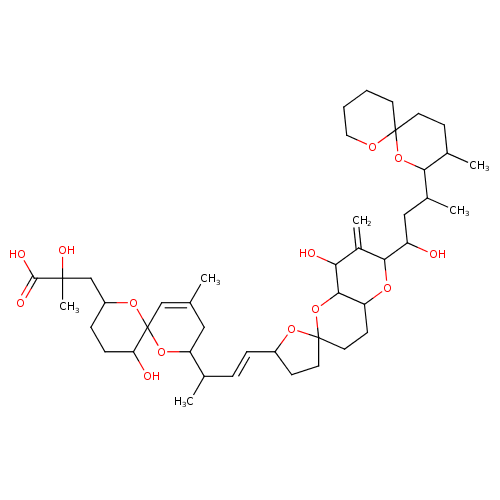
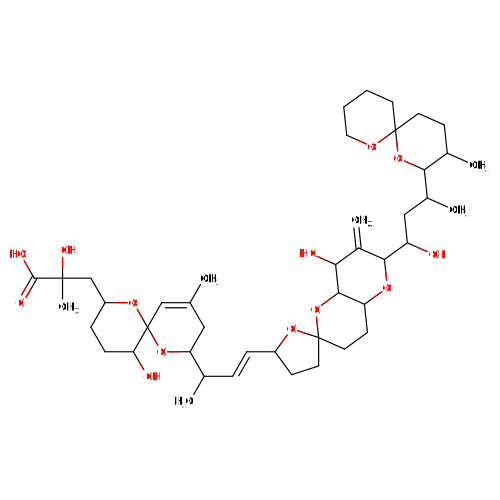
Okadaic acid is found in mollusks. Okadaic acid is found in the marine sponges Halichondria okadai and Halichondria melanodocia and shellfish. It is a metabolite of Prorocentrum lima. It is a diarrhetic shellfish toxin. Okadaic acid is a toxin that accumulates in bivalves and causes diarrhetic shellfish poisoning. The molecular formula of okadaic acid, which is a derivative of a C38 fatty acid, is C44H68O13. The IUPAC name of okadaic acid is (2R)-2-hydroxy-3-{(2S,5R,6R,8S)-5-hydroxy-[(1R,2E)-3-((2R,5R,6'S,8'R,8a'S)-8'-hydroxy-6'-{(1S,3S)-1-hydroxy-3-[(3R,6S)-3-methyl-1,7-dioxaspiro[5.5]undec-2-yl]butyl}-7'-methyleneoctahydro-3H,3'H-spiro[furan-2,2'-pyrano[3,2-b]pyran]-5-yl)-1-methylprop-2-en-1-yl]-10-methyl-1,7-dioxaspiro[5.5]undec-10-en-2-yl}-2-methylpropanoic acid. Okadaic acid was named from the marine sponge Halichondria okadai, from which okadaic acid was isolated for the first time. It has also been isolated from another marine sponge, H. malanodocia, as a cytotoxin. The real producer of okadaic acid is a marine dinoflagellate. Okadaic acid has been shown to exhibit anti-tumor, signalling, apoptotic and lipolytic functions Okadaic acid belongs to the family of Okadaic Acids and Derivatives. These are heat-stable polyether and lipophilic compounds that accumulate in the fatty tissue of shellfish. (1, 2, 3, 4).
belongs to the class of organic compounds known as ketals. These are acetals derived from ketones by replacement of the oxo group by two hydrocarbyloxy groups R2C(OR)2 ( R not Hydrogen ). This term, once abandoned, has been reinstated as a subclass of acetals.
Okadaic acid (OA) dramatically increases both nerve growth factor (NGF) mRNA content (50-fold) and NGF secretion (100-fold) in astrocytes. Okadaic acid also activated NGF gene transcription, which was preceded by an induction of c-fos and c-jun gene transcription. The induction of NGF expression by okadaic acid appeared independent from protein kinase C activity because down-regulating protein kinase C activity failed to decrease the okadaic acid stimulation. Results indicate that okadaic acid profoundly stimulates NGF expression in astrocytes mainly by enhancing NGF mRNA stability and suggest important roles for phosphoprotein phosphatases in regulating NGF production. Instead of activating protein kinase C like the phorbol ester tumor promoters, OA specifically inhibits phosphoprotein phosphatases 1 and 2A leading to an increase in the phosphorylation state of many cellular proteins. Interestingly, OA treatment of fibroblasts mimicked the effects of IL-1 on protein phosphorylation, suggesting that one cellular action of IL-1 might be to inhibit phosphoprotein phosphatase activity. OA has also been found to increase NGF mRNA content in mixed glial-neuronal hippocampal cell cultures similar to IL-1. The toxic potency of this phycotoxin is highly associated with the presence of the free carboxylic acid. Therefore, the toxin forms where the carboxylic acid is acylated are less toxic. However, it is clear that enzymatic hydrolisis after consumption of contaminated shellfish can occur, therefore liberating the free acid. (PMID: 19925818; PMID: 7890729)
No indication of carcinogenicity to humans (not listed by IARC).
Uses/Sources
Okadaic acid is found in mollusks. Okadaic acid is found in the marine sponges Halichondria okadai and Halichondria melanodocia and shellfish. It is a diarrhetic shellfish toxin. Okadaic acid is a toxin that accumulates in bivalves and causes diarrhetic shellfish poisoning. Okadaic acid was named from the marine sponge Halichondria okadai, from which okadaic acid was isolated for the first time. It has also been isolated from another marine sponge, H. malanodocia, as a cytotoxin.