Record Information
Version1.0
Creation Date2014-08-29 04:49:19 UTC
Update Date2026-05-14 17:00:05 UTC
Accession NumberCHEM002981
Identification
Common NameDigitoxin
ClassSmall Molecule
DescriptionDigitoxin is only found in individuals that have used or taken this drug. It is a cardiac glycoside sometimes used in place of digoxin. It has a longer half-life than digoxin; toxic effects, which are similar to those of digoxin, are longer lasting. (From Martindale, The Extra Pharmacopoeia, 30th ed, p665)Digitoxin inhibits the Na-K-ATPase membrane pump, resulting in an increase in intracellular sodium and calcium concentrations. Increased intracellular concentrations of calcium may promote activation of contractile proteins (e.g., actin, myosin). Digitoxin also acts on the electrical activity of the heart, increasing the slope of phase 4 depolarization, shortening the action potential duration, and decreasing the maximal diastolic potential.

Contaminant Sources
  • Clean Air Act Chemicals
  • FooDB Chemicals
  • HMDB Contaminants - Urine
  • STOFF IDENT Compounds
  • T3DB toxins
  • ToxCast & Tox21 Chemicals
Contaminant Type
  • Anti-Arrhythmia Agent
  • Cardiotonic Agent
  • Drug
  • Enzyme Inhibitor
  • Ester
  • Human Neurotoxin
  • Metabolite
  • Organic Compound
  • PFAS
  • Phytotoxin
  • Synthetic Compound
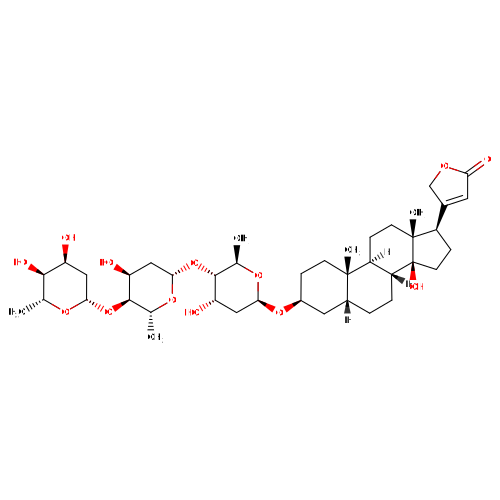
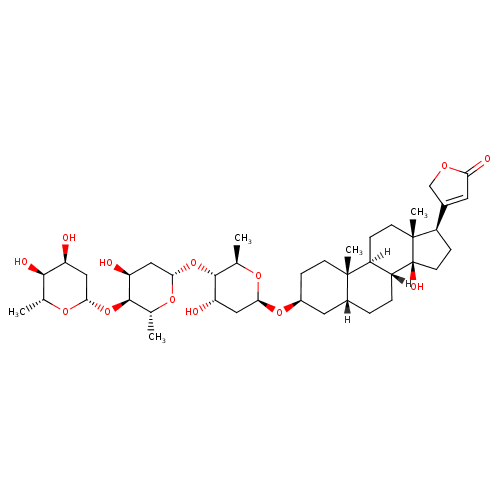
Chemical Structure
Thumb
Synonyms
ValueSource
CrystodiginChEBI
DigitoxosideChEBI
DigitoksinHMDB
DigitoxinumHMDB
Bürger, digitoxinHMDB
Didier, digitoxinHMDB
Digitoxin awdHMDB
Digitoxin didierHMDB
DigimedHMDB
DigophtonHMDB
Nativelle, digitalineHMDB
DigimerckHMDB
Digitoxin bürgerHMDB
AWD, digitoxinHMDB
CoramedanHMDB
Digitaline nativelleHMDB
Digitoxin philoHMDB
Digitoxin-philoHMDB
Chemical FormulaC41H64O13
Average Molecular Mass764.939 g/mol
Monoisotopic Mass764.435 g/mol
CAS Registry Number71-63-6
IUPAC Name4-[(1R,3aS,3bR,5aR,7S,9aS,9bS,11aR)-7-{[(2R,4S,5S,6R)-5-{[(2S,4S,5S,6R)-5-{[(2S,4S,5S,6R)-4,5-dihydroxy-6-methyloxan-2-yl]oxy}-4-hydroxy-6-methyloxan-2-yl]oxy}-4-hydroxy-6-methyloxan-2-yl]oxy}-3a-hydroxy-9a,11a-dimethyl-hexadecahydro-1H-cyclopenta[a]phenanthren-1-yl]-2,5-dihydrofuran-2-one
Traditional Name4-[(1S,2S,5S,7R,10R,11S,14R,15R)-5-{[(2R,4S,5S,6R)-5-{[(2S,4S,5S,6R)-5-{[(2S,4S,5S,6R)-4,5-dihydroxy-6-methyloxan-2-yl]oxy}-4-hydroxy-6-methyloxan-2-yl]oxy}-4-hydroxy-6-methyloxan-2-yl]oxy}-11-hydroxy-2,15-dimethyltetracyclo[8.7.0.0^{2,7}.0^{11,15}]heptadecan-14-yl]-5H-furan-2-one
SMILES[H][C@]12CC[C@]3([H])[C@]([H])(CC[C@]4(C)[C@H](CC[C@]34O)C3=CC(=O)OC3)[C@@]1(C)CC[C@@H](C2)O[C@H]1C[C@H](O)[C@H](O[C@H]2C[C@H](O)[C@H](O[C@H]3C[C@H](O)[C@H](O)[C@@H](C)O3)[C@@H](C)O2)[C@@H](C)O1
InChI IdentifierInChI=1S/C41H64O13/c1-20-36(46)29(42)16-34(49-20)53-38-22(3)51-35(18-31(38)44)54-37-21(2)50-33(17-30(37)43)52-25-8-11-39(4)24(15-25)6-7-28-27(39)9-12-40(5)26(10-13-41(28,40)47)23-14-32(45)48-19-23/h14,20-22,24-31,33-38,42-44,46-47H,6-13,15-19H2,1-5H3/t20-,21-,22-,24-,25+,26-,27+,28-,29+,30+,31+,33+,34+,35+,36-,37-,38-,39+,40-,41+/m1/s1
InChI KeyWDJUZGPOPHTGOT-XUDUSOBPSA-N
Chemical Taxonomy
Description belongs to the class of organic compounds known as cardenolide glycosides and derivatives. Cardenolide glycosides and derivatives are compounds containing a carbohydrate glycosidically bound to the cardenolide moiety.
KingdomOrganic compounds
Super ClassLipids and lipid-like molecules
ClassSteroids and steroid derivatives
Sub ClassSteroid lactones
Direct ParentCardenolide glycosides and derivatives
Alternative Parents
Substituents
  • Cardanolide-glycoside
  • Steroidal glycoside
  • Oligosaccharide
  • 14-hydroxysteroid
  • Hydroxysteroid
  • Glycosyl compound
  • O-glycosyl compound
  • 2-furanone
  • Oxane
  • Cyclic alcohol
  • Dihydrofuran
  • Alpha,beta-unsaturated carboxylic ester
  • Enoate ester
  • Tertiary alcohol
  • Lactone
  • Carboxylic acid ester
  • Secondary alcohol
  • Monocarboxylic acid or derivatives
  • Organoheterocyclic compound
  • Oxacycle
  • Acetal
  • Carboxylic acid derivative
  • Hydrocarbon derivative
  • Alcohol
  • Organic oxide
  • Organic oxygen compound
  • Organooxygen compound
  • Carbonyl group
  • Aliphatic heteropolycyclic compound
Molecular FrameworkAliphatic heteropolycyclic compounds
External Descriptors
Biological Properties
StatusDetected and Not Quantified
OriginExogenous
Cellular Locations
  • Extracellular
  • Membrane
Biofluid LocationsNot Available
Tissue LocationsNot Available
PathwaysNot Available
ApplicationsNot Available
Biological Roles
Chemical Roles
Physical Properties
StateSolid
AppearanceWhite powder.
Experimental Properties
PropertyValue
Melting Point255.5°C
Boiling PointNot Available
Solubility3.9 mg/L (at 25°C)
Predicted Properties
PropertyValueSource
Water Solubility0.029 g/LALOGPS
logP2.33ALOGPS
logP3.6ChemAxon
logS-4.4ALOGPS
pKa (Strongest Acidic)7.18ChemAxon
pKa (Strongest Basic)0.24ChemAxon
Physiological Charge0ChemAxon
Hydrogen Acceptor Count12ChemAxon
Hydrogen Donor Count5ChemAxon
Polar Surface Area182.83 ŲChemAxon
Rotatable Bond Count7ChemAxon
Refractivity191.72 m³·mol⁻¹ChemAxon
Polarizability83.54 ųChemAxon
Number of Rings8ChemAxon
Bioavailability0ChemAxon
Rule of FiveNoChemAxon
Ghose FilterNoChemAxon
Veber's RuleNoChemAxon
MDDR-like RuleYesChemAxon
Spectra
Spectra
Spectrum TypeDescriptionSplash KeyView
Predicted GC-MSPredicted GC-MS Spectrum - GC-MS (TMS_1_1) - 70eV, PositiveNot AvailableSpectrum
Predicted GC-MSPredicted GC-MS Spectrum - GC-MS (TMS_1_2) - 70eV, PositiveNot AvailableSpectrum
Predicted GC-MSPredicted GC-MS Spectrum - GC-MS (TMS_1_3) - 70eV, PositiveNot AvailableSpectrum
Predicted GC-MSPredicted GC-MS Spectrum - GC-MS (TMS_1_4) - 70eV, PositiveNot AvailableSpectrum
Predicted GC-MSPredicted GC-MS Spectrum - GC-MS (TMS_1_5) - 70eV, PositiveNot AvailableSpectrum
Predicted GC-MSPredicted GC-MS Spectrum - GC-MS (TBDMS_1_1) - 70eV, PositiveNot AvailableSpectrum
Predicted GC-MSPredicted GC-MS Spectrum - GC-MS (TBDMS_1_2) - 70eV, PositiveNot AvailableSpectrum
Predicted GC-MSPredicted GC-MS Spectrum - GC-MS (TBDMS_1_3) - 70eV, PositiveNot AvailableSpectrum
Predicted GC-MSPredicted GC-MS Spectrum - GC-MS (TBDMS_1_4) - 70eV, PositiveNot AvailableSpectrum
Predicted GC-MSPredicted GC-MS Spectrum - GC-MS (TBDMS_1_5) - 70eV, PositiveNot AvailableSpectrum
Predicted LC-MS/MSPredicted LC-MS/MS Spectrum - 10V, Positivesplash10-0a6s-0006224900-f4742cfd25e169006a71Spectrum
Predicted LC-MS/MSPredicted LC-MS/MS Spectrum - 20V, Positivesplash10-0a70-0319222100-bea3c6b184e571520ea6Spectrum
Predicted LC-MS/MSPredicted LC-MS/MS Spectrum - 40V, Positivesplash10-057i-1529132100-9064e603378164f3a6ffSpectrum
Predicted LC-MS/MSPredicted LC-MS/MS Spectrum - 10V, Negativesplash10-03xs-0114111900-18fd68a867e967c9eb96Spectrum
Predicted LC-MS/MSPredicted LC-MS/MS Spectrum - 20V, Negativesplash10-006t-1309122200-4bd32c7f47afcb5b41e8Spectrum
Predicted LC-MS/MSPredicted LC-MS/MS Spectrum - 40V, Negativesplash10-0f7k-4109220000-0aa801db64fdf3061347Spectrum
Predicted LC-MS/MSPredicted LC-MS/MS Spectrum - 10V, Positivesplash10-014i-0113001900-f5dd1ea4cb72d5606efaSpectrum
Predicted LC-MS/MSPredicted LC-MS/MS Spectrum - 20V, Positivesplash10-03yi-1920000300-3b483a0363bee036e99dSpectrum
Predicted LC-MS/MSPredicted LC-MS/MS Spectrum - 40V, Positivesplash10-07it-3911010000-a2fc3b8d5a5637c01cbdSpectrum
Predicted LC-MS/MSPredicted LC-MS/MS Spectrum - 10V, Negativesplash10-0w30-0701396700-e02084f39bd1fc586deeSpectrum
Predicted LC-MS/MSPredicted LC-MS/MS Spectrum - 20V, Negativesplash10-03fu-4900001400-f7f7a9a96401f1317dd0Spectrum
Predicted LC-MS/MSPredicted LC-MS/MS Spectrum - 40V, Negativesplash10-01r6-5901001400-067cacc939d1c902b4c3Spectrum
MSMass Spectrum (Electron Ionization)splash10-052g-9620000000-5ddc0df4702d2f0b8581Spectrum
1D NMR13C NMR SpectrumNot AvailableSpectrum
Toxicity Profile
Route of ExposureNot Available
Mechanism of ToxicityDigitoxin inhibits the Na-K-ATPase membrane pump, resulting in an increase in intracellular sodium and calcium concentrations. Increased intracellular concentrations of calcium may promote activation of contractile proteins (e.g., actin, myosin). Digitoxin also acts on the electrical activity of the heart, increasing the slope of phase 4 depolarization, shortening the action potential duration, and decreasing the maximal diastolic potential.
MetabolismHepatic.
Toxicity ValuesNot Available
Lethal DoseNot Available
Carcinogenicity (IARC Classification)No indication of carcinogenicity to humans (not listed by IARC).
Uses/SourcesFor the treatment and management of congestive cardiac insufficiency, arrhythmias and heart failure.
Minimum Risk LevelNot Available
Health EffectsNot Available
SymptomsNot Available
TreatmentNot Available
Concentrations
Not Available
DrugBank IDDB01396
HMDB IDHMDB0015468
FooDB IDFDB006525
Phenol Explorer IDNot Available
KNApSAcK IDC00003617
BiGG IDNot Available
BioCyc IDNot Available
METLIN IDNot Available
PDB IDNot Available
Wikipedia LinkDigitoxin
Chemspider ID389987
ChEBI ID28544
PubChem Compound ID441207
Kegg Compound IDC06955
YMDB IDNot Available
ECMDB IDNot Available
References
Synthesis ReferenceNot Available
MSDSLink
General References
1. Kurowski V, Iven H, Djonlagic H: Treatment of a patient with severe digitoxin intoxication by Fab fragments of anti-digitalis antibodies. Intensive Care Med. 1992;18(7):439-42.
2. Johansson S, Lindholm P, Gullbo J, Larsson R, Bohlin L, Claeson P: Cytotoxicity of digitoxin and related cardiac glycosides in human tumor cells. Anticancer Drugs. 2001 Jun;12(5):475-83.
3. Hippius M, Humaid B, Sicker T, Hoffmann A, Gottler M, Hasford J: Adverse drug reaction monitoring--digitoxin overdosage in the elderly. Int J Clin Pharmacol Ther. 2001 Aug;39(8):336-43.
4. Belz GG, Breithaupt-Grogler K, Osowski U: Treatment of congestive heart failure--current status of use of digitoxin. Eur J Clin Invest. 2001;31 Suppl 2:10-7.
5. Simons K, Toomre D: Lipid rafts and signal transduction. Nat Rev Mol Cell Biol. 2000 Oct;1(1):31-9.
6. Watson AD: Thematic review series: systems biology approaches to metabolic and cardiovascular disorders. Lipidomics: a global approach to lipid analysis in biological systems. J Lipid Res. 2006 Oct;47(10):2101-11. Epub 2006 Aug 10.
7. Sethi JK, Vidal-Puig AJ: Thematic review series: adipocyte biology. Adipose tissue function and plasticity orchestrate nutritional adaptation. J Lipid Res. 2007 Jun;48(6):1253-62. Epub 2007 Mar 20.
8. Lingwood D, Simons K: Lipid rafts as a membrane-organizing principle. Science. 2010 Jan 1;327(5961):46-50. doi: 10.1126/science.1174621.
9. The lipid handbook with CD-ROM
10. https://www.ncbi.nlm.nih.gov/pubmed/?term=10438974
11. https://www.ncbi.nlm.nih.gov/pubmed/?term=10687899
12. https://www.ncbi.nlm.nih.gov/pubmed/?term=26573786