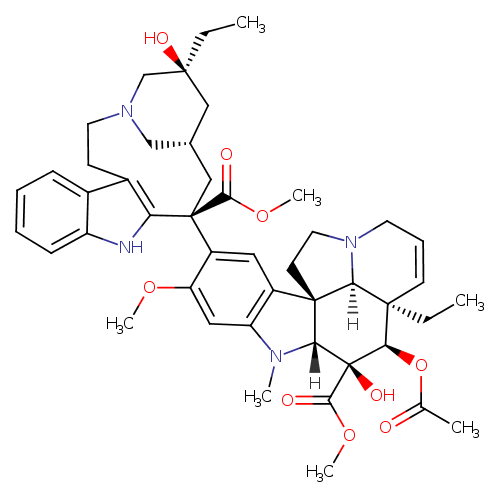
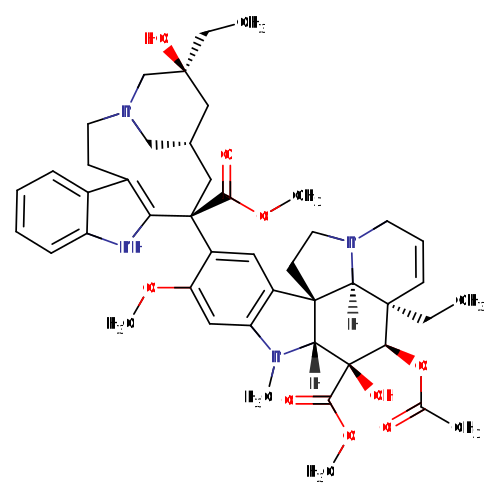
Vinblastine is only found in individuals that have used or taken this drug. It is an antitumor alkaloid isolated from Vinca rosea. (Merck, 11th ed.)The antitumor activity of vinblastine is thought to be due primarily to inhibition of mitosis at metaphase through its interaction with tubulin. Vinblastine binds to the microtubular proteins of the mitotic spindle, leading to crystallization of the microtubule and mitotic arrest or cell death.
belongs to the class of organic compounds known as glutamic acid and derivatives. Glutamic acid and derivatives are compounds containing glutamic acid or a derivative thereof resulting from reaction of glutamic acid at the amino group or the carboxy group, or from the replacement of any hydrogen of glycine by a heteroatom.
The antitumor activity of vinblastine is thought to be due primarily to inhibition of mitosis at metaphase through its interaction with tubulin. Vinblastine binds to the microtubular proteins of the mitotic spindle, leading to crystallization of the microtubule and mitotic arrest or cell death.
Metabolism
Hepatic. Metabolism of vinblastine has been shown to be mediated by hepatic cytochrome P450 3A isoenzymes.
Route of Elimination: The major route of excretion may be through the biliary system.
Half Life: Triphasic: 35 min, 53 min, and 19 hours
No indication of carcinogenicity to humans (not listed by IARC).
Uses/Sources
For treatment of breast cancer, testicular cancer, lymphomas, neuroblastoma, Hodgkin's and non-Hodgkin's lymphomas, mycosis fungoides, histiocytosis, and Kaposi's sarcoma.
Pierre Potier, Pierre Mangeney, Nicole Langlois, Yves Langlois, “Process for the synthesis of vinblastine and leurosidine.” U.S. Patent US4305875, issued October, 1977.