Record Information
Version1.0
Creation Date2014-08-29 04:49:14 UTC
Update Date2026-05-14 16:41:43 UTC
Accession NumberCHEM002976
Identification
Common NameVincristine
ClassSmall Molecule
DescriptionVincristine is only found in individuals that have used or taken this drug. It is an antitumor alkaloid isolated from Vinca Rosea. (Merck, 11th ed.) The antitumor activity of Vincristine is thought to be due primarily to inhibition of mitosis at metaphase through its interaction with tubulin. Like other vinca alkaloids, Vincristine may also interfere with: 1) amino acid, cyclic AMP, and glutathione metabolism, 2) calmodulin-dependent Ca2+-transport ATPase activity, 3) cellular respiration, and 4) nucleic acid and lipid biosynthesis. Vincristine is indicated for the treatment of acute leukaemia, malignant lymphoma, Hodgkin's disease, acute erythraemia, and acute panmyelosis. Vincristine sulfate is often chosen as part of polychemotherapy because of lack of significant bone marrow suppression (at recommended doses) and of unique clinical toxicity (neuropathy).
Contaminant Sources
  • HMDB Contaminants - Urine
  • STOFF IDENT Compounds
  • T3DB toxins
  • ToxCast & Tox21 Chemicals
Contaminant Type
  • Amide
  • Amine
  • Antineoplastic Agent, Phytogenic
  • Drug
  • Ester
  • Ether
  • Human Neurotoxin
  • Metabolite
  • Organic Compound
  • PFAS
  • Phytotoxin
  • Synthetic Compound
  • Tubulin Modulator
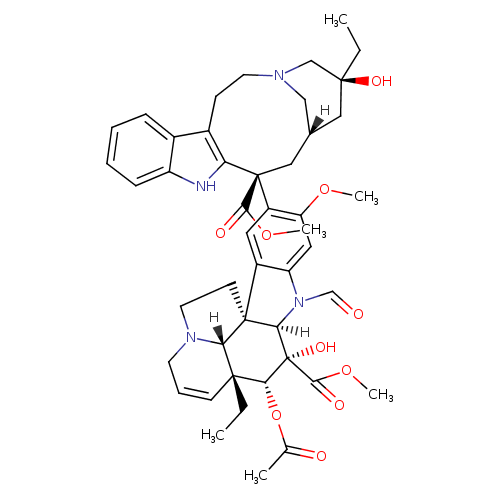
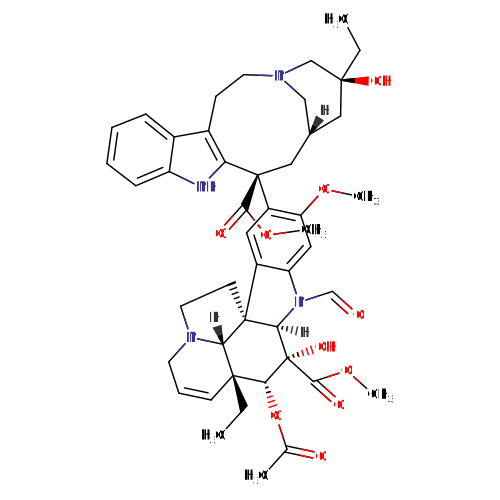
Chemical Structure
Thumb
Synonyms
ValueSource
(+)-VincristineChEBI
22-oxo-VincaleukoblastineChEBI
22-OxovincaleukoblastineChEBI
LeucristineChEBI
LeurocristineChEBI
OncovinChEBI
VincristinChEBI
VinkristinChEBI
TecnocrisKegg
Indole alkaloidHMDB
LCRHMDB
VCRHMDB
VINHMDB
VincristinaHMDB
Vincristine sulfateHMDB
VincrstineHMDB
VincrystineHMDB
Z-D-Val-lys(Z)-OHHMDB
CitomidHMDB
OncovineHMDB
Sulfate, vincristineHMDB
Vincasar PFSHMDB
VincrisulHMDB
OnkocristinHMDB
VincasarHMDB
FarmistinHMDB
PFS, VincasarHMDB
Vincristin bristolHMDB
Vincristin medacHMDB
VintecHMDB
CellcristinHMDB
Chemical FormulaC46H56N4O10
Average Molecular Mass824.958 g/mol
Monoisotopic Mass824.400 g/mol
CAS Registry Number57-22-7
IUPAC Namemethyl (1R,9R,10S,11R,12R,19R)-11-(acetyloxy)-12-ethyl-4-[(1R,13S,15R,17S)-17-ethyl-17-hydroxy-13-(methoxycarbonyl)-1,11-diazatetracyclo[13.3.1.0^{4,12}.0^{5,10}]nonadeca-4(12),5,7,9-tetraen-13-yl]-8-formyl-10-hydroxy-5-methoxy-8,16-diazapentacyclo[10.6.1.0^{1,9}.0^{2,7}.0^{16,19}]nonadeca-2(7),3,5,13-tetraene-10-carboxylate
Traditional Namevincristine
SMILES[H][C@@]12N3CC[C@@]11C4=CC(=C(OC)C=C4N(C=O)[C@@]1([H])[C@](O)([C@H](OC(C)=O)[C@]2(CC)C=CC3)C(=O)OC)[C@]1(C[C@]2([H])CN(C[C@](O)(CC)C2)CCC2=C1NC1=CC=CC=C21)C(=O)OC
InChI IdentifierInChI=1S/C46H56N4O10/c1-7-42(55)22-28-23-45(40(53)58-5,36-30(14-18-48(24-28)25-42)29-12-9-10-13-33(29)47-36)32-20-31-34(21-35(32)57-4)50(26-51)38-44(31)16-19-49-17-11-15-43(8-2,37(44)49)39(60-27(3)52)46(38,56)41(54)59-6/h9-13,15,20-21,26,28,37-39,47,55-56H,7-8,14,16-19,22-25H2,1-6H3/t28-,37+,38-,39-,42+,43-,44-,45+,46+/m1/s1
InChI KeyOGWKCGZFUXNPDA-XQKSVPLYSA-N
Chemical Taxonomy
Description belongs to the class of organic compounds known as dipeptides. These are organic compounds containing a sequence of exactly two alpha-amino acids joined by a peptide bond.
KingdomOrganic compounds
Super ClassOrganic acids and derivatives
ClassCarboxylic acids and derivatives
Sub ClassAmino acids, peptides, and analogues
Direct ParentDipeptides
Alternative Parents
Substituents
  • Alpha-dipeptide
  • Alpha-amino acid ester
  • Benzazepine
  • Alpha-amino acid or derivatives
  • Azepine
  • Fatty acid ester
  • Aralkylamine
  • Dicarboxylic acid or derivatives
  • Monocyclic benzene moiety
  • Fatty acyl
  • Benzenoid
  • Tertiary carboxylic acid amide
  • Carboxylic acid ester
  • Amino acid or derivatives
  • Amino acid
  • Lactam
  • Carboxamide group
  • Carboxylic acid
  • Secondary aliphatic amine
  • Azacycle
  • Secondary amine
  • Organoheterocyclic compound
  • Organic nitrogen compound
  • Organonitrogen compound
  • Carbonyl group
  • Organooxygen compound
  • Hydrocarbon derivative
  • Organic oxide
  • Organopnictogen compound
  • Amine
  • Organic oxygen compound
  • Aromatic heteropolycyclic compound
Molecular FrameworkAromatic heteropolycyclic compounds
External Descriptors
Biological Properties
StatusDetected and Not Quantified
OriginExogenous
Cellular Locations
  • Cytoplasm
  • Membrane
Biofluid LocationsNot Available
Tissue LocationsNot Available
Pathways
NameSMPDB LinkKEGG Link
Vincristine PathwayNot AvailableNot Available
ApplicationsNot Available
Biological Roles
Chemical RolesNot Available
Physical Properties
StateSolid
AppearanceWhite powder.
Experimental Properties
PropertyValue
Melting Point220°C
Boiling PointNot Available
Solubility3.00e-02 g/L
Predicted Properties
PropertyValueSource
Water Solubility0.03 g/LALOGPS
logP3.36ALOGPS
logP3.13ChemAxon
logS-4.4ALOGPS
pKa (Strongest Acidic)10.85ChemAxon
pKa (Strongest Basic)8.66ChemAxon
Physiological Charge2ChemAxon
Hydrogen Acceptor Count9ChemAxon
Hydrogen Donor Count3ChemAxon
Polar Surface Area171.17 ŲChemAxon
Rotatable Bond Count10ChemAxon
Refractivity221.48 m³·mol⁻¹ChemAxon
Polarizability88.59 ųChemAxon
Number of Rings9ChemAxon
Bioavailability1ChemAxon
Rule of FiveNoChemAxon
Ghose FilterNoChemAxon
Veber's RuleNoChemAxon
MDDR-like RuleYesChemAxon
Spectra
Spectra
Spectrum TypeDescriptionSplash KeyView
Predicted GC-MSPredicted GC-MS Spectrum - GC-MS (TMS_1_1) - 70eV, PositiveNot AvailableSpectrum
Predicted GC-MSPredicted GC-MS Spectrum - GC-MS (TMS_1_2) - 70eV, PositiveNot AvailableSpectrum
Predicted GC-MSPredicted GC-MS Spectrum - GC-MS (TMS_1_3) - 70eV, PositiveNot AvailableSpectrum
LC-MS/MSLC-MS/MS Spectrum - 35V, Positivesplash10-004i-0000000090-ddde8bc651d70b277aa7Spectrum
LC-MS/MSLC-MS/MS Spectrum - 35V, Negativesplash10-00e9-0010001890-ec40da49423247b42f44Spectrum
Predicted LC-MS/MSPredicted LC-MS/MS Spectrum - 10V, Positivesplash10-05r0-0000000960-3a843563d341d8bc8c67Spectrum
Predicted LC-MS/MSPredicted LC-MS/MS Spectrum - 20V, Positivesplash10-05ot-0000000910-19f858ef585f6c37c067Spectrum
Predicted LC-MS/MSPredicted LC-MS/MS Spectrum - 40V, Positivesplash10-0537-1200000900-8774d71fd76cf13c57feSpectrum
Predicted LC-MS/MSPredicted LC-MS/MS Spectrum - 10V, Negativesplash10-0c00-2005000950-4682841abaeccf6ff250Spectrum
Predicted LC-MS/MSPredicted LC-MS/MS Spectrum - 20V, Negativesplash10-052r-1009000100-ce5fe6558a0993ae42c6Spectrum
Predicted LC-MS/MSPredicted LC-MS/MS Spectrum - 40V, Negativesplash10-0a4i-9002300800-16d21458a9981b9e680cSpectrum
Predicted LC-MS/MSPredicted LC-MS/MS Spectrum - 10V, Positivesplash10-004i-0000000390-aa3de8e6a5248eff1e03Spectrum
Predicted LC-MS/MSPredicted LC-MS/MS Spectrum - 20V, Positivesplash10-004j-0000000950-0e6c15ea67ad87695172Spectrum
Predicted LC-MS/MSPredicted LC-MS/MS Spectrum - 40V, Positivesplash10-0abc-9100112810-31f4dcec28eef9c1ce0cSpectrum
Predicted LC-MS/MSPredicted LC-MS/MS Spectrum - 10V, Negativesplash10-0a4i-9000000420-c00fa346c22549393c80Spectrum
Predicted LC-MS/MSPredicted LC-MS/MS Spectrum - 20V, Negativesplash10-0a4i-8000000900-54ffe3b7f7c10887482fSpectrum
Predicted LC-MS/MSPredicted LC-MS/MS Spectrum - 40V, Negativesplash10-0002-4040000900-727e48a803b558914e66Spectrum
Toxicity Profile
Route of ExposureNot Available
Mechanism of ToxicityThe antitumor activity of Vincristine is thought to be due primarily to inhibition of mitosis at metaphase through its interaction with tubulin. Like other vinca alkaloids, Vincristine may also interfere with: 1) amino acid, cyclic AMP, and glutathione metabolism, 2) calmodulin-dependent Ca2+-transport ATPase activity, 3) cellular respiration, and 4) nucleic acid and lipid biosynthesis.
MetabolismHepatic. Cytochrome P450 isoenzymes of the CYP3A subfamily facilitate the metabolism of vincristine. Route of Elimination: The liver is the major excretory organ in humans and animals. 80% of an injected dose of vincristine sulfate is excreted via feces. 10 - 20% is excreted via urine. Half Life: When intravenously injected into cancer patients, a triphasic serum decay patten was observed. The initial, middle, and terminal half-lives are 5 minutes, 2.3 hours, 85 hours respectively. The range of the terminal half-life is humans is 19 - 155 hours.
Toxicity ValuesIVN-RAT LD50 1300 mg/kg; IPR-MUS LD50 5.2 mg/kg.
Lethal DoseNot Available
Carcinogenicity (IARC Classification)Vincristine sulfate is not classifiable as to its carcinogenicity to humans (Group 3). Vincristine is part of MOPP, a combination chemotherapy regimen that is carcinogenic to humans (Group 1). (5)
Uses/SourcesTreatment of acute lymphocytic leukemia (ALL), Hodgkin lymphoma, non-Hodgkin lymphomas, Wilms' tumor, neuroblastoma, rhabdomyosarcoma. Liposomal vincristine is indicated for the treatment of relapsed Philadelphia chromosome-negative (Ph-) acute lymphoblastic leukemia (ALL).

Minimum Risk LevelNot Available
Health EffectsNot Available
SymptomsNot Available
TreatmentNot Available
Concentrations
Not Available
DrugBank IDDB00541
HMDB IDHMDB0014681
FooDB IDNot Available
Phenol Explorer IDNot Available
KNApSAcK IDC00001783
BiGG IDNot Available
BioCyc IDCPD-19894
METLIN IDNot Available
PDB IDNot Available
Wikipedia LinkVincristine
Chemspider ID5758
ChEBI ID28445
PubChem Compound ID5978
Kegg Compound IDC07204
YMDB IDNot Available
ECMDB IDNot Available
References
Synthesis Reference

Homer L. Pearce, “Method of preparing vincristine.” U.S. Patent US4303584, issued November, 1967.

MSDSLink
General References
1. Graf WD, Chance PF, Lensch MW, Eng LJ, Lipe HP, Bird TD: Severe vincristine neuropathy in Charcot-Marie-Tooth disease type 1A. Cancer. 1996 Apr 1;77(7):1356-62.
2. Gidding CE, Kellie SJ, Kamps WA, de Graaf SS: Vincristine revisited. Crit Rev Oncol Hematol. 1999 Feb;29(3):267-87.
3. JOHNSON IS, ARMSTRONG JG, GORMAN M, BURNETT JP Jr: THE VINCA ALKALOIDS: A NEW CLASS OF ONCOLYTIC AGENTS. Cancer Res. 1963 Sep;23:1390-427.
4. Qweider M, Gilsbach JM, Rohde V: Inadvertent intrathecal vincristine administration: a neurosurgical emergency. Case report. J Neurosurg Spine. 2007 Mar;6(3):280-3.
5. FDA label
6. https://www.ncbi.nlm.nih.gov/pubmed/?term=18520608
7. https://www.ncbi.nlm.nih.gov/pubmed/?term=30277559
8. https://www.ncbi.nlm.nih.gov/pubmed/?term=30429697
9. https://www.ncbi.nlm.nih.gov/pubmed/?term=30599272
10. https://www.ncbi.nlm.nih.gov/pubmed/?term=30604513
11. https://www.ncbi.nlm.nih.gov/pubmed/?term=30657998
12. https://www.ncbi.nlm.nih.gov/pubmed/?term=31048222
13. https://www.ncbi.nlm.nih.gov/pubmed/?term=31161774
14. https://www.ncbi.nlm.nih.gov/pubmed/?term=31214762
15. https://www.ncbi.nlm.nih.gov/pubmed/?term=31296986