Record Information
Version1.0
Creation Date2014-08-29 04:49:13 UTC
Update Date2026-04-03 00:04:13 UTC
Accession NumberCHEM002975
Identification
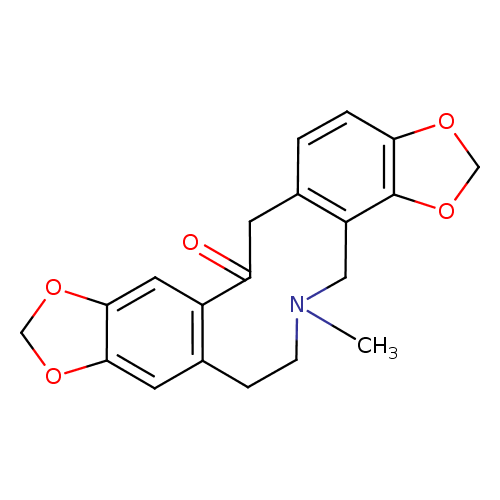
Common NameProtopine
ClassSmall Molecule
DescriptionProtopine is a benzylisoquinoline alkaloid occurring in opium poppies and other plants of the family papaveraceae. It has been found to inhibit histamine H1 receptors and platelet aggregation, and acts as an opioid analgesic.
Contaminant Sources
  • FooDB Chemicals
  • T3DB toxins
Contaminant Type
  • Amine
  • Ester
  • Food Toxin
  • Metabolite
  • Natural Compound
  • Organic Compound
  • Plant Toxin
Chemical Structure
Thumb
Synonyms
ValueSource
4,6,7,14-Tetrahydro-5-methyl-bis(1,3)benzodioxolo(4,5-c-5',6'-g)azecin-13(5H)-oneChEBI
7-Methyl-6,8,9,16-tetrahydrobis[1,3]benzodioxolo[4,5-c:5',6'-g]azecin-15(7H)-oneChEBI
CorydinineChEBI
FumarineChEBI
MacleyineChEBI
BiflorineHMDB
HypercorineHMDB
ProtopinHMDB
Protopine mesylateMeSH, HMDB
Protopine hydrochlorideMeSH, HMDB
Chemical FormulaC20H19NO5
Average Molecular Mass353.369 g/mol
Monoisotopic Mass353.126 g/mol
CAS Registry Number130-86-9
IUPAC Name15-methyl-7,9,19,21-tetraoxa-15-azapentacyclo[15.7.0.0⁴,¹².0⁶,¹⁰.0¹⁸,²²]tetracosa-1(17),4(12),5,10,18(22),23-hexaen-3-one
Traditional Nameprotopine
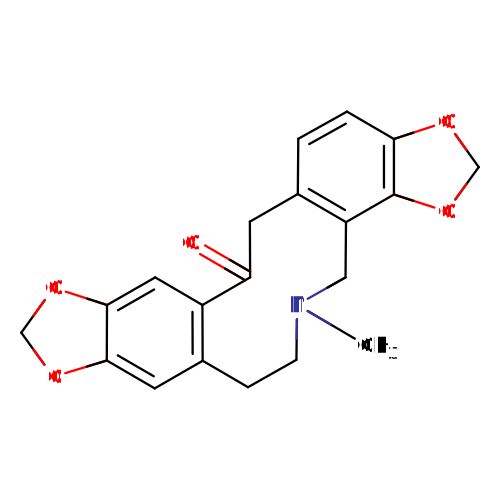
SMILESCN1CCC2=C(C=C3OCOC3=C2)C(=O)CC2=C(C1)C1=C(OCO1)C=C2
InChI IdentifierInChI=1S/C20H19NO5/c1-21-5-4-13-7-18-19(25-10-24-18)8-14(13)16(22)6-12-2-3-17-20(15(12)9-21)26-11-23-17/h2-3,7-8H,4-6,9-11H2,1H3
InChI KeyGPTFURBXHJWNHR-UHFFFAOYSA-N
Chemical Taxonomy
Description belongs to the class of organic compounds known as protopine alkaloids. These are alkaloids with a structure based on a tricyclic protopine formed by oxidative ring fission of protoberberine N-metho salts.
KingdomOrganic compounds
Super ClassAlkaloids and derivatives
ClassProtopine alkaloids
Sub ClassNot Available
Direct ParentProtopine alkaloids
Alternative Parents
Substituents
  • Protopine skeleton
  • Benzodioxole
  • Aryl ketone
  • Aryl alkyl ketone
  • Aralkylamine
  • Benzenoid
  • Ketone
  • Tertiary amine
  • Tertiary aliphatic amine
  • Acetal
  • Oxacycle
  • Azacycle
  • Organoheterocyclic compound
  • Organic oxide
  • Organopnictogen compound
  • Organooxygen compound
  • Organonitrogen compound
  • Organic oxygen compound
  • Hydrocarbon derivative
  • Amine
  • Organic nitrogen compound
  • Aromatic heteropolycyclic compound
Molecular FrameworkAromatic heteropolycyclic compounds
External Descriptors
Biological Properties
StatusDetected and Not Quantified
OriginExogenous
Cellular Locations
  • Membrane
Biofluid LocationsNot Available
Tissue Locations
  • Kidney
PathwaysNot Available
ApplicationsNot Available
Biological Roles
Chemical RolesNot Available
Physical Properties
StateSolid
AppearanceWhite powder.
Experimental Properties
PropertyValue
Melting Point208°C
Boiling PointNot Available
SolubilityNot Available
Predicted Properties
PropertyValueSource
Water Solubility0.2 g/LALOGPS
logP1.95ALOGPS
logP2.59ChemAxon
logS-3.2ALOGPS
pKa (Strongest Acidic)15.82ChemAxon
pKa (Strongest Basic)4.95ChemAxon
Physiological Charge0ChemAxon
Hydrogen Acceptor Count6ChemAxon
Hydrogen Donor Count0ChemAxon
Polar Surface Area57.23 ŲChemAxon
Rotatable Bond Count0ChemAxon
Refractivity94.57 m³·mol⁻¹ChemAxon
Polarizability36.68 ųChemAxon
Number of Rings5ChemAxon
Bioavailability1ChemAxon
Rule of FiveYesChemAxon
Ghose FilterYesChemAxon
Veber's RuleNoChemAxon
MDDR-like RuleNoChemAxon
Spectra
Spectra
Spectrum TypeDescriptionSplash KeyView
GC-MSGC-MS Spectrum - GC-MS (1 TMS)splash10-004r-2931000000-d14db9f8fbba357a7ceaSpectrum
GC-MSGC-MS Spectrum - GC-MS (Non-derivatized)splash10-004r-2931000000-d14db9f8fbba357a7ceaSpectrum
Predicted GC-MSPredicted GC-MS Spectrum - GC-MS (Non-derivatized) - 70eV, Positivesplash10-00ri-2049000000-c70fb92c70c89eb31559Spectrum
Predicted GC-MSPredicted GC-MS Spectrum - GC-MS (Non-derivatized) - 70eV, PositiveNot AvailableSpectrum
LC-MS/MSLC-MS/MS Spectrum - LC-ESI-QQ , positivesplash10-0f79-0936000000-da2afff6dba215da666aSpectrum
LC-MS/MSLC-MS/MS Spectrum - LC-ESI-QQ , positivesplash10-000i-0931000000-3ae8ba25a400b3cfc336Spectrum
LC-MS/MSLC-MS/MS Spectrum - LC-ESI-QQ , positivesplash10-0udi-0009000000-d474e4da85bfe6b8622eSpectrum
LC-MS/MSLC-MS/MS Spectrum - LC-ESI-QQ , positivesplash10-0udi-0009000000-c77daec49f175e0080d3Spectrum
LC-MS/MSLC-MS/MS Spectrum - LC-ESI-QQ , positivesplash10-0udi-0629000000-f410a01812829c61b1b5Spectrum
LC-MS/MSLC-MS/MS Spectrum - LC-ESI-QQ , positivesplash10-000i-0921000000-cb2a7100722bf81f462fSpectrum
LC-MS/MSLC-MS/MS Spectrum - LC-ESI-QQ , positivesplash10-000i-0930000000-e740d177ef096526ca53Spectrum
LC-MS/MSLC-MS/MS Spectrum - LC-ESI-IT , positivesplash10-000j-0932000000-899dc6a90055430abee2Spectrum
LC-MS/MSLC-MS/MS Spectrum - LC-ESI-QTOF , positivesplash10-0udi-0009000000-1833ae0a6ab82f156d51Spectrum
LC-MS/MSLC-MS/MS Spectrum - LC-ESI-QTOF , positivesplash10-0udr-0938000000-8a5ae3db2af3946a0e75Spectrum
LC-MS/MSLC-MS/MS Spectrum - LC-ESI-QTOF , positivesplash10-000i-0920000000-925c965ff2b76b30d02fSpectrum
LC-MS/MSLC-MS/MS Spectrum - , positivesplash10-0f79-0944000000-e1624142a49564f32b99Spectrum
LC-MS/MSLC-MS/MS Spectrum - 6V, Positivesplash10-000i-0910000000-79485782e2b17a1fccefSpectrum
LC-MS/MSLC-MS/MS Spectrum - 6V, Positivesplash10-000i-0931000000-a9d401bee935049397deSpectrum
LC-MS/MSLC-MS/MS Spectrum - 6V, Positivesplash10-000i-0920000000-092e042fc79ca310c193Spectrum
LC-MS/MSLC-MS/MS Spectrum - 6V, Positivesplash10-000i-0941000000-1fdf197d94d08c882c08Spectrum
LC-MS/MSLC-MS/MS Spectrum - 10V, Positivesplash10-0udi-0009000000-aab71a61504570b7beebSpectrum
LC-MS/MSLC-MS/MS Spectrum - 20V, Positivesplash10-0udr-0928000000-60509c382ac86776f91cSpectrum
LC-MS/MSLC-MS/MS Spectrum - 40V, Positivesplash10-000i-0920000000-925c965ff2b76b30d02fSpectrum
Predicted LC-MS/MSPredicted LC-MS/MS Spectrum - 10V, Positivesplash10-0udi-0009000000-0089e0012db766e23529Spectrum
Predicted LC-MS/MSPredicted LC-MS/MS Spectrum - 20V, Positivesplash10-0udj-0509000000-ed54f57036aee6ac913cSpectrum
Predicted LC-MS/MSPredicted LC-MS/MS Spectrum - 40V, Positivesplash10-004j-1900000000-e130dfa9e240571ed4e0Spectrum
Predicted LC-MS/MSPredicted LC-MS/MS Spectrum - 10V, Negativesplash10-0udi-0009000000-400e98b52794a7bf4fbdSpectrum
Predicted LC-MS/MSPredicted LC-MS/MS Spectrum - 20V, Negativesplash10-0udi-0009000000-71833c50697c0a4e532cSpectrum
Predicted LC-MS/MSPredicted LC-MS/MS Spectrum - 40V, Negativesplash10-002f-9658000000-c8824149cc8b247dcb6fSpectrum
MSMass Spectrum (Electron Ionization)splash10-0002-2910000000-c237219498d206631a06Spectrum
Toxicity Profile
Route of ExposureNot Available
Mechanism of ToxicityProtopine has been found to inhibit histamine H1 receptors and platelet aggregation, and acts as an analgesic. It is one of the compounds with activity like OPIATE ALKALOIDS, acting at OPIOID RECEPTORS. Properties include induction of ANALGESIA or NARCOSIS. Protopine can selectively bind to but do not activate histamine H1 receptors, thereby blocking the actions of endogenous histamine. Classical antihistaminics antagonize or prevent the action of histamine mainly in immediate hypersensitivity. They act in the bronchi, capillaries, and some other smooth muscles, and are used to prevent or allay motion sickness, seasonal rhinitis, and allergic dermatitis and to induce somnolence. Protopine can also function as platelet aggregation inhibitors which antagonize or impair any mechanism leading to blood platelet aggregation, whether during the phases of activation and shape change or following the dense-granule release reaction and stimulation of the prostaglandin-thromboxane system. Protopine inhibits the contractility of isolated cardiac papillary muscles and the proliferation of vascular smooth muscle cells induced by endothelin. It also shortens action potential duration and prolongs the effective refractory period in guinea pig cardiac papillary muscles. The protective effect on rat heart from ischemia_reperfusion damage and the relaxation of rat thoracic aorta induced by protopine have been related to the inhibition of Ca2+ influx through both voltage- and receptor-operated Ca2+ channels. Protopine has been the focus of a large number of biological studies in which they both exhibited, for instance, anti-parasitic activity and only weak cytotoxicity in comparison with other types of isoquinoline alkaloids. Protopine was found to be cytoprotective against oxidative stress induced cell death in vitro. The alkaloid was shown to have anti-arrhythmic, anti-thrombotic, anti-inflammatory, and hepatoprotective effects in animal models. The biological activity of protopine may be associated with its ability to inhibit calcium, sodium, and potassium channels. (PMID:15588728; PMID:21419197; L2104)
MetabolismNot Available
Toxicity ValuesNot Available
Lethal DoseNot Available
Carcinogenicity (IARC Classification)No indication of carcinogenicity to humans (not listed by IARC).
Uses/SourcesIt has been found to inhibit histamine H1 receptors and platelet aggregation, and acts as an opioid analgesic.
Minimum Risk LevelNot Available
Health EffectsNot Available
SymptomsNot Available
TreatmentNot Available
Concentrations
Not Available
DrugBank IDNot Available
HMDB IDHMDB0003920
FooDB IDFDB023249
Phenol Explorer IDNot Available
KNApSAcK IDC00001906
BiGG IDNot Available
BioCyc IDPROTOPINE
METLIN ID6988
PDB IDNot Available
Wikipedia LinkProtopine
Chemspider ID4799
ChEBI ID16415
PubChem Compound ID4970
Kegg Compound IDC05189
YMDB IDNot Available
ECMDB IDNot Available
References
Synthesis ReferenceRueffer, M.; Zenk, M. H. Enzymatic formation of protopines by a microsomal cytochrome P-450 system of Corydalis vaginans. Tetrahedron Letters (1987), 28(44), 5307-10.
MSDSLink
General References
1. https://www.ncbi.nlm.nih.gov/pubmed/?term=22029392
2. Rueffer, M.; Zenk, M. H. Enzymatic formation of protopines by a microsomal cytochrome P-450 system of Corydalis vaginans. Tetrahedron Letters (1987), 28(44), 5307-10.
3. Rueffer, M.; Zenk, M. H. Enzymatic formation of protopines by a microsomal cytochrome P-450 system of Corydalis vaginans. Tetrahedron Letters (1987), 28(44), 5307-10.
4. Paul LD, Maurer HH: Studies on the metabolism and toxicological detection of the Eschscholtzia californica alkaloids californine and protopine in urine using gas chromatography-mass spectrometry. J Chromatogr B Analyt Technol Biomed Life Sci. 2003 Jun 5;789(1):43-57.
5. Wynne PM, Vine JH, Amiet RG: Protopine alkaloids in horse urine. J Chromatogr B Analyt Technol Biomed Life Sci. 2004 Nov 5;811(1):85-91.
6. Jiang B, Cao K, Wang R: Inhibitory effect of protopine on K(ATP) channel subunits expressed in HEK-293 cells. Eur J Pharmacol. 2004 Dec 15;506(2):93-100.