Record Information
Version1.0
Creation Date2014-08-29 04:48:33 UTC
Update Date2026-04-17 19:33:46 UTC
Accession NumberCHEM002941
Identification
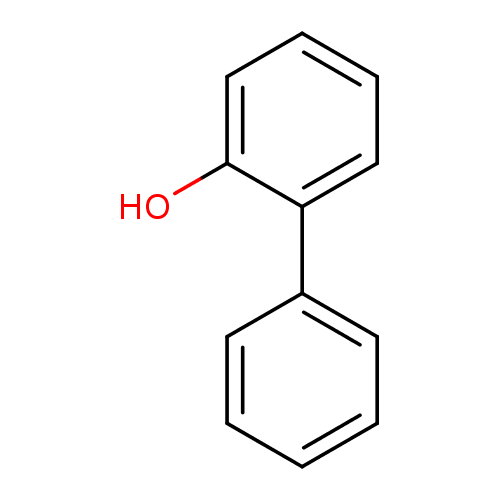
Common Name2-Biphenylol
ClassSmall Molecule
Description2-Biphenylol is found in lemon. It is an antifungal agent and preservative. 2-Biphenylol is used for post-harvest control of storage disease in apples, citrus fruit, stone fruit, tomatoes, cucumber and peppers through the use of impregnated wrapping materials or by direct application in a wax. 2-Biphenylol is used in food seasonings. Inhibitory to a wider range of moulds than Biphenyl HMJ12-A. The practical way of treatment is to immerse citrus fruit in an alkaline aqueous solution of the parent compound or its Na salt. 2-Biphenylol belongs to the family of Biphenyls and Derivatives. These are organic compounds containing to benzene rings linked together by a C-C bond.
Contaminant Sources
  • Clean Air Act Chemicals
  • EAFUS Chemicals
  • EPA Endocrine Screening
  • FooDB Chemicals
  • HMDB Contaminants - Urine
  • HPV EPA Chemicals
  • IARC Carcinogens Group 3
  • My Exposome Chemicals
  • STOFF IDENT Compounds
  • T3DB toxins
  • ToxCast & Tox21 Chemicals
Contaminant Type
  • Food Additive
  • Food Toxin
  • Household Toxin
  • Metabolite
  • Natural Compound
  • Organic Compound
  • Plant Toxin
  • Preservative
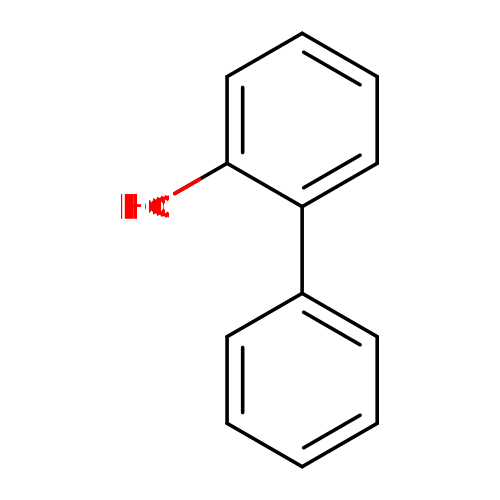
Chemical Structure
Thumb
Synonyms
ValueSource
2-HydroxybiphenylChEBI
2-PhenylphenolChEBI
O-DiphenylolChEBI
O-HydroxybiphenylChEBI
O-HydroxydiphenylChEBI
O-PhenylphenolChEBI
Orthophenyl phenolChEBI
AmocidKegg
2-HydroxydiphenylMeSH
2-Phenylphenol sodiumMeSH
DowicideMeSH
LyortholMeSH
O-PhenylphenateMeSH
Ortho-phenylphenateMeSH
OrthophenylphenolMeSH
Sodium O-phenylphenoateMeSH
Sodium ortho-phenylphenateMeSH
Sodium ortho-phenylphenolMeSH
(1,1'-Biphenyl)-2-olHMDB
(1,1-Biphenyl)-2-olHMDB
1,1'-Biphenyl-2-olHMDB
1-Hydroxy-2-phenylbenzeneHMDB
2-FenylfenolHMDB
2-Hydroxy biphenylHMDB
2-Hydroxy-1,1'-biphenylHMDB
2-Phenylphenol, bsi, isoHMDB
BiphenylolHMDB
Dowicide 1HMDB
e231HMDB
FEMA 3959HMDB
HBPHMDB
HydroxdiphenylHMDB
Hydroxy-2-phenylbenzeneHMDB
HydroxybiphenylHMDB
ManuseptHMDB
NectrylHMDB
Nipacide OPPHMDB
O-BiphenylolHMDB
O-Phenyl phenolHMDB
O-XenolHMDB
O-XonalHMDB
OPP?HMDB
ortho-PhenylphenolHMDB
OrthohydroxydipbenylHMDB
OrthohydroxydiphenylHMDB
OrthoxenolHMDB
PhenylphenolHMDB
RotolineHMDB
StelliseptHMDB
TorsiteHMDB
2-BiphenylolChEBI
Chemical FormulaC12H10O
Average Molecular Mass170.207 g/mol
Monoisotopic Mass170.073 g/mol
CAS Registry Number90-43-7
IUPAC Name[1,1'-biphenyl]-2-ol
Traditional Nameo-phenylphenol
SMILESOC1=CC=CC=C1C1=CC=CC=C1
InChI IdentifierInChI=1S/C12H10O/c13-12-9-5-4-8-11(12)10-6-2-1-3-7-10/h1-9,13H
InChI KeyLLEMOWNGBBNAJR-UHFFFAOYSA-N
Chemical Taxonomy
Description belongs to the class of organic compounds known as biphenyls and derivatives. These are organic compounds containing to benzene rings linked together by a C-C bond.
KingdomOrganic compounds
Super ClassBenzenoids
ClassBenzene and substituted derivatives
Sub ClassBiphenyls and derivatives
Direct ParentBiphenyls and derivatives
Alternative Parents
Substituents
  • Biphenyl
  • 1-hydroxy-4-unsubstituted benzenoid
  • 1-hydroxy-2-unsubstituted benzenoid
  • Phenol
  • Organic oxygen compound
  • Hydrocarbon derivative
  • Organooxygen compound
  • Aromatic homomonocyclic compound
Molecular FrameworkAromatic homomonocyclic compounds
External Descriptors
Biological Properties
StatusDetected and Not Quantified
OriginExogenous
Cellular Locations
  • Membrane
Biofluid LocationsNot Available
Tissue LocationsNot Available
PathwaysNot Available
Applications
Biological Roles
Chemical Roles
Physical Properties
StateSolid
AppearanceWhite powder.
Experimental Properties
PropertyValue
Melting Point56°C
Boiling PointNot Available
Solubility0.7 mg/mL at 25°C
Predicted Properties
PropertyValueSource
Water Solubility0.34 g/LALOGPS
logP3.21ALOGPS
logP3.32ChemAxon
logS-2.7ALOGPS
pKa (Strongest Acidic)9.69ChemAxon
pKa (Strongest Basic)-5.6ChemAxon
Physiological Charge0ChemAxon
Hydrogen Acceptor Count1ChemAxon
Hydrogen Donor Count1ChemAxon
Polar Surface Area20.23 ŲChemAxon
Rotatable Bond Count1ChemAxon
Refractivity53.18 m³·mol⁻¹ChemAxon
Polarizability18.75 ųChemAxon
Number of Rings2ChemAxon
Bioavailability1ChemAxon
Rule of FiveYesChemAxon
Ghose FilterYesChemAxon
Veber's RuleYesChemAxon
MDDR-like RuleNoChemAxon
Spectra
Spectra
Spectrum TypeDescriptionSplash KeyView
GC-MSGC-MS Spectrum - EI-B (Non-derivatized)splash10-00di-1900000000-f58c83912c81582962ecSpectrum
GC-MSGC-MS Spectrum - EI-B (Non-derivatized)splash10-00xr-1900000000-ba4f084280aee3b63cb9Spectrum
GC-MSGC-MS Spectrum - EI-B (Non-derivatized)splash10-00xr-2900000000-0395543c94def63fbf1cSpectrum
GC-MSGC-MS Spectrum - GC-EI-TOF (Non-derivatized)splash10-03fr-1790000000-2fec91e9a3b831e4f661Spectrum
GC-MSGC-MS Spectrum - EI-B (Non-derivatized)splash10-00di-1900000000-f58c83912c81582962ecSpectrum
GC-MSGC-MS Spectrum - EI-B (Non-derivatized)splash10-00xr-1900000000-ba4f084280aee3b63cb9Spectrum
GC-MSGC-MS Spectrum - EI-B (Non-derivatized)splash10-00xr-2900000000-0395543c94def63fbf1cSpectrum
GC-MSGC-MS Spectrum - GC-EI-TOF (Non-derivatized)splash10-03fr-1790000000-2fec91e9a3b831e4f661Spectrum
Predicted GC-MSPredicted GC-MS Spectrum - GC-MS (Non-derivatized) - 70eV, Positivesplash10-00di-0900000000-43bf1dee532a54447f41Spectrum
Predicted GC-MSPredicted GC-MS Spectrum - GC-MS (1 TMS) - 70eV, Positivesplash10-00di-9760000000-5e1078b290b37f1d47bcSpectrum
Predicted GC-MSPredicted GC-MS Spectrum - GC-MS (Non-derivatized) - 70eV, PositiveNot AvailableSpectrum
LC-MS/MSLC-MS/MS Spectrum - LC-ESI-ITFT , positivesplash10-0fml-0900000000-7b06dbf8c12560a092e6Spectrum
LC-MS/MSLC-MS/MS Spectrum - LC-ESI-ITFT , positivesplash10-0fb9-0900000000-dc2a630f122797c0a30dSpectrum
LC-MS/MSLC-MS/MS Spectrum - LC-ESI-ITFT , positivesplash10-0udl-0900000000-0058244c148d04bcffb9Spectrum
LC-MS/MSLC-MS/MS Spectrum - LC-ESI-ITFT , positivesplash10-0udl-0900000000-28f041bf0b0faf02ccd5Spectrum
LC-MS/MSLC-MS/MS Spectrum - 60V, Negativesplash10-00kf-9500000000-f6d4cbb6fefb881a66dfSpectrum
LC-MS/MSLC-MS/MS Spectrum - 45V, Negativesplash10-00kf-9500000000-645cd80d916513b7da2eSpectrum
LC-MS/MSLC-MS/MS Spectrum - 75V, Negativesplash10-0006-9200000000-cb0f070ccdf943ac78ccSpectrum
LC-MS/MSLC-MS/MS Spectrum - 90V, Negativesplash10-0006-9200000000-e74e7ad70d8227b5a7e9Spectrum
LC-MS/MSLC-MS/MS Spectrum - 90V, Positivesplash10-0fb9-0900000000-6327145722d77a345d12Spectrum
LC-MS/MSLC-MS/MS Spectrum - 15V, Positivesplash10-00di-0900000000-58d1482e199dc20e2e65Spectrum
LC-MS/MSLC-MS/MS Spectrum - 30V, Positivesplash10-00di-0900000000-28311b68921ae494a0e8Spectrum
LC-MS/MSLC-MS/MS Spectrum - 60V, Positivesplash10-0fb9-0900000000-931a5f59b51289796ad9Spectrum
LC-MS/MSLC-MS/MS Spectrum - 45V, Positivesplash10-00dl-0900000000-85cbd30844e2c9d2b8ccSpectrum
LC-MS/MSLC-MS/MS Spectrum - 15V, Negativesplash10-00kf-9600000000-6bdabf5fa4f9b4d076d0Spectrum
LC-MS/MSLC-MS/MS Spectrum - 30V, Negativesplash10-00kf-9700000000-6e22867439b22f4327deSpectrum
LC-MS/MSLC-MS/MS Spectrum - 90V, Positivesplash10-0fb9-0900000000-c230f5371d3e1af25788Spectrum
LC-MS/MSLC-MS/MS Spectrum - 75V, Positivesplash10-0fb9-0900000000-665c01eb096b23432bf1Spectrum
Predicted LC-MS/MSPredicted LC-MS/MS Spectrum - 10V, Positivesplash10-00di-0900000000-aa09c65297232074b1daSpectrum
Predicted LC-MS/MSPredicted LC-MS/MS Spectrum - 20V, Positivesplash10-00di-1900000000-042a540d9a28eba4bb1eSpectrum
Predicted LC-MS/MSPredicted LC-MS/MS Spectrum - 40V, Positivesplash10-0f96-9600000000-ee2a147f3a7a3bbc0bdaSpectrum
Predicted LC-MS/MSPredicted LC-MS/MS Spectrum - 10V, Negativesplash10-014i-0900000000-05ec524c3078c379ec6fSpectrum
Predicted LC-MS/MSPredicted LC-MS/MS Spectrum - 20V, Negativesplash10-014i-1900000000-cf114607f489ee954397Spectrum
Predicted LC-MS/MSPredicted LC-MS/MS Spectrum - 40V, Negativesplash10-002f-9500000000-075a7f587e50b80d93c6Spectrum
Predicted LC-MS/MSPredicted LC-MS/MS Spectrum - 10V, Positivesplash10-00di-0900000000-13ac4e364e8d0c6b9e7cSpectrum
Predicted LC-MS/MSPredicted LC-MS/MS Spectrum - 20V, Positivesplash10-00di-0900000000-5e0bca337cd8a7eff74fSpectrum
MSMass Spectrum (Electron Ionization)splash10-01bc-3900000000-adae00e9be0477f3901bSpectrum
1D NMR1H NMR SpectrumNot AvailableSpectrum
1D NMR13C NMR SpectrumNot AvailableSpectrum
Toxicity Profile
Route of ExposureNot Available
Mechanism of ToxicityNot Available
MetabolismNot Available
Toxicity ValuesNot Available
Lethal DoseNot Available
Carcinogenicity (IARC Classification)3, not classifiable as to its carcinogenicity to humans. (15)
Uses/Sources2-Biphenylol is found in lemon. It is an antifungal agent and preservative. 2-Biphenylol is used for post-harvest control of storage disease in apples, citrus fruit, stone fruit, tomatoes, cucumber and peppers through the use of impregnated wrapping materials or by direct application in a wax. 2-Biphenylol is used in food seasonings. The practical way of treatment is to immerse citrus fruit in an alkaline aqueous solution of the parent compound or its Na salt.
Minimum Risk LevelNot Available
Health EffectsNot Available
SymptomsNot Available
TreatmentNot Available
Concentrations
Not Available
DrugBank IDNot Available
HMDB IDHMDB0032582
FooDB IDFDB010519
Phenol Explorer IDNot Available
KNApSAcK IDNot Available
BiGG IDNot Available
BioCyc IDNot Available
METLIN IDNot Available
PDB IDNot Available
Wikipedia LinkBiphenyl-2-ol
Chemspider ID13839012
ChEBI ID17043
PubChem Compound ID7017
Kegg Compound IDC02499
YMDB IDNot Available
ECMDB IDNot Available
References
Synthesis ReferenceNot Available
MSDSNot Available
General References
1. https://www.ncbi.nlm.nih.gov/pubmed/?term=14753781
2. https://www.ncbi.nlm.nih.gov/pubmed/?term=23156781
3. https://www.ncbi.nlm.nih.gov/pubmed/?term=23665931
4. https://www.ncbi.nlm.nih.gov/pubmed/?term=24525378
5. Shen DT, Crawford TB, Gorham JR, McGuire TC: Inactivation of equine infectious anemia virus by chemical disinfectants. Am J Vet Res. 1977 Aug;38(8):1217-9.
6. Johnson GD, Harsy SG, Geronimo J, Wise JM: Orthophenylphenol and phenylhydroquinone residues in citrus fruit and processed citrus products after postharvest fungicidal treatments with sodium orthophenylphenate in California and Florida. J Agric Food Chem. 2001 May;49(5):2497-502.
7. Humphreys MJ, Allman R, Lloyd D: Determination of the viability of Trichomonas vaginalis using flow cytometry. Cytometry. 1994 Apr 1;15(4):343-8.
8. HOPKINS EF, LOUCKS KW: Prevention of the phytotoxic action of sodium orthophenylphenate on citrus fruits by hexamine. Science. 1950 Dec 15;112(2920):720-1.
9. Diaz Borras A, Vila Aguilar R, Hernandez Gimenez E: Synergistic effect of fungicides on resistant strains of Penicillium italicum and Penicillium digitatum. Int J Food Microbiol. 1988 Aug;7(1):79-85.
10. Csermely P, Balint E, Grimley PM, Aszalos A: Protein kinase C is involved in the early signals of interferon-alpha but not of interferon-gamma in U937 cells. J Interferon Res. 1990 Dec;10(6):605-11.
11. Reitz RH, Fox TR, Quast JF, Hermann EA, Watanabe PG: Biochemical factors involved in the effects of orthophenylphenol (OPP) and sodium orthophenylphenate (SOPP) on the urinary tract of male F344 rats. Toxicol Appl Pharmacol. 1984 Apr;73(2):345-9.
12. Cinelli AR, Salzberg BM: Dendritic origin of late events in optical recordings from salamander olfactory bulb. J Neurophysiol. 1992 Sep;68(3):786-806.
13. Evans JA, Darlington DN, Gann DS: A circulating factor(s) mediates cell depolarization in hemorrhagic shock. Ann Surg. 1991 Jun;213(6):549-56; discussion 556-7.
14. Fangstrom B, Hovander L, Bignert A, Athanassiadis I, Linderholm L, Grandjean P, Weihe P, Bergman A: Concentrations of polybrominated diphenyl ethers, polychlonnated biphenyls, and polychlorobiphenylols in serum from pregnant Faroese women and their children 7 years later. Environ Sci Technol. 2005 Dec 15;39(24):9457-63.
15. McDONOUGH ES: Inhibition of mold contamination in Drosophila food using sodium orthophenylphenate. Science. 1953 Oct 2;118(3066):388.
16. Santhamma KR, Bhaduri A: Characterization of the respiratory chain of Leishmania donovani promastigotes. Mol Biochem Parasitol. 1995 Dec;75(1):43-53.
17. Calori-Domingues MA, Fonseca H: Laboratory evaluation of chemical control of aflatoxin production in unshelled peanuts (Arachis hypogaea L.). Food Addit Contam. 1995 May-Jun;12(3):347-50.
18. Ranzani MR, Fonseca H: Mycological evaluation of chemically-treated unshelled peanuts. Food Addit Contam. 1995 May-Jun;12(3):343-6.
19. Yannai, Shmuel. (2004) Dictionary of food compounds with CD-ROM: Additives, flavors, and ingredients. Boca Raton: Chapman & Hall/CRC.