Record Information
Version1.0
Creation Date2014-08-29 04:48:23 UTC
Update Date2026-03-31 19:16:06 UTC
Accession NumberCHEM002933
Identification
Common NameMonoethylhexyl phthalic acid
ClassSmall Molecule
DescriptionMonoethylhexyl phthalic acid (MEHP) is an active metabolite of Bis(2-ethylhexyl)phthalate (DEHP). DEHP measured from the blood of pregnant women have been significantly associated with the decreased penis width, shorter anogenital distance, and the incomplete descent of testes of their newborn sons, replicating effects identified in animals. DEHP hydrolyzes to MEHP via the enzyme Bis(2-ethylhexyl)phthalate acylhydrolase(3.1.1.60)and subsequently to phthalate salts. The released alcohol is susceptible to oxidation to the aldehyde and carboxylic acid.
Contaminant Sources
  • FooDB Chemicals
  • HMDB Contaminants - Urine
  • HPV EPA Chemicals
  • T3DB toxins
  • ToxCast & Tox21 Chemicals
Contaminant Type
  • Animal Toxin
  • Ester
  • Ether
  • Food Toxin
  • Industrial/Workplace Toxin
  • Metabolite
  • Natural Compound
  • Organic Compound
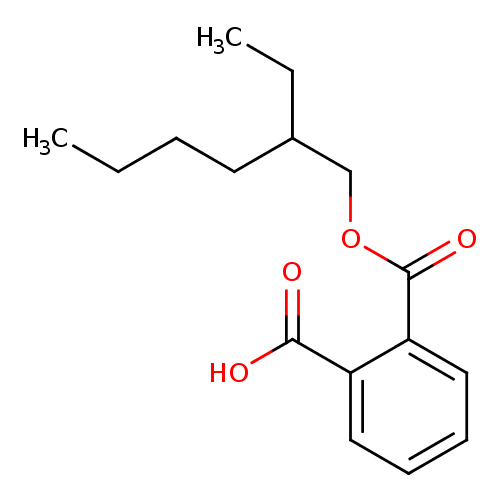
Chemical Structure
Thumb
Synonyms
ValueSource
(2-Ethylhexyl) hydrogen phthalateChEBI
1,2-Benzenedicarboxylic acid, mono(2-ethylhexyl) esterChEBI
2-([(2-Ethylhexyl)oxy]carbonyl)benzoic acidChEBI
2-Ethylhexyl hydrogen phthalateChEBI
2-Ethylhexyl phthalateChEBI
MEHPChEBI
mono(2-Ethylhexyl)phthalateChEBI
mono-(2-Ethylhexyl)phthalateChEBI
mono-2-Ethylhexyl phthalateChEBI
Monoethylhexyl phthalateChEBI
Phthalic acid, 2-ethylhexyl esterChEBI
(2-Ethylhexyl) hydrogen phthalic acidGenerator
1,2-Benzenedicarboxylate, mono(2-ethylhexyl) esterGenerator
2-([(2-Ethylhexyl)oxy]carbonyl)benzoateGenerator
2-Ethylhexyl hydrogen phthalic acidGenerator
2-Ethylhexyl phthalic acidGenerator
mono(2-Ethylhexyl)phthalic acidGenerator
mono-(2-Ethylhexyl)phthalic acidGenerator
mono-2-Ethylhexyl phthalic acidGenerator
Phthalate, 2-ethylhexyl esterGenerator
MEHP CPDMeSH
mono(Ethylhexyl) phthalateMeSH
mono-(2-Ethylhexyl)phthalate, sodium saltMeSH
1,2-Benzenedicarboxylicacid,mono(2-ethylhexyl)esterHMDB
mono-EthylhexylHMDB
mono-EthylhexylphthalateHMDB
Monoethylhexyl phthalate (mehp)HMDB
MonoethylhexylphthalateHMDB
MONOOCTYL phthalATEHMDB
Phthalic acid 1-hydrogen 2-(2-ethylhexyl) esterHMDB
Phthalic acid hydrogen 1-(2-ethylhexyl) esterHMDB
PHTHALIC ACID mono-2-ethylhexyl esterHMDB
PHTHALIC ACID monooctyl esterHMDB
Phthalicacid,2-ethylhexylesterHMDB
phthalicacidmono-2-ETHYLEXYLESTERHMDB
PHTHALICACIDMONOETHYLHEXYLHMDB
PhthalicacidmonoethylhexylesterHMDB
Monoethylhexyl phthalic acidGenerator
mono(2-Ethylhexyl) phthalic acidGenerator
Chemical FormulaC16H22O4
Average Molecular Mass278.344 g/mol
Monoisotopic Mass278.152 g/mol
CAS Registry Number4376-20-9
IUPAC Name2-{[(2-ethylhexyl)oxy]carbonyl}benzoic acid
Traditional Namebar 1
SMILESCCCCC(CC)COC(=O)C1=CC=CC=C1C(O)=O
InChI IdentifierInChI=1S/C16H22O4/c1-3-5-8-12(4-2)11-20-16(19)14-10-7-6-9-13(14)15(17)18/h6-7,9-10,12H,3-5,8,11H2,1-2H3,(H,17,18)
InChI KeyDJDSLBVSSOQSLW-UHFFFAOYSA-N
Chemical Taxonomy
Description belongs to the class of organic compounds known as benzoic acid esters. These are ester derivatives of benzoic acid.
KingdomOrganic compounds
Super ClassBenzenoids
ClassBenzene and substituted derivatives
Sub ClassBenzoic acids and derivatives
Direct ParentBenzoic acid esters
Alternative Parents
Substituents
  • Benzoate ester
  • Benzoic acid
  • Benzoyl
  • Dicarboxylic acid or derivatives
  • Carboxylic acid ester
  • Carboxylic acid
  • Carboxylic acid derivative
  • Organic oxygen compound
  • Organic oxide
  • Hydrocarbon derivative
  • Organooxygen compound
  • Aromatic homomonocyclic compound
Molecular FrameworkAromatic homomonocyclic compounds
External Descriptors
Biological Properties
StatusDetected and Not Quantified
OriginExogenous
Cellular Locations
  • Membrane
Biofluid LocationsNot Available
Tissue LocationsNot Available
PathwaysNot Available
ApplicationsNot Available
Biological RolesNot Available
Chemical RolesNot Available
Physical Properties
StateSolid
AppearanceWhite powder.
Experimental Properties
PropertyValue
Melting PointNot Available
Boiling PointNot Available
SolubilityNot Available
Predicted Properties
PropertyValueSource
Water Solubility0.013 g/LALOGPS
logP4.36ALOGPS
logP4.66ChemAxon
logS-4.3ALOGPS
pKa (Strongest Acidic)3.08ChemAxon
pKa (Strongest Basic)-7ChemAxon
Physiological Charge-1ChemAxon
Hydrogen Acceptor Count3ChemAxon
Hydrogen Donor Count1ChemAxon
Polar Surface Area63.6 ŲChemAxon
Rotatable Bond Count9ChemAxon
Refractivity77.49 m³·mol⁻¹ChemAxon
Polarizability30.96 ųChemAxon
Number of Rings1ChemAxon
Bioavailability1ChemAxon
Rule of FiveYesChemAxon
Ghose FilterYesChemAxon
Veber's RuleNoChemAxon
MDDR-like RuleNoChemAxon
Spectra
Spectra
Spectrum TypeDescriptionSplash KeyView
GC-MSGC-MS Spectrum - GC-EI-TOF (Non-derivatized)splash10-00dj-2970000000-346112e2dd7eb2ef672fSpectrum
Predicted GC-MSPredicted GC-MS Spectrum - GC-MS (Non-derivatized) - 70eV, Positivesplash10-0002-5920000000-6756fbba86aadca647ceSpectrum
Predicted GC-MSPredicted GC-MS Spectrum - GC-MS (1 TMS) - 70eV, Positivesplash10-00di-7392000000-fd40ccd8c52320562e5cSpectrum
Predicted GC-MSPredicted GC-MS Spectrum - GC-MS (Non-derivatized) - 70eV, PositiveNot AvailableSpectrum
LC-MS/MSLC-MS/MS Spectrum - 30V, Positivesplash10-006t-0960000000-efbb62fb904150b613f2Spectrum
LC-MS/MSLC-MS/MS Spectrum - 15V, Positivesplash10-006t-0960000000-bace63e54682391af671Spectrum
LC-MS/MSLC-MS/MS Spectrum - 45V, Positivesplash10-00kb-0910000000-77eed661ab413010d354Spectrum
LC-MS/MSLC-MS/MS Spectrum - 60V, Positivesplash10-00mk-0900000000-214bdb75cf5614522a03Spectrum
LC-MS/MSLC-MS/MS Spectrum - 45V, Negativesplash10-00ai-0900000000-d636e4277afd375744d2Spectrum
LC-MS/MSLC-MS/MS Spectrum - 30V, Negativesplash10-001i-0900000000-e6f221aefc0e24f648d5Spectrum
LC-MS/MSLC-MS/MS Spectrum - 75V, Positivesplash10-002b-0900000000-d8cdf715271ec6e661b8Spectrum
LC-MS/MSLC-MS/MS Spectrum - 15V, Negativesplash10-0059-0940000000-bbc0013de532edede483Spectrum
LC-MS/MSLC-MS/MS Spectrum - 90V, Negativesplash10-004i-9100000000-d5a5ecd4f3c706f53a0fSpectrum
LC-MS/MSLC-MS/MS Spectrum - 45V, Positivesplash10-00kb-0910000000-a2eba6e125597cb7530dSpectrum
LC-MS/MSLC-MS/MS Spectrum - 60V, Negativesplash10-00b9-2900000000-1d8439ed7614ed714822Spectrum
LC-MS/MSLC-MS/MS Spectrum - 75V, Negativesplash10-004i-9800000000-3f611dc53f826ce06536Spectrum
Predicted LC-MS/MSPredicted LC-MS/MS Spectrum - 10V, Positivesplash10-03fr-0790000000-972234c38f1e6baf9909Spectrum
Predicted LC-MS/MSPredicted LC-MS/MS Spectrum - 20V, Positivesplash10-03di-4930000000-1ab987bce4973d4f07f4Spectrum
Predicted LC-MS/MSPredicted LC-MS/MS Spectrum - 40V, Positivesplash10-0a4l-9500000000-53028683cce560c7a65bSpectrum
Predicted LC-MS/MSPredicted LC-MS/MS Spectrum - 10V, Negativesplash10-004i-0490000000-44a004dad8099c4e00deSpectrum
Predicted LC-MS/MSPredicted LC-MS/MS Spectrum - 20V, Negativesplash10-00w9-1940000000-8169435369a241584a63Spectrum
Predicted LC-MS/MSPredicted LC-MS/MS Spectrum - 40V, Negativesplash10-00fr-6900000000-56a7cc157be52d6494f3Spectrum
Predicted LC-MS/MSPredicted LC-MS/MS Spectrum - 10V, Positivesplash10-004i-0290000000-bf11acdb8d5f1fa06aa5Spectrum
Predicted LC-MS/MSPredicted LC-MS/MS Spectrum - 20V, Positivesplash10-0532-2940000000-474dfefcab564610df5fSpectrum
Predicted LC-MS/MSPredicted LC-MS/MS Spectrum - 40V, Positivesplash10-0a4i-9500000000-0b315e8ad86892867d12Spectrum
Predicted LC-MS/MSPredicted LC-MS/MS Spectrum - 10V, Negativesplash10-004i-0290000000-048ea11376b7fe328007Spectrum
Predicted LC-MS/MSPredicted LC-MS/MS Spectrum - 20V, Negativesplash10-00b9-5950000000-012e94386a547e3c0c23Spectrum
Predicted LC-MS/MSPredicted LC-MS/MS Spectrum - 40V, Negativesplash10-004i-9410000000-a8dbecb62f34e602da89Spectrum
MSMass Spectrum (Electron Ionization)splash10-0002-4900000000-af0f2c76a7c01b845a00Spectrum
Toxicity Profile
Route of ExposureNot Available
Mechanism of ToxicityNot Available
MetabolismNot Available
Toxicity ValuesNot Available
Lethal DoseNot Available
Carcinogenicity (IARC Classification)No indication of carcinogenicity to humans (not listed by IARC).
Uses/SourcesNot Available
Minimum Risk LevelNot Available
Health EffectsNot Available
SymptomsNot Available
TreatmentNot Available
Concentrations
Not Available
DrugBank IDNot Available
HMDB IDHMDB0013248
FooDB IDFDB029358
Phenol Explorer IDNot Available
KNApSAcK IDNot Available
BiGG IDNot Available
BioCyc IDNot Available
METLIN IDNot Available
PDB IDNot Available
Wikipedia LinkNot Available
Chemspider ID19208
ChEBI ID17243
PubChem Compound ID20393
Kegg Compound IDC03343
YMDB IDNot Available
ECMDB IDNot Available
References
Synthesis ReferenceNot Available
MSDSNot Available
General References
1. Hasmall S, Orphanides G, James N, Pennie W, Hedley K, Soames A, Kimber I, Roberts R: Downregulation of lactoferrin by PPARalpha ligands: role in perturbation of hepatocyte proliferation and apoptosis. Toxicol Sci. 2002 Aug;68(2):304-13.
2. Hasmall SC, James NH, Macdonald N, West D, Chevalier S, Cosulich SC, Roberts RA: Suppression of apoptosis and induction of DNA synthesis in vitro by the phthalate plasticizers monoethylhexylphthalate (MEHP) and diisononylphthalate (DINP): a comparison of rat and human hepatocytes in vitro. Arch Toxicol. 1999 Nov;73(8-9):451-6.
3. Anderson WA, Barnes KA, Castle L, Damant AP, Scotter MJ: Determination of isotopically labelled monoesterphthalates in urine by high performance liquid chromatography-mass spectrometry. Analyst. 2002 Sep;127(9):1193-7.
4. Marttinen SK, Kettunen RH, Sormunen KM, Rintala JA: Removal of bis(2-ethylhexyl) phthalate at a sewage treatment plant. Water Res. 2003 Mar;37(6):1385-93.
5. Quintana JB, Rodil R, Reemtsma T: Determination of phosphoric acid mono- and diesters in municipal wastewater by solid-phase extraction and ion-pair liquid chromatography-tandem mass spectrometry. Anal Chem. 2006 Mar 1;78(5):1644-50.
6. Luisi S, Latini G, de Felice C, Sanseverino F, di Pasquale D, Mazzeo P, Petraglia F: Low serum concentrations of di-(2-ethylhexyl)phthalate in women with uterine fibromatosis. Gynecol Endocrinol. 2006 Feb;22(2):92-5.
7. Howdeshell KL, Furr J, Lambright CR, Rider CV, Wilson VS, Gray LE Jr: Cumulative effects of dibutyl phthalate and diethylhexyl phthalate on male rat reproductive tract development: altered fetal steroid hormones and genes. Toxicol Sci. 2007 Sep;99(1):190-202. Epub 2007 Mar 30.
8. Lovekamp-Swan T, Davis BJ: Mechanisms of phthalate ester toxicity in the female reproductive system. Environ Health Perspect. 2003 Feb;111(2):139-45.
9. Kambia K, Dine T, Gressier B, Dupin-Spriet T, Luyckx M, Brunet C: Evaluation of the direct toxicity of trioctyltrimellitate (TOTM), di(2-ethylhexyl) phthalate (DEHP) and their hydrolysis products on isolated rat hepatocytes. Int J Artif Organs. 2004 Nov;27(11):971-8.
10. Rosado-Berrios CA, Velez C, Zayas B: Mitochondrial permeability and toxicity of diethylhexyl and monoethylhexyl phthalates on TK6 human lymphoblasts cells. Toxicol In Vitro. 2011 Dec;25(8):2010-6. doi: 10.1016/j.tiv.2011.08.001. Epub 2011 Aug 16.
11. Rokos CL, Ledwith BJ: Peroxisome proliferators activate extracellular signal-regulated kinases in immortalized mouse liver cells. J Biol Chem. 1997 May 16;272(20):13452-7.
12. Forgacs AL, Ding Q, Jaremba RG, Huhtaniemi IT, Rahman NA, Zacharewski TR: BLTK1 murine Leydig cells: a novel steroidogenic model for evaluating the effects of reproductive and developmental toxicants. Toxicol Sci. 2012 Jun;127(2):391-402. doi: 10.1093/toxsci/kfs121. Epub 2012 Mar 29.
13. Janer G, Verhoef A, Gilsing HD, Piersma AH: Use of the rat postimplantation embryo culture to assess the embryotoxic potency within a chemical category and to identify toxic metabolites. Toxicol In Vitro. 2008 Oct;22(7):1797-805. doi: 10.1016/j.tiv.2008.07.007. Epub 2008 Jul 15.
14. Theunissen PT, Robinson JF, Pennings JL, van Herwijnen MH, Kleinjans JC, Piersma AH: Compound-specific effects of diverse neurodevelopmental toxicants on global gene expression in the neural embryonic stem cell test (ESTn). Toxicol Appl Pharmacol. 2012 Aug 1;262(3):330-40. doi: 10.1016/j.taap.2012.05.011. Epub 2012 May 23.
15. Hoppin JA, Brock JW, Davis BJ, Baird DD: Reproducibility of urinary phthalate metabolites in first morning urine samples. Environ Health Perspect. 2002 May;110(5):515-8.
16. Kato K, Shoda S, Takahashi M, Doi N, Yoshimura Y, Nakazawa H: Determination of three phthalate metabolites in human urine using on-line solid-phase extraction-liquid chromatography-tandem mass spectrometry. J Chromatogr B Analyt Technol Biomed Life Sci. 2003 May 25;788(2):407-11.
17. Koo HJ, Lee BM: Human monitoring of phthalates and risk assessment. J Toxicol Environ Health A. 2005 Aug 27;68(16):1379-92.
18. Kim SH, Chun S, Jang JY, Chae HD, Kim CH, Kang BM: Increased plasma levels of phthalate esters in women with advanced-stage endometriosis: a prospective case-control study. Fertil Steril. 2011 Jan;95(1):357-9. doi: 10.1016/j.fertnstert.2010.07.1059. Epub 2010 Aug 25.
19. Ge RS, Chen GR, Dong Q, Akingbemi B, Sottas CM, Santos M, Sealfon SC, Bernard DJ, Hardy MP: Biphasic effects of postnatal exposure to diethylhexylphthalate on the timing of puberty in male rats. J Androl. 2007 Jul-Aug;28(4):513-20. Epub 2007 Feb 7.
20. Hoppin JA, Ulmer R, London SJ: Phthalate exposure and pulmonary function. Environ Health Perspect. 2004 Apr;112(5):571-4.
21. Barron MG, Schultz IR, Hayton WL: Presystemic branchial metabolism limits di-2-ethylhexyl phthalate accumulation in fish. Toxicol Appl Pharmacol. 1989 Mar 15;98(1):49-57.
22. Holm A, Solbu K, Molander P, Lundanes E, Greibrokk T: Sensitive biomonitoring of phthalate metabolites in human urine using packed capillary column switching liquid chromatography coupled to electrospray ionization ion-trap mass spectrometry. Anal Bioanal Chem. 2004 Apr;378(7):1762-8. Epub 2004 Jan 31.
23. Christen V, Crettaz P, Oberli-Schrammli A, Fent K: Some flame retardants and the antimicrobials triclosan and triclocarban enhance the androgenic activity in vitro. Chemosphere. 2010 Nov;81(10):1245-52. doi: 10.1016/j.chemosphere.2010.09.031. Epub 2010 Oct 12.
24. Ellero-Simatos S, Claus SP, Benelli C, Forest C, Letourneur F, Cagnard N, Beaune PH, de Waziers I: Combined transcriptomic-(1)H NMR metabonomic study reveals that monoethylhexyl phthalate stimulates adipogenesis and glyceroneogenesis in human adipocytes. J Proteome Res. 2011 Dec 2;10(12):5493-502. doi: 10.1021/pr200765v. Epub 2011 Nov 9.
25. Rose ML, Rivera CA, Bradford BU, Graves LM, Cattley RC, Schoonhoven R, Swenberg JA, Thurman RG: Kupffer cell oxidant production is central to the mechanism of peroxisome proliferators. Carcinogenesis. 1999 Jan;20(1):27-33.