Record Information
Version1.0
Creation Date2014-08-29 04:47:56 UTC
Update Date2026-04-05 16:32:45 UTC
Accession NumberCHEM002926
Identification
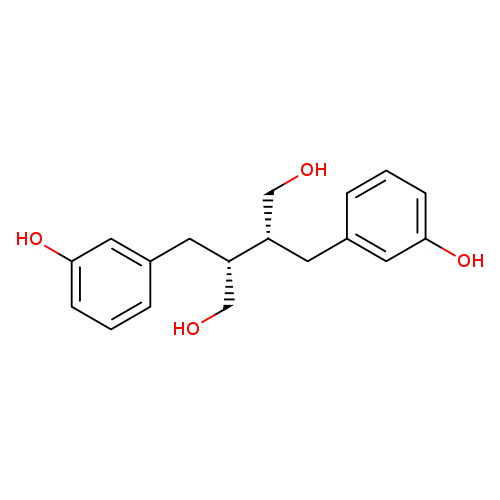
Common NameEnterodiol
ClassSmall Molecule
DescriptionEnterodiol is one of the most important lignan-type phytoestrogens identified in serum, urine, bile and seminal fluids of humans and animals. Phytoestrogens are a diverse group of compounds found in many edible plants that have, as their common denominator, a phenolic group that they share with estrogenic steroids. This phenolic group appears to play an important role in determining the estrogenic agonist/antagonistic properties of these compounds. Phytoestrogens have been categorized according to their chemical structures as isoflavones, lignans and coumestans. Enterodiol is formed by bacteria in the intestinal tract from the plant lignans matairesinol and secoisolariciresinol, which exist in various whole-grain cereals (barley, rye and wheat), seeds, nuts, legumes and vegetables. (1).
Contaminant Sources
  • FooDB Chemicals
  • HMDB Contaminants - Urine
  • T3DB toxins
  • ToxCast & Tox21 Chemicals
Contaminant Type
  • Animal Toxin
  • Food Toxin
  • Industrial/Workplace Toxin
  • Metabolite
  • Natural Compound
  • Organic Compound
Chemical Structure
Thumb
Synonyms
ValueSource
(-)-EnterodiolHMDB
(2R,3R)-2,3-Bis[(3-hydroxyphenyl)methyl]-1,4-butanediolHMDB
Arbo 9HMDB
[R-(R*,r*)]-2,3-bis[(3-hydroxyphenyl)methyl]-1,4-butanediolHMDB
2,3-Bis(3'-hydroxybenzyl)butane-1,4-diolHMDB
2,3-BHBBDHMDB
2,3-Bis(3-hydroxybenzyl)butane-1,4-diolHMDB
EnterodiolHMDB
Chemical FormulaC18H22O4
Average Molecular Mass302.365 g/mol
Monoisotopic Mass302.152 g/mol
CAS Registry Number80226-00-2
IUPAC NameNot Available
Traditional Name(-)-enterodiol
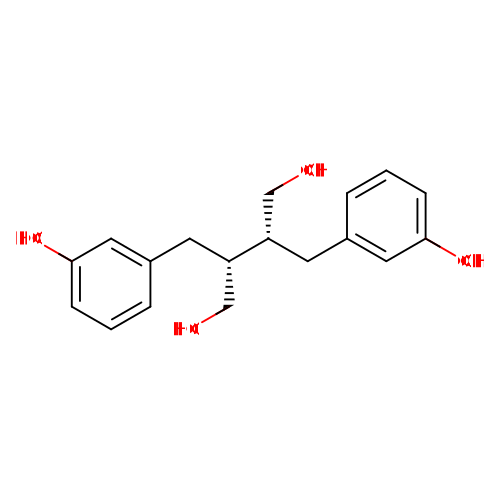
SMILESOC[C@H](CC1=CC(O)=CC=C1)[C@H](CO)CC1=CC(O)=CC=C1
InChI IdentifierInChI=1S/C18H22O4/c19-11-15(7-13-3-1-5-17(21)9-13)16(12-20)8-14-4-2-6-18(22)10-14/h1-6,9-10,15-16,19-22H,7-8,11-12H2/t15-,16-/m0/s1
InChI KeyDWONJCNDULPHLV-HOTGVXAUSA-N
Chemical Taxonomy
Description belongs to the class of organic compounds known as dibenzylbutanediol lignans. These are lignan compounds containing a 2,3-dibenzylbutane-1,4-diol moiety.
KingdomOrganic compounds
Super ClassLignans, neolignans and related compounds
ClassDibenzylbutane lignans
Sub ClassDibenzylbutanediol lignans
Direct ParentDibenzylbutanediol lignans
Alternative Parents
Substituents
  • Dibenzylbutanediol
  • 1-hydroxy-4-unsubstituted benzenoid
  • 1-hydroxy-2-unsubstituted benzenoid
  • Phenol
  • Benzenoid
  • Monocyclic benzene moiety
  • Organic oxygen compound
  • Hydrocarbon derivative
  • Primary alcohol
  • Organooxygen compound
  • Alcohol
  • Aromatic homomonocyclic compound
Molecular FrameworkAromatic homomonocyclic compounds
External Descriptors
Biological Properties
StatusDetected and Not Quantified
OriginExogenous
Cellular Locations
  • Membrane
Biofluid LocationsNot Available
Tissue LocationsNot Available
PathwaysNot Available
ApplicationsNot Available
Biological RolesNot Available
Chemical RolesNot Available
Physical Properties
StateSolid
AppearanceWhite powder.
Experimental Properties
PropertyValue
Melting PointNot Available
Boiling PointNot Available
SolubilityNot Available
Predicted Properties
PropertyValueSource
Water Solubility0.025 g/LALOGPS
logP1.91ALOGPS
logP2.65ChemAxon
logS-4.1ALOGPS
pKa (Strongest Acidic)9.79ChemAxon
pKa (Strongest Basic)-2.6ChemAxon
Physiological Charge0ChemAxon
Hydrogen Acceptor Count4ChemAxon
Hydrogen Donor Count4ChemAxon
Polar Surface Area80.92 ŲChemAxon
Rotatable Bond Count7ChemAxon
Refractivity86.36 m³·mol⁻¹ChemAxon
Polarizability32.76 ųChemAxon
Number of Rings2ChemAxon
Bioavailability1ChemAxon
Rule of FiveYesChemAxon
Ghose FilterYesChemAxon
Veber's RuleNoChemAxon
MDDR-like RuleNoChemAxon
Spectra
Spectra
Spectrum TypeDescriptionSplash KeyView
Predicted GC-MSPredicted GC-MS Spectrum - GC-MS (Non-derivatized) - 70eV, Positivesplash10-0a4i-2950000000-4ed8a5eb8bfaabb7a263Spectrum
Predicted GC-MSPredicted GC-MS Spectrum - GC-MS (4 TMS) - 70eV, Positivesplash10-004i-6520390000-6840ee48e5d508b92d94Spectrum
Predicted GC-MSPredicted GC-MS Spectrum - GC-MS (Non-derivatized) - 70eV, PositiveNot AvailableSpectrum
LC-MS/MSLC-MS/MS Spectrum - 30V, Positivesplash10-0a4i-0900000000-6fd5b1caf0b11ab3dd17Spectrum
LC-MS/MSLC-MS/MS Spectrum - 10V, Positivesplash10-014i-0290000000-b01fb4b064e58a38e170Spectrum
LC-MS/MSLC-MS/MS Spectrum - 50V, Positivesplash10-0a4i-3900000000-4ed09c20e4a4fb3f3875Spectrum
LC-MS/MSLC-MS/MS Spectrum - 10V, Positivesplash10-0aor-0940000000-786ff272cb009339906fSpectrum
LC-MS/MSLC-MS/MS Spectrum - 10V, Positivesplash10-0aor-0940000000-a340102680583cfc68f0Spectrum
LC-MS/MSLC-MS/MS Spectrum - 50V, Positivesplash10-0pb9-3900000000-aa3626a0e9a6776858b7Spectrum
LC-MS/MSLC-MS/MS Spectrum - 10V, Positivesplash10-0aor-0940000000-41e4cc9deb7aa9c799c0Spectrum
LC-MS/MSLC-MS/MS Spectrum - 10V, Positivesplash10-014i-0290000000-179116fcc815df1446feSpectrum
LC-MS/MSLC-MS/MS Spectrum - 6V, Positivesplash10-014i-0290000000-fd222de6f034fee01c31Spectrum
LC-MS/MSLC-MS/MS Spectrum - 50V, Positivesplash10-0ar3-2900000000-ee35613960c900d06fb4Spectrum
LC-MS/MSLC-MS/MS Spectrum - 6V, Positivesplash10-014i-0290000000-2de3385ce84eba140c88Spectrum
LC-MS/MSLC-MS/MS Spectrum - 30V, Positivesplash10-0a4i-0900000000-9fba8f3772864b12ddbbSpectrum
LC-MS/MSLC-MS/MS Spectrum - 10V, Positivesplash10-014i-0290000000-ebad5296a50b0dcf053aSpectrum
Predicted LC-MS/MSPredicted LC-MS/MS Spectrum - 10V, Positivesplash10-0udr-0398000000-f09da6eee4bc76ff516aSpectrum
Predicted LC-MS/MSPredicted LC-MS/MS Spectrum - 20V, Positivesplash10-0frj-0971000000-bce5b39682ed3570612fSpectrum
Predicted LC-MS/MSPredicted LC-MS/MS Spectrum - 40V, Positivesplash10-05r9-0960000000-6920c1866fa29475fabcSpectrum
Predicted LC-MS/MSPredicted LC-MS/MS Spectrum - 10V, Negativesplash10-0udi-0039000000-c4358f7b97aab38a1ecfSpectrum
Predicted LC-MS/MSPredicted LC-MS/MS Spectrum - 20V, Negativesplash10-0udi-0096000000-fbf3e7cc759ef05d5425Spectrum
Predicted LC-MS/MSPredicted LC-MS/MS Spectrum - 40V, Negativesplash10-0fdo-1690000000-046c3b836806f630a4edSpectrum
Predicted LC-MS/MSPredicted LC-MS/MS Spectrum - 10V, Positivesplash10-0udi-0859000000-8fb5cc787a664fd76c34Spectrum
Predicted LC-MS/MSPredicted LC-MS/MS Spectrum - 20V, Positivesplash10-0690-1950000000-7ae3b12589c277c0e377Spectrum
Predicted LC-MS/MSPredicted LC-MS/MS Spectrum - 40V, Positivesplash10-0a4l-2940000000-bfd4fbb4059ae278438fSpectrum
Predicted LC-MS/MSPredicted LC-MS/MS Spectrum - 10V, Negativesplash10-0udi-0039000000-7d394202ae81237c33a9Spectrum
Predicted LC-MS/MSPredicted LC-MS/MS Spectrum - 20V, Negativesplash10-0udi-0393000000-63ea158a62162e087ae0Spectrum
Predicted LC-MS/MSPredicted LC-MS/MS Spectrum - 40V, Negativesplash10-0r13-0890000000-72542e20683700bfc0c2Spectrum
Toxicity Profile
Route of ExposureNot Available
Mechanism of ToxicityNot Available
MetabolismNot Available
Toxicity ValuesNot Available
Lethal DoseNot Available
Carcinogenicity (IARC Classification)No indication of carcinogenicity to humans (not listed by IARC).
Uses/SourcesPhytoestrogens are a diverse group of compounds found in many edible plants that have, as their common denominator, a phenolic group that they share with estrogenic steroids.
Minimum Risk LevelNot Available
Health EffectsNot Available
SymptomsNot Available
TreatmentNot Available
Concentrations
Not Available
DrugBank IDNot Available
HMDB IDHMDB0005056
FooDB IDFDB021828
Phenol Explorer IDNot Available
KNApSAcK IDC00000702
BiGG IDNot Available
BioCyc IDNot Available
METLIN IDNot Available
PDB IDNot Available
Wikipedia LinkEnterodiol
Chemspider ID102992
ChEBI ID544560
PubChem Compound ID115089
Kegg Compound IDC18166
YMDB IDNot Available
ECMDB IDNot Available
References
Synthesis ReferenceMahalanabis, K. K.; Mumtax, M.; Snieckuz, V. Dimetalated tertiary succinamides. Synthesis of several classes of lignans including the mammalian urinary lignans enterolactone and enterodiol. Tetrahedron Letters (1982), 23(39), 3975-8.
MSDSLink
General References
1. Steinshamn H, Purup S, Thuen E, Hansen-Moller J: Effects of clover-grass silages and concentrate supplementation on the content of phytoestrogens in dairy cow milk. J Dairy Sci. 2008 Jul;91(7):2715-25. doi: 10.3168/jds.2007-0857.
2. Nielsen TS, Norgaard JV, Purup S, Frette XC, Bonefeld-Jorgensen EC: Estrogenic activity of bovine milk high or low in equol using immature mouse uterotrophic responses and an estrogen receptor transactivation assay. Cancer Epidemiol. 2009 Jul;33(1):61-8. doi: 10.1016/j.canep.2009.04.003. Epub 2009 May 31.
3. Mahalanabis, K. K.; Mumtax, M.; Snieckuz, V. Dimetalated tertiary succinamides. Synthesis of several classes of lignans including the mammalian urinary lignans enterolactone and enterodiol. Tetrahedron Letters (1982), 23(39), 3975-8.
4. Wang LQ: Mammalian phytoestrogens: enterodiol and enterolactone. J Chromatogr B Analyt Technol Biomed Life Sci. 2002 Sep 25;777(1-2):289-309.
5. Publications of the University of Eastern Finland. Dissertations in Health Sciences., no 510