Record Information
Version1.0
Creation Date2014-08-29 04:47:45 UTC
Update Date2026-03-31 19:50:25 UTC
Accession NumberCHEM002924
Identification
Common NameDaidzein
ClassSmall Molecule
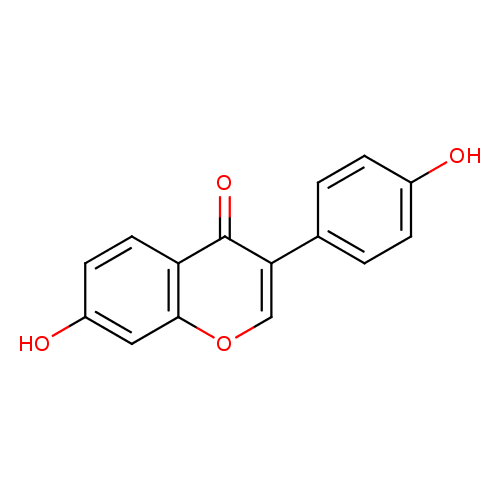
DescriptionDaidzein is one of several known isoflavones. Isoflavones compounds are found in a number of plants, but soybeans and soy products like tofu and textured vegetable protein are the primary food source. Up until recently, daidzein was considered to be one of the most important and most studied isoflavones, however more recently attention has shifted to isoflavone metabolites. Equol represents the main active product of daidzein metabolism, produced via specific microflora in the gut. The clinical effectiveness of soy isoflavones may be a function of the ability to biotransform soy isoflavones to the more potent estrogenic metabolite, equol, which may enhance the actions of soy isoflavones, owing to its greater affinity for estrogen receptors, unique antiandrogenic properties, and superior antioxidant activity. However, not all individuals consuming daidzein produce equol. Only approximately one-third to one-half of the population is able to metabolize daidzein to equol. This high variability in equol production is presumably attributable to interindividual differences in the composition of the intestinal microflora, which may play an important role in the mechanisms of action of isoflavones. But, the specific bacterial species in the colon involved in the production of equol are yet to be discovered. (2, 1).
Contaminant Sources
  • FooDB Chemicals
  • HMDB Contaminants - Urine
  • STOFF IDENT Compounds
  • T3DB toxins
  • ToxCast & Tox21 Chemicals
Contaminant Type
  • Ester
  • Food Toxin
  • Industrial/Workplace Toxin
  • Metabolite
  • Natural Compound
  • Organic Compound
  • Plant Toxin
Chemical Structure
Thumb
Synonyms
ValueSource
4',7-DihydroxyisoflavoneChEBI
7,4'-DihydroxyisoflavoneChEBI
7-Hydroxy-3-(4-hydroxyphenyl)-4-benzopyroneChEBI
7-Hydroxy-3-(4-hydroxyphenyl)-4H-1-benzopyran-4-oneChEBI
DaidzeolChEBI
IsoaurostatinChEBI
DiadzeinMeSH
4',7-Dihydroxy-isoflavoneHMDB
Chemical FormulaC15H10O4
Average Molecular Mass254.241 g/mol
Monoisotopic Mass254.058 g/mol
CAS Registry Number486-66-8
IUPAC Name7-hydroxy-3-(4-hydroxyphenyl)-4H-chromen-4-one
Traditional Namedaidzein
SMILESOC1=CC=C(C=C1)C1=COC2=C(C=CC(O)=C2)C1=O
InChI IdentifierInChI=1S/C15H10O4/c16-10-3-1-9(2-4-10)13-8-19-14-7-11(17)5-6-12(14)15(13)18/h1-8,16-17H
InChI KeyZQSIJRDFPHDXIC-UHFFFAOYSA-N
Chemical Taxonomy
Description belongs to the class of organic compounds known as isoflavones. These are polycyclic compounds containing a 2-isoflavene skeleton which bears a ketone group at the C4 carbon atom.
KingdomOrganic compounds
Super ClassPhenylpropanoids and polyketides
ClassIsoflavonoids
Sub ClassIsoflav-2-enes
Direct ParentIsoflavones
Alternative Parents
Substituents
  • Isoflavone
  • Hydroxyisoflavonoid
  • Chromone
  • Benzopyran
  • 1-benzopyran
  • Pyranone
  • Phenol
  • 1-hydroxy-2-unsubstituted benzenoid
  • Benzenoid
  • Monocyclic benzene moiety
  • Pyran
  • Heteroaromatic compound
  • Oxacycle
  • Organoheterocyclic compound
  • Organooxygen compound
  • Organic oxygen compound
  • Hydrocarbon derivative
  • Organic oxide
  • Aromatic heteropolycyclic compound
Molecular FrameworkAromatic heteropolycyclic compounds
External Descriptors
Biological Properties
StatusDetected and Not Quantified
OriginExogenous
Cellular Locations
  • Membrane
Biofluid LocationsNot Available
Tissue LocationsNot Available
PathwaysNot Available
Applications
Biological Roles
Chemical Roles
Physical Properties
StateSolid
AppearanceWhite powder.
Experimental Properties
PropertyValue
Melting Point323°C
Boiling PointNot Available
SolubilityNot Available
Predicted Properties
PropertyValueSource
Water Solubility0.085 g/LALOGPS
logP3.3ALOGPS
logP2.73ChemAxon
logS-3.5ALOGPS
pKa (Strongest Acidic)6.48ChemAxon
pKa (Strongest Basic)-5.3ChemAxon
Physiological Charge-1ChemAxon
Hydrogen Acceptor Count4ChemAxon
Hydrogen Donor Count2ChemAxon
Polar Surface Area66.76 ŲChemAxon
Rotatable Bond Count1ChemAxon
Refractivity69.7 m³·mol⁻¹ChemAxon
Polarizability25.75 ųChemAxon
Number of Rings3ChemAxon
Bioavailability1ChemAxon
Rule of FiveYesChemAxon
Ghose FilterYesChemAxon
Veber's RuleNoChemAxon
MDDR-like RuleNoChemAxon
Spectra
Spectra
Spectrum TypeDescriptionSplash KeyView
GC-MSGC-MS Spectrum - GC-EI-TOF (Pegasus III TOF-MS system, Leco; GC 6890, Agilent Technologies) (Non-derivatized)splash10-001j-1928000000-f956e5fd0e616ef96161Spectrum
GC-MSGC-MS Spectrum - GC-MS (2 TMS)splash10-000t-1619000000-eb2f87cd7d535b4d0446Spectrum
GC-MSGC-MS Spectrum - GC-EI-TOF (Non-derivatized)splash10-001j-1928000000-f956e5fd0e616ef96161Spectrum
GC-MSGC-MS Spectrum - GC-MS (Non-derivatized)splash10-000t-1619000000-eb2f87cd7d535b4d0446Spectrum
GC-MSGC-MS Spectrum - GC-EI-TOF (Non-derivatized)splash10-001j-1927000000-87f11afa0cde5b353147Spectrum
Predicted GC-MSPredicted GC-MS Spectrum - GC-MS (Non-derivatized) - 70eV, Positivesplash10-004i-1390000000-0ff8f0de4d2d339f9357Spectrum
Predicted GC-MSPredicted GC-MS Spectrum - GC-MS (2 TMS) - 70eV, Positivesplash10-00gi-4229000000-71c73470904ad7b680eeSpectrum
Predicted GC-MSPredicted GC-MS Spectrum - GC-MS (Non-derivatized) - 70eV, PositiveNot AvailableSpectrum
LC-MS/MSLC-MS/MS Spectrum - Quattro_QQQ 10V, Positive (Annotated)splash10-0udi-0090000000-20d2c8ade6aac1f46e8aSpectrum
LC-MS/MSLC-MS/MS Spectrum - Quattro_QQQ 25V, Positive (Annotated)splash10-0udi-0970000000-a2349152106bd9da1257Spectrum
LC-MS/MSLC-MS/MS Spectrum - Quattro_QQQ 40V, Positive (Annotated)splash10-0006-9100000000-691c394958fd19d47510Spectrum
LC-MS/MSLC-MS/MS Spectrum - LC-APPI-QQ (API2000) , Positivesplash10-0f7x-4900000000-5acb56232432597c00e5Spectrum
LC-MS/MSLC-MS/MS Spectrum - LC-APPI-QQ (API2000) , Positivesplash10-0pej-1930000000-89bedfb39603a12f3c75Spectrum
LC-MS/MSLC-MS/MS Spectrum - LC-APPI-QQ (API2000) , Positivesplash10-0a4i-0490000000-c633d3449d8bb0206fc2Spectrum
LC-MS/MSLC-MS/MS Spectrum - LC-APPI-QQ (API2000) , Positivesplash10-0a4i-0190000000-3a5de741e814e47d5cbeSpectrum
LC-MS/MSLC-MS/MS Spectrum - LC-APPI-QQ (API2000) , Positivesplash10-0a4i-0090000000-fb84819005f7f65b4fc8Spectrum
LC-MS/MSLC-MS/MS Spectrum - LC-APPI-QQ (API2000) , Positivesplash10-0a4i-0090000000-b3ae695d217c756a5f8fSpectrum
LC-MS/MSLC-MS/MS Spectrum - LC-ESI-QTOF (UPLC Q-Tof Premier, Waters) 5V, Positivesplash10-0a4i-0090000000-d25bba2f5a1ac12e3d86Spectrum
LC-MS/MSLC-MS/MS Spectrum - LC-ESI-QTOF (UPLC Q-Tof Premier, Waters) , Negativesplash10-0udi-0190000000-a9b6c8c416cb482a5dc1Spectrum
LC-MS/MSLC-MS/MS Spectrum - LC-ESI-QTOF (UPLC Q-Tof Premier, Waters) , Negativesplash10-0089-1970000000-f6070acf0fd663c4ae6fSpectrum
LC-MS/MSLC-MS/MS Spectrum - LC-ESI-QTOF (UPLC Q-Tof Premier, Waters) , Positivesplash10-0uem-1900000000-fa199caebb806e9eb0f9Spectrum
LC-MS/MSLC-MS/MS Spectrum - LC-ESI-QTOF (UPLC Q-Tof Premier, Waters) , Positivesplash10-0a4i-0490000000-3defe1cbaf29e0cd2d1fSpectrum
LC-MS/MSLC-MS/MS Spectrum - LC-ESI-QTOF (UPLC Q-Tof Premier, Waters) , Positivesplash10-0a4i-1790000000-2502633932fc66220039Spectrum
LC-MS/MSLC-MS/MS Spectrum - LC-ESI-QTOF (UPLC Q-Tof Premier, Waters) , Negativesplash10-0udi-0290000000-56b4c039a64ab57d3e70Spectrum
LC-MS/MSLC-MS/MS Spectrum - LC-ESI-QTOF (UPLC Q-Tof Premier, Waters) 30V, Negativesplash10-0089-2970000000-f32e85ba94cb6621d4f1Spectrum
Predicted LC-MS/MSPredicted LC-MS/MS Spectrum - 10V, Positivesplash10-0a4i-0090000000-7dcbed418d38de120895Spectrum
Predicted LC-MS/MSPredicted LC-MS/MS Spectrum - 20V, Positivesplash10-0a4i-0090000000-c522d590074eabe8c4c4Spectrum
Predicted LC-MS/MSPredicted LC-MS/MS Spectrum - 40V, Positivesplash10-002r-6950000000-7b85969731514bf2d0bcSpectrum
Predicted LC-MS/MSPredicted LC-MS/MS Spectrum - 10V, Negativesplash10-0udi-0090000000-388d21c85a84d4e0988aSpectrum
Predicted LC-MS/MSPredicted LC-MS/MS Spectrum - 20V, Negativesplash10-0udi-0090000000-cc8371583b5ba50a4f0dSpectrum
Predicted LC-MS/MSPredicted LC-MS/MS Spectrum - 40V, Negativesplash10-0gbi-3950000000-cb120c48a579b9363f74Spectrum
Predicted LC-MS/MSPredicted LC-MS/MS Spectrum - 10V, Positivesplash10-0a4i-0090000000-7dcbed418d38de120895Spectrum
Predicted LC-MS/MSPredicted LC-MS/MS Spectrum - 20V, Positivesplash10-0a4i-0090000000-c522d590074eabe8c4c4Spectrum
1D NMR1H NMR SpectrumNot AvailableSpectrum
2D NMR[1H,13C] 2D NMR SpectrumNot AvailableSpectrum
Toxicity Profile
Route of ExposureNot Available
Mechanism of ToxicityNot Available
MetabolismNot Available
Toxicity ValuesNot Available
Lethal DoseNot Available
Carcinogenicity (IARC Classification)No indication of carcinogenicity to humans (not listed by IARC).
Uses/SourcesIsoflavones compounds are found in a number of plants, but soybeans and soy products like tofu and textured vegetable protein are the primary food source. Equol represents the main active product of daidzein metabolism, produced via specific microflora in the gut.
Minimum Risk LevelNot Available
Health EffectsNot Available
SymptomsNot Available
TreatmentNot Available
Concentrations
Not Available
DrugBank IDDB13182
HMDB IDHMDB0003312
FooDB IDFDB002608
Phenol Explorer ID394
KNApSAcK IDC00009380
BiGG IDNot Available
BioCyc IDDAIDZEIN
METLIN IDNot Available
PDB IDNot Available
Wikipedia LinkDaidzein
Chemspider ID4445025
ChEBI ID28197
PubChem Compound ID5281708
Kegg Compound IDC10208
YMDB IDNot Available
ECMDB IDNot Available
References
Synthesis ReferenceBaker, Wilson; Robinson, Robert; Simpson, N. M. Synthetical experiments in the isoflavone group. VII. Synthesis of daidzein. Journal of the Chemical Society (1933), 274-5.
MSDSLink
General References
1. https://www.ncbi.nlm.nih.gov/pubmed/?term=11193416
2. https://www.ncbi.nlm.nih.gov/pubmed/?term=16802696
3. https://www.ncbi.nlm.nih.gov/pubmed/?term=23267126
4. https://www.ncbi.nlm.nih.gov/pubmed/?term=23337939
5. https://www.ncbi.nlm.nih.gov/pubmed/?term=23342971
6. https://www.ncbi.nlm.nih.gov/pubmed/?term=23439294
7. https://www.ncbi.nlm.nih.gov/pubmed/?term=9544566
8. Baker, Wilson; Robinson, Robert; Simpson, N. M. Synthetical experiments in the isoflavone group. VII. Synthesis of daidzein. Journal of the Chemical Society (1933), 274-5.
9. Antignac JP, Cariou R, Le Bizec B, Cravedi JP, Andre F: Identification of phytoestrogens in bovine milk using liquid chromatography/electrospray tandem mass spectrometry. Rapid Commun Mass Spectrom. 2003;17(12):1256-64. doi: 10.1002/rcm.1052.
10. Steinshamn H, Purup S, Thuen E, Hansen-Moller J: Effects of clover-grass silages and concentrate supplementation on the content of phytoestrogens in dairy cow milk. J Dairy Sci. 2008 Jul;91(7):2715-25. doi: 10.3168/jds.2007-0857.
11. Nielsen TS, Norgaard JV, Purup S, Frette XC, Bonefeld-Jorgensen EC: Estrogenic activity of bovine milk high or low in equol using immature mouse uterotrophic responses and an estrogen receptor transactivation assay. Cancer Epidemiol. 2009 Jul;33(1):61-8. doi: 10.1016/j.canep.2009.04.003. Epub 2009 May 31.
12. Baker, Wilson; Robinson, Robert; Simpson, N. M. Synthetical experiments in the isoflavone group. VII. Synthesis of daidzein. Journal of the Chemical Society (1933), 274-5.
13. Jackman KA, Woodman OL, Sobey CG: Isoflavones, equol and cardiovascular disease: pharmacological and therapeutic insights. Curr Med Chem. 2007;14(26):2824-30.
14. Yuan JP, Wang JH, Liu X: Metabolism of dietary soy isoflavones to equol by human intestinal microflora--implications for health. Mol Nutr Food Res. 2007 Jul;51(7):765-81.