Record Information
Version1.0
Creation Date2014-08-29 04:47:38 UTC
Update Date2026-03-31 18:04:45 UTC
Accession NumberCHEM002923
Identification
Common NameGenistein
ClassSmall Molecule
DescriptionGenistein is one of several known isoflavones. Isoflavones compounds, such as genistein and daidzein, are found in a number of plants, but soybeans and soy products like tofu and textured vegetable protein are the primary food source. Genistein is a natural bioactive compound derived from legumes and has drawn because of its potentially beneficial effects on some human degenerative diseases. It has a weak estrogenic effect and is a well-known non-specific tyrosine kinase inhibitor at pharmacological doses. Epidemiological studies show that genistein intake is inversely associated with the risk of cardiovascular diseases. Data suggests a protective role of genistein in cardiovascular events. However, the mechanisms of the genistein action on vascular protective effects are unclear. Past extensive studies exploring its hypolipidemic effect resulted in contradictory data. Genistein also is a relatively poor antioxidant. However, genistein protects against pro-inflammatory factor-induced vascular endothelial barrier dysfunction and inhibits leukocyte-endothelium interaction, thereby modulating vascular inflammation, a major event in the pathogenesis of atherosclerosis. Genistein exerts a non-genomic action by targeting on important signaling molecules in vascular endothelial cells (ECs). Genistein rapidly activates endothelial nitric oxide synthase and production of nitric oxide in ECs. This genistein effect is novel since it is independent of its known effects, but mediated by the cyclic adenosine monophosphate/protein kinase A (cAMP/PKA) cascade. Genistein directly stimulates the plasma membrane-associated adenylate cyclases, leading to activation of the cAMP signaling pathway. In addition, genistein activates peroxisome proliferator-activated receptors, ligand-activated nuclear receptors important to normal vascular function. Furthermore, genistein reduces reactive oxygen species (ROS) by attenuating the expression of ROS-producing enzymes. These findings reveal the roles for genistein in the regulation of vascular function and provide a basis for further investigating its therapeutic potential for inflammatory-related vascular disease. (1).
Contaminant Sources
  • Cosmetic Chemicals
  • FooDB Chemicals
  • HMDB Contaminants - Urine
  • STOFF IDENT Compounds
  • T3DB toxins
  • ToxCast & Tox21 Chemicals
Contaminant Type
  • Anticarcinogenic Agent
  • Ester
  • Food Toxin
  • Industrial/Workplace Toxin
  • Metabolite
  • Natural Compound
  • Organic Compound
  • Phytoestrogen
  • Plant Toxin
  • Protein Kinase Inhibitor
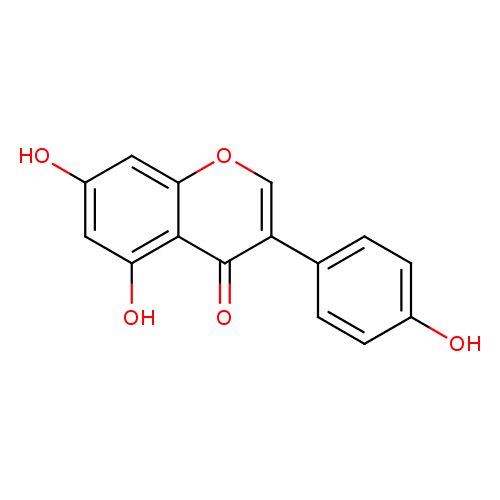
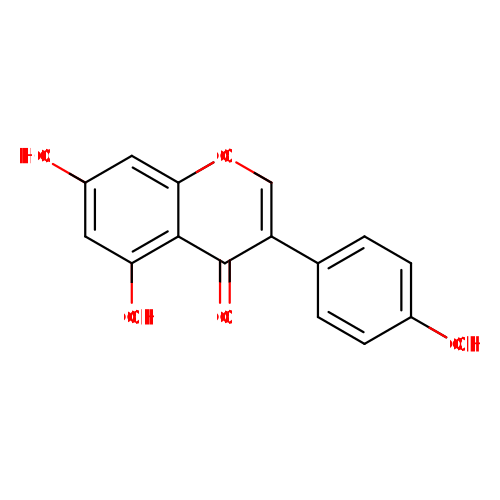
Chemical Structure
Thumb
Synonyms
ValueSource
4',5,7-TrihydroxyisoflavoneChEBI
5,7,4'-TrihydroxyisoflavoneChEBI
5,7-Dihydroxy-3-(4-hydroxyphenyl)-4H-1-benzopyran-4-oneChEBI
PrunetolChEBI
SophoricolChEBI
4',5, 7-TrihydroxyisoflavoneHMDB
4',5,7-Trihydroxy-isoflavoneHMDB
4,5,7-Trihydroxy iso-flavoneHMDB
Genistein 85% HPLCHMDB
GenisteolHMDB
GenisterinHMDB
GenesteinHMDB
Chemical FormulaC15H10O5
Average Molecular Mass270.240 g/mol
Monoisotopic Mass270.053 g/mol
CAS Registry Number446-72-0
IUPAC Name5,7-dihydroxy-3-(4-hydroxyphenyl)-4H-chromen-4-one
Traditional Namegenistein
SMILESOC1=CC=C(C=C1)C1=COC2=CC(O)=CC(O)=C2C1=O
InChI IdentifierInChI=1S/C15H10O5/c16-9-3-1-8(2-4-9)11-7-20-13-6-10(17)5-12(18)14(13)15(11)19/h1-7,16-18H
InChI KeyTZBJGXHYKVUXJN-UHFFFAOYSA-N
Chemical Taxonomy
Description belongs to the class of organic compounds known as isoflavones. These are polycyclic compounds containing a 2-isoflavene skeleton which bears a ketone group at the C4 carbon atom.
KingdomOrganic compounds
Super ClassPhenylpropanoids and polyketides
ClassIsoflavonoids
Sub ClassIsoflav-2-enes
Direct ParentIsoflavones
Alternative Parents
Substituents
  • Hydroxyisoflavonoid
  • Isoflavone
  • Chromone
  • Benzopyran
  • 1-benzopyran
  • 1-hydroxy-4-unsubstituted benzenoid
  • 1-hydroxy-2-unsubstituted benzenoid
  • Pyranone
  • Phenol
  • Monocyclic benzene moiety
  • Benzenoid
  • Pyran
  • Heteroaromatic compound
  • Vinylogous acid
  • Oxacycle
  • Organoheterocyclic compound
  • Organic oxygen compound
  • Organooxygen compound
  • Hydrocarbon derivative
  • Organic oxide
  • Aromatic heteropolycyclic compound
Molecular FrameworkAromatic heteropolycyclic compounds
External Descriptors
Biological Properties
StatusDetected and Not Quantified
OriginExogenous
Cellular Locations
  • Membrane
Biofluid LocationsNot Available
Tissue Locations
  • Adipose Tissue
  • Adrenal Gland
  • Epidermis
  • Fibroblasts
  • Intestine
  • Liver
  • Lymph Node
  • Muscle
  • Neuron
  • Placenta
  • Platelet
  • Prostate
  • Testes
PathwaysNot Available
Applications
Biological Roles
Chemical Roles
Physical Properties
StateSolid
AppearanceWhite powder.
Experimental Properties
PropertyValue
Melting Point301.5 dec°C
Boiling PointNot Available
SolubilityNot Available
Predicted Properties
PropertyValueSource
Water Solubility0.12 g/LALOGPS
logP3.04ALOGPS
logP3.08ChemAxon
logS-3.3ALOGPS
pKa (Strongest Acidic)6.55ChemAxon
pKa (Strongest Basic)-5.3ChemAxon
Physiological Charge-1ChemAxon
Hydrogen Acceptor Count5ChemAxon
Hydrogen Donor Count3ChemAxon
Polar Surface Area86.99 ŲChemAxon
Rotatable Bond Count1ChemAxon
Refractivity71.68 m³·mol⁻¹ChemAxon
Polarizability26.59 ųChemAxon
Number of Rings3ChemAxon
Bioavailability1ChemAxon
Rule of FiveYesChemAxon
Ghose FilterYesChemAxon
Veber's RuleNoChemAxon
MDDR-like RuleNoChemAxon
Spectra
Spectra
Spectrum TypeDescriptionSplash KeyView
GC-MSGC-MS Spectrum - GC-EI-TOF (Pegasus III TOF-MS system, Leco; GC 6890, Agilent Technologies) (Non-derivatized)splash10-00di-0321900000-1dd6fcaf99898bd949dfSpectrum
GC-MSGC-MS Spectrum - GC-EI-TOF (Non-derivatized)splash10-00di-0321900000-1dd6fcaf99898bd949dfSpectrum
Predicted GC-MSPredicted GC-MS Spectrum - GC-MS (Non-derivatized) - 70eV, Positivesplash10-0006-0490000000-2922d094b504ca63625fSpectrum
Predicted GC-MSPredicted GC-MS Spectrum - GC-MS (3 TMS) - 70eV, Positivesplash10-00di-3232900000-5532bb09d0ee2a1c2b07Spectrum
Predicted GC-MSPredicted GC-MS Spectrum - GC-MS (Non-derivatized) - 70eV, PositiveNot AvailableSpectrum
LC-MS/MSLC-MS/MS Spectrum - LC-APPI-QQ (API2000) , Positivesplash10-014l-9600000000-04b546320e268d817276Spectrum
LC-MS/MSLC-MS/MS Spectrum - LC-APPI-QQ (API2000) , Positivesplash10-00kf-5910000000-7e265d1b4640f882195aSpectrum
LC-MS/MSLC-MS/MS Spectrum - LC-APPI-QQ (API2000) , Positivesplash10-0v4m-1960000000-7843ec8ae23314f88147Spectrum
LC-MS/MSLC-MS/MS Spectrum - LC-APPI-QQ (API2000) , Positivesplash10-00di-0290000000-52ec910b223a3688fbc0Spectrum
LC-MS/MSLC-MS/MS Spectrum - LC-APPI-QQ (API2000) , Positivesplash10-00di-0190000000-4045f471e10774927fb0Spectrum
LC-MS/MSLC-MS/MS Spectrum - LC-APPI-QQ (API2000) , Positivesplash10-00di-0090000000-b593f863241cb83cbaa8Spectrum
LC-MS/MSLC-MS/MS Spectrum - LC-APPI-QQ (API2000) , Positivesplash10-00di-0190000000-0cd8d123608bd54f7214Spectrum
LC-MS/MSLC-MS/MS Spectrum - LC-ESI-QTOF (UPLC Q-Tof Premier, Waters) 5V, Positivesplash10-00di-0090000000-9ce354d07dc39313259bSpectrum
LC-MS/MSLC-MS/MS Spectrum - LC-ESI-QTOF (UPLC Q-Tof Premier, Waters) , Negativesplash10-001i-0910000000-5eb75a138568fa4ac897Spectrum
LC-MS/MSLC-MS/MS Spectrum - LC-ESI-QTOF (UPLC Q-Tof Premier, Waters) , Positivesplash10-0fr6-2920000000-a32f6ae97952bb96de05Spectrum
LC-MS/MSLC-MS/MS Spectrum - LC-ESI-QTOF (UPLC Q-Tof Premier, Waters) , Positivesplash10-00di-0290000000-4592d557e739a114cbfaSpectrum
LC-MS/MSLC-MS/MS Spectrum - LC-ESI-ITTOF (LCMS-IT-TOF) , Positivesplash10-00di-0090000000-14ae481944ad1a1f7ca0Spectrum
LC-MS/MSLC-MS/MS Spectrum - LC-ESI-ITTOF (LCMS-IT-TOF) , Negativesplash10-014i-0090030000-a3400b0a77da6983528fSpectrum
LC-MS/MSLC-MS/MS Spectrum - ESI-TOF , Negativesplash10-014i-0090000000-6db4d2441911d696b121Spectrum
LC-MS/MSLC-MS/MS Spectrum - ESI-TOF 20V, Negativesplash10-014i-0090000000-6db4d2441911d696b121Spectrum
LC-MS/MSLC-MS/MS Spectrum - ESI-TOF 50V, Negativesplash10-001i-0900000000-ad50062f85b9c32e1426Spectrum
LC-MS/MSLC-MS/MS Spectrum - ESI-TOF 40V, Negativesplash10-001i-0910000000-6a694e60823635f66757Spectrum
LC-MS/MSLC-MS/MS Spectrum - ESI-TOF , Negativesplash10-014i-0090000000-720c4e1f43db9f50b589Spectrum
LC-MS/MSLC-MS/MS Spectrum - ESI-TOF 20V, Negativesplash10-014i-0090000000-0e3ca66534f635efb4d8Spectrum
Predicted LC-MS/MSPredicted LC-MS/MS Spectrum - 10V, Positivesplash10-00di-0090000000-3ca72bf3c489e8b06845Spectrum
Predicted LC-MS/MSPredicted LC-MS/MS Spectrum - 20V, Positivesplash10-00di-0090000000-664850196c63c1380b4eSpectrum
Predicted LC-MS/MSPredicted LC-MS/MS Spectrum - 40V, Positivesplash10-0udi-5790000000-f3cf7e73e69ebaba0989Spectrum
Predicted LC-MS/MSPredicted LC-MS/MS Spectrum - 10V, Negativesplash10-014i-0090000000-aa4506f67fa71b5e6f4eSpectrum
Predicted LC-MS/MSPredicted LC-MS/MS Spectrum - 20V, Negativesplash10-014i-0090000000-f1f0ad0b45f461f988dbSpectrum
Predicted LC-MS/MSPredicted LC-MS/MS Spectrum - 40V, Negativesplash10-0gb9-3960000000-16725698ad6eee8f88dcSpectrum
1D NMR1H NMR SpectrumNot AvailableSpectrum
2D NMR[1H,13C] 2D NMR SpectrumNot AvailableSpectrum
Toxicity Profile
Route of ExposureNot Available
Mechanism of ToxicityGenistein may inhibit cancer cell growth by blocking enzymes required for cell growth. Genistein may decrease cardiovascular risk in postmenopausal women by interacting with the nuclear estrogen receptors to alter the transcription of cell specific genes. In randomized clinical trials, genistein was seen to increase the ratio of nitric oxide to endothelin and improved flow-mediated endothelium dependent vasodilation in healthy postmenopausal women. [1] In addition, genistein may have beneficial effects on glucose metabolism by inhibiting islet tyrosine kinase activity as well as insulin release dependent on glucose and sulfonylurea. [1]
MetabolismNot Available
Toxicity ValuesNot Available
Lethal DoseNot Available
Carcinogenicity (IARC Classification)No indication of carcinogenicity to humans (not listed by IARC).
Uses/SourcesCurrently Genistein is being studied in clinical trials as a treatment for prostate cancer.
Minimum Risk LevelNot Available
Health EffectsNot Available
SymptomsNot Available
TreatmentNot Available
Concentrations
Not Available
DrugBank IDDB01645
HMDB IDHMDB0003217
FooDB IDFDB011828
Phenol Explorer ID396
KNApSAcK IDC00002526
BiGG IDNot Available
BioCyc IDCPD-3141
METLIN ID3398
PDB IDNot Available
Wikipedia LinkGenistein
Chemspider ID4444448
ChEBI ID28088
PubChem Compound ID5280961
Kegg Compound IDC06563
YMDB IDNot Available
ECMDB IDNot Available
References
Synthesis Reference

J. Mark Weber, Andreas Constantinou, Paul E. Hessler, “Process of preparing genistein.” U.S. Patent US5554519, issued June, 1994.

MSDSLink
General References
1. Baker, Wilson; Robinson, Robert. Synthetical experiments in the isoflavone group. IV. Synthesis of 2-methylirigenol. Journal of the Chemical Society (1929), Volume Date 1928, 152-61.
2. King RA, Mano MM, Head RJ: Assessment of isoflavonoid concentrations in Australian bovine milk samples. J Dairy Res. 1998 Aug;65(3):479-89.
3. Antignac JP, Cariou R, Le Bizec B, Cravedi JP, Andre F: Identification of phytoestrogens in bovine milk using liquid chromatography/electrospray tandem mass spectrometry. Rapid Commun Mass Spectrom. 2003;17(12):1256-64. doi: 10.1002/rcm.1052.
4. Steinshamn H, Purup S, Thuen E, Hansen-Moller J: Effects of clover-grass silages and concentrate supplementation on the content of phytoestrogens in dairy cow milk. J Dairy Sci. 2008 Jul;91(7):2715-25. doi: 10.3168/jds.2007-0857.
5. Baker, Wilson; Robinson, Robert. Synthetical experiments in the isoflavone group. IV. Synthesis of 2-methylirigenol. Journal of the Chemical Society (1929), Volume Date 1928, 152-61.
6. Wisniewski AB, Klein SL, Lakshmanan Y, Gearhart JP: Exposure to genistein during gestation and lactation demasculinizes the reproductive system in rats. J Urol. 2003 Apr;169(4):1582-6.
7. Ohno S, Nakajima Y, Inoue K, Nakazawa H, Nakajin S: Genistein administration decreases serum corticosterone and testosterone levels in rats. Life Sci. 2003 Dec 26;74(6):733-42.
8. Kim S, Shin HJ, Kim SY, Kim JH, Lee YS, Kim DH, Lee MO: Genistein enhances expression of genes involved in fatty acid catabolism through activation of PPARalpha. Mol Cell Endocrinol. 2004 May 31;220(1-2):51-8.
9. de Pascual-Teresa S, Hallund J, Talbot D, Schroot J, Williams CM, Bugel S, Cassidy A: Absorption of isoflavones in humans: effects of food matrix and processing. J Nutr Biochem. 2006 Apr;17(4):257-64.
10. Huang X, Chen S, Xu L, Liu Y, Deb DK, Platanias LC, Bergan RC: Genistein inhibits p38 map kinase activation, matrix metalloproteinase type 2, and cell invasion in human prostate epithelial cells. Cancer Res. 2005 Apr 15;65(8):3470-8.
11. Ronis MJ, Little JM, Barone GW, Chen G, Radominska-Pandya A, Badger TM: Sulfation of the isoflavones genistein and daidzein in human and rat liver and gastrointestinal tract. J Med Food. 2006 Fall;9(3):348-55.
12. Fotsis T, Pepper MS, Aktas E, Breit S, Rasku S, Adlercreutz H, Wahala K, Montesano R, Schweigerer L: Flavonoids, dietary-derived inhibitors of cell proliferation and in vitro angiogenesis. Cancer Res. 1997 Jul 15;57(14):2916-21.
13. Casagrande F, Darbon JM: p21CIP1 is dispensable for the G2 arrest caused by genistein in human melanoma cells. Exp Cell Res. 2000 Jul 10;258(1):101-8.
14. Li Y, Ahmed F, Ali S, Philip PA, Kucuk O, Sarkar FH: Inactivation of nuclear factor kappaB by soy isoflavone genistein contributes to increased apoptosis induced by chemotherapeutic agents in human cancer cells. Cancer Res. 2005 Aug 1;65(15):6934-42.
15. D'Souza N, Skonberg DI, Camire ME, Guthrie KE, Malison J, Lima L: Influence of dietary genistein levels on tissue genistein deposition and on the physical, chemical, and sensory quality of rainbow trout, Oncorhynchus mykiss. J Agric Food Chem. 2005 May 4;53(9):3631-6.
16. Sonee M, Sum T, Wang C, Mukherjee SK: The soy isoflavone, genistein, protects human cortical neuronal cells from oxidative stress. Neurotoxicology. 2004 Sep;25(5):885-91.
17. Li M, Zhang Z, Hill DL, Chen X, Wang H, Zhang R: Genistein, a dietary isoflavone, down-regulates the MDM2 oncogene at both transcriptional and posttranslational levels. Cancer Res. 2005 Sep 15;65(18):8200-8.
18. Si H, Liu D: Phytochemical genistein in the regulation of vascular function: new insights. Curr Med Chem. 2007;14(24):2581-9.
19. Crisafulli A, Altavilla D, Marini H, Bitto A, Cucinotta D, Frisina N, Corrado F, D'Anna R, Squadrito G, Adamo EB, Marini R, Romeo A, Cancellieri F, Buemi M, Squadrito F: Effects of the phytoestrogen genistein on cardiovascular risk factors in postmenopausal women. Menopause. 2005 Mar;12(2):186-92.
20. https://www.ncbi.nlm.nih.gov/pubmed/?term=10741415
21. https://www.ncbi.nlm.nih.gov/pubmed/?term=11564287
22. https://www.ncbi.nlm.nih.gov/pubmed/?term=18413741
23. https://www.ncbi.nlm.nih.gov/pubmed/?term=18490856
24. https://www.ncbi.nlm.nih.gov/pubmed/?term=18815740
25. https://www.ncbi.nlm.nih.gov/pubmed/?term=19107852
26. https://www.ncbi.nlm.nih.gov/pubmed/?term=19402570
27. https://www.ncbi.nlm.nih.gov/pubmed/?term=22303062
28. https://www.ncbi.nlm.nih.gov/pubmed/?term=24297371
29. https://www.ncbi.nlm.nih.gov/pubmed/?term=24379139
30. https://www.ncbi.nlm.nih.gov/pubmed/?term=28166217