Record Information
Version1.0
Creation Date2014-08-29 04:47:20 UTC
Update Date2026-03-31 19:50:54 UTC
Accession NumberCHEM002920
Identification
Common NameMonoisobutyl phthalic acid
ClassSmall Molecule
DescriptionMonoisobutyl phthalic acid is a phthalate metabolite that has been found in human meconium and in semen , saliva , and urine Phthalate esters are a family of multifunctional compounds widely used as plasticizers, solvents, or additives in many diverse products such as poly(vinyl chloride) (PVC) materials, pharmaceuticals and medical devices, pesticides, lubricants, and personal care products. Humans have been exposed to phthalates through the manufacture, ubiquitous use, and disposal of PVC materials and other phthalate-containing products. (1, 2, 3, 1).
Contaminant Sources
  • FooDB Chemicals
  • HMDB Contaminants - Urine
  • T3DB toxins
Contaminant Type
  • Animal Toxin
  • Ester
  • Ether
  • Food Toxin
  • Industrial/Workplace Toxin
  • Metabolite
  • Natural Compound
  • Organic Compound
  • Pesticide
  • Plasticizer
  • Solvent
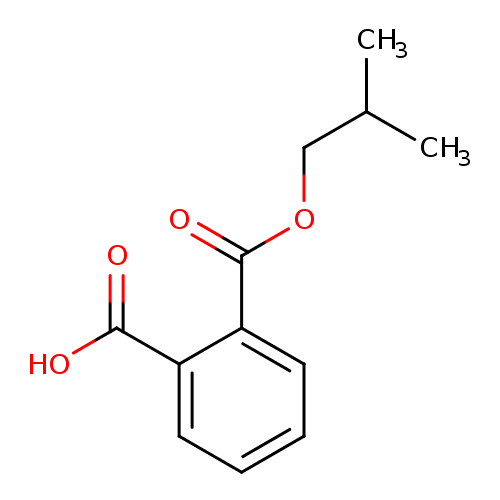
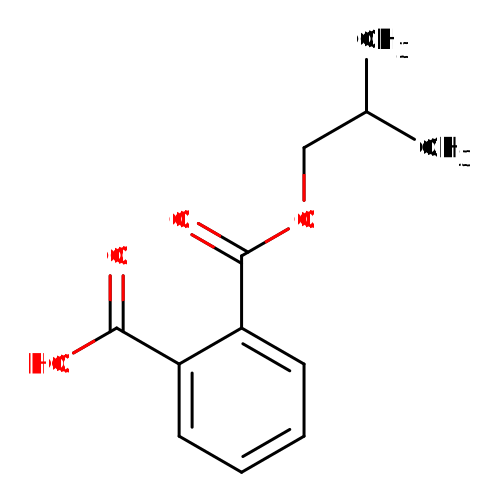
Chemical Structure
Thumb
Synonyms
ValueSource
1,2-Benzenedicarboxylic acid, mono(2-methylpropyl) esterChEBI
2-(Isobutoxycarbonyl)benzoic acidChEBI
Isobutyl hydrogen phthalateChEBI
MIBPChEBI
mono-Iso-butyl phthalateChEBI
Phthalic acid, monoisobutyl esterChEBI
1,2-Benzenedicarboxylate, mono(2-methylpropyl) esterGenerator
2-(Isobutoxycarbonyl)benzoateGenerator
Isobutyl hydrogen phthalic acidGenerator
mono-Iso-butyl phthalic acidGenerator
Phthalate, monoisobutyl esterGenerator
Monoisobutyl phthalateGenerator
Monoisobutyl phthalic acidChEBI
Chemical FormulaC12H14O4
Average Molecular Mass222.237 g/mol
Monoisotopic Mass222.089 g/mol
CAS Registry Number30833-53-5
IUPAC Name2-[(2-methylpropoxy)carbonyl]benzoic acid
Traditional NameMIBP
SMILESCC(C)COC(=O)C1=CC=CC=C1C(O)=O
InChI IdentifierInChI=1S/C12H14O4/c1-8(2)7-16-12(15)10-6-4-3-5-9(10)11(13)14/h3-6,8H,7H2,1-2H3,(H,13,14)
InChI KeyRZJSUWQGFCHNFS-UHFFFAOYSA-N
Chemical Taxonomy
Description belongs to the class of organic compounds known as benzoic acid esters. These are ester derivatives of benzoic acid.
KingdomOrganic compounds
Super ClassBenzenoids
ClassBenzene and substituted derivatives
Sub ClassBenzoic acids and derivatives
Direct ParentBenzoic acid esters
Alternative Parents
Substituents
  • Benzoate ester
  • Benzoic acid
  • Benzoyl
  • Dicarboxylic acid or derivatives
  • Carboxylic acid ester
  • Carboxylic acid
  • Carboxylic acid derivative
  • Organic oxygen compound
  • Organic oxide
  • Hydrocarbon derivative
  • Organooxygen compound
  • Aromatic homomonocyclic compound
Molecular FrameworkAromatic homomonocyclic compounds
External DescriptorsNot Available
Biological Properties
StatusDetected and Not Quantified
OriginExogenous
Cellular Locations
  • Membrane
Biofluid LocationsNot Available
Tissue LocationsNot Available
PathwaysNot Available
ApplicationsNot Available
Biological RolesNot Available
Chemical RolesNot Available
Physical Properties
StateSolid
AppearanceWhite powder.
Experimental Properties
PropertyValue
Melting PointNot Available
Boiling PointNot Available
SolubilityNot Available
Predicted Properties
PropertyValueSource
Water Solubility0.79 g/LALOGPS
logP2.38ALOGPS
logP2.88ChemAxon
logS-2.4ALOGPS
pKa (Strongest Acidic)3.08ChemAxon
pKa (Strongest Basic)-7ChemAxon
Physiological Charge-1ChemAxon
Hydrogen Acceptor Count3ChemAxon
Hydrogen Donor Count1ChemAxon
Polar Surface Area63.6 ŲChemAxon
Rotatable Bond Count5ChemAxon
Refractivity59.08 m³·mol⁻¹ChemAxon
Polarizability22.83 ųChemAxon
Number of Rings1ChemAxon
Bioavailability1ChemAxon
Rule of FiveYesChemAxon
Ghose FilterYesChemAxon
Veber's RuleNoChemAxon
MDDR-like RuleNoChemAxon
Spectra
Spectra
Spectrum TypeDescriptionSplash KeyView
Predicted GC-MSPredicted GC-MS Spectrum - GC-MS (Non-derivatized) - 70eV, Positivesplash10-0002-4910000000-ac2484b74eb5cfd5b690Spectrum
Predicted GC-MSPredicted GC-MS Spectrum - GC-MS (1 TMS) - 70eV, Positivesplash10-00di-6390000000-4ca9de5bf766a991b3dcSpectrum
Predicted GC-MSPredicted GC-MS Spectrum - GC-MS (Non-derivatized) - 70eV, PositiveNot AvailableSpectrum
LC-MS/MSLC-MS/MS Spectrum - LC-ESI-QFT , negativesplash10-0089-0930000000-d249a5cd21193a8a3cd2Spectrum
LC-MS/MSLC-MS/MS Spectrum - LC-ESI-QFT , positivesplash10-0002-0900000000-13d64e3eb0a1e3e235beSpectrum
LC-MS/MSLC-MS/MS Spectrum - 35V, Negativesplash10-0089-0930000000-3a306e5ce6ca6a0e9127Spectrum
LC-MS/MSLC-MS/MS Spectrum - 35V, Positivesplash10-0002-0900000000-b4a2e5d94dccaced84c1Spectrum
Predicted LC-MS/MSPredicted LC-MS/MS Spectrum - 10V, Positivesplash10-0ab9-6690000000-8f32418bd6ccde0549c0Spectrum
Predicted LC-MS/MSPredicted LC-MS/MS Spectrum - 20V, Positivesplash10-0a4i-9720000000-286cdd7561a043eef3d0Spectrum
Predicted LC-MS/MSPredicted LC-MS/MS Spectrum - 40V, Positivesplash10-0a4i-9500000000-6c3aca6817c2db6bb804Spectrum
Predicted LC-MS/MSPredicted LC-MS/MS Spectrum - 10V, Negativesplash10-00di-1790000000-2d20ca2ec96d84986321Spectrum
Predicted LC-MS/MSPredicted LC-MS/MS Spectrum - 20V, Negativesplash10-0100-2910000000-46c6c191f37b2782021aSpectrum
Predicted LC-MS/MSPredicted LC-MS/MS Spectrum - 40V, Negativesplash10-00di-6900000000-0d9a0ca1ebdbc964dac0Spectrum
Predicted LC-MS/MSPredicted LC-MS/MS Spectrum - 10V, Positivesplash10-0a4j-0940000000-827565da796a34bbd6b1Spectrum
Predicted LC-MS/MSPredicted LC-MS/MS Spectrum - 20V, Positivesplash10-052b-1900000000-bfe543859b406a2dae92Spectrum
Predicted LC-MS/MSPredicted LC-MS/MS Spectrum - 40V, Positivesplash10-0a4i-2900000000-8cb1cf43ad6057fc27c8Spectrum
Predicted LC-MS/MSPredicted LC-MS/MS Spectrum - 10V, Negativesplash10-00b9-0930000000-2a9d225bebcec6f94629Spectrum
Predicted LC-MS/MSPredicted LC-MS/MS Spectrum - 20V, Negativesplash10-004i-6910000000-2ae4c65b2cf89d2dde5aSpectrum
Predicted LC-MS/MSPredicted LC-MS/MS Spectrum - 40V, Negativesplash10-004i-9200000000-c321d909ae49bc32f15aSpectrum
Toxicity Profile
Route of ExposureNot Available
Mechanism of ToxicityPhthalates are synthetic industrial compounds capable of disrupting the endocrine system. The phthalates have been the most common chemical compounds with the ability to disrupt the endocrine system. Phthalates, when acting in a critical period of the development of genital tract, lead to disturbances in the androgen-signaling pathway. Fetal testicular dysgenesis syndrome, otherwise known as the ”phthalate syndrome” in rodents, is a consequence of reduced level of fetal testosterone, insulin-like growth factor-3 (IGF-3) and follicule stimulating hormone (FSH). A negative correlation between levels in breast milk and free testosterone of babies was observed, while there was a positive correlation between mono-ethyl phthalate (MEP) and mono-butyl (MBP) with sex hormone bingind globuline (SHBG) and mono-metyl phthalate (MMP) and MEP and MBP with the ratio of lutenzing hormone (LH) and free testosterone. Exposure to phthalates is significantly associated with the duration of pregnancy. According to some studies, the chemical structure of some phthalates and prostaglandin/thromboxane, interleukin-1 connects the phthalates with induction of intrauterine inflammatory processes as well as shortening of pregnancy. (4)
MetabolismNot Available
Toxicity ValuesNot Available
Lethal DoseNot Available
Carcinogenicity (IARC Classification)No indication of carcinogenicity to humans (not listed by IARC).
Uses/SourcesThis is a natural compound that is used as a pesticide.
Minimum Risk LevelNot Available
Health EffectsNot Available
SymptomsNot Available
TreatmentNot Available
Concentrations
Not Available
DrugBank IDNot Available
HMDB IDHMDB0002056
FooDB IDFDB022820
Phenol Explorer IDNot Available
KNApSAcK IDNot Available
BiGG IDNot Available
BioCyc IDNot Available
METLIN IDNot Available
PDB IDNot Available
Wikipedia LinkNot Available
Chemspider ID83306
ChEBI ID90038
PubChem Compound ID92272
Kegg Compound IDNot Available
YMDB IDNot Available
ECMDB IDNot Available
References
Synthesis ReferenceKe, Changying. Esterification synthesis of diisobutyl phthalate. Huaxue Shijie (1986), 27(10), 440-2.
MSDSNot Available
General References
1. https://www.ncbi.nlm.nih.gov/pubmed/?term=25558797
2. https://www.ncbi.nlm.nih.gov/pubmed/?term=25938866
3. https://www.ncbi.nlm.nih.gov/pubmed/?term=26036586
4. https://www.ncbi.nlm.nih.gov/pubmed/?term=26207744
5. https://www.ncbi.nlm.nih.gov/pubmed/?term=26233661
6. https://www.ncbi.nlm.nih.gov/pubmed/?term=26251123
7. https://www.ncbi.nlm.nih.gov/pubmed/?term=26385792
8. https://www.ncbi.nlm.nih.gov/pubmed/?term=26545148
9. https://www.ncbi.nlm.nih.gov/pubmed/?term=26575634
10. https://www.ncbi.nlm.nih.gov/pubmed/?term=26586408
11. https://www.ncbi.nlm.nih.gov/pubmed/?term=26608625
12. https://www.ncbi.nlm.nih.gov/pubmed/?term=26947464
13. https://www.ncbi.nlm.nih.gov/pubmed/?term=27079661
14. https://www.ncbi.nlm.nih.gov/pubmed/?term=27156842
15. https://www.ncbi.nlm.nih.gov/pubmed/?term=27372718
16. Ke, Changying. Esterification synthesis of diisobutyl phthalate. Huaxue Shijie (1986), 27(10), 440-2.
17. Silva MJ, Reidy JA, Samandar E, Herbert AR, Needham LL, Calafat AM: Detection of phthalate metabolites in human saliva. Arch Toxicol. 2005 Nov;79(11):647-52. Epub 2005 Jul 2.
18. Kato K, Silva MJ, Needham LL, Calafat AM: Quantifying phthalate metabolites in human meconium and semen using automated off-line solid-phase extraction coupled with on-line SPE and isotope-dilution high-performance liquid chromatography--tandem mass spectrometry. Anal Chem. 2006 Sep 15;78(18):6651-5.
19. Silva MJ, Slakman AR, Reidy JA, Preau JL Jr, Herbert AR, Samandar E, Needham LL, Calafat AM: Analysis of human urine for fifteen phthalate metabolites using automated solid-phase extraction. J Chromatogr B Analyt Technol Biomed Life Sci. 2004 Jun 5;805(1):161-7.