Record Information
Version1.0
Creation Date2014-08-29 04:47:15 UTC
Update Date2026-04-03 00:02:08 UTC
Accession NumberCHEM002918
Identification
Common NameDiethylthiophosphate
ClassSmall Molecule
DescriptionDiethylthiophosphate is the most frequent metabolite of organophosphorus (OP) found in urine Organophosphorus compounds are widely used as pesticides because of easy degradation in the environment. Acute OP intoxication results from blockage of the decomposition of synaptic acetylcholine because the pesticide covalently binds to chlolinesterase Chronic exposure to POs has neurological sequelae as well and data suggests that OP exposure alters sperm chromatin condensation (1, 2, 3, 1).
Contaminant Sources
  • FooDB Chemicals
  • HMDB Contaminants - Urine
  • T3DB toxins
Contaminant Type
  • Animal Toxin
  • Ester
  • Food Toxin
  • Metabolite
  • Natural Compound
  • Organic Compound
  • Pesticide
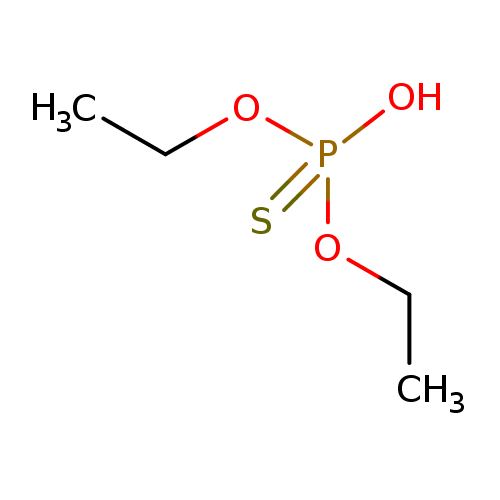
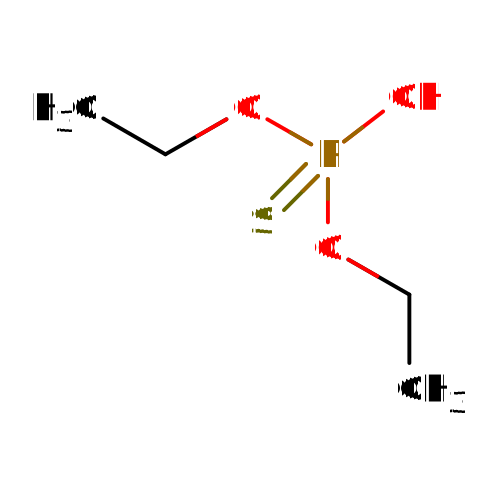
Chemical Structure
Thumb
Synonyms
ValueSource
DETPChEBI
Diethylthiophosphoric acidChEBI
DiethylthiophosphorateHMDB
O,O-Diethyl phosphorothionateHMDB
O,O-Diethyl phosphorothionate, ammonium saltMeSH, HMDB
O,O-Diethyl phosphorothionate, sodium saltMeSH, HMDB
O,O-Diethyl phosphorothioateMeSH, HMDB
O,O-Diethyl phosphorothionate, potassium saltMeSH, HMDB
DiethylthiophosphateGenerator
O,O-Diethyl hydrogen thiophosphoric acidGenerator, HMDB
Chemical FormulaC4H11O3PS
Average Molecular Mass170.167 g/mol
Monoisotopic Mass170.017 g/mol
CAS Registry Number5871-17-0
IUPAC Namediethoxy(sulfanylidene)phosphinous acid
Traditional NameDETP
SMILESCCOP(O)(=S)OCC
InChI IdentifierInChI=1S/C4H11O3PS/c1-3-6-8(5,9)7-4-2/h3-4H2,1-2H3,(H,5,9)
InChI KeyPKUWKAXTAVNIJR-UHFFFAOYSA-N
Chemical Taxonomy
Description belongs to the class of organic compounds known as thiophosphate diesters. These are organic compounds containing the thiophosphoric acid functional group or a derivative thereof, with the general structure ROP(OR')(OR'')=S, where exactly two R-groups are organyl groups.
KingdomOrganic compounds
Super ClassOrganic acids and derivatives
ClassOrganic thiophosphoric acids and derivatives
Sub ClassThiophosphoric acid esters
Direct ParentThiophosphate diesters
Alternative Parents
Substituents
  • Thiophosphate diester
  • Organic oxygen compound
  • Hydrocarbon derivative
  • Organooxygen compound
  • Aliphatic acyclic compound
Molecular FrameworkAliphatic acyclic compounds
External Descriptors
Biological Properties
StatusDetected and Not Quantified
OriginExogenous
Cellular Locations
  • Cytoplasm
  • Extracellular
Biofluid LocationsNot Available
Tissue LocationsNot Available
PathwaysNot Available
ApplicationsNot Available
Biological Roles
Chemical RolesNot Available
Physical Properties
StateSolid
AppearanceWhite powder.
Experimental Properties
PropertyValue
Melting PointNot Available
Boiling PointNot Available
SolubilityNot Available
Predicted Properties
PropertyValueSource
Water Solubility6.06 g/LALOGPS
logP1.22ALOGPS
logP1.34ChemAxon
logS-1.4ALOGPS
pKa (Strongest Acidic)2.86ChemAxon
Physiological Charge-1ChemAxon
Hydrogen Acceptor Count1ChemAxon
Hydrogen Donor Count1ChemAxon
Polar Surface Area38.69 ŲChemAxon
Rotatable Bond Count4ChemAxon
Refractivity41.1 m³·mol⁻¹ChemAxon
Polarizability15.97 ųChemAxon
Number of Rings0ChemAxon
Bioavailability1ChemAxon
Rule of FiveYesChemAxon
Ghose FilterYesChemAxon
Veber's RuleYesChemAxon
MDDR-like RuleNoChemAxon
Spectra
Spectra
Spectrum TypeDescriptionSplash KeyView
Predicted GC-MSPredicted GC-MS Spectrum - GC-MS (Non-derivatized) - 70eV, Positivesplash10-01vo-4900000000-eca7564ce2ac94c32b49Spectrum
Predicted GC-MSPredicted GC-MS Spectrum - GC-MS (Non-derivatized) - 70eV, PositiveNot AvailableSpectrum
LC-MS/MSLC-MS/MS Spectrum - Quattro_QQQ 10V, Positive (Annotated)splash10-014l-0900000000-4d60832ad8293c6ffadaSpectrum
LC-MS/MSLC-MS/MS Spectrum - Quattro_QQQ 25V, Positive (Annotated)splash10-00kb-9400000000-4edb8f3e7564089a88f3Spectrum
LC-MS/MSLC-MS/MS Spectrum - Quattro_QQQ 40V, Positive (Annotated)splash10-000t-9000000000-992c7d4759e33fca928dSpectrum
LC-MS/MSLC-MS/MS Spectrum - LC-ESI-QQ (API3000, Applied Biosystems) 10V, Negativesplash10-014i-0900000000-c8423ea1caef16b9a74eSpectrum
LC-MS/MSLC-MS/MS Spectrum - LC-ESI-QQ (API3000, Applied Biosystems) 20V, Negativesplash10-0005-7900000000-eba2d541218620747842Spectrum
LC-MS/MSLC-MS/MS Spectrum - LC-ESI-QQ (API3000, Applied Biosystems) 30V, Negativesplash10-0002-9000000000-ae31cece541b8a3affddSpectrum
LC-MS/MSLC-MS/MS Spectrum - LC-ESI-QQ (API3000, Applied Biosystems) 40V, Negativesplash10-0002-9000000000-1772cdb892c30908258dSpectrum
LC-MS/MSLC-MS/MS Spectrum - LC-ESI-QQ (API3000, Applied Biosystems) 50V, Negativesplash10-0002-9000000000-0a0320defdca903d57ddSpectrum
LC-MS/MSLC-MS/MS Spectrum - LC-ESI-QQ , negativesplash10-014i-0900000000-c8423ea1caef16b9a74eSpectrum
LC-MS/MSLC-MS/MS Spectrum - LC-ESI-QQ , negativesplash10-0005-7900000000-eba2d541218620747842Spectrum
LC-MS/MSLC-MS/MS Spectrum - LC-ESI-QQ , negativesplash10-0002-9000000000-ae31cece541b8a3affddSpectrum
LC-MS/MSLC-MS/MS Spectrum - LC-ESI-QQ , negativesplash10-0002-9000000000-1772cdb892c30908258dSpectrum
LC-MS/MSLC-MS/MS Spectrum - LC-ESI-QQ , negativesplash10-0002-9000000000-0a0320defdca903d57ddSpectrum
Predicted LC-MS/MSPredicted LC-MS/MS Spectrum - 10V, Positivesplash10-00dl-0900000000-5044901daaf5712fa9ecSpectrum
Predicted LC-MS/MSPredicted LC-MS/MS Spectrum - 20V, Positivesplash10-03kc-1900000000-19204dbb8b74001b3fd2Spectrum
Predicted LC-MS/MSPredicted LC-MS/MS Spectrum - 40V, Positivesplash10-004i-7900000000-f90194c8eeb269ef0a00Spectrum
Predicted LC-MS/MSPredicted LC-MS/MS Spectrum - 10V, Negativesplash10-00kf-1900000000-e860be0b6c7be56a72f3Spectrum
Predicted LC-MS/MSPredicted LC-MS/MS Spectrum - 20V, Negativesplash10-0006-9700000000-8cf600a8319cb75ee542Spectrum
Predicted LC-MS/MSPredicted LC-MS/MS Spectrum - 40V, Negativesplash10-03dm-9700000000-f384fa244ef2411c8f54Spectrum
Predicted LC-MS/MSPredicted LC-MS/MS Spectrum - 10V, Negativesplash10-0006-9500000000-ff238d3cf2c783ff8b25Spectrum
Predicted LC-MS/MSPredicted LC-MS/MS Spectrum - 20V, Negativesplash10-0006-9000000000-7ed10e2dbf916ab00db8Spectrum
Predicted LC-MS/MSPredicted LC-MS/MS Spectrum - 40V, Negativesplash10-0006-9000000000-7ed10e2dbf916ab00db8Spectrum
Predicted LC-MS/MSPredicted LC-MS/MS Spectrum - 10V, Positivesplash10-03dl-0900000000-c7095c703601052b840fSpectrum
Predicted LC-MS/MSPredicted LC-MS/MS Spectrum - 20V, Positivesplash10-03di-1900000000-735f3f957e502e52eef3Spectrum
Predicted LC-MS/MSPredicted LC-MS/MS Spectrum - 40V, Positivesplash10-0002-9000000000-b9b7ee005a9da13c1a9dSpectrum
1D NMR1H NMR SpectrumNot AvailableSpectrum
1D NMR13C NMR SpectrumNot AvailableSpectrum
1D NMR1H NMR SpectrumNot AvailableSpectrum
1D NMR13C NMR SpectrumNot AvailableSpectrum
1D NMR1H NMR SpectrumNot AvailableSpectrum
1D NMR13C NMR SpectrumNot AvailableSpectrum
1D NMR1H NMR SpectrumNot AvailableSpectrum
1D NMR13C NMR SpectrumNot AvailableSpectrum
1D NMR1H NMR SpectrumNot AvailableSpectrum
1D NMR13C NMR SpectrumNot AvailableSpectrum
1D NMR1H NMR SpectrumNot AvailableSpectrum
1D NMR13C NMR SpectrumNot AvailableSpectrum
1D NMR1H NMR SpectrumNot AvailableSpectrum
1D NMR13C NMR SpectrumNot AvailableSpectrum
1D NMR1H NMR SpectrumNot AvailableSpectrum
1D NMR13C NMR SpectrumNot AvailableSpectrum
1D NMR1H NMR SpectrumNot AvailableSpectrum
1D NMR13C NMR SpectrumNot AvailableSpectrum
1D NMR1H NMR SpectrumNot AvailableSpectrum
1D NMR13C NMR SpectrumNot AvailableSpectrum
1D NMR1H NMR SpectrumNot AvailableSpectrum
2D NMR[1H,13C] 2D NMR SpectrumNot AvailableSpectrum
Toxicity Profile
Route of ExposureNot Available
Mechanism of ToxicityDiethylthiophosphate (DETP) induces DNA damage only in the hepatic cell lines, and this effect could be related to a secondary non-diffusible metabolite generated by the activity of P450 enzymes since P450 enzyme inhibitors also inhibited the induction of DNA damage in hepatic cells. This organophosphorous (OP) metabolite has shown some toxicity in human peripheral blood mononucleated cells (PBMC). DETP is a cytotoxic compound in human PBMC. A relationship between urinary levels of DETP and the number of sperm susceptible to chromatin alteration has been reported among rural agricultural workers. In addition, a correlation between the frequency of aneuploidy in sperm and the levels of DETP in urine was identified in a rural population exposed to OP pesticides, indicating that the potential for genotoxicity following OP exposure may depend on the type and quantity of specific metabolites produced, such as DETP. (7)
MetabolismMetabolism of organophosphates occurs principally by oxidation, by hydrolysis via esterases and by reaction with glutathione. Demethylation and glucuronidation may also occur. Oxidation of organophosphorus pesticides may result in moderately toxic products. In general, phosphorothioates are not directly toxic but require oxidative metabolism to the proximal toxin. The glutathione transferase reactions produce products that are, in most cases, of low toxicity. Paraoxonase (PON1) is a key enzyme in the metabolism of organophosphates. PON1 can inactivate some organophosphates through hydrolysis. PON1 hydrolyzes the active metabolites in several organophosphates insecticides as well as, nerve agents such as soman, sarin, and VX. The presence of PON1 polymorphisms causes there to be different enzyme levels and catalytic efficiency of this esterase, which in turn suggests that different individuals may be more susceptible to the toxic effect of organophosphate exposure.
Toxicity ValuesNot Available
Lethal DoseNot Available
Carcinogenicity (IARC Classification)No indication of carcinogenicity to humans (not listed by IARC).
Uses/SourcesThis is a natural compound that is used as a pesticide.
Minimum Risk LevelNot Available
Health EffectsNot Available
SymptomsNot Available
TreatmentNot Available
Concentrations
Not Available
DrugBank IDDB07674
HMDB IDHMDB0001460
FooDB IDFDB022638
Phenol Explorer IDNot Available
KNApSAcK IDNot Available
BiGG IDNot Available
BioCyc IDNot Available
METLIN ID6256
PDB IDNot Available
Wikipedia LinkNot Available
Chemspider ID635
ChEBI ID28006
PubChem Compound ID655
Kegg Compound IDC06607
YMDB IDNot Available
ECMDB IDNot Available
References
Synthesis ReferenceNot Available
MSDSLink
General References
1. https://www.ncbi.nlm.nih.gov/pubmed/?term=15050412
2. https://www.ncbi.nlm.nih.gov/pubmed/?term=23892639
3. Heudorf U, Angerer J: Metabolites of organophosphorous insecticides in urine specimens from inhabitants of a residential area. Environ Res. 2001 May;86(1):80-7.
4. Wagner SL, Orwick DL: Chronic organophosphate exposure associated with transient hypertonia in an infant. Pediatrics. 1994 Jul;94(1):94-7.
5. Aprea C, Sciarra G, Orsi D, Boccalon P, Sartorelli P, Sartorelli E: Urinary excretion of alkylphosphates in the general population (Italy). Sci Total Environ. 1996 Jan 5;177(1-3):37-41.
6. Sanchez-Pena LC, Reyes BE, Lopez-Carrillo L, Recio R, Moran-Martinez J, Cebrian ME, Quintanilla-Vega B: Organophosphorous pesticide exposure alters sperm chromatin structure in Mexican agricultural workers. Toxicol Appl Pharmacol. 2004 Apr 1;196(1):108-13.
7. Lin WC, Kuei CH, Wu HC, Yang CC, Chang HY: Method for the determination of dialkyl phosphates in urine by strong anion exchange disk extraction and in-vial derivatization. J Anal Toxicol. 2002 Apr;26(3):176-80.
8. Steenland K, Jenkins B, Ames RG, O'Malley M, Chrislip D, Russo J: Chronic neurological sequelae to organophosphate pesticide poisoning. Am J Public Health. 1994 May;84(5):731-6.