Record Information
Version1.0
Creation Date2014-08-28 21:19:25 UTC
Update Date2026-05-14 16:48:06 UTC
Accession NumberCHEM002915
Identification
Common NameTetracycline
ClassSmall Molecule
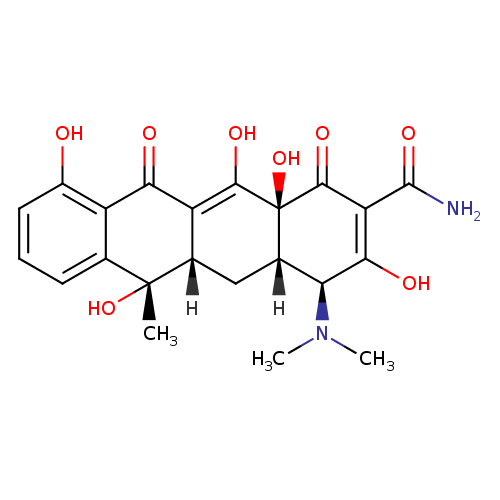
DescriptionTetracycline is a broad spectrum polyketide antibiotic produced by the Streptomyces genus of Actinobacteria. It exerts a bacteriostatic effect on bacteria by binding reversible to the bacterial 30S ribosomal subunit and blocking incoming aminoacyl tRNA from binding to the ribosome acceptor site. It also binds to some extent to the bacterial 50S ribosomal subunit and may alter the cytoplasmic membrane causing intracellular components to leak from bacterial cells.
Contaminant Sources
  • HMDB Contaminants - Urine
  • STOFF IDENT Compounds
  • T3DB toxins
  • ToxCast & Tox21 Chemicals
Contaminant Type
  • Anti-Bacterial Agent
  • Antiprotozoal Agent
  • Drug
  • Human Neurotoxin
  • Metabolite
  • Organic Compound
  • Protein Synthesis Inhibitor
  • Synthetic Compound
  • Tetracycline
Chemical Structure
Thumb
Synonyms
ValueSource
(4S,4AS,5as,12as)-4-(dimethylamino)-1,4,4a,5,5a,6,11,12a-octahydro-3,6,10,12,12a-pentahydroxy-6-methyl-1,11-dioxo-2-naphthacenecarboxamideChEBI
AbramycinChEBI
AchromycinChEBI
AnhydrotetracyclineChEBI
DeschlorobiomycinChEBI
LiquamycinChEBI
TetracyclinChEBI
TetracyclinumChEBI
TetrazyklinChEBI
TsiklomitsinChEBI
TCKegg
SumycinKegg
Tetracycline HCLHMDB
Chemical FormulaC22H24N2O8
Average Molecular Mass444.435 g/mol
Monoisotopic Mass444.153 g/mol
CAS Registry Number60-54-8
IUPAC Name(4S,4aS,5aS,6S,12aS)-4-(dimethylamino)-3,6,10,12,12a-pentahydroxy-6-methyl-1,11-dioxo-1,4,4a,5,5a,6,11,12a-octahydrotetracene-2-carboxamide
Traditional Nametetracycline
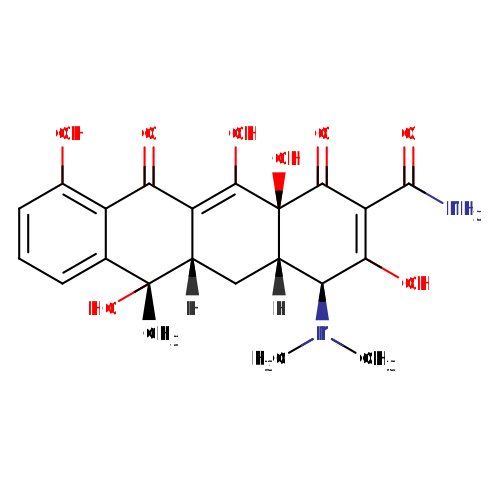
SMILES[H][C@@]12C[C@@]3([H])C(=C(O)[C@]1(O)C(=O)C(C(N)=O)=C(O)[C@H]2N(C)C)C(=O)C1=C(O)C=CC=C1[C@@]3(C)O
InChI IdentifierInChI=1S/C22H24N2O8/c1-21(31)8-5-4-6-11(25)12(8)16(26)13-9(21)7-10-15(24(2)3)17(27)14(20(23)30)19(29)22(10,32)18(13)28/h4-6,9-10,15,25,27-28,31-32H,7H2,1-3H3,(H2,23,30)/t9-,10-,15-,21+,22-/m0/s1
InChI KeyOFVLGDICTFRJMM-WESIUVDSSA-N
Chemical Taxonomy
Description belongs to the class of organic compounds known as tetracyclines. These are polyketides having an octahydrotetracene-2-carboxamide skeleton, substituted with many hydroxy and other groups.
KingdomOrganic compounds
Super ClassPhenylpropanoids and polyketides
ClassTetracyclines
Sub ClassNot Available
Direct ParentTetracyclines
Alternative Parents
Substituents
  • Tetracycline
  • Naphthacene
  • Tetracene
  • Anthracene carboxylic acid or derivatives
  • Tetralin
  • Aryl ketone
  • 1-hydroxy-4-unsubstituted benzenoid
  • 1-hydroxy-2-unsubstituted benzenoid
  • Cyclohexenone
  • Aralkylamine
  • Benzenoid
  • Tertiary alcohol
  • Vinylogous acid
  • Tertiary aliphatic amine
  • Amino acid or derivatives
  • Tertiary amine
  • Carboxamide group
  • Primary carboxylic acid amide
  • Ketone
  • Polyol
  • Carboxylic acid derivative
  • Enol
  • Amine
  • Organic oxygen compound
  • Organopnictogen compound
  • Organonitrogen compound
  • Organooxygen compound
  • Alcohol
  • Carbonyl group
  • Organic nitrogen compound
  • Organic oxide
  • Hydrocarbon derivative
  • Aromatic homopolycyclic compound
Molecular FrameworkAromatic homopolycyclic compounds
External Descriptors
Biological Properties
StatusDetected and Not Quantified
OriginExogenous
Cellular Locations
  • Cytoplasm
  • Extracellular
  • Membrane
Biofluid LocationsNot Available
Tissue Locations
  • Bone Marrow
  • Heart
  • Liver
Pathways
NameSMPDB LinkKEGG Link
Tetracycline Action PathwaySMP00294 Not Available
Applications
Biological Roles
Chemical Roles
Physical Properties
StateSolid
AppearanceWhite powder.
Experimental Properties
PropertyValue
Melting Point172.5 dec°C
Boiling PointNot Available
Solubility231 mg/L (at 25°C)
Predicted Properties
PropertyValueSource
Water Solubility1.33 g/LALOGPS
logP-0.56ALOGPS
logP-3.5ChemAxon
logS-2.5ALOGPS
pKa (Strongest Acidic)2.92ChemAxon
pKa (Strongest Basic)8.19ChemAxon
Physiological Charge0ChemAxon
Hydrogen Acceptor Count9ChemAxon
Hydrogen Donor Count6ChemAxon
Polar Surface Area181.62 ŲChemAxon
Rotatable Bond Count2ChemAxon
Refractivity114.19 m³·mol⁻¹ChemAxon
Polarizability42.9 ųChemAxon
Number of Rings4ChemAxon
Bioavailability1ChemAxon
Rule of FiveNoChemAxon
Ghose FilterNoChemAxon
Veber's RuleNoChemAxon
MDDR-like RuleNoChemAxon
Spectra
Spectra
Spectrum TypeDescriptionSplash KeyView
Predicted GC-MSPredicted GC-MS Spectrum - GC-MS (Non-derivatized) - 70eV, Positivesplash10-0bvi-5259500000-bd5eacef407c7cbcfc2aSpectrum
Predicted GC-MSPredicted GC-MS Spectrum - GC-MS (3 TMS) - 70eV, Positivesplash10-0002-5023749000-5781179b3d4ec0f18e56Spectrum
Predicted GC-MSPredicted GC-MS Spectrum - GC-MS (Non-derivatized) - 70eV, PositiveNot AvailableSpectrum
Predicted GC-MSPredicted GC-MS Spectrum - GC-MS (TMS_2_2) - 70eV, PositiveNot AvailableSpectrum
Predicted GC-MSPredicted GC-MS Spectrum - GC-MS (TMS_3_5) - 70eV, PositiveNot AvailableSpectrum
Predicted GC-MSPredicted GC-MS Spectrum - GC-MS (TMS_3_6) - 70eV, PositiveNot AvailableSpectrum
Predicted GC-MSPredicted GC-MS Spectrum - GC-MS (TMS_3_7) - 70eV, PositiveNot AvailableSpectrum
Predicted GC-MSPredicted GC-MS Spectrum - GC-MS (TMS_4_1) - 70eV, PositiveNot AvailableSpectrum
Predicted GC-MSPredicted GC-MS Spectrum - GC-MS (TMS_4_2) - 70eV, PositiveNot AvailableSpectrum
Predicted GC-MSPredicted GC-MS Spectrum - GC-MS (TMS_4_3) - 70eV, PositiveNot AvailableSpectrum
Predicted GC-MSPredicted GC-MS Spectrum - GC-MS (TMS_4_8) - 70eV, PositiveNot AvailableSpectrum
Predicted GC-MSPredicted GC-MS Spectrum - GC-MS (TMS_4_9) - 70eV, PositiveNot AvailableSpectrum
Predicted GC-MSPredicted GC-MS Spectrum - GC-MS (TMS_4_10) - 70eV, PositiveNot AvailableSpectrum
Predicted GC-MSPredicted GC-MS Spectrum - GC-MS (TMS_5_1) - 70eV, PositiveNot AvailableSpectrum
Predicted GC-MSPredicted GC-MS Spectrum - GC-MS (TMS_5_2) - 70eV, PositiveNot AvailableSpectrum
Predicted GC-MSPredicted GC-MS Spectrum - GC-MS (TMS_5_3) - 70eV, PositiveNot AvailableSpectrum
Predicted GC-MSPredicted GC-MS Spectrum - GC-MS (TMS_5_8) - 70eV, PositiveNot AvailableSpectrum
Predicted GC-MSPredicted GC-MS Spectrum - GC-MS (TBDMS_2_2) - 70eV, PositiveNot AvailableSpectrum
Predicted GC-MSPredicted GC-MS Spectrum - GC-MS (TBDMS_3_1) - 70eV, PositiveNot AvailableSpectrum
Predicted GC-MSPredicted GC-MS Spectrum - GC-MS (TBDMS_3_5) - 70eV, PositiveNot AvailableSpectrum
Predicted GC-MSPredicted GC-MS Spectrum - GC-MS (TBDMS_3_6) - 70eV, PositiveNot AvailableSpectrum
Predicted GC-MSPredicted GC-MS Spectrum - GC-MS (TBDMS_3_7) - 70eV, PositiveNot AvailableSpectrum
Predicted GC-MSPredicted GC-MS Spectrum - GC-MS ("Tetracycline,2TMS,#2" TMS) - 70eV, PositiveNot AvailableSpectrum
LC-MS/MSLC-MS/MS Spectrum - LC-ESI-QFT , negativesplash10-01sc-1900000000-7b792268aeb0a63c32c5Spectrum
LC-MS/MSLC-MS/MS Spectrum - LC-ESI-QFT , negativesplash10-01p9-1900000000-da0b69e206bb0369723cSpectrum
LC-MS/MSLC-MS/MS Spectrum - LC-ESI-QFT , negativesplash10-000i-3900000000-299e4496b1f8e2f213ccSpectrum
LC-MS/MSLC-MS/MS Spectrum - LC-ESI-QFT , positivesplash10-01ta-0000900000-e5ca6594fe72eb2bcd1fSpectrum
LC-MS/MSLC-MS/MS Spectrum - LC-ESI-QFT , positivesplash10-0ik9-0402900000-9ef4a0d08180ce9b2a1cSpectrum
LC-MS/MSLC-MS/MS Spectrum - 30V, Positivesplash10-0ik9-0402900000-a84ce5e2767545f4dd7eSpectrum
LC-MS/MSLC-MS/MS Spectrum - 30V, Negativesplash10-01sc-1900000000-7b792268aeb0a63c32c5Spectrum
LC-MS/MSLC-MS/MS Spectrum - 15V, Positivesplash10-01ta-0000900000-908fcaa876a610a2ecbeSpectrum
LC-MS/MSLC-MS/MS Spectrum - 45V, Negativesplash10-01p9-1900000000-da0b69e206bb0369723cSpectrum
Predicted LC-MS/MSPredicted LC-MS/MS Spectrum - 10V, Positivesplash10-004j-0000900000-b0b8239482dc0ab660e1Spectrum
Predicted LC-MS/MSPredicted LC-MS/MS Spectrum - 20V, Positivesplash10-01t9-0001900000-11d8380f89252d777068Spectrum
Predicted LC-MS/MSPredicted LC-MS/MS Spectrum - 40V, Positivesplash10-0btc-2268900000-9b20bc13399f86c0ff4aSpectrum
Predicted LC-MS/MSPredicted LC-MS/MS Spectrum - 10V, Negativesplash10-0006-0002900000-bbde63c16f1d6207b45aSpectrum
Predicted LC-MS/MSPredicted LC-MS/MS Spectrum - 20V, Negativesplash10-0fal-0118900000-1d65f8ee8fa0af312c20Spectrum
Predicted LC-MS/MSPredicted LC-MS/MS Spectrum - 40V, Negativesplash10-00r6-9166000000-84828062c581777db668Spectrum
Predicted LC-MS/MSPredicted LC-MS/MS Spectrum - 10V, Positivesplash10-002b-0000900000-3355d21a81297e70a696Spectrum
Predicted LC-MS/MSPredicted LC-MS/MS Spectrum - 20V, Positivesplash10-03di-0000900000-aec34c9f29d5643c9dd7Spectrum
Predicted LC-MS/MSPredicted LC-MS/MS Spectrum - 40V, Positivesplash10-015i-9333100000-24fa0a1d06d44e57511dSpectrum
Predicted LC-MS/MSPredicted LC-MS/MS Spectrum - 10V, Negativesplash10-002f-0004900000-ce47e08c76771852979bSpectrum
Predicted LC-MS/MSPredicted LC-MS/MS Spectrum - 20V, Negativesplash10-05ec-0049700000-8b1cbde084e892a26b15Spectrum
Predicted LC-MS/MSPredicted LC-MS/MS Spectrum - 40V, Negativesplash10-001u-1069300000-553a5cff4aef98461f76Spectrum
1D NMR13C NMR SpectrumNot AvailableSpectrum
1D NMR1H NMR SpectrumNot AvailableSpectrum
1D NMR13C NMR SpectrumNot AvailableSpectrum
1D NMR1H NMR SpectrumNot AvailableSpectrum
1D NMR13C NMR SpectrumNot AvailableSpectrum
1D NMR1H NMR SpectrumNot AvailableSpectrum
1D NMR13C NMR SpectrumNot AvailableSpectrum
1D NMR1H NMR SpectrumNot AvailableSpectrum
1D NMR13C NMR SpectrumNot AvailableSpectrum
1D NMR1H NMR SpectrumNot AvailableSpectrum
1D NMR13C NMR SpectrumNot AvailableSpectrum
1D NMR1H NMR SpectrumNot AvailableSpectrum
1D NMR13C NMR SpectrumNot AvailableSpectrum
1D NMR1H NMR SpectrumNot AvailableSpectrum
1D NMR13C NMR SpectrumNot AvailableSpectrum
1D NMR1H NMR SpectrumNot AvailableSpectrum
1D NMR13C NMR SpectrumNot AvailableSpectrum
1D NMR1H NMR SpectrumNot AvailableSpectrum
1D NMR13C NMR SpectrumNot AvailableSpectrum
1D NMR1H NMR SpectrumNot AvailableSpectrum
Toxicity Profile
Route of ExposureBioavailability is less than 40% when administered via intramuscular injection, 100% intravenously, and 60-80% orally (fasting adults). Food and/or milk reduce GI absorption of oral preparations of tetracycline by 50% or more.
Mechanism of ToxicityTetracyclines target the 28S small subunit of the mitochondrial ribosome thereby deactivation mitochondrial protein synthesis. As a result tetracyclines are cytotoxic to the most metabolically active cells or tissues including the heart, liver, thymus and bone-marrow. (2). The likely target of most tetracyclines is the 12S rRNA molecule in the mitochondrial ribosome, which is analogous to the 16S rRNA in bacterial ribosomes.
MetabolismNot metabolized Route of Elimination: They are concentrated by the liver in the bile and excreted in the urine and feces at high concentrations in a biologically active form. Half Life: 6-12 hours
Toxicity ValuesLD50=808mg/kg (orally in mice)
Lethal DoseNot Available
Carcinogenicity (IARC Classification)No indication of carcinogenicity to humans (not listed by IARC).
Uses/SourcesUsed to treat bacterial infections such as Rocky Mountain spotted fever, typhus fever, tick fevers, Q fever, rickettsialpox and Brill-Zinsser disease. May be used to treat infections caused by Chlamydiae spp., B. burgdorferi (Lyme disease), and upper respiratory infections caused by typical (S. pneumoniae, H. influenzae, and M. catarrhalis) and atypical organisms (C. pneumoniae, M. pneumoniae, L. pneumophila). May also be used to treat acne. Tetracycline may be an alternative drug for people who are allergic to penicillin.
Minimum Risk LevelNot Available
Health EffectsSide effects from normal doses of tetracyclines are relatively minimal, but of particular note is phototoxicity. Tetracylclines increase the risk of sunburn under exposure to light from the sun or other sources. Tetracyclines may also cause stomach or bowel upsets, and, on rare occasions, allergic reactions. Very rarely, severe headache and vision problems may be signs of dangerous secondary intracranial hypertension, also known as pseudotumor cerebri. Tetracyclines are teratogens and cause tooth discolouration and poor tooth mineralization in the fetus as they develop in infancy. Symptoms of tetracycline overdose include anorexia, nausea, diarrhea, glossitis, dysphagia, enterocolitis and inflammatory lesions, skin reactions such as maculopapular and erythematous rashes, exfoliative dermatitis, photosensitivity, hypersensitivity reactions such as urticaria, angioneurotic oedema, anaphylaxis, anaphyl-actoid purpura, pericarditis, and exacerbation of systemic lupus erythematosus, benign intracranial hypertension in adults disappearing on discontinuation of the medicine, haematologic abnormalities such as haemolytic anaemia, thrombocytopenia, neutropenia, and eosinophilia.
SymptomsNot Available
TreatmentDrug therapy is discontinued immediately; exchange transfusion may be required to remove the drug. Sometimes, phenobarbital (UGT induction) is used.
Concentrations
Not Available
DrugBank IDDB00759
HMDB IDHMDB0014897
FooDB IDNot Available
Phenol Explorer IDNot Available
KNApSAcK IDNot Available
BiGG IDNot Available
BioCyc IDCPD0-1414
METLIN IDNot Available
PDB IDTAC
Wikipedia LinkTetracycline
Chemspider ID10257122
ChEBI ID27902
PubChem Compound IDNot Available
Kegg Compound IDC06570
YMDB IDNot Available
ECMDB IDNot Available
References
Synthesis Reference

Thomas F. McNamara, Nungavaram S. Ramamurthy, Lorne M. Golub, “Non-antibacterial tetracycline compositions possessing anti-collagenolytic properties and methods of preparing and using same.” U.S. Patent US4704383, issued May, 1963.

MSDSLink
General References
1. https://www.ncbi.nlm.nih.gov/pubmed/?term=11061623
2. https://www.ncbi.nlm.nih.gov/pubmed/?term=11550419
3. https://www.ncbi.nlm.nih.gov/pubmed/?term=11744940
4. https://www.ncbi.nlm.nih.gov/pubmed/?term=12934399
5. https://www.ncbi.nlm.nih.gov/pubmed/?term=14585720
6. https://www.ncbi.nlm.nih.gov/pubmed/?term=15825421
7. https://www.ncbi.nlm.nih.gov/pubmed/?term=15913752
8. https://www.ncbi.nlm.nih.gov/pubmed/?term=16443056
9. https://www.ncbi.nlm.nih.gov/pubmed/?term=1650428
10. https://www.ncbi.nlm.nih.gov/pubmed/?term=16749547
11. https://www.ncbi.nlm.nih.gov/pubmed/?term=17251127
12. https://www.ncbi.nlm.nih.gov/pubmed/?term=17260506
13. https://www.ncbi.nlm.nih.gov/pubmed/?term=18326855
14. https://www.ncbi.nlm.nih.gov/pubmed/?term=18406588
15. https://www.ncbi.nlm.nih.gov/pubmed/?term=19032078
16. https://www.ncbi.nlm.nih.gov/pubmed/?term=19112759
17. https://www.ncbi.nlm.nih.gov/pubmed/?term=19136803
18. https://www.ncbi.nlm.nih.gov/pubmed/?term=25286144
19. https://www.ncbi.nlm.nih.gov/pubmed/?term=26876942
20. Nina Bilandžić, Božica Solomun Kolanović, Ivana Varenina, Giampiero Scortichini, Loredana Annunziata, Matko Brstilo, Nevenka Rudan. Veterinary drug residues determination in raw milk in Croatia. Food Control. Volume 22, Issue 12, December 2011, Pages 1941-1948
21. Griffin MO, Fricovsky E, Ceballos G, Villarreal F: Tetracyclines: a pleitropic family of compounds with promising therapeutic properties. Review of the literature. Am J Physiol Cell Physiol. 2010 Sep;299(3):C539-48. doi: 10.1152/ajpcell.00047.2010. Epub 2010 Jun 30.
22. Wikipedia: http://en.wikipedia.org/wiki/Tetracycline