Record Information
Version1.0
Creation Date2014-08-28 20:38:55 UTC
Update Date2026-03-26 18:33:54 UTC
Accession NumberCHEM002914
Identification
Common NameChloramphenicol
ClassSmall Molecule
DescriptionAn antibiotic first isolated from cultures of Streptomyces venequelae in 1947 but now produced synthetically. It has a relatively simple structure and was the first broad-spectrum antibiotic to be discovered. It acts by interfering with bacterial protein synthesis and is mainly bacteriostatic. (From Martindale, The Extra Pharmacopoeia, 29th ed, p106)
Contaminant Sources
  • HMDB Contaminants - Urine
  • IARC Carcinogens Group 2A
  • STOFF IDENT Compounds
  • Suspected Compounds
  • T3DB toxins
  • ToxCast & Tox21 Chemicals
Contaminant Type
  • Anti-Bacterial Agent
  • Drug
  • Metabolite
  • Organic Compound
  • Protein Synthesis Inhibitor
  • Synthetic Compound
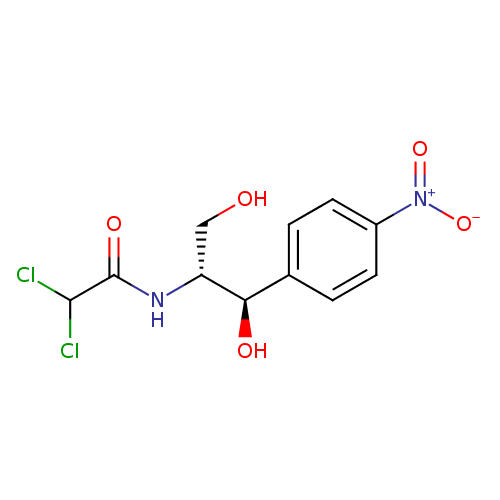
Chemical Structure
Thumb
Synonyms
ValueSource
ChloramexChEBI
ChloramphenicolumChEBI
ChlornitromycinChEBI
ChlorocidChEBI
ChlorocolChEBI
ChloromycetinChEBI
CloramfenicolChEBI
D-(-)-2,2-Dichloro-N-(beta-hydroxy-alpha-(hydroxymethyl)-p-nitrophenylethyl)acetamideChEBI
D-(-)-Threo-1-p-nitrophenyl-2-dichloroacetylamino-1,3-propanediolChEBI
FenicolChEBI
GlobenicolChEBI
HalomycetinChEBI
LaevomycetinumChEBI
LevomicetinaChEBI
LevomycetinChEBI
OleomycetinChEBI
SificetinaChEBI
CPKegg
AmphicolKegg
EconochlorKegg
D-(-)-2,2-Dichloro-N-(b-hydroxy-a-(hydroxymethyl)-p-nitrophenylethyl)acetamideGenerator
D-(-)-2,2-Dichloro-N-(β-hydroxy-α-(hydroxymethyl)-p-nitrophenylethyl)acetamideGenerator
CAFHMDB
CAPHMDB
ChloramfenikolHMDB
ChloramphenicoleHMDB
ChloroamphenicolHMDB
CloroamfenicoloHMDB
D-ChloramphenicolHMDB
DetreomycinHMDB
KloramfenikolHMDB
CloranfenicolHMDB
OphthochlorHMDB
SyntomycinHMDB
AmphenicolsMeSH
AmphenicolMeSH
Chemical FormulaC11H12Cl2N2O5
Average Molecular Mass323.129 g/mol
Monoisotopic Mass322.012 g/mol
CAS Registry Number56-75-7
IUPAC Name2,2-dichloro-N-[(1R,2R)-1,3-dihydroxy-1-(4-nitrophenyl)propan-2-yl]acetamide
Traditional Namechloramphenicol
SMILESOC[C@@H](NC(=O)C(Cl)Cl)[C@H](O)C1=CC=C(C=C1)[N+]([O-])=O
InChI IdentifierInChI=1S/C11H12Cl2N2O5/c12-10(13)11(18)14-8(5-16)9(17)6-1-3-7(4-2-6)15(19)20/h1-4,8-10,16-17H,5H2,(H,14,18)/t8-,9-/m1/s1
InChI KeyWIIZWVCIJKGZOK-RKDXNWHRSA-N
Chemical Taxonomy
Description belongs to the class of organic compounds known as nitrobenzenes. Nitrobenzenes are compounds containing a nitrobenzene moiety, which consists of a benzene ring with a carbon bearing a nitro group.
KingdomOrganic compounds
Super ClassBenzenoids
ClassBenzene and substituted derivatives
Sub ClassNitrobenzenes
Direct ParentNitrobenzenes
Alternative Parents
Substituents
  • Nitrobenzene
  • Nitroaromatic compound
  • C-nitro compound
  • Secondary alcohol
  • Organic nitro compound
  • Carboximidic acid
  • Carboximidic acid derivative
  • Organic oxoazanium
  • Allyl-type 1,3-dipolar organic compound
  • Propargyl-type 1,3-dipolar organic compound
  • Organic 1,3-dipolar compound
  • Aromatic alcohol
  • Organopnictogen compound
  • Primary alcohol
  • Organooxygen compound
  • Organonitrogen compound
  • Organochloride
  • Alkyl halide
  • Organohalogen compound
  • Organic oxygen compound
  • Organic nitrogen compound
  • Organic zwitterion
  • Alcohol
  • Alkyl chloride
  • Organic oxide
  • Hydrocarbon derivative
  • Aromatic homomonocyclic compound
Molecular FrameworkAromatic homomonocyclic compounds
External Descriptors
Biological Properties
StatusDetected and Not Quantified
OriginExogenous
Cellular Locations
  • Cytoplasm
  • Extracellular
  • Membrane
Biofluid LocationsNot Available
Tissue Locations
  • Bone Marrow
  • Heart
  • Liver
PathwaysNot Available
Applications
Biological Roles
Chemical Roles
Physical Properties
StateSolid
AppearanceWhite powder.
Experimental Properties
PropertyValue
Melting Point171°C
Boiling PointNot Available
Solubility2500 mg/L (at 25°C)
Predicted Properties
PropertyValueSource
Water Solubility0.46 g/LALOGPS
logP1.15ALOGPS
logP0.88ChemAxon
logS-2.8ALOGPS
pKa (Strongest Acidic)7.49ChemAxon
pKa (Strongest Basic)-2.8ChemAxon
Physiological Charge0ChemAxon
Hydrogen Acceptor Count5ChemAxon
Hydrogen Donor Count3ChemAxon
Polar Surface Area115.38 ŲChemAxon
Rotatable Bond Count6ChemAxon
Refractivity73.2 m³·mol⁻¹ChemAxon
Polarizability28.08 ųChemAxon
Number of Rings1ChemAxon
Bioavailability1ChemAxon
Rule of FiveYesChemAxon
Ghose FilterYesChemAxon
Veber's RuleNoChemAxon
MDDR-like RuleNoChemAxon
Spectra
Spectra
Spectrum TypeDescriptionSplash KeyView
Predicted GC-MSPredicted GC-MS Spectrum - GC-MS (Non-derivatized) - 70eV, Positivesplash10-0udi-3900000000-2ba6754ba027027454d1Spectrum
Predicted GC-MSPredicted GC-MS Spectrum - GC-MS (2 TMS) - 70eV, Positivesplash10-0udi-3911100000-5438beab478c45792ddbSpectrum
Predicted GC-MSPredicted GC-MS Spectrum - GC-MS (Non-derivatized) - 70eV, PositiveNot AvailableSpectrum
LC-MS/MSLC-MS/MS Spectrum - LC-ESI-qTof , Positivesplash10-014i-0920000000-96bfb1c31d89e3f10cafSpectrum
LC-MS/MSLC-MS/MS Spectrum - LC-ESI-QFT , negativesplash10-0kmi-0945000000-40a09f3f9528bd669823Spectrum
LC-MS/MSLC-MS/MS Spectrum - LC-ESI-QFT , negativesplash10-0udi-0900000000-64dbb16119292f4410e2Spectrum
LC-MS/MSLC-MS/MS Spectrum - LC-ESI-QFT , negativesplash10-0udi-0900000000-5c8fbcad8e93fa9f2906Spectrum
LC-MS/MSLC-MS/MS Spectrum - LC-ESI-QFT , negativesplash10-0uk9-1900000000-4c6518583a7488591aa3Spectrum
LC-MS/MSLC-MS/MS Spectrum - LC-ESI-QFT , negativesplash10-00di-1900000000-00574ed667d64b4a45e9Spectrum
LC-MS/MSLC-MS/MS Spectrum - LC-ESI-QFT , negativesplash10-00di-1900000000-d4ac63e9260ab31ac6b1Spectrum
LC-MS/MSLC-MS/MS Spectrum - LC-ESI-QTOF , negativesplash10-0zml-0933000000-4ae209b29cb52d4e3844Spectrum
LC-MS/MSLC-MS/MS Spectrum - LC-ESI-QTOF , negativesplash10-056r-0933000000-74ff5ec451e56526d425Spectrum
LC-MS/MSLC-MS/MS Spectrum - Linear Ion Trap , negativesplash10-0a4l-0590000000-90d108018a0f99815fb7Spectrum
LC-MS/MSLC-MS/MS Spectrum - Linear Ion Trap , negativesplash10-0a4l-0690000000-161f2afa43298fd3437aSpectrum
LC-MS/MSLC-MS/MS Spectrum - LC-ESI-QFT , negativesplash10-0uk9-0923000000-86308db0ec59b40b1533Spectrum
LC-MS/MSLC-MS/MS Spectrum - LC-ESI-QFT , positivesplash10-05fr-0094000000-ad8da59124745b38a76fSpectrum
LC-MS/MSLC-MS/MS Spectrum - LC-ESI-QFT , positivesplash10-00di-0390000000-06fcf307f2fdb79741adSpectrum
LC-MS/MSLC-MS/MS Spectrum - LC-ESI-QFT , positivesplash10-014i-1940000000-be07d702045f4d3e05acSpectrum
LC-MS/MSLC-MS/MS Spectrum - LC-ESI-QFT , positivesplash10-014i-1910000000-55a74a828c3c9750ee1cSpectrum
LC-MS/MSLC-MS/MS Spectrum - LC-ESI-QFT , positivesplash10-0159-2900000000-bf685c17ab79583133eeSpectrum
LC-MS/MSLC-MS/MS Spectrum - LC-ESI-QFT , positivesplash10-0159-4900000000-e6f6ccbfffe89c345365Spectrum
LC-MS/MSLC-MS/MS Spectrum - LC-ESI-QTOF , positivesplash10-00di-0191000000-41f70006e2b4e5f8d8aaSpectrum
Predicted LC-MS/MSPredicted LC-MS/MS Spectrum - 10V, Positivesplash10-00di-0109000000-7f19e2214bd804fbb572Spectrum
Predicted LC-MS/MSPredicted LC-MS/MS Spectrum - 20V, Positivesplash10-014j-0289000000-ea9835706b530fa07197Spectrum
Predicted LC-MS/MSPredicted LC-MS/MS Spectrum - 40V, Positivesplash10-03di-2910000000-531d8b69053d0c007aebSpectrum
Predicted LC-MS/MSPredicted LC-MS/MS Spectrum - 10V, Negativesplash10-00di-0109000000-cc647af0a1726c8e11c5Spectrum
Predicted LC-MS/MSPredicted LC-MS/MS Spectrum - 20V, Negativesplash10-0229-3915000000-a08bc180ba95289b9297Spectrum
Predicted LC-MS/MSPredicted LC-MS/MS Spectrum - 40V, Negativesplash10-004i-4900000000-7ccaa4da01cb96a52d23Spectrum
Toxicity Profile
Route of ExposureRapidly and completely absorbed from gastrointestinal tract following oral administration (bioavailability 80%). Well absorbed following intramuscular administration (bioavailability 70%). Intraocular and some systemic absorption also occurs after topical application to the eye.
Mechanism of ToxicityChloramphenicol targets the large 39S subunit of the mitochondrial ribosome thereby deactivation mitochondrial protein synthesis. As a result chloramphenicol is cytotoxic to the most metabolically active cells or tissues including the heart, liver, thymus and bone-marrow. (6). The likely target of chloramphenicol is the 16S rRNA molecule in the mitochondrial ribosome, which is analogous to the 23S rRNA in bacterial ribosomes.
MetabolismHepatic, with 90% conjugated to inactive glucuronide. Half Life: Half-life in adults with normal hepatic and renal function is 1.5 - 3.5 hours. In patients with impaired renal function half-life is 3 - 4 hours. In patients with severely impaired hepatic function half-life is 4.6 - 11.6 hours. Half-life in children 1 month to 16 years old is 3 - 6.5 hours, while half-life in infants 1 to 2 days old is 24 hours or longer and is highly variable, especially in low birth-weight infants.
Toxicity ValuesOral, mouse: LD50 = 1500 mg/kg Oral, rat: LD50 = 2500 mg/kg.
Lethal DoseNot Available
Carcinogenicity (IARC Classification)2A, probably carcinogenic to humans. (7)
Uses/SourcesUsed in treatment of cholera, as it destroys the vibrios and decreases the diarrhea. It is effective against tetracycline-resistant vibrios. It is also used in eye drops or ointment to treat bacterial conjunctivitis.
Minimum Risk LevelNot Available
Health EffectsThe most serious adverse effect associated with chloramphenicol treatment is bone marrow toxicity, which may occur in two distinct forms: 1) bone marrow suppression, which is a direct toxic effect of the drug and is usually reversible, and 2) aplastic anemia, which is idiosyncratic (rare, unpredictable) and generally fatal. Other less serious reactions from chloramphenicol use include fever, rashes, headache, and confusion. Use of intravenous chloramphenicol has also been associated with gray baby syndrome, a phenomenon resulting from newborn infants' inability to metabolize chloramphenicol in the liver via UDP-glucuronyl transferase. Gray baby syndrome is characterized by vomiting, ashen gray color of the skin, limp body tone, hypotension and cyanosis.
SymptomsToxic reactions including fatalities have occurred in the premature and newborn; the signs and symptoms associated with these reactions have been referred to as the gray syndrome. Symptoms include (in order of appearance) abdominal distension with or without emesis, progressive pallid cyanosis, vasomotor collapse frequently accompanied by irregular respiration, and death within a few hours of onset of these symptoms.
TreatmentDrug therapy is discontinued immediately; exchange transfusion may be required to remove the drug. Sometimes, phenobarbital (UGT induction) is used.
Concentrations
Not Available
DrugBank IDDB00446
HMDB IDHMDB0014589
FooDB IDNot Available
Phenol Explorer IDNot Available
KNApSAcK IDNot Available
BiGG IDNot Available
BioCyc IDNot Available
METLIN IDNot Available
PDB IDCLM
Wikipedia LinkChloramphenicol
Chemspider ID5744
ChEBI ID17698
PubChem Compound ID5959
Kegg Compound IDC00918
YMDB IDNot Available
ECMDB IDM2MDB005497
References
Synthesis Reference

Guang-Zhong Wu, Wanda I. Tormos, “Asymmetric process for preparing florfenicol, thiamphenicol chloramphenicol and oxazoline intermediates.” U.S. Patent US5352832, issued May, 1992.

MSDSNot Available
General References
1. https://www.ncbi.nlm.nih.gov/pubmed/?term=11468347
2. https://www.ncbi.nlm.nih.gov/pubmed/?term=12217690
3. https://www.ncbi.nlm.nih.gov/pubmed/?term=16659995
4. https://www.ncbi.nlm.nih.gov/pubmed/?term=16897441
5. https://www.ncbi.nlm.nih.gov/pubmed/?term=17217404
6. https://www.ncbi.nlm.nih.gov/pubmed/?term=17692887
7. https://www.ncbi.nlm.nih.gov/pubmed/?term=18559535
8. https://www.ncbi.nlm.nih.gov/pubmed/?term=18657290
9. https://www.ncbi.nlm.nih.gov/pubmed/?term=18794387
10. https://www.ncbi.nlm.nih.gov/pubmed/?term=23142491
11. https://www.ncbi.nlm.nih.gov/pubmed/?term=23317719
12. https://www.ncbi.nlm.nih.gov/pubmed/?term=23395526
13. https://www.ncbi.nlm.nih.gov/pubmed/?term=23494278
14. https://www.ncbi.nlm.nih.gov/pubmed/?term=23512826
15. https://www.ncbi.nlm.nih.gov/pubmed/?term=657786
16. https://www.ncbi.nlm.nih.gov/pubmed/?term=6653106
17. Wali SS, Macfarlane JT, Weir WR, Cleland PG, Ball PA, Hassan-King M, Whittle HC, Greenwood BM: Single injection treatment of meningococcal meningitis. 2. Long-acting chloramphenicol. Trans R Soc Trop Med Hyg. 1979;73(6):698-702.
18. Bhutta ZA, Niazi SK, Suria A: Chloramphenicol clearance in typhoid fever: implications for therapy. Indian J Pediatr. 1992 Mar-Apr;59(2):213-9.
19. Pecoul B, Varaine F, Keita M, Soga G, Djibo A, Soula G, Abdou A, Etienne J, Rey M: Long-acting chloramphenicol versus intravenous ampicillin for treatment of bacterial meningitis. Lancet. 1991 Oct 5;338(8771):862-6.
20. Puddicombe JB, Wali SS, Greenwood BM: A field trial of a single intramuscular injection of long-acting chloramphenicol in the treatment of meningococcal meningitis. Trans R Soc Trop Med Hyg. 1984;78(3):399-403.
21. Nathan N, Borel T, Djibo A, Evans D, Djibo S, Corty JF, Guillerm M, Alberti KP, Pinoges L, Guerin PJ, Legros D: Ceftriaxone as effective as long-acting chloramphenicol in short-course treatment of meningococcal meningitis during epidemics: a randomised non-inferiority study. Lancet. 2005 Jul 23-29;366(9482):308-13.