Record Information
Version1.0
Creation Date2014-08-28 19:48:07 UTC
Update Date2026-05-14 16:24:58 UTC
Accession NumberCHEM002912
Identification
Common NameLymecycline
ClassSmall Molecule
DescriptionLymecycline is a tetracycline broad-spectrum antibiotic marketed by the pharmaceutical company Galderma. It is approximately 5,000 times more soluble than tetracycline base and is unique amongst tetracyclines in that it is absorbed by an active transport process across the intestinal wall, making use of the same fast and efficient mechanism by which carbohydrates are absorbed.
Contaminant Sources
  • HMDB Contaminants - Urine
  • T3DB toxins
  • ToxCast & Tox21 Chemicals
Contaminant Type
  • Anti-Bacterial Agent
  • Antiprotozoal Agent
  • Drug
  • Metabolite
  • Organic Compound
  • Synthetic Compound
  • Tetracycline
Chemical Structure
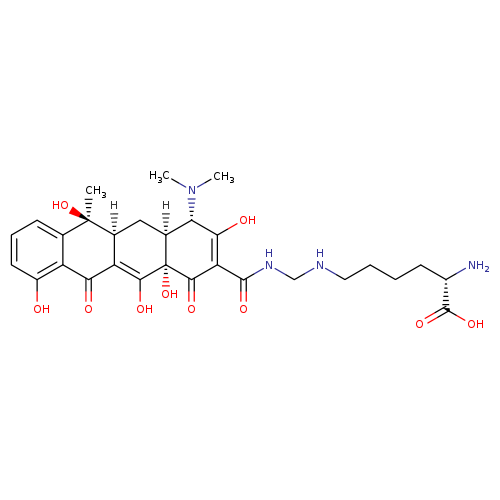
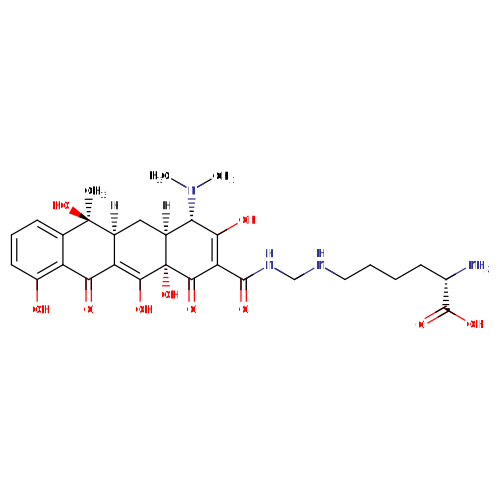
Thumb
Synonyms
ValueSource
(+)-N-(5-Amino-5-carboxypentylaminomethyl)-4-dimethylamino-1,4,4a,5,5a,6,11,12a-octahydro-3,6,10,12,12a-pentahydroxy-6-methyl-1,11-dioxonaphthacene-2-carboxamideChEBI
LimeciclinaChEBI
LymecyclinumChEBI
N-LysinomethyltetracyclineChEBI
N(2)-(((+)-5-Amino-5-carboxypentylamino)methyl)tetracyclineChEBI
N6-((4-(Dimethylamino)-1,4,4a,5,5a,6,11,12a-octahydro-3,6,10,12,12a-pentahydroxy-6-methyl-1,11-dioxo-2-naphthacenecarboxamido)methyl)lysineChEBI
Tetracycline-L-methylene lysineChEBI
Tetracycline-L-methylenelysineChEBI
7-ChlorotetracyclineHMDB
ChlorotetracyclineHMDB
ChlortetracyclinHMDB
ChlortetracyclineHMDB
Chlortetracyclinium chlorideHMDB
CLTCHMDB
Chemical FormulaC29H38N4O10
Average Molecular Mass602.633 g/mol
Monoisotopic Mass602.259 g/mol
CAS Registry Number992-21-2
IUPAC Name(2S)-6-[({[(4S,4aS,5aS,6S,12aS)-4-(dimethylamino)-3,6,10,12,12a-pentahydroxy-6-methyl-1,11-dioxo-1,4,4a,5,5a,6,11,12a-octahydrotetracen-2-yl]formamido}methyl)amino]-2-aminohexanoic acid
Traditional Namelymecycline
SMILES[H][C@@]12C[C@@]3([H])C(C(=O)C4=C(O)C=CC=C4[C@@]3(C)O)=C(O)[C@]1(O)C(=O)C(C(=O)NCNCCCC[C@H](N)C(O)=O)=C(O)[C@H]2N(C)C
InChI IdentifierInChI=1S/C29H38N4O10/c1-28(42)13-7-6-9-17(34)18(13)22(35)19-14(28)11-15-21(33(2)3)23(36)20(25(38)29(15,43)24(19)37)26(39)32-12-31-10-5-4-8-16(30)27(40)41/h6-7,9,14-16,21,31,34,36-37,42-43H,4-5,8,10-12,30H2,1-3H3,(H,32,39)(H,40,41)/t14-,15-,16-,21-,28+,29-/m0/s1
InChI KeyAHEVKYYGXVEWNO-UEPZRUIBSA-N
Chemical Taxonomy
Description belongs to the class of organic compounds known as tetracyclines. These are polyketides having an octahydrotetracene-2-carboxamide skeleton, substituted with many hydroxy and other groups.
KingdomOrganic compounds
Super ClassPhenylpropanoids and polyketides
ClassTetracyclines
Sub ClassNot Available
Direct ParentTetracyclines
Alternative Parents
Substituents
  • Tetracycline
  • Naphthacene
  • Tetracene
  • Anthracene carboxylic acid or derivatives
  • Tetralin
  • L-alpha-amino acid
  • Alpha-amino acid
  • Alpha-amino acid or derivatives
  • Aryl ketone
  • Medium-chain fatty acid
  • 1-hydroxy-2-unsubstituted benzenoid
  • Amino fatty acid
  • Cyclohexenone
  • 1-hydroxy-4-unsubstituted benzenoid
  • Aralkylamine
  • Hydroxy fatty acid
  • Fatty acyl
  • Benzenoid
  • Vinylogous acid
  • Tertiary alcohol
  • Amino acid
  • Secondary carboxylic acid amide
  • Carboxamide group
  • Amino acid or derivatives
  • Ketone
  • Tertiary amine
  • Tertiary aliphatic amine
  • Secondary amine
  • Carboxylic acid derivative
  • Carboxylic acid
  • Secondary aliphatic amine
  • Enol
  • Polyol
  • Monocarboxylic acid or derivatives
  • Amine
  • Organic oxygen compound
  • Organic nitrogen compound
  • Alcohol
  • Carbonyl group
  • Organopnictogen compound
  • Primary amine
  • Organic oxide
  • Primary aliphatic amine
  • Hydrocarbon derivative
  • Organooxygen compound
  • Organonitrogen compound
  • Aromatic homopolycyclic compound
Molecular FrameworkAromatic homopolycyclic compounds
External Descriptors
Biological Properties
StatusDetected and Not Quantified
OriginExogenous
Cellular Locations
  • Cytoplasm
  • Membrane
Biofluid LocationsNot Available
Tissue Locations
  • Bone Marrow
  • Heart
  • Liver
Pathways
NameSMPDB LinkKEGG Link
Lymecycline Action PathwaySMP00295 Not Available
Applications
Biological Roles
Chemical Roles
Physical Properties
StateSolid
AppearanceWhite powder.
Experimental Properties
PropertyValue
Melting PointNot Available
Boiling PointNot Available
SolubilitySoluble (at all physiological pH values)
Predicted Properties
PropertyValueSource
Water Solubility1.31 g/LALOGPS
logP-0.27ALOGPS
logP-8.3ChemAxon
logS-2.7ALOGPS
pKa (Strongest Acidic)0.4ChemAxon
pKa (Strongest Basic)9.5ChemAxon
Physiological Charge0ChemAxon
Hydrogen Acceptor Count13ChemAxon
Hydrogen Donor Count9ChemAxon
Polar Surface Area242.98 ŲChemAxon
Rotatable Bond Count10ChemAxon
Refractivity154.51 m³·mol⁻¹ChemAxon
Polarizability62.88 ųChemAxon
Number of Rings4ChemAxon
Bioavailability0ChemAxon
Rule of FiveNoChemAxon
Ghose FilterNoChemAxon
Veber's RuleNoChemAxon
MDDR-like RuleYesChemAxon
Spectra
Spectra
Spectrum TypeDescriptionSplash KeyView
Predicted GC-MSPredicted GC-MS Spectrum - GC-MS (Non-derivatized) - 70eV, Positivesplash10-0a5i-3019250000-12eac72ab7dedd803b34Spectrum
Predicted GC-MSPredicted GC-MS Spectrum - GC-MS (1 TMS) - 70eV, Positivesplash10-0a4i-5005649000-3f203b4cc7bb2470c649Spectrum
Predicted GC-MSPredicted GC-MS Spectrum - GC-MS (TMS_1_2) - 70eV, PositiveNot AvailableSpectrum
Predicted GC-MSPredicted GC-MS Spectrum - GC-MS (TMS_1_3) - 70eV, PositiveNot AvailableSpectrum
Predicted GC-MSPredicted GC-MS Spectrum - GC-MS (TMS_1_4) - 70eV, PositiveNot AvailableSpectrum
Predicted GC-MSPredicted GC-MS Spectrum - GC-MS (TMS_1_5) - 70eV, PositiveNot AvailableSpectrum
Predicted GC-MSPredicted GC-MS Spectrum - GC-MS (TMS_1_6) - 70eV, PositiveNot AvailableSpectrum
Predicted GC-MSPredicted GC-MS Spectrum - GC-MS (TMS_1_7) - 70eV, PositiveNot AvailableSpectrum
Predicted GC-MSPredicted GC-MS Spectrum - GC-MS (TMS_1_8) - 70eV, PositiveNot AvailableSpectrum
Predicted GC-MSPredicted GC-MS Spectrum - GC-MS (TMS_1_9) - 70eV, PositiveNot AvailableSpectrum
Predicted GC-MSPredicted GC-MS Spectrum - GC-MS (TMS_2_1) - 70eV, PositiveNot AvailableSpectrum
Predicted GC-MSPredicted GC-MS Spectrum - GC-MS (TMS_2_2) - 70eV, PositiveNot AvailableSpectrum
Predicted GC-MSPredicted GC-MS Spectrum - GC-MS (TMS_2_3) - 70eV, PositiveNot AvailableSpectrum
Predicted GC-MSPredicted GC-MS Spectrum - GC-MS (TMS_2_4) - 70eV, PositiveNot AvailableSpectrum
Predicted GC-MSPredicted GC-MS Spectrum - GC-MS (TMS_2_5) - 70eV, PositiveNot AvailableSpectrum
Predicted GC-MSPredicted GC-MS Spectrum - GC-MS (TMS_2_6) - 70eV, PositiveNot AvailableSpectrum
Predicted GC-MSPredicted GC-MS Spectrum - GC-MS (TMS_2_7) - 70eV, PositiveNot AvailableSpectrum
Predicted GC-MSPredicted GC-MS Spectrum - GC-MS (TMS_2_8) - 70eV, PositiveNot AvailableSpectrum
Predicted GC-MSPredicted GC-MS Spectrum - GC-MS (TMS_2_9) - 70eV, PositiveNot AvailableSpectrum
Predicted GC-MSPredicted GC-MS Spectrum - GC-MS (TMS_2_10) - 70eV, PositiveNot AvailableSpectrum
Predicted GC-MSPredicted GC-MS Spectrum - GC-MS (TMS_2_11) - 70eV, PositiveNot AvailableSpectrum
Predicted GC-MSPredicted GC-MS Spectrum - GC-MS (TMS_2_12) - 70eV, PositiveNot AvailableSpectrum
Predicted GC-MSPredicted GC-MS Spectrum - GC-MS (TMS_2_13) - 70eV, PositiveNot AvailableSpectrum
Predicted GC-MSPredicted GC-MS Spectrum - GC-MS (TMS_2_14) - 70eV, PositiveNot AvailableSpectrum
Predicted GC-MSPredicted GC-MS Spectrum - GC-MS (TMS_2_15) - 70eV, PositiveNot AvailableSpectrum
Predicted LC-MS/MSPredicted LC-MS/MS Spectrum - 10V, Positivesplash10-000i-0200091000-89e41c2e3834190df201Spectrum
Predicted LC-MS/MSPredicted LC-MS/MS Spectrum - 20V, Positivesplash10-001r-6700590000-4e361cb29ebc1a76bb63Spectrum
Predicted LC-MS/MSPredicted LC-MS/MS Spectrum - 40V, Positivesplash10-001i-9828330000-d0ae1ca5167e192c6d34Spectrum
Predicted LC-MS/MSPredicted LC-MS/MS Spectrum - 10V, Negativesplash10-0udi-0322669000-c5830c776faedf57e438Spectrum
Predicted LC-MS/MSPredicted LC-MS/MS Spectrum - 20V, Negativesplash10-0f89-1735931000-4014754799d6e1877655Spectrum
Predicted LC-MS/MSPredicted LC-MS/MS Spectrum - 40V, Negativesplash10-0ntd-5549300000-866a3d185c36d9e549e2Spectrum
Predicted LC-MS/MSPredicted LC-MS/MS Spectrum - 10V, Negativesplash10-0f89-1410098000-d903d835ba62ec246e53Spectrum
Predicted LC-MS/MSPredicted LC-MS/MS Spectrum - 20V, Negativesplash10-0006-8439164000-3f302bf25f25bb5e551aSpectrum
Predicted LC-MS/MSPredicted LC-MS/MS Spectrum - 40V, Negativesplash10-0006-9101230000-d4f12ffa94a44190d8e8Spectrum
Predicted LC-MS/MSPredicted LC-MS/MS Spectrum - 10V, Positivesplash10-000i-0100291000-3fa58d959484de3466acSpectrum
Predicted LC-MS/MSPredicted LC-MS/MS Spectrum - 20V, Positivesplash10-015i-2100791000-ba5e16a41c66bdd2f8aeSpectrum
Predicted LC-MS/MSPredicted LC-MS/MS Spectrum - 40V, Positivesplash10-001i-9310100000-419827f97c772d16a694Spectrum
1D NMR1H NMR SpectrumNot AvailableSpectrum
1D NMR13C NMR SpectrumNot AvailableSpectrum
1D NMR1H NMR SpectrumNot AvailableSpectrum
1D NMR13C NMR SpectrumNot AvailableSpectrum
1D NMR1H NMR SpectrumNot AvailableSpectrum
1D NMR13C NMR SpectrumNot AvailableSpectrum
1D NMR1H NMR SpectrumNot AvailableSpectrum
1D NMR13C NMR SpectrumNot AvailableSpectrum
1D NMR1H NMR SpectrumNot AvailableSpectrum
1D NMR13C NMR SpectrumNot AvailableSpectrum
1D NMR1H NMR SpectrumNot AvailableSpectrum
1D NMR13C NMR SpectrumNot AvailableSpectrum
1D NMR1H NMR SpectrumNot AvailableSpectrum
1D NMR13C NMR SpectrumNot AvailableSpectrum
1D NMR1H NMR SpectrumNot AvailableSpectrum
1D NMR13C NMR SpectrumNot AvailableSpectrum
1D NMR1H NMR SpectrumNot AvailableSpectrum
1D NMR13C NMR SpectrumNot AvailableSpectrum
1D NMR1H NMR SpectrumNot AvailableSpectrum
1D NMR13C NMR SpectrumNot AvailableSpectrum
Toxicity Profile
Route of ExposureAbsorption is fast and efficient. Bioavailability is 100% following oral administration.
Mechanism of ToxicityTetracyclines target the 28S small subunit of the mitochondrial ribosome thereby deactivation mitochondrial protein synthesis. As a result tetracyclines are cytotoxic to the most metabolically active cells or tissues including the heart, liver, thymus and bone-marrow. (2). The likely target of most tetracyclines is the 12S rRNA molecule in the mitochondrial ribosome, which is analogous to the 16S rRNA in bacterial ribosomes.
MetabolismNot Available
Toxicity ValuesNot Available
Lethal DoseNot Available
Carcinogenicity (IARC Classification)No indication of carcinogenicity to humans (not listed by IARC).
Uses/SourcesFor the treatment of infections and to treat acne. It may also be used to treat urinary tract infections, gum disease, and other bacterial infections such as gonorrhea and chlamydia. Lymecycline is also used commonly as a prophylactic treatment for infection by Bacillus anthracis (anthrax). It is also effective against Yersinia pestis and malaria and is also prescribed for the treatment of Lyme disease.
Minimum Risk LevelNot Available
Health EffectsSide effects from normal doses of tetracyclines are relatively minimal, but of particular note is phototoxicity. Tetracylclines increase the risk of sunburn under exposure to light from the sun or other sources. Tetracyclines may also cause stomach or bowel upsets, and, on rare occasions, allergic reactions. Very rarely, severe headache and vision problems may be signs of dangerous secondary intracranial hypertension, also known as pseudotumor cerebri. Tetracyclines are teratogens and cause tooth discolouration and poor tooth mineralization in the fetus as they develop in infancy. Symptoms of tetracycline overdose include anorexia, nausea, diarrhea, glossitis, dysphagia, enterocolitis and inflammatory lesions, skin reactions such as maculopapular and erythematous rashes, exfoliative dermatitis, photosensitivity, hypersensitivity reactions such as urticaria, angioneurotic oedema, anaphylaxis, anaphyl-actoid purpura, pericarditis, and exacerbation of systemic lupus erythematosus, benign intracranial hypertension in adults disappearing on discontinuation of the medicine, haematologic abnormalities such as haemolytic anaemia, thrombocytopenia, neutropenia, and eosinophilia.
SymptomsSymptoms include nausea, vomiting, diarrhoea, glossitis, enterocolitis, dysphagia, dermatitis, hypersensitivity reactions, proctitis, and vaginitis.
TreatmentDrug therapy is discontinued immediately; exchange transfusion may be required to remove the drug. Sometimes, phenobarbital (UGT induction) is used.
Concentrations
Not Available
DrugBank IDDB00256
HMDB IDHMDB0014401
FooDB IDNot Available
Phenol Explorer IDNot Available
KNApSAcK IDNot Available
BiGG IDNot Available
BioCyc IDNot Available
METLIN IDNot Available
PDB IDNot Available
Wikipedia LinkLymecycline
Chemspider ID20121315
ChEBI ID59040
PubChem Compound IDNot Available
Kegg Compound IDNot Available
YMDB IDNot Available
ECMDB IDNot Available
References
Synthesis Reference

Willis L. Winstrom, “Process and apparatus for the preparation of chlortetracycline-containing animal feed compositions.” U.S. Patent US06844006, issued January 18, 2005.

MSDSNot Available
General References
1. https://www.ncbi.nlm.nih.gov/pubmed/?term=1650428
2. https://www.ncbi.nlm.nih.gov/pubmed/?term=24985054
3. https://www.ncbi.nlm.nih.gov/pubmed/?term=25672310
4. Meynadier J, Alirezai M: Systemic antibiotics for acne. Dermatology. 1998;196(1):135-9.
5. MEDSAFE: http://www.medsafe.govt.nz/profs/Datasheet/t/Tetralysalcap.pdf