Record Information
Version1.0
Creation Date2014-08-28 18:03:36 UTC
Update Date2026-05-14 16:24:57 UTC
Accession NumberCHEM002910
Identification
Common NameDoxycycline
ClassSmall Molecule
DescriptionA synthetic tetracycline derivative with similar antimicrobial activity. Animal studies suggest that it may cause less tooth staining than other tetracyclines. It is used in some areas for the treatment of chloroquine-resistant falciparum malaria (malaria, falciparum). [PubChem]
Contaminant Sources
  • HMDB Contaminants - Urine
  • STOFF IDENT Compounds
  • T3DB toxins
Contaminant Type
  • Anti-Bacterial Agent
  • Antimalarial
  • Drug
  • Metabolite
  • Organic Compound
  • Synthetic Compound
  • Tetracycline
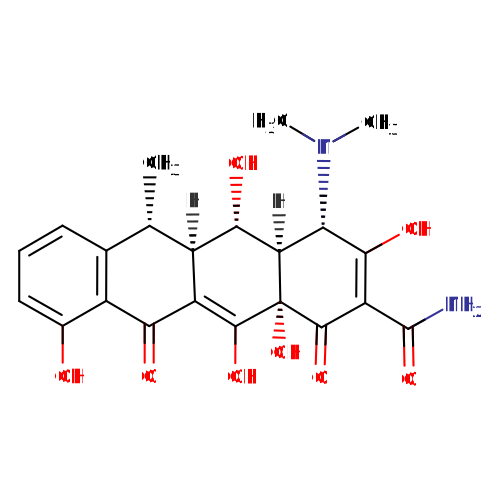
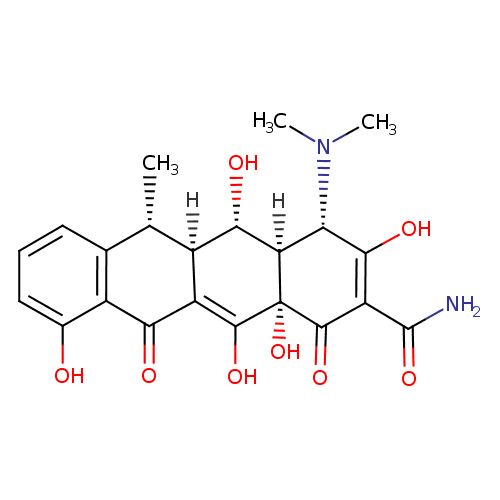
Chemical Structure
Thumb
Synonyms
ValueSource
(4S,4AR,5S,5ar,6R,12as)-4-(dimethylamino)-3,5,10,12,12a-pentahydroxy-6-methyl-1,11-dioxo-1,4,4a,5,5a,6,11,12a-octahydrotetracene-2-carboxamideChEBI
5-Hydroxy-alpha-6-deoxytetracyclineChEBI
6alpha-Deoxy-5-oxytetracyclineChEBI
DoxiciclinaChEBI
DoxycyclinChEBI
Doxycycline (anhydrous)ChEBI
DoxycyclinumChEBI
JenacyclinChEBI
SupracyclinChEBI
VibramycinChEBI
DoxychelKegg
5-Hydroxy-a-6-deoxytetracyclineGenerator
5-Hydroxy-α-6-deoxytetracyclineGenerator
6a-Deoxy-5-oxytetracyclineGenerator
6Α-deoxy-5-oxytetracyclineGenerator
DOXYHMDB
Doxcycline anhydrousHMDB
Doxycycline hyclateHMDB
Doxycycline monohydrateHMDB
DoxytetracyclineHMDB
Chemical FormulaC22H24N2O8
Average Molecular Mass444.435 g/mol
Monoisotopic Mass444.153 g/mol
CAS Registry Number564-25-0
IUPAC Name(4S,4aR,5S,5aR,6R,12aS)-4-(dimethylamino)-3,5,10,12,12a-pentahydroxy-6-methyl-1,11-dioxo-1,4,4a,5,5a,6,11,12a-octahydrotetracene-2-carboxamide
Traditional Namevibramycin
SMILES[H][C@@]12[C@@H](C)C3=C(C(O)=CC=C3)C(=O)C1=C(O)[C@]1(O)C(=O)C(C(N)=O)=C(O)[C@@H](N(C)C)[C@]1([H])[C@H]2O
InChI IdentifierInChI=1S/C22H24N2O8/c1-7-8-5-4-6-9(25)11(8)16(26)12-10(7)17(27)14-15(24(2)3)18(28)13(21(23)31)20(30)22(14,32)19(12)29/h4-7,10,14-15,17,25,27-29,32H,1-3H3,(H2,23,31)/t7-,10+,14+,15-,17-,22-/m0/s1
InChI KeyJBIWCJUYHHGXTC-AKNGSSGZSA-N
Chemical Taxonomy
Description belongs to the class of organic compounds known as tetracyclines. These are polyketides having an octahydrotetracene-2-carboxamide skeleton, substituted with many hydroxy and other groups.
KingdomOrganic compounds
Super ClassPhenylpropanoids and polyketides
ClassTetracyclines
Sub ClassNot Available
Direct ParentTetracyclines
Alternative Parents
Substituents
  • Tetracycline
  • Naphthacene
  • Tetracene
  • Anthracene carboxylic acid or derivatives
  • Tetralin
  • Aryl ketone
  • 1-hydroxy-4-unsubstituted benzenoid
  • 1-hydroxy-2-unsubstituted benzenoid
  • Cyclohexenone
  • Aralkylamine
  • Benzenoid
  • Tertiary alcohol
  • Vinylogous acid
  • Tertiary aliphatic amine
  • Amino acid or derivatives
  • Tertiary amine
  • Carboxamide group
  • Secondary alcohol
  • Primary carboxylic acid amide
  • Ketone
  • Polyol
  • Carboxylic acid derivative
  • Enol
  • Amine
  • Organic oxygen compound
  • Organopnictogen compound
  • Organonitrogen compound
  • Organooxygen compound
  • Alcohol
  • Carbonyl group
  • Organic nitrogen compound
  • Organic oxide
  • Hydrocarbon derivative
  • Aromatic homopolycyclic compound
Molecular FrameworkAromatic homopolycyclic compounds
External Descriptors
Biological Properties
StatusDetected and Not Quantified
OriginExogenous
Cellular Locations
  • Cytoplasm
  • Membrane
Biofluid LocationsNot Available
Tissue Locations
  • Bone Marrow
  • Heart
  • Liver
Pathways
NameSMPDB LinkKEGG Link
Doxycycline Action PathwaySMP00291 Not Available
Applications
Biological Roles
Chemical RolesNot Available
Physical Properties
StateSolid
AppearanceWhite powder.
Experimental Properties
PropertyValue
Melting Point201°C
Boiling PointNot Available
Solubility630 mg/L (at 25°C)
Predicted Properties
PropertyValueSource
Water Solubility0.63 g/LALOGPS
logP-0.72ALOGPS
logP-3.4ChemAxon
logS-2.8ALOGPS
pKa (Strongest Acidic)-2.2ChemAxon
pKa (Strongest Basic)7.75ChemAxon
Physiological Charge-1ChemAxon
Hydrogen Acceptor Count9ChemAxon
Hydrogen Donor Count6ChemAxon
Polar Surface Area181.62 ŲChemAxon
Rotatable Bond Count2ChemAxon
Refractivity113.89 m³·mol⁻¹ChemAxon
Polarizability42.88 ųChemAxon
Number of Rings4ChemAxon
Bioavailability1ChemAxon
Rule of FiveNoChemAxon
Ghose FilterNoChemAxon
Veber's RuleNoChemAxon
MDDR-like RuleNoChemAxon
Spectra
Spectra
Spectrum TypeDescriptionSplash KeyView
Predicted GC-MSPredicted GC-MS Spectrum - GC-MS (Non-derivatized) - 70eV, Positivesplash10-0zfr-5392300000-04bc3e193569d5361cd9Spectrum
Predicted GC-MSPredicted GC-MS Spectrum - GC-MS (3 TMS) - 70eV, Positivesplash10-0002-1350309000-72de0c19abb90597f06eSpectrum
Predicted GC-MSPredicted GC-MS Spectrum - GC-MS (Non-derivatized) - 70eV, PositiveNot AvailableSpectrum
Predicted LC-MS/MSPredicted LC-MS/MS Spectrum - 10V, Positivesplash10-004j-0000900000-026ab0fbae1dd1507067Spectrum
Predicted LC-MS/MSPredicted LC-MS/MS Spectrum - 20V, Positivesplash10-01t9-0101900000-b4323fa1f473089244d4Spectrum
Predicted LC-MS/MSPredicted LC-MS/MS Spectrum - 40V, Positivesplash10-0udi-2594400000-f2ce8a8f6861b3523262Spectrum
Predicted LC-MS/MSPredicted LC-MS/MS Spectrum - 10V, Negativesplash10-0006-0111900000-972580ac62554c18b5b7Spectrum
Predicted LC-MS/MSPredicted LC-MS/MS Spectrum - 20V, Negativesplash10-0ue9-1347900000-0a4c864410c35dab696dSpectrum
Predicted LC-MS/MSPredicted LC-MS/MS Spectrum - 40V, Negativesplash10-0006-9274000000-977247efe53ffd07604dSpectrum
Predicted LC-MS/MSPredicted LC-MS/MS Spectrum - 10V, Negativesplash10-0006-0000900000-534d9e06ad5a10761ca5Spectrum
Predicted LC-MS/MSPredicted LC-MS/MS Spectrum - 20V, Negativesplash10-054o-1058900000-571243613867552794e7Spectrum
Predicted LC-MS/MSPredicted LC-MS/MS Spectrum - 40V, Negativesplash10-0006-1151900000-a881594f78a577b36809Spectrum
Predicted LC-MS/MSPredicted LC-MS/MS Spectrum - 10V, Positivesplash10-004j-0000900000-03f2125a40ab58671a7cSpectrum
Predicted LC-MS/MSPredicted LC-MS/MS Spectrum - 20V, Positivesplash10-004i-0000900000-0caeb4b9b6416b04d891Spectrum
Predicted LC-MS/MSPredicted LC-MS/MS Spectrum - 40V, Positivesplash10-0f6x-3491500000-84cc2bdb46c951f2c183Spectrum
1D NMR13C NMR SpectrumNot AvailableSpectrum
1D NMR1H NMR SpectrumNot AvailableSpectrum
1D NMR13C NMR SpectrumNot AvailableSpectrum
1D NMR1H NMR SpectrumNot AvailableSpectrum
1D NMR13C NMR SpectrumNot AvailableSpectrum
1D NMR1H NMR SpectrumNot AvailableSpectrum
1D NMR13C NMR SpectrumNot AvailableSpectrum
1D NMR1H NMR SpectrumNot AvailableSpectrum
1D NMR13C NMR SpectrumNot AvailableSpectrum
1D NMR1H NMR SpectrumNot AvailableSpectrum
1D NMR13C NMR SpectrumNot AvailableSpectrum
1D NMR1H NMR SpectrumNot AvailableSpectrum
1D NMR13C NMR SpectrumNot AvailableSpectrum
1D NMR1H NMR SpectrumNot AvailableSpectrum
1D NMR13C NMR SpectrumNot AvailableSpectrum
1D NMR1H NMR SpectrumNot AvailableSpectrum
1D NMR13C NMR SpectrumNot AvailableSpectrum
1D NMR1H NMR SpectrumNot AvailableSpectrum
1D NMR13C NMR SpectrumNot AvailableSpectrum
1D NMR1H NMR SpectrumNot AvailableSpectrum
Toxicity Profile
Route of ExposureCompletely absorbed following oral administration.
Mechanism of ToxicityTetracyclines target the 28S small subunit of the mitochondrial ribosome thereby deactivation mitochondrial protein synthesis. As a result tetracyclines are cytotoxic to the most metabolically active cells or tissues including the heart, liver, thymus and bone-marrow. (4). The likely target of most tetracyclines is the 12S rRNA molecule in the mitochondrial ribosome, which is analogous to the 16S rRNA in bacterial ribosomes.
MetabolismHepatic Route of Elimination: They are concentrated by the liver in the bile and excreted in the urine and feces at high concentrations in a biologically active form. Half Life: 18-22 hours
Toxicity ValuesLD50=262 mg/kg (I.P. in rat).
Lethal DoseNot Available
Carcinogenicity (IARC Classification)No indication of carcinogenicity to humans (not listed by IARC).
Uses/SourcesDoxycycline is indicated for use in respiratory tract infections caused by Mycoplasma pneumoniae, Haemophilus influenzae, Streptococcus pneumoniae, Legionella spp., or Klebsiella spp. It is also used for prophylaxis of malaria. Doxycycline is indicated for a variety of bacterial infections, from Mycobacterium fortuitum and M. marinum, to susceptible E. coli and Brucella spp. It can be used as an alternative to treating plague, tetanus, Campylobacter fetus
Minimum Risk LevelNot Available
Health EffectsSide effects from normal doses of tetracyclines are relatively minimal, but of particular note is phototoxicity. Tetracylclines increase the risk of sunburn under exposure to light from the sun or other sources. Tetracyclines may also cause stomach or bowel upsets, and, on rare occasions, allergic reactions. Very rarely, severe headache and vision problems may be signs of dangerous secondary intracranial hypertension, also known as pseudotumor cerebri. Tetracyclines are teratogens and cause tooth discolouration and poor tooth mineralization in the fetus as they develop in infancy. Symptoms of tetracycline overdose include anorexia, nausea, diarrhea, glossitis, dysphagia, enterocolitis and inflammatory lesions, skin reactions such as maculopapular and erythematous rashes, exfoliative dermatitis, photosensitivity, hypersensitivity reactions such as urticaria, angioneurotic oedema, anaphylaxis, anaphyl-actoid purpura, pericarditis, and exacerbation of systemic lupus erythematosus, benign intracranial hypertension in adults disappearing on discontinuation of the medicine, haematologic abnormalities such as haemolytic anaemia, thrombocytopenia, neutropenia, and eosinophilia.
SymptomsSymptoms of overdose include anorexia, nausea, diarrhoea, glossitis, dysphagia, enterocolitis and inflammatory lesions (with monilial overgrowth) in the anogenital region, skin reactions such as maculopapular and erythematous rashes, exfoliative dermatitis, photosensitivity, hypersensitivity reactions such as urticaria, angioneurotic oedema, anaphylaxis, anaphyl-actoid purpura, pericarditis, and exacerbation of systemic lupus erythematosus, benign intracranial hypertension in adults disappearing on discontinuation of the medicine, haematologic abnormalities such as haemolytic anaemia, thrombocytopenia, neutropenia, and eosinophilia.
TreatmentDrug therapy is discontinued immediately; exchange transfusion may be required to remove the drug. Sometimes, phenobarbital (UGT induction) is used.
Concentrations
Not Available
DrugBank IDDB00254
HMDB IDHMDB0014399
FooDB IDNot Available
Phenol Explorer IDNot Available
KNApSAcK IDC00017127
BiGG IDNot Available
BioCyc IDNot Available
METLIN IDNot Available
PDB IDDXT
Wikipedia LinkDoxycycline
Chemspider ID10469369
ChEBI ID50845
PubChem Compound IDNot Available
Kegg Compound IDC06973
YMDB IDNot Available
ECMDB IDNot Available
References
Synthesis Reference

Dai-Wu Seol, “DNA cassette for the production of secretable recombinant trimeric TRAIL proteins, tetracycline/ doxycycline-inducible adeno-associated virus vector, their combination and use in gene therapy.” U.S. Patent US20020128438, issued September 12, 2002.

MSDSLink
General References
1. https://www.ncbi.nlm.nih.gov/pubmed/?term=1650428
2. Hoerauf A, Mand S, Fischer K, Kruppa T, Marfo-Debrekyei Y, Debrah AY, Pfarr KM, Adjei O, Buttner DW: Doxycycline as a novel strategy against bancroftian filariasis-depletion of Wolbachia endosymbionts from Wuchereria bancrofti and stop of microfilaria production. Med Microbiol Immunol. 2003 Nov;192(4):211-6. Epub 2003 Mar 5.
3. Taylor MJ, Makunde WH, McGarry HF, Turner JD, Mand S, Hoerauf A: Macrofilaricidal activity after doxycycline treatment of Wuchereria bancrofti: a double-blind, randomised placebo-controlled trial. Lancet. 2005 Jun 18-24;365(9477):2116-21.
4. Dahl EL, Shock JL, Shenai BR, Gut J, DeRisi JL, Rosenthal PJ: Tetracyclines specifically target the apicoplast of the malaria parasite Plasmodium falciparum. Antimicrob Agents Chemother. 2006 Sep;50(9):3124-31.