Record Information
Version1.0
Creation Date2014-08-12 17:09:46 UTC
Update Date2026-04-17 19:30:46 UTC
Accession NumberCHEM002905
Identification
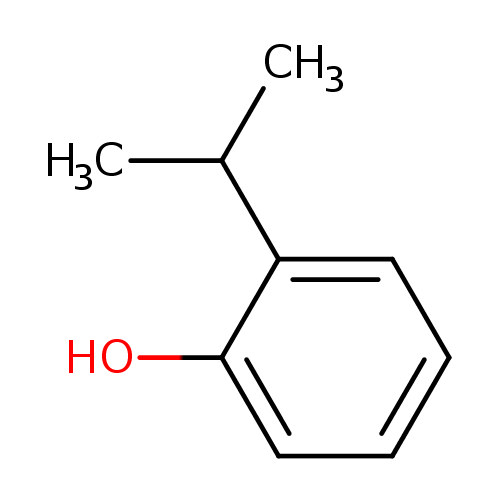
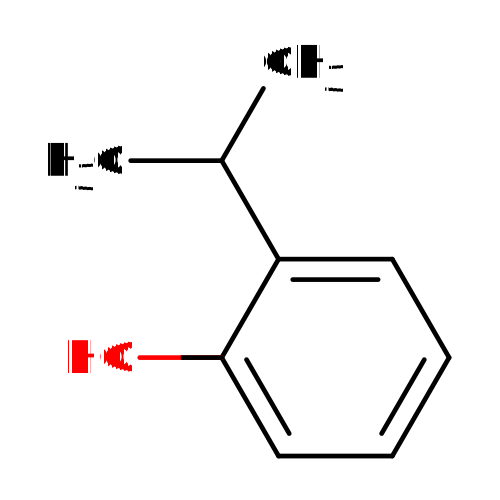
Common Name2-Isopropylphenol
ClassSmall Molecule
Description2-Isopropylphenol is a flavouring ingredient 2-isopropylphenol belongs to the family of Cumenes. These are aromatic compounds containing a prop-2-ylbenzene moiety.
Contaminant Sources
  • EAFUS Chemicals
  • FooDB Chemicals
  • HPV EPA Chemicals
  • T3DB toxins
  • ToxCast & Tox21 Chemicals
Contaminant Type
  • Flavouring Agent
  • Food Toxin
  • Industrial/Workplace Toxin
  • Metabolite
  • Organic Compound
  • Synthetic Compound
Chemical Structure
Thumb
Synonyms
ValueSource
1-Hydroxy-2-isopropylbenzeneChEBI
2-(1-Methylethyl)phenolChEBI
O-CumenolChEBI
O-HydroxycumeneChEBI
O-IsopropylphenolChEBI
Ortho-isopropylphenolMeSH
1-Hydroxy-3-isopropylbenzeneHMDB
2-(1-Methylethyl)-phenolHMDB
2-(1-Methylethyl)phenol, 9ciHMDB
2-(Propan-2-yl)phenolHMDB
FEMA 3461HMDB
Isopropyl-phenolHMDB
Isopropylphenol, orthoHMDB
O-Isopropyl-phenolHMDB
Prodox 131HMDB
Chemical FormulaC9H12O
Average Molecular Mass136.191 g/mol
Monoisotopic Mass136.089 g/mol
CAS Registry Number88-69-7
IUPAC Name2-(propan-2-yl)phenol
Traditional Name2-isopropylphenol
SMILESCC(C)C1=CC=CC=C1O
InChI IdentifierInChI=1S/C9H12O/c1-7(2)8-5-3-4-6-9(8)10/h3-7,10H,1-2H3
InChI KeyCRBJBYGJVIBWIY-UHFFFAOYSA-N
Chemical Taxonomy
Description belongs to the class of organic compounds known as cumenes. These are aromatic compounds containing a prop-2-ylbenzene moiety.
KingdomOrganic compounds
Super ClassBenzenoids
ClassBenzene and substituted derivatives
Sub ClassCumenes
Direct ParentCumenes
Alternative Parents
Substituents
  • Phenylpropane
  • Cumene
  • 1-hydroxy-4-unsubstituted benzenoid
  • 1-hydroxy-2-unsubstituted benzenoid
  • Phenol
  • Organic oxygen compound
  • Hydrocarbon derivative
  • Organooxygen compound
  • Aromatic homomonocyclic compound
Molecular FrameworkAromatic homomonocyclic compounds
External Descriptors
Biological Properties
StatusDetected and Not Quantified
OriginExogenous
Cellular Locations
  • Membrane
Biofluid LocationsNot Available
Tissue LocationsNot Available
PathwaysNot Available
ApplicationsNot Available
Biological RolesNot Available
Chemical RolesNot Available
Physical Properties
StateLiquid
AppearanceNot Available
Experimental Properties
PropertyValue
Melting Point15 - 16°C
Boiling PointNot Available
SolubilityInsoluble
Predicted Properties
PropertyValueSource
Water Solubility3.09 g/LALOGPS
logP2.78ALOGPS
logP2.91ChemAxon
logS-1.6ALOGPS
pKa (Strongest Acidic)10.5ChemAxon
pKa (Strongest Basic)-5.2ChemAxon
Physiological Charge0ChemAxon
Hydrogen Acceptor Count1ChemAxon
Hydrogen Donor Count1ChemAxon
Polar Surface Area20.23 ŲChemAxon
Rotatable Bond Count1ChemAxon
Refractivity42.23 m³·mol⁻¹ChemAxon
Polarizability15.63 ųChemAxon
Number of Rings1ChemAxon
Bioavailability1ChemAxon
Rule of FiveYesChemAxon
Ghose FilterNoChemAxon
Veber's RuleYesChemAxon
MDDR-like RuleNoChemAxon
Spectra
Spectra
Spectrum TypeDescriptionSplash KeyView
GC-MSGC-MS Spectrum - EI-B (Non-derivatized)splash10-00dr-9700000000-0a3ec6f0b6db49b1bb8cSpectrum
Predicted GC-MSPredicted GC-MS Spectrum - GC-MS (Non-derivatized) - 70eV, Positivesplash10-00dr-6900000000-65b25162f6cb1b887f17Spectrum
Predicted GC-MSPredicted GC-MS Spectrum - GC-MS (1 TMS) - 70eV, Positivesplash10-006x-8900000000-6f77c31ece141c6bd323Spectrum
Predicted GC-MSPredicted GC-MS Spectrum - GC-MS (Non-derivatized) - 70eV, PositiveNot AvailableSpectrum
Predicted LC-MS/MSPredicted LC-MS/MS Spectrum - 10V, Positivesplash10-000i-0900000000-f27e4c86fd02f3a4d9f5Spectrum
Predicted LC-MS/MSPredicted LC-MS/MS Spectrum - 20V, Positivesplash10-000i-7900000000-b30b63f3decaee02aa55Spectrum
Predicted LC-MS/MSPredicted LC-MS/MS Spectrum - 40V, Positivesplash10-0uxu-9400000000-6296af1e3299f7217b19Spectrum
Predicted LC-MS/MSPredicted LC-MS/MS Spectrum - 10V, Negativesplash10-000i-0900000000-69d37dcc656ad26252a0Spectrum
Predicted LC-MS/MSPredicted LC-MS/MS Spectrum - 20V, Negativesplash10-000i-0900000000-36ddf0e1e27114cf431aSpectrum
Predicted LC-MS/MSPredicted LC-MS/MS Spectrum - 40V, Negativesplash10-00ku-7900000000-512c84878dbff828e6bfSpectrum
Predicted LC-MS/MSPredicted LC-MS/MS Spectrum - 10V, Negativesplash10-000i-0900000000-3d153ee27562ca42735cSpectrum
Predicted LC-MS/MSPredicted LC-MS/MS Spectrum - 20V, Negativesplash10-0019-0900000000-197285ccea74149669c9Spectrum
Predicted LC-MS/MSPredicted LC-MS/MS Spectrum - 40V, Negativesplash10-014l-9100000000-8b244056e4ef8843629aSpectrum
Predicted LC-MS/MSPredicted LC-MS/MS Spectrum - 10V, Positivesplash10-0002-9300000000-3a595b114a7498fb8470Spectrum
Predicted LC-MS/MSPredicted LC-MS/MS Spectrum - 20V, Positivesplash10-00ku-6900000000-4dd9eeb2be33c550227cSpectrum
Predicted LC-MS/MSPredicted LC-MS/MS Spectrum - 40V, Positivesplash10-00mo-9000000000-66881aa4860995f95badSpectrum
MSMass Spectrum (Electron Ionization)splash10-00di-4900000000-0ab562a07073aa1cb86aSpectrum
1D NMR1H NMR SpectrumNot AvailableSpectrum
1D NMR13C NMR SpectrumNot AvailableSpectrum
1D NMR1H NMR SpectrumNot AvailableSpectrum
1D NMR13C NMR SpectrumNot AvailableSpectrum
1D NMR1H NMR SpectrumNot AvailableSpectrum
1D NMR13C NMR SpectrumNot AvailableSpectrum
1D NMR1H NMR SpectrumNot AvailableSpectrum
1D NMR13C NMR SpectrumNot AvailableSpectrum
1D NMR1H NMR SpectrumNot AvailableSpectrum
1D NMR13C NMR SpectrumNot AvailableSpectrum
1D NMR1H NMR SpectrumNot AvailableSpectrum
1D NMR13C NMR SpectrumNot AvailableSpectrum
1D NMR1H NMR SpectrumNot AvailableSpectrum
1D NMR13C NMR SpectrumNot AvailableSpectrum
1D NMR1H NMR SpectrumNot AvailableSpectrum
1D NMR13C NMR SpectrumNot AvailableSpectrum
1D NMR1H NMR SpectrumNot AvailableSpectrum
1D NMR13C NMR SpectrumNot AvailableSpectrum
1D NMR1H NMR SpectrumNot AvailableSpectrum
1D NMR13C NMR SpectrumNot AvailableSpectrum
1D NMR1H NMR SpectrumNot AvailableSpectrum
Toxicity Profile
Route of ExposureNot Available
Mechanism of ToxicityNot Available
MetabolismNot Available
Toxicity ValuesNot Available
Lethal DoseNot Available
Carcinogenicity (IARC Classification)No indication of carcinogenicity to humans (not listed by IARC).
Uses/SourcesNot Available
Minimum Risk LevelNot Available
Health EffectsNot Available
SymptomsNot Available
TreatmentNot Available
Concentrations
Not Available
DrugBank IDNot Available
HMDB IDHMDB0032029
FooDB IDFDB008729
Phenol Explorer IDNot Available
KNApSAcK IDC00010968
BiGG IDNot Available
BioCyc IDCPD-14150
METLIN IDNot Available
PDB IDIP0
Wikipedia LinkNot Available
Chemspider ID6677
ChEBI ID38506
PubChem Compound ID6943
Kegg Compound IDNot Available
YMDB IDNot Available
ECMDB IDNot Available
References
Synthesis ReferenceNot Available
MSDSNot Available
General References
1. https://www.ncbi.nlm.nih.gov/pubmed/?term=14758593
2. https://www.ncbi.nlm.nih.gov/pubmed/?term=7811094
3.
4. Chiha M, Merouani S, Hamdaoui O, Baup S, Gondrexon N, Petrier C: Modeling of ultrasonic degradation of non-volatile organic compounds by Langmuir-type kinetics. Ultrason Sonochem. 2010 Jun;17(5):773-82. doi: 10.1016/j.ultsonch.2010.03.007. Epub 2010 Mar 27.
5. Toyama T, Momotani N, Ogata Y, Miyamori Y, Inoue D, Sei K, Mori K, Kikuchi S, Ike M: Isolation and characterization of 4-tert-butylphenol-utilizing Sphingobium fuliginis strains from Phragmites australis rhizosphere sediment. Appl Environ Microbiol. 2010 Oct;76(20):6733-40. doi: 10.1128/AEM.00258-10. Epub 2010 Aug 27.
6. Li J, Ma M, Wang Z: In vitro profiling of endocrine disrupting effects of phenols. Toxicol In Vitro. 2010 Feb;24(1):201-7. doi: 10.1016/j.tiv.2009.09.008. Epub 2009 Sep 16.
7. Toyama T, Maeda N, Murashita M, Chang YC, Kikuchi S: Isolation and characterization of a novel 2-sec-butylphenol-degrading bacterium Pseudomonas sp. strain MS-1. Biodegradation. 2010 Apr;21(2):157-65. doi: 10.1007/s10532-009-9290-y. Epub 2009 Aug 25.
8. Cho S, Choi Y, Park S, Park T: Carvacrol prevents diet-induced obesity by modulating gene expressions involved in adipogenesis and inflammation in mice fed with high-fat diet. J Nutr Biochem. 2012 Feb;23(2):192-201. doi: 10.1016/j.jnutbio.2010.11.016. Epub 2011 Mar 29.
9. Glenn GM, Klamczynski AP, Woods DF, Chiou B, Orts WJ, Imam SH: Encapsulation of plant oils in porous starch microspheres. J Agric Food Chem. 2010 Apr 14;58(7):4180-4. doi: 10.1021/jf9037826.
10. Shiizaki K, Asai S, Ebata S, Kawanishi M, Yagi T: Establishment of yeast reporter assay systems to detect ligands of thyroid hormone receptors alpha and beta. Toxicol In Vitro. 2010 Mar;24(2):638-44. doi: 10.1016/j.tiv.2009.10.001. Epub 2009 Oct 22.
11. Krcmar S: Responses of Tabanidae (Diptera) to canopy traps baited with 4-methylphenol, 3-isopropylphenol, and naphthalene. J Vector Ecol. 2007 Dec;32(2):188-92.
12. Harvey KA, Xu Z, Whitley P, Davisson VJ, Siddiqui RA: Characterization of anticancer properties of 2,6-diisopropylphenol-docosahexaenoate and analogues in breast cancer cells. Bioorg Med Chem. 2010 Mar 1;18(5):1866-74. doi: 10.1016/j.bmc.2010.01.045. Epub 2010 Jan 25.
13. Tsuchiya H, Ueno T, Tanaka T, Matsuura N, Mizogami M: Comparative study on determination of antioxidant and membrane activities of propofol and its related compounds. Eur J Pharm Sci. 2010 Jan 31;39(1-3):97-102. doi: 10.1016/j.ejps.2009.11.001. Epub 2009 Nov 6.
14. Leon I, Cocinero EJ, Millan J, Rijs AM, Usabiaga I, Lesarri A, Castano F, Fernandez JA: A combined spectroscopic and theoretical study of propofol.(H2O)3. J Chem Phys. 2012 Aug 21;137(7):074303.
15. Li J, Ma M, Wang Z: A two-hybrid yeast assay to quantify the effects of xenobiotics on retinoid X receptor-mediated gene expression. Toxicol Lett. 2008 Feb 15;176(3):198-206. doi: 10.1016/j.toxlet.2007.11.006. Epub 2007 Dec 3.
16. Feng Y, Colosi LM, Gao S, Huang Q, Mao L: Transformation and removal of tetrabromobisphenol A from water in the presence of natural organic matter via laccase-catalyzed reactions: reaction rates, products, and pathways. Environ Sci Technol. 2013 Jan 15;47(2):1001-8. doi: 10.1021/es302680c. Epub 2013 Jan 7.
17. Li J, Ma M, Wang Z: A two-hybrid yeast assay to quantify the effects of xenobiotics on thyroid hormone-mediated gene expression. Environ Toxicol Chem. 2008 Jan;27(1):159-67.
18. Alessio RJ, Li X, Martin DF: Removal of BPA model compounds and related substances by means of column chromatography using Octolig(R). J Environ Sci Health A Tox Hazard Subst Environ Eng. 2012;47(14):2198-204. doi: 10.1080/10934529.2012.707535.
19. Novak M, Brinster AM, Dickhoff JN, Erb JM, Jones MP, Leopold SH, Vollman AT, Wang YT, Glover SA: Chemistry of 4-alkylaryloxenium ion "precursors": sound and fury signifying something? J Org Chem. 2007 Dec 21;72(26):9954-62. Epub 2007 Nov 21.
20. Yannai, Shmuel. (2004) Dictionary of food compounds with CD-ROM: Additives, flavors, and ingredients. Boca Raton: Chapman & Hall/CRC.