Record Information
Version1.0
Creation Date2013-04-25 07:56:53 UTC
Update Date2026-05-14 18:25:21 UTC
Accession NumberCHEM002852
Identification
Common NameNiclosamide
ClassSmall Molecule
DescriptionNiclosamide is used for the treatment of most tapeworm infections. Helminths (worms) are multicellular organisms that infect very large numbers of humans and cause a broad range of diseases. Over 1 billion people are infected with intestinal nematodes, and many millions are infected with filarial nematodes, flukes, and tapeworms. They are an even greater problem in domestic animals.
Contaminant Sources
  • HMDB Contaminants - Urine
  • STOFF IDENT Compounds
  • T3DB toxins
  • ToxCast & Tox21 Chemicals
Contaminant Type
  • Amide
  • Amine
  • Drug
  • Ester
  • Metabolite
  • Organic Compound
  • Organochloride
  • Pesticide
  • Synthetic Compound
Chemical Structure
Thumb
Synonyms
ValueSource
NiclocideKegg
Aventis brand OF niclosamideHMDB
Bayer brand OF niclosamideHMDB
FenasalHMDB
Bayer 73HMDB
BayluscideHMDB
ClonitralideHMDB
YomesanHMDB
Bayer 2353HMDB
Niclosamide, 2-aminoethanol (1:1)HMDB
PhenasalHMDB
RadewermHMDB
TrédémineHMDB
Chemical FormulaC13H8Cl2N2O4
Average Molecular Mass327.120 g/mol
Monoisotopic Mass325.986 g/mol
CAS Registry Number50-65-7
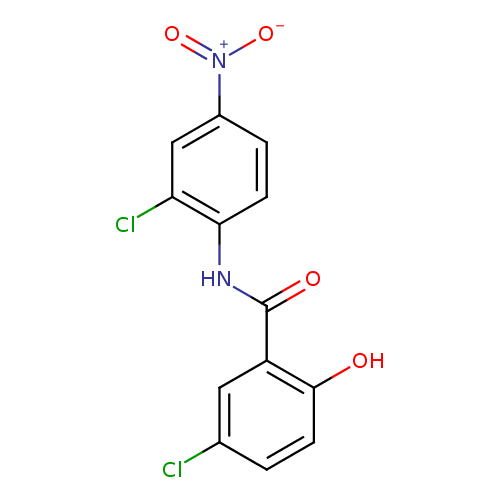
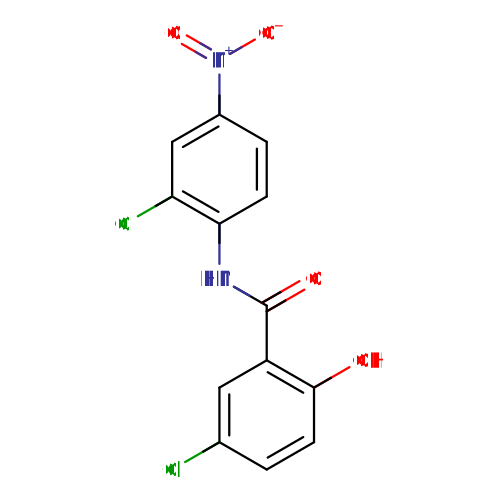
IUPAC Name5-chloro-N-(2-chloro-4-nitrophenyl)-2-hydroxybenzamide
Traditional Nameniclosamide
SMILESOC1=C(C=C(Cl)C=C1)C(=O)NC1=C(Cl)C=C(C=C1)[N+]([O-])=O
InChI IdentifierInChI=1S/C13H8Cl2N2O4/c14-7-1-4-12(18)9(5-7)13(19)16-11-3-2-8(17(20)21)6-10(11)15/h1-6,18H,(H,16,19)
InChI KeyRJMUSRYZPJIFPJ-UHFFFAOYSA-N
Chemical Taxonomy
Description belongs to the class of organic compounds known as benzanilides. These are aromatic compounds containing an anilide group in which the carboxamide group is substituted with a benzene ring. They have the general structure RNC(=O)R', where R,R'= benzene.
KingdomOrganic compounds
Super ClassBenzenoids
ClassBenzene and substituted derivatives
Sub ClassAnilides
Direct ParentBenzanilides
Alternative Parents
Substituents
  • Benzanilide
  • Salicylamide
  • Salicylic acid or derivatives
  • 3-halobenzoic acid or derivatives
  • Halobenzoic acid or derivatives
  • Benzamide
  • Benzoic acid or derivatives
  • Nitrobenzene
  • Nitroaromatic compound
  • Benzoyl
  • 4-halophenol
  • 4-chlorophenol
  • 1-hydroxy-2-unsubstituted benzenoid
  • Chlorobenzene
  • Halobenzene
  • Phenol
  • Aryl chloride
  • Aryl halide
  • Vinylogous acid
  • Secondary carboxylic acid amide
  • Organic nitro compound
  • Carboxamide group
  • C-nitro compound
  • Allyl-type 1,3-dipolar organic compound
  • Propargyl-type 1,3-dipolar organic compound
  • Organic 1,3-dipolar compound
  • Carboxylic acid derivative
  • Organic oxoazanium
  • Organic nitrogen compound
  • Organopnictogen compound
  • Organic oxide
  • Organohalogen compound
  • Organochloride
  • Organonitrogen compound
  • Organic oxygen compound
  • Organooxygen compound
  • Hydrocarbon derivative
  • Organic zwitterion
  • Aromatic homomonocyclic compound
Molecular FrameworkAromatic homomonocyclic compounds
External DescriptorsNot Available
Biological Properties
StatusDetected and Not Quantified
OriginExogenous
Cellular Locations
  • Cytoplasm
  • Membrane
Biofluid LocationsNot Available
Tissue LocationsNot Available
PathwaysNot Available
ApplicationsNot Available
Biological RolesNot Available
Chemical RolesNot Available
Physical Properties
StateSolid
AppearanceWhite powder.
Experimental Properties
PropertyValue
Melting Point230°C
Boiling PointNot Available
Solubility1.6 mg/L (at 20°C)
Predicted Properties
PropertyValueSource
Water Solubility0.008 g/LALOGPS
logP4.49ALOGPS
logP3.91ChemAxon
logS-4.6ALOGPS
pKa (Strongest Acidic)6.89ChemAxon
pKa (Strongest Basic)-4.4ChemAxon
Physiological Charge-1ChemAxon
Hydrogen Acceptor Count4ChemAxon
Hydrogen Donor Count2ChemAxon
Polar Surface Area95.15 ŲChemAxon
Rotatable Bond Count3ChemAxon
Refractivity80.51 m³·mol⁻¹ChemAxon
Polarizability28.47 ųChemAxon
Number of Rings2ChemAxon
Bioavailability1ChemAxon
Rule of FiveYesChemAxon
Ghose FilterYesChemAxon
Veber's RuleNoChemAxon
MDDR-like RuleNoChemAxon
Spectra
Spectra
Spectrum TypeDescriptionSplash KeyView
Predicted GC-MSPredicted GC-MS Spectrum - GC-MS (Non-derivatized) - 70eV, Positivesplash10-0udi-6901000000-2b365b023e021b160f32Spectrum
Predicted GC-MSPredicted GC-MS Spectrum - GC-MS (1 TMS) - 70eV, Positivesplash10-00fr-8930000000-69bd67a318e9efd73ddeSpectrum
Predicted GC-MSPredicted GC-MS Spectrum - GC-MS (Non-derivatized) - 70eV, PositiveNot AvailableSpectrum
LC-MS/MSLC-MS/MS Spectrum - LC-ESI-qTof , Positivesplash10-0006-2920000000-abe97627fbae89daa0dbSpectrum
LC-MS/MSLC-MS/MS Spectrum - LC-ESI-QFT , negativesplash10-00di-0029000000-07d09d3c05d206cf1709Spectrum
LC-MS/MSLC-MS/MS Spectrum - LC-ESI-QFT , negativesplash10-00dr-0982000000-be44b0c8755c752ba0f3Spectrum
LC-MS/MSLC-MS/MS Spectrum - LC-ESI-QFT , negativesplash10-00di-0910000000-4aa0326731fc70d171deSpectrum
LC-MS/MSLC-MS/MS Spectrum - LC-ESI-QFT , negativesplash10-00di-0900000000-d166a8246615e944705aSpectrum
LC-MS/MSLC-MS/MS Spectrum - LC-ESI-QFT , negativesplash10-00di-0900000000-8da8fb85b28f330b445dSpectrum
LC-MS/MSLC-MS/MS Spectrum - LC-ESI-QFT , negativesplash10-0abi-0900000000-10c251c2f1c5006a7f25Spectrum
LC-MS/MSLC-MS/MS Spectrum - LC-ESI-QFT , positivesplash10-0fka-5952000000-25e2c37ca8eb59d1db22Spectrum
LC-MS/MSLC-MS/MS Spectrum - LC-ESI-QFT , positivesplash10-0002-9200000000-57c28b8b2b3dc926256dSpectrum
LC-MS/MSLC-MS/MS Spectrum - LC-ESI-QFT , positivesplash10-0002-9100000000-2b567071c6cfa78ecf55Spectrum
LC-MS/MSLC-MS/MS Spectrum - LC-ESI-QFT , positivesplash10-0002-9100000000-33d3827b1d5b1d8b0dd1Spectrum
LC-MS/MSLC-MS/MS Spectrum - LC-ESI-QFT , positivesplash10-0002-9000000000-9cee7be3f0ec47a2cf6eSpectrum
LC-MS/MSLC-MS/MS Spectrum - LC-ESI-QFT , positivesplash10-0002-9000000000-cf3d1288bd0150e477beSpectrum
LC-MS/MSLC-MS/MS Spectrum - , positivesplash10-004i-0519000000-8dd141b868e2002a2bfaSpectrum
LC-MS/MSLC-MS/MS Spectrum - , positivesplash10-0udi-4900000000-d83bc5ee9b78c460078cSpectrum
LC-MS/MSLC-MS/MS Spectrum - 60V, Negativesplash10-00di-0900000000-1c2167607d05b47594fbSpectrum
LC-MS/MSLC-MS/MS Spectrum - 75V, Negativesplash10-00di-0900000000-25ef559cdcba657ec7bfSpectrum
LC-MS/MSLC-MS/MS Spectrum - 45V, Negativesplash10-00di-0910000000-137a6a40379842639b2aSpectrum
LC-MS/MSLC-MS/MS Spectrum - 30V, Negativesplash10-00dr-0982000000-c63ef31f0e3de2dbbbd1Spectrum
Predicted LC-MS/MSPredicted LC-MS/MS Spectrum - 10V, Positivesplash10-004i-0009000000-19d348ccf2b61b75bf34Spectrum
Predicted LC-MS/MSPredicted LC-MS/MS Spectrum - 20V, Positivesplash10-004i-0009000000-7d6ea94b8683b59260b8Spectrum
Predicted LC-MS/MSPredicted LC-MS/MS Spectrum - 40V, Positivesplash10-056r-0639000000-2cc47cc1fb3e56e9be10Spectrum
Predicted LC-MS/MSPredicted LC-MS/MS Spectrum - 10V, Negativesplash10-00di-0009000000-720f5eedf2a446e4de88Spectrum
Predicted LC-MS/MSPredicted LC-MS/MS Spectrum - 20V, Negativesplash10-00di-0009000000-9146e1b30ee98c36f42bSpectrum
Predicted LC-MS/MSPredicted LC-MS/MS Spectrum - 40V, Negativesplash10-05bf-6629000000-77e8ecb80b64e657ec0fSpectrum
Toxicity Profile
Route of ExposureNiclosamide appears to be minimally absorbed from the gastrointestinal tract - neither the drug nor its metabolites have been recovered from the blood or urine.
Mechanism of ToxicityNiclosamide works by killing tapeworms on contact. Adult worms (but not ova) are rapidly killed, presumably due to uncoupling of oxidative phosphorylation or stimulation of ATPase activity. The killed worms are then passed in the stool or sometimes destroyed in the intestine. Niclosamide may work as a molluscicide by binding to and damaging DNA.
MetabolismNot Available
Toxicity ValuesNot Available
Lethal DoseNot Available
Carcinogenicity (IARC Classification)No indication of carcinogenicity to humans (not listed by IARC).
Uses/SourcesFor the treatment of tapeworm and intestinal fluke infections: Taenia saginata (Beef Tapeworm), Taenia solium (Pork Tapeworm), Diphyllobothrium latum (Fish Tapeworm), Fasciolopsis buski (large intestinal fluke). Niclosamide is also used as a molluscicide in the control of schistosomiasis.
Minimum Risk LevelNot Available
Health EffectsNot Available
SymptomsNot Available
TreatmentNot Available
Concentrations
Not Available
DrugBank IDDB06803
HMDB IDHMDB0015679
FooDB IDNot Available
Phenol Explorer IDNot Available
KNApSAcK IDNot Available
BiGG IDNot Available
BioCyc IDNot Available
METLIN IDNot Available
PDB IDNot Available
Wikipedia LinkNiclosamide
Chemspider ID4322
ChEBI ID478218
PubChem Compound ID4477
Kegg Compound IDNot Available
YMDB IDNot Available
ECMDB IDNot Available
References
Synthesis Reference

DrugSyn.org

MSDSNot Available
General References
1. 2010. Detailed Drug Information for the Consumerâ„¢. Greenwood Village, CO. Thomson Reuters. ISBN-10: 1-56363-575-5. ISSN: 0740-4174. STAT!Ref Online Electronic Medical Library.
2. Clinical Pharmacology of the Antihelminthic Drugs Chapter 53). Katzung BG: Basic & Clinical Pharmacology, 12th edition: http://accesspharmacy.com/content.aspx?aid=55830906