Record Information
Version1.0
Creation Date2013-04-25 07:56:53 UTC
Update Date2026-04-03 01:22:42 UTC
Accession NumberCHEM002847
Identification
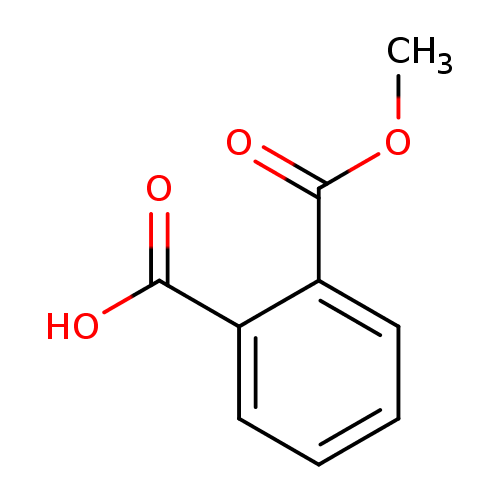
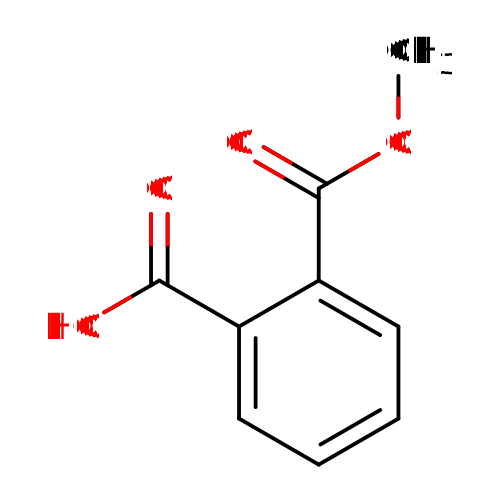
Common NameMonomethyl phthalate
ClassSmall Molecule
DescriptionMonomethyl phthalate is a metabolite, or breakdown product, of dimethyl phthalate, used in insect repellant, plastic, and as a rocket propellant.
Contaminant Sources
  • FooDB Chemicals
  • T3DB toxins
  • ToxCast & Tox21 Chemicals
Contaminant Type
  • Ester
  • Ether
  • Food Toxin
  • Household Toxin
  • Industrial/Workplace Toxin
  • Metabolite
  • Organic Compound
  • Plastic
  • Synthetic Compound
Chemical Structure
Thumb
Synonyms
ValueSource
Monomethyl phthalic acidGenerator
2-(Methoxycarbonyl)benzoateHMDB, Generator
2-(Methoxycarbonyl)benzoic acidHMDB
Methyl hydrogen phthalateHMDB
Methyl phthalateHMDB
Monomethyl 1,2-benzenedicarboxylateHMDB
O-(Methoxycarbonyl)benzoateHMDB
O-(Methoxycarbonyl)benzoic acidHMDB
1,2-Benzenedicarboxylic acid monomethyl esterMeSH, HMDB
Monomethyl phthalateMeSH
Chemical FormulaC9H8O4
Average Molecular Mass180.157 g/mol
Monoisotopic Mass180.042 g/mol
CAS Registry Number4376-18-5
IUPAC Name2-(methoxycarbonyl)benzoic acid
Traditional Namemethyl hydrogen phthalate
SMILESCOC(=O)C1=CC=CC=C1C(O)=O
InChI IdentifierInChI=1S/C9H8O4/c1-13-9(12)7-5-3-2-4-6(7)8(10)11/h2-5H,1H3,(H,10,11)
InChI KeyFNJSWIPFHMKRAT-UHFFFAOYSA-N
Chemical Taxonomy
Description belongs to the class of organic compounds known as benzoic acid esters. These are ester derivatives of benzoic acid.
KingdomOrganic compounds
Super ClassBenzenoids
ClassBenzene and substituted derivatives
Sub ClassBenzoic acids and derivatives
Direct ParentBenzoic acid esters
Alternative Parents
Substituents
  • Benzoate ester
  • Benzoic acid
  • Benzoyl
  • Dicarboxylic acid or derivatives
  • Methyl ester
  • Carboxylic acid ester
  • Carboxylic acid
  • Carboxylic acid derivative
  • Organic oxygen compound
  • Organic oxide
  • Hydrocarbon derivative
  • Organooxygen compound
  • Aromatic homomonocyclic compound
Molecular FrameworkAromatic homomonocyclic compounds
External DescriptorsNot Available
Biological Properties
StatusDetected and Not Quantified
OriginExogenous
Cellular Locations
  • Cytoplasm
  • Extracellular
Biofluid LocationsNot Available
Tissue LocationsNot Available
PathwaysNot Available
ApplicationsNot Available
Biological RolesNot Available
Chemical RolesNot Available
Physical Properties
StateSolid
AppearanceWhite powder.
Experimental Properties
PropertyValue
Melting Point82 - 84°C
Boiling PointNot Available
SolubilityNot Available
Predicted Properties
PropertyValueSource
Water Solubility1.76 g/LALOGPS
logP1.5ALOGPS
logP1.63ChemAxon
logS-2ALOGPS
pKa (Strongest Acidic)3.09ChemAxon
pKa (Strongest Basic)-6.9ChemAxon
Physiological Charge-1ChemAxon
Hydrogen Acceptor Count3ChemAxon
Hydrogen Donor Count1ChemAxon
Polar Surface Area63.6 ŲChemAxon
Rotatable Bond Count3ChemAxon
Refractivity45.34 m³·mol⁻¹ChemAxon
Polarizability16.88 ųChemAxon
Number of Rings1ChemAxon
Bioavailability1ChemAxon
Rule of FiveYesChemAxon
Ghose FilterYesChemAxon
Veber's RuleNoChemAxon
MDDR-like RuleNoChemAxon
Spectra
Spectra
Spectrum TypeDescriptionSplash KeyView
Predicted GC-MSPredicted GC-MS Spectrum - GC-MS (Non-derivatized) - 70eV, Positivesplash10-06rt-4900000000-7ecedc5a0ae37b95fb89Spectrum
Predicted GC-MSPredicted GC-MS Spectrum - GC-MS (1 TMS) - 70eV, Positivesplash10-00dr-9740000000-01768b5a1dd9f429bc59Spectrum
Predicted GC-MSPredicted GC-MS Spectrum - GC-MS (Non-derivatized) - 70eV, PositiveNot AvailableSpectrum
LC-MS/MSLC-MS/MS Spectrum - 45V, Positivesplash10-01ot-0900000000-65098170b3784885cf3eSpectrum
LC-MS/MSLC-MS/MS Spectrum - 60V, Positivesplash10-0002-1900000000-eb93036cba5677f432e4Spectrum
LC-MS/MSLC-MS/MS Spectrum - 30V, Positivesplash10-01ot-0900000000-6757db1ade89e1c39c0fSpectrum
LC-MS/MSLC-MS/MS Spectrum - 15V, Positivesplash10-01ot-0900000000-bfa80ccf09eb7547a421Spectrum
LC-MS/MSLC-MS/MS Spectrum - 75V, Positivesplash10-00r2-6900000000-7e7becd99ce7a415a27aSpectrum
LC-MS/MSLC-MS/MS Spectrum - 90V, Positivesplash10-014j-9300000000-85d661af2d7811973328Spectrum
LC-MS/MSLC-MS/MS Spectrum - 30V, Negativesplash10-0a4i-0900000000-e16e03b30bfbb5c3e6f0Spectrum
LC-MS/MSLC-MS/MS Spectrum - 90V, Negativesplash10-00b9-9400000000-d46f471c7dd86ce167d8Spectrum
LC-MS/MSLC-MS/MS Spectrum - 75V, Negativesplash10-00fu-9800000000-94470b2ac4d094b65956Spectrum
LC-MS/MSLC-MS/MS Spectrum - 15V, Negativesplash10-0a4i-0900000000-f0a6ee4ef8d00d665066Spectrum
LC-MS/MSLC-MS/MS Spectrum - 45V, Negativesplash10-0a4i-0900000000-f5d8dcb50914d6dec34cSpectrum
LC-MS/MSLC-MS/MS Spectrum - 60V, Negativesplash10-0abc-3900000000-4cbbe5ea3080e1835e8bSpectrum
Predicted LC-MS/MSPredicted LC-MS/MS Spectrum - 10V, Positivesplash10-001i-0900000000-a30afed48b4abca44a75Spectrum
Predicted LC-MS/MSPredicted LC-MS/MS Spectrum - 20V, Positivesplash10-001j-0900000000-6c900681bbe7b512eb7bSpectrum
Predicted LC-MS/MSPredicted LC-MS/MS Spectrum - 40V, Positivesplash10-0a4i-3900000000-894c68b2baa026fb0ba0Spectrum
Predicted LC-MS/MSPredicted LC-MS/MS Spectrum - 10V, Negativesplash10-004i-0900000000-9ffa6bd1a11cb78d8eebSpectrum
Predicted LC-MS/MSPredicted LC-MS/MS Spectrum - 20V, Negativesplash10-002r-0900000000-56be31444cf112d7c4a3Spectrum
Predicted LC-MS/MSPredicted LC-MS/MS Spectrum - 40V, Negativesplash10-0udr-2900000000-bba5768c32c4e6274e8dSpectrum
Predicted LC-MS/MSPredicted LC-MS/MS Spectrum - 10V, Positivesplash10-01ot-0900000000-cc0e0c22916327043a55Spectrum
Predicted LC-MS/MSPredicted LC-MS/MS Spectrum - 20V, Positivesplash10-052b-0900000000-782a28b988f8b2a279d7Spectrum
Predicted LC-MS/MSPredicted LC-MS/MS Spectrum - 40V, Positivesplash10-0a4i-3900000000-3b0ed44720a2090fc9b0Spectrum
Predicted LC-MS/MSPredicted LC-MS/MS Spectrum - 10V, Negativesplash10-004r-3900000000-6ec50e9028830ab6da82Spectrum
Predicted LC-MS/MSPredicted LC-MS/MS Spectrum - 20V, Negativesplash10-004i-9500000000-da5c1bf0509aad044937Spectrum
Predicted LC-MS/MSPredicted LC-MS/MS Spectrum - 40V, Negativesplash10-004i-9000000000-79b57c4c262a25bff431Spectrum
MSMass Spectrum (Electron Ionization)splash10-0ufr-9400000000-0563d9ffe58f40e5046cSpectrum
Toxicity Profile
Route of ExposureNot Available
Mechanism of ToxicityNot Available
MetabolismNot Available
Toxicity ValuesNot Available
Lethal DoseNot Available
Carcinogenicity (IARC Classification)No indication of carcinogenicity to humans (not listed by IARC).
Uses/SourcesMonomethyl phthalate is a metabolite, or breakdown product, of dimethyl phthalate, used in insect repellant, plastic, and as a rocket propellant.
Minimum Risk LevelNot Available
Health EffectsNot Available
SymptomsNot Available
TreatmentNot Available
Concentrations
Not Available
DrugBank IDNot Available
HMDB IDHMDB0002130
FooDB IDFDB022858
Phenol Explorer IDNot Available
KNApSAcK IDNot Available
BiGG IDNot Available
BioCyc IDNot Available
METLIN IDNot Available
PDB IDNot Available
Wikipedia LinkNot Available
Chemspider ID19207
ChEBI ID491486
PubChem Compound ID20392
Kegg Compound IDNot Available
YMDB IDNot Available
ECMDB IDNot Available
References
Synthesis ReferenceMedonos, Vladimir; Pasek, Josef; Ruzicka, Vlastimil. Preparation of methyl phthalate by addition of dimethyl ether to phthalic anhydride. Chemicky Prumysl (1957), 7 281-5.
MSDSLink
General References
1. Medonos, Vladimir; Pasek, Josef; Ruzicka, Vlastimil. Preparation of methyl phthalate by addition of dimethyl ether to phthalic anhydride. Chemicky Prumysl (1957), 7 281-5.
2. Silva MJ, Reidy JA, Samandar E, Herbert AR, Needham LL, Calafat AM: Detection of phthalate metabolites in human saliva. Arch Toxicol. 2005 Nov;79(11):647-52. Epub 2005 Jul 2.
3. Liang DW, Zhang T, Fang HH: Denitrifying degradation of dimethyl phthalate. Appl Microbiol Biotechnol. 2007 Feb;74(1):221-9. Epub 2006 Nov 10.