Record Information
Version1.0
Creation Date2013-04-25 07:56:52 UTC
Update Date2026-03-26 19:50:44 UTC
Accession NumberCHEM002831
Identification
Common NameMalathion
ClassSmall Molecule
DescriptionMalathion is an organophosphate parasympathomimetic which binds irreversibly to cholinesterase. Malathion is an insecticide of relatively low human toxicity.
Contaminant Sources
  • Clean Air Act Chemicals
  • EPA Endocrine Screening
  • HMDB Contaminants - Urine
  • HPV EPA Chemicals
  • IARC Carcinogens Group 2A
  • IARC Carcinogens Group 3
  • My Exposome Chemicals
  • STOFF IDENT Compounds
  • T3DB toxins
  • ToxCast & Tox21 Chemicals
Contaminant Type
  • Cholinesterase Inhibitor
  • Drug
  • Ester
  • Ether
  • Household Toxin
  • Insecticide
  • Metabolite
  • Organic Compound
  • Pesticide
  • Synthetic Compound
Chemical Structure
Thumb
Synonyms
ValueSource
OvideKegg
[(Dimethoxyphosphinothioyl)thio]butanedioic acid diethyl esterHMDB
CarbophosHMDB
Diethyl (dimethoxyphosphinothioylthio)succinateHMDB
KarbofosHMDB
MaldisonHMDB
MercaptothionHMDB
O,O-Dimethyl S-(1,2-bis(ethoxycarbonyl)ethyl)HMDB
O,O-Dimethyl S-(1,2-dicarbethoxyethyl) dithiophosphateHMDB
O,O-Dimethyl S-(1,2-dicarbethoxyethyl)phosphorodithioateHMDB
O,O-Dimethyl S-1,2-di(ethoxycarbamyl)ethylHMDB
O,O-Dimethyldithiophosphate diethylmercaptosuccinateHMDB
[(Dimethoxyphosphinothioyl)thio]butanedioate diethyl esterHMDB
Diethyl (dimethoxyphosphinothioylthio)succinic acidHMDB
O,O-Dimethyl S-(1,2-dicarbethoxyethyl) dithiophosphoric acidHMDB
O,O-Dimethyl S-(1,2-dicarbethoxyethyl)phosphorodithioic acidHMDB
O,O-Dimethyldithiophosphoric acid diethylmercaptosuccinic acidHMDB
CarbofosHMDB
Compound 4049HMDB
Experimental insecticide 4049HMDB
Insecticide no. 4049HMDB
MalathioneHMDB
Mercaptosuccinic acid diethyl esterHMDB
MercaptotionHMDB
MLTHMDB
OleophosphothionHMDB
SadophosHMDB
CythionHMDB
CarbafosHMDB
PriodermHMDB
Chemical FormulaC10H19O6PS2
Average Molecular Mass330.358 g/mol
Monoisotopic Mass330.036 g/mol
CAS Registry Number121-75-5
IUPAC Name1,4-diethyl 2-{[dimethoxy(sulfanylidene)-lambda5-phosphanyl]sulfanyl}butanedioate
Traditional Name1,4-diethyl 2-{[dimethoxy(sulfanylidene)-lambda5-phosphanyl]sulfanyl}butanedioate
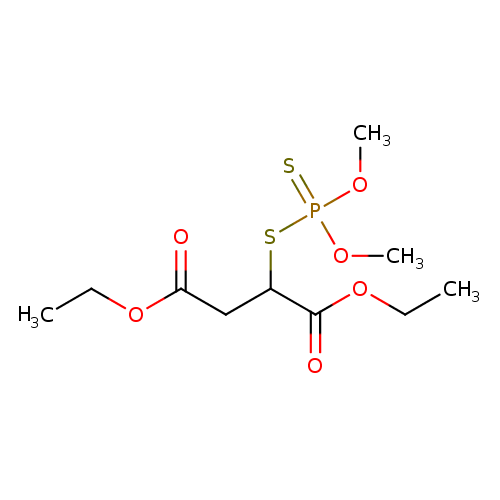
SMILESCCOC(=O)CC(SP(=S)(OC)OC)C(=O)OCC
InChI IdentifierInChI=1S/C10H19O6PS2/c1-5-15-9(11)7-8(10(12)16-6-2)19-17(18,13-3)14-4/h8H,5-7H2,1-4H3
InChI KeyJXSJBGJIGXNWCI-UHFFFAOYSA-N
Chemical Taxonomy
Description belongs to the class of organic compounds known as fatty acid esters. These are carboxylic ester derivatives of a fatty acid.
KingdomOrganic compounds
Super ClassLipids and lipid-like molecules
ClassFatty Acyls
Sub ClassFatty acid esters
Direct ParentFatty acid esters
Alternative Parents
Substituents
  • Fatty acid ester
  • Dicarboxylic acid or derivatives
  • Dithiophosphate o-ester
  • Dithiophosphate s-ester
  • Organic dithiophosphate
  • Carboxylic acid ester
  • Carboxylic acid derivative
  • Organothiophosphorus compound
  • Sulfenyl compound
  • Organooxygen compound
  • Hydrocarbon derivative
  • Organic oxide
  • Organic oxygen compound
  • Organosulfur compound
  • Carbonyl group
  • Aliphatic acyclic compound
Molecular FrameworkAliphatic acyclic compounds
External Descriptors
Biological Properties
StatusDetected and Not Quantified
OriginExogenous
Cellular Locations
  • Cytoplasm
  • Extracellular
  • Membrane
Biofluid LocationsNot Available
Tissue LocationsNot Available
PathwaysNot Available
Applications
Biological Roles
Chemical Roles
Physical Properties
StateLiquid
AppearanceNot Available
Experimental Properties
PropertyValue
Melting Point2.8°C
Boiling Point156-157°C at 7.00E-01 mm Hg
Solubility143 mg/L (at 20°C)
Predicted Properties
PropertyValueSource
Water Solubility0.16 g/LALOGPS
logP2.67ALOGPS
logP1.86ChemAxon
logS-3.3ALOGPS
pKa (Strongest Basic)-6.8ChemAxon
Physiological Charge0ChemAxon
Hydrogen Acceptor Count2ChemAxon
Hydrogen Donor Count0ChemAxon
Polar Surface Area71.06 ŲChemAxon
Rotatable Bond Count11ChemAxon
Refractivity78.18 m³·mol⁻¹ChemAxon
Polarizability31.66 ųChemAxon
Number of Rings0ChemAxon
Bioavailability1ChemAxon
Rule of FiveYesChemAxon
Ghose FilterYesChemAxon
Veber's RuleNoChemAxon
MDDR-like RuleNoChemAxon
Spectra
Spectra
Spectrum TypeDescriptionSplash KeyView
Predicted GC-MSPredicted GC-MS Spectrum - GC-MS (Non-derivatized) - 70eV, Positivesplash10-0a6s-5491000000-3592a22f2b1b3d40e724Spectrum
Predicted GC-MSPredicted GC-MS Spectrum - GC-MS (Non-derivatized) - 70eV, PositiveNot AvailableSpectrum
Predicted LC-MS/MSPredicted LC-MS/MS Spectrum - 10V, Positivesplash10-0532-0192000000-80a735602f43e69672f5Spectrum
Predicted LC-MS/MSPredicted LC-MS/MS Spectrum - 20V, Positivesplash10-052b-5290000000-5faa1d20fccf211cb57fSpectrum
Predicted LC-MS/MSPredicted LC-MS/MS Spectrum - 40V, Positivesplash10-001i-1910000000-a05ceb6094ed350bc453Spectrum
Predicted LC-MS/MSPredicted LC-MS/MS Spectrum - 10V, Negativesplash10-0faj-1193000000-b338e42eda1d6c05c7bcSpectrum
Predicted LC-MS/MSPredicted LC-MS/MS Spectrum - 20V, Negativesplash10-0006-1091000000-f5d217b3c309d0fbe4b8Spectrum
Predicted LC-MS/MSPredicted LC-MS/MS Spectrum - 40V, Negativesplash10-00fr-2390000000-b3ee35aea6b6f4b408a8Spectrum
Predicted LC-MS/MSPredicted LC-MS/MS Spectrum - 10V, Positivesplash10-00b9-0901000000-8e0175da8dcd3d5c20f6Spectrum
Predicted LC-MS/MSPredicted LC-MS/MS Spectrum - 20V, Positivesplash10-004i-0900000000-1e03cd94309b778f8fd8Spectrum
Predicted LC-MS/MSPredicted LC-MS/MS Spectrum - 40V, Positivesplash10-00b9-2900000000-49adc13defccdec4c850Spectrum
Predicted LC-MS/MSPredicted LC-MS/MS Spectrum - 10V, Negativesplash10-00di-0901000000-6de30c8781d1a5a9985aSpectrum
Predicted LC-MS/MSPredicted LC-MS/MS Spectrum - 20V, Negativesplash10-00di-1900000000-5e2663e1be7df3418ce5Spectrum
Predicted LC-MS/MSPredicted LC-MS/MS Spectrum - 40V, Negativesplash10-00di-0900000000-93b6b347a6b79a7090e5Spectrum
MSMass Spectrum (Electron Ionization)splash10-004i-8900000000-c6bc16fae6e217410d40Spectrum
1D NMR1H NMR SpectrumNot AvailableSpectrum
1D NMR13C NMR SpectrumNot AvailableSpectrum
Toxicity Profile
Route of ExposureMalathion in an acetone vehicle has been reported to be absorbed through normal human skin only to the extent of 8% of the applied dose. Absorption may be increased when malathion is applied to damaged skin. Malathion is rapidly and effectively absorbed by practically all routes including the gastrointestinal tract, skin, mucous membranes, and lungs. However, it is readily excreted in the urine, and does not accumulate in organs or tissues.
Mechanism of ToxicityMalathion is a cholinesterase or acetylcholinesterase (AChE) inhibitor. A cholinesterase inhibitor (or 'anticholinesterase') suppresses the action of acetylcholinesterase. Because of its essential function, chemicals that interfere with the action of acetylcholinesterase are potent neurotoxins, causing excessive salivation and eye-watering in low doses, followed by muscle spasms and ultimately death. Nerve gases and many substances used in insecticides have been shown to act by binding a serine in the active site of acetylcholine esterase, inhibiting the enzyme completely. Acetylcholine esterase breaks down the neurotransmitter acetylcholine, which is released at nerve and muscle junctions, in order to allow the muscle or organ to relax. The result of acetylcholine esterase inhibition is that acetylcholine builds up and continues to act so that any nerve impulses are continually transmitted and muscle contractions do not stop. Among the most common acetylcholinesterase inhibitors are phosphorus-based compounds, which are designed to bind to the active site of the enzyme. The structural requirements are a phosphorus atom bearing two lipophilic groups, a leaving group (such as a halide or thiocyanate), and a terminal oxygen.
MetabolismMetabolism of organophosphates occurs principally by oxidation, by hydrolysis via esterases and by reaction with glutathione. Demethylation and glucuronidation may also occur. Oxidation of organophosphorus pesticides may result in moderately toxic products. In general, phosphorothioates are not directly toxic but require oxidative metabolism to the proximal toxin. The glutathione transferase reactions produce products that are, in most cases, of low toxicity. Paraoxonase (PON1) is a key enzyme in the metabolism of organophosphates. PON1 can inactivate some organophosphates through hydrolysis. PON1 hydrolyzes the active metabolites in several organophosphates insecticides as well as, nerve agents such as soman, sarin, and VX. The presence of PON1 polymorphisms causes there to be different enzyme levels and catalytic efficiency of this esterase, which in turn suggests that different individuals may be more susceptible to the toxic effect of organophosphate exposure.
Toxicity ValuesMalathion is slightly toxic via the oral route, with reported oral LD50 values of 1000 mg/kg to greater than 10,000 mg/kg in the rat. It is also slightly toxic via the dermal route, with reported dermal LD50 values of greater than 4000 mg/kg in rats.
Lethal DoseNot Available
Carcinogenicity (IARC Classification)3, not classifiable as to its carcinogenicity to humans. (4)
Uses/SourcesFor patients infected with Pediculus humanus capitis (head lice and their ova) of the scalp hair.
Minimum Risk LevelNot Available
Health EffectsAcute exposure to cholinesterase inhibitors can cause a cholinergic crisis characterized by severe nausea/vomiting, salivation, sweating, bradycardia, hypotension, collapse, and convulsions. Increasing muscle weakness is a possibility and may result in death if respiratory muscles are involved. Accumulation of ACh at motor nerves causes overstimulation of nicotinic expression at the neuromuscular junction. When this occurs symptoms such as muscle weakness, fatigue, muscle cramps, fasciculation, and paralysis can be seen. When there is an accumulation of ACh at autonomic ganglia this causes overstimulation of nicotinic expression in the sympathetic system. Symptoms associated with this are hypertension, and hypoglycemia. Overstimulation of nicotinic acetylcholine receptors in the central nervous system, due to accumulation of ACh, results in anxiety, headache, convulsions, ataxia, depression of respiration and circulation, tremor, general weakness, and potentially coma. When there is expression of muscarinic overstimulation due to excess acetylcholine at muscarinic acetylcholine receptors symptoms of visual disturbances, tightness in chest, wheezing due to bronchoconstriction, increased bronchial secretions, increased salivation, lacrimation, sweating, peristalsis, and urination can occur. Certain reproductive effects in fertility, growth, and development for males and females have been linked specifically to organophosphate pesticide exposure. Most of the research on reproductive effects has been conducted on farmers working with pesticides and insecticdes in rural areas. In females menstrual cycle disturbances, longer pregnancies, spontaneous abortions, stillbirths, and some developmental effects in offspring have been linked to organophosphate pesticide exposure. Prenatal exposure has been linked to impaired fetal growth and development. Neurotoxic effects have also been linked to poisoning with OP pesticides causing four neurotoxic effects in humans: cholinergic syndrome, intermediate syndrome, organophosphate-induced delayed polyneuropathy (OPIDP), and chronic organophosphate-induced neuropsychiatric disorder (COPIND). These syndromes result after acute and chronic exposure to OP pesticides.
SymptomsSymptoms of low dose exposure include excessive salivation and eye-watering. Acute dose symptoms include severe nausea/vomiting, salivation, sweating, bradycardia, hypotension, collapse, and convulsions. Increasing muscle weakness is a possibility and may result in death if respiratory muscles are involved. Hypertension, hypoglycemia, anxiety, headache, tremor and ataxia may also result.
TreatmentIf the compound has been ingested, rapid gastric lavage should be performed using 5% sodium bicarbonate. For skin contact, the skin should be washed with soap and water. If the compound has entered the eyes, they should be washed with large quantities of isotonic saline or water. In serious cases, atropine and/or pralidoxime should be administered. Anti-cholinergic drugs work to counteract the effects of excess acetylcholine and reactivate AChE. Atropine can be used as an antidote in conjunction with pralidoxime or other pyridinium oximes (such as trimedoxime or obidoxime), though the use of '-oximes' has been found to be of no benefit, or possibly harmful, in at least two meta-analyses. Atropine is a muscarinic antagonist, and thus blocks the action of acetylcholine peripherally.

Concentrations
Not Available
DrugBank IDDB00772
HMDB IDHMDB0014910
FooDB IDNot Available
Phenol Explorer IDNot Available
KNApSAcK IDNot Available
BiGG IDNot Available
BioCyc IDNot Available
METLIN IDNot Available
PDB IDNot Available
Wikipedia LinkMalathion
Chemspider ID3864
ChEBI ID141474
PubChem Compound ID4004
Kegg Compound IDC07497
YMDB IDNot Available
ECMDB IDNot Available
References
Synthesis Reference

Noel Rouy, Georges Gros, “Process for the preparation of malathion.” U.S. Patent US4367180, issued August, 1969.

MSDSLink
General References
1. Baker EL Jr, Warren M, Zack M, Dobbin RD, Miles JW, Miller S, Alderman L, Teeters WR: Epidemic malathion poisoning in Pakistan malaria workers. Lancet. 1978 Jan 7;1(8054):31-4.
2. Edwards JW, Lee SG, Heath LM, Pisaniello DL: Worker exposure and a risk assessment of malathion and fenthion used in the control of Mediterranean fruit fly in South Australia. Environ Res. 2007 Jan;103(1):38-45. Epub 2006 Aug 17.
3. Bonner MR, Coble J, Blair A, Beane Freeman LE, Hoppin JA, Sandler DP, Alavanja MC: Malathion exposure and the incidence of cancer in the agricultural health study. Am J Epidemiol. 2007 Nov 1;166(9):1023-34. Epub 2007 Aug 23.
4. Simons K, Toomre D: Lipid rafts and signal transduction. Nat Rev Mol Cell Biol. 2000 Oct;1(1):31-9.
5. Watson AD: Thematic review series: systems biology approaches to metabolic and cardiovascular disorders. Lipidomics: a global approach to lipid analysis in biological systems. J Lipid Res. 2006 Oct;47(10):2101-11. Epub 2006 Aug 10.
6. Sethi JK, Vidal-Puig AJ: Thematic review series: adipocyte biology. Adipose tissue function and plasticity orchestrate nutritional adaptation. J Lipid Res. 2007 Jun;48(6):1253-62. Epub 2007 Mar 20.
7. Lingwood D, Simons K: Lipid rafts as a membrane-organizing principle. Science. 2010 Jan 1;327(5961):46-50. doi: 10.1126/science.1174621.
8. The lipid handbook with CD-ROM