Record Information
Version1.0
Creation Date2013-04-25 07:56:52 UTC
Update Date2026-03-31 17:55:18 UTC
Accession NumberCHEM002817
Identification
Common NameHalosulfuron-methyl
ClassSmall Molecule
DescriptionHalosulfuron-methyl is a selective herbicide for post-emergence control of sedges and other weeds in turf. It is also used on maize, sugarcane and rice. It interferes with the function of the acetolactate synthase enzyme, resulting in a rapid cessation of cell division and plant growth in both roots and shoots. In sulfite-sensitive individuals, skin reactions have been reported following dermal exposure.
Contaminant Sources
  • FooDB Chemicals
  • STOFF IDENT Compounds
  • T3DB toxins
  • ToxCast & Tox21 Chemicals
Contaminant Type
  • Amide
  • Amine
  • Ester
  • Ether
  • Food Toxin
  • Herbicide
  • Household Toxin
  • Metabolite
  • Organic Compound
  • Organochloride
  • Pesticide
  • Synthetic Compound
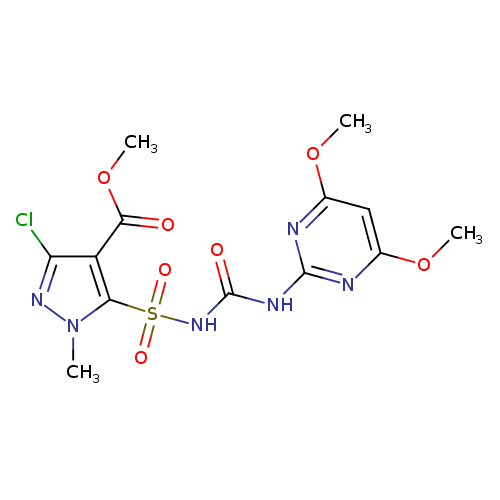
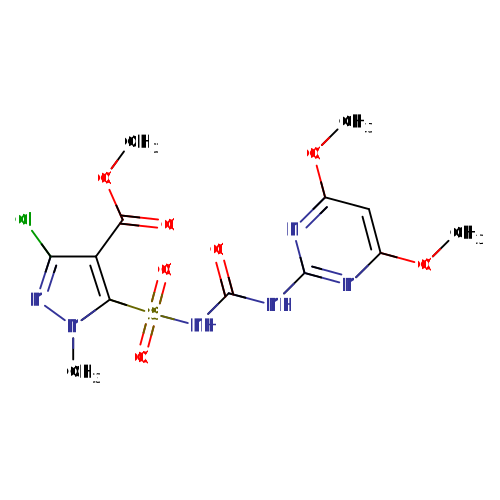
Chemical Structure
Thumb
Synonyms
ValueSource
Halosulphuron-methylGenerator
a 841101HMDB
BattalionHMDB
C.i. natural brown 3HMDB
Halosulfuron-methyl, bsiHMDB
InpoolHMDB
ManageHMDB
MON 12000HMDB
MON 12037HMDB
NC 319HMDB
PermitHMDB
Permit 75WGHMDB
SandeaHMDB
SempraHMDB
Halosulfuron methylMeSH, HMDB
Chemical FormulaC13H15ClN6O7S
Average Molecular Mass434.812 g/mol
Monoisotopic Mass434.041 g/mol
CAS Registry Number100784-20-1
IUPAC Namemethyl 3-chloro-5-({[(4,6-dimethoxypyrimidin-2-yl)carbamoyl]amino}sulfonyl)-1-methyl-1H-pyrazole-4-carboxylate
Traditional Namemethyl 3-chloro-5-{[(4,6-dimethoxypyrimidin-2-yl)carbamoyl]aminosulfonyl}-1-methylpyrazole-4-carboxylate
SMILESCOC(=O)C1=C(N(C)N=C1Cl)S(=O)(=O)NC(=O)NC1=NC(OC)=CC(OC)=N1
InChI IdentifierInChI=1S/C13H15ClN6O7S/c1-20-10(8(9(14)18-20)11(21)27-4)28(23,24)19-13(22)17-12-15-6(25-2)5-7(16-12)26-3/h5H,1-4H3,(H2,15,16,17,19,22)
InChI KeyFMGZEUWROYGLAY-UHFFFAOYSA-N
Chemical Taxonomy
Description belongs to the class of organic compounds known as pyrazole carboxylic acids and derivatives. These are heterocyclic compounds containing a pyrazole ring in which a hydrogen atom is replaced by a carboxylic acid group.
KingdomOrganic compounds
Super ClassOrganoheterocyclic compounds
ClassAzoles
Sub ClassPyrazoles
Direct ParentPyrazole carboxylic acids and derivatives
Alternative Parents
Substituents
  • Pyrazole-4-carboxylic acid or derivatives
  • Alkyl aryl ether
  • Sulfonylurea
  • Aryl chloride
  • Aryl halide
  • Pyrimidine
  • Organic sulfonic acid or derivatives
  • Organosulfonic acid or derivatives
  • Sulfonyl
  • Heteroaromatic compound
  • Aminosulfonyl compound
  • Methyl ester
  • Vinylogous halide
  • Vinylogous amide
  • Carboxylic acid ester
  • Azacycle
  • Ether
  • Organic 1,3-dipolar compound
  • Propargyl-type 1,3-dipolar organic compound
  • Carboxylic acid derivative
  • Carboximidic acid derivative
  • Monocarboxylic acid or derivatives
  • Organic oxygen compound
  • Organochloride
  • Organohalogen compound
  • Organonitrogen compound
  • Organopnictogen compound
  • Organooxygen compound
  • Organosulfur compound
  • Organic oxide
  • Hydrocarbon derivative
  • Organic nitrogen compound
  • Aromatic heteromonocyclic compound
Molecular FrameworkAromatic heteromonocyclic compounds
External Descriptors
Biological Properties
StatusDetected and Not Quantified
OriginExogenous
Cellular Locations
  • Membrane
Biofluid LocationsNot Available
Tissue LocationsNot Available
PathwaysNot Available
ApplicationsNot Available
Biological RolesNot Available
Chemical RolesNot Available
Physical Properties
StateSolid
AppearanceWhite powder.
Experimental Properties
PropertyValue
Melting Point176 - 177°C
Boiling PointNot Available
SolubilityNot Available
Predicted Properties
PropertyValueSource
Water Solubility0.22 g/LALOGPS
logP1.74ALOGPS
logP1.45ChemAxon
logS-3.3ALOGPS
pKa (Strongest Acidic)4.53ChemAxon
pKa (Strongest Basic)1.68ChemAxon
Physiological Charge-1ChemAxon
Hydrogen Acceptor Count9ChemAxon
Hydrogen Donor Count2ChemAxon
Polar Surface Area163.63 ŲChemAxon
Rotatable Bond Count6ChemAxon
Refractivity109.13 m³·mol⁻¹ChemAxon
Polarizability39.26 ųChemAxon
Number of Rings2ChemAxon
Bioavailability1ChemAxon
Rule of FiveYesChemAxon
Ghose FilterYesChemAxon
Veber's RuleNoChemAxon
MDDR-like RuleNoChemAxon
Spectra
Spectra
Spectrum TypeDescriptionSplash KeyView
Predicted GC-MSPredicted GC-MS Spectrum - GC-MS (Non-derivatized) - 70eV, Positivesplash10-0zgi-2910300000-aa7bd5d3d54e66da1c95Spectrum
Predicted GC-MSPredicted GC-MS Spectrum - GC-MS (Non-derivatized) - 70eV, PositiveNot AvailableSpectrum
Predicted LC-MS/MSPredicted LC-MS/MS Spectrum - 10V, Positivesplash10-0f79-0140900000-df3dac23df879e904830Spectrum
Predicted LC-MS/MSPredicted LC-MS/MS Spectrum - 20V, Positivesplash10-0udi-0791100000-099d20b30baf19251ebeSpectrum
Predicted LC-MS/MSPredicted LC-MS/MS Spectrum - 40V, Positivesplash10-08mi-7911000000-e78bfbaec9d2fb4dbf63Spectrum
Predicted LC-MS/MSPredicted LC-MS/MS Spectrum - 10V, Negativesplash10-0ue9-0721900000-674a20af190d7c5ee689Spectrum
Predicted LC-MS/MSPredicted LC-MS/MS Spectrum - 20V, Negativesplash10-0zmi-7591200000-b4cbdeacb3a5ba2651f3Spectrum
Predicted LC-MS/MSPredicted LC-MS/MS Spectrum - 40V, Negativesplash10-0bvi-9641000000-ce6458bea764d344b753Spectrum
Predicted LC-MS/MSPredicted LC-MS/MS Spectrum - 10V, Negativesplash10-0fai-0090700000-2917b709870cdfbfb655Spectrum
Predicted LC-MS/MSPredicted LC-MS/MS Spectrum - 20V, Negativesplash10-0ufr-1890100000-e44cf4fb4eb079c13505Spectrum
Predicted LC-MS/MSPredicted LC-MS/MS Spectrum - 40V, Negativesplash10-0uml-9801000000-7ca96d6a1a5093033441Spectrum
Predicted LC-MS/MSPredicted LC-MS/MS Spectrum - 10V, Positivesplash10-001r-0700900000-7fccdc787261e3bf0ba0Spectrum
Predicted LC-MS/MSPredicted LC-MS/MS Spectrum - 20V, Positivesplash10-001i-0900100000-9adce7353aa7173b56f5Spectrum
Predicted LC-MS/MSPredicted LC-MS/MS Spectrum - 40V, Positivesplash10-014r-1922100000-59398c62ccafe99ebdb1Spectrum
1D NMR1H NMR SpectrumNot AvailableSpectrum
1D NMR13C NMR SpectrumNot AvailableSpectrum
Toxicity Profile
Route of ExposureNot Available
Mechanism of ToxicityNot Available
MetabolismNot Available
Toxicity ValuesNot Available
Lethal DoseNot Available
Carcinogenicity (IARC Classification)No indication of carcinogenicity to humans (not listed by IARC).
Uses/SourcesThis is a man-made compound that is used as a pesticide.
Minimum Risk LevelNot Available
Health EffectsNot Available
SymptomsNot Available
TreatmentNot Available
Concentrations
Not Available
DrugBank IDNot Available
HMDB IDHMDB0034859
FooDB IDFDB013429
Phenol Explorer IDNot Available
KNApSAcK IDNot Available
BiGG IDNot Available
BioCyc IDNot Available
METLIN IDNot Available
PDB IDNot Available
Wikipedia LinkNot Available
Chemspider ID82861
ChEBI IDNot Available
PubChem Compound ID91763
Kegg Compound IDC18442
YMDB IDNot Available
ECMDB IDNot Available
References
Synthesis ReferenceNot Available
MSDSNot Available
General References
1. Yannai, Shmuel. (2004) Dictionary of food compounds with CD-ROM: Additives, flavors, and ingredients. Boca Raton: Chapman & Hall/CRC.