Record Information
Version1.0
Creation Date2013-04-25 07:56:50 UTC
Update Date2016-11-09 01:08:58 UTC
Accession NumberCHEM002766
Identification
Common NameCarfentrazone-ethyl
ClassSmall Molecule
DescriptionCarfentrazone-ethyl is a contact herbicide used to control broadleaf and sedge weeds in cereals.  The mode of action of carfentrazone-ethyl is the disruption of membranes by inhibiting the action of protoporphyrinogen oxidase, causing cell death.  Carfentrazone is non-selective, and can be used for complete vegetation control, as well as as a desiccant and a defoliant in some crops.  
Contaminant Sources
  • My Exposome Chemicals
  • STOFF IDENT Compounds
  • T3DB toxins
  • ToxCast & Tox21 Chemicals
Contaminant Type
  • Ester
  • Ether
  • Herbicide
  • Organic Compound
  • Organochloride
  • Organofluoride
  • Pesticide
  • Synthetic Compound
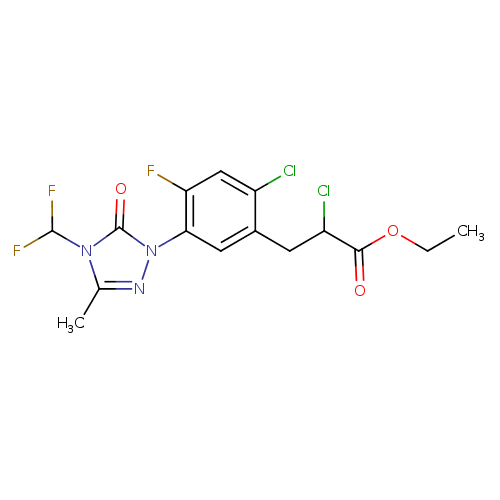
Chemical Structure
Thumb
Synonyms
ValueSource
((14)C)Carfentrazone-ethylMeSH
Ethyl alpha-2-dichloro-5-(4-(difluoromethyl)-4,5-dihydro-3-methyl-5-oxo-1H-1,2,4-triazol-1-yl)-4-fluorobenzenepropanoateMeSH
Chemical FormulaC15H14Cl2F3N3O3
Average Molecular Mass412.191 g/mol
Monoisotopic Mass411.036 g/mol
CAS Registry Number128639-02-1
IUPAC Nameethyl 2-chloro-3-{2-chloro-5-[4-(difluoromethyl)-3-methyl-5-oxo-4,5-dihydro-1H-1,2,4-triazol-1-yl]-4-fluorophenyl}propanoate
Traditional Namecarfentrazone-ethyl
SMILESCCOC(=O)C(Cl)CC1=CC(N2N=C(C)N(C(F)F)C2=O)=C(F)C=C1Cl
InChI IdentifierInChI=1S/C15H14Cl2F3N3O3/c1-3-26-13(24)10(17)4-8-5-12(11(18)6-9(8)16)23-15(25)22(14(19)20)7(2)21-23/h5-6,10,14H,3-4H2,1-2H3
InChI KeyMLKCGVHIFJBRCD-UHFFFAOYSA-N
Chemical Taxonomy
Description belongs to the class of organic compounds known as phenyl-1,2,4-triazoles. These are organic compounds containing a 1,2,4-triazole substituted by a phenyl group.
KingdomOrganic compounds
Super ClassOrganoheterocyclic compounds
ClassAzoles
Sub ClassTriazoles
Direct ParentPhenyl-1,2,4-triazoles
Alternative Parents
Substituents
  • Phenyl-1,2,4-triazole
  • Chlorobenzene
  • Fatty acid ester
  • Fluorobenzene
  • Halobenzene
  • Aryl chloride
  • Aryl fluoride
  • Aryl halide
  • Monocyclic benzene moiety
  • Benzenoid
  • Fatty acyl
  • Heteroaromatic compound
  • Alpha-halocarboxylic acid or derivatives
  • Alpha-halocarboxylic acid derivative
  • Carboxylic acid ester
  • Azacycle
  • Monocarboxylic acid or derivatives
  • Carboxylic acid derivative
  • Organonitrogen compound
  • Organic oxygen compound
  • Organic nitrogen compound
  • Organopnictogen compound
  • Organic oxide
  • Carbonyl group
  • Organohalogen compound
  • Alkyl halide
  • Alkyl fluoride
  • Alkyl chloride
  • Organooxygen compound
  • Hydrocarbon derivative
  • Organochloride
  • Organofluoride
  • Aromatic heteromonocyclic compound
Molecular FrameworkAromatic heteromonocyclic compounds
External Descriptors
Biological Properties
StatusDetected and Not Quantified
OriginExogenous
Cellular Locations
  • Membrane
Biofluid LocationsNot Available
Tissue LocationsNot Available
PathwaysNot Available
ApplicationsNot Available
Biological RolesNot Available
Chemical RolesNot Available
Physical Properties
StateSolid
AppearanceWhite powder.
Experimental Properties
PropertyValue
Melting PointNot Available
Boiling PointNot Available
SolubilityNot Available
Predicted Properties
PropertyValueSource
Water Solubility0.0031 g/LALOGPS
logP3.99ALOGPS
logP4.29ChemAxon
logS-5.1ALOGPS
pKa (Strongest Basic)-7.3ChemAxon
Physiological Charge0ChemAxon
Hydrogen Acceptor Count3ChemAxon
Hydrogen Donor Count0ChemAxon
Polar Surface Area62.21 ŲChemAxon
Rotatable Bond Count7ChemAxon
Refractivity87.74 m³·mol⁻¹ChemAxon
Polarizability35.55 ųChemAxon
Number of Rings2ChemAxon
Bioavailability1ChemAxon
Rule of FiveYesChemAxon
Ghose FilterYesChemAxon
Veber's RuleNoChemAxon
MDDR-like RuleNoChemAxon
Spectra
Spectra
Spectrum TypeDescriptionSplash KeyView
Predicted GC-MSPredicted GC-MS Spectrum - GC-MS (Non-derivatized) - 70eV, Positivesplash10-004j-9234000000-7fb4e7e380bf8e0a2d43Spectrum
Predicted GC-MSPredicted GC-MS Spectrum - GC-MS (Non-derivatized) - 70eV, PositiveNot AvailableSpectrum
LC-MS/MSLC-MS/MS Spectrum - 45V, Positivesplash10-0fba-0195000000-30d06b61935e7ffbdcc2Spectrum
LC-MS/MSLC-MS/MS Spectrum - 60V, Positivesplash10-00bc-0490000000-e386d7b27e56da4eb555Spectrum
LC-MS/MSLC-MS/MS Spectrum - 30V, Positivesplash10-00kb-0009000000-afc535c3cbf8dea68646Spectrum
LC-MS/MSLC-MS/MS Spectrum - 15V, Positivesplash10-03yi-0009600000-a552ec509d50ae8e0d98Spectrum
LC-MS/MSLC-MS/MS Spectrum - 75V, Positivesplash10-00ou-0940000000-fafe9c790cea3eb58eb7Spectrum
LC-MS/MSLC-MS/MS Spectrum - 90V, Positivesplash10-00mo-0910000000-e9a8378e4d00552e1205Spectrum
Predicted LC-MS/MSPredicted LC-MS/MS Spectrum - 10V, Positivesplash10-03di-1209500000-dda3116936ad8755bc19Spectrum
Predicted LC-MS/MSPredicted LC-MS/MS Spectrum - 20V, Positivesplash10-0006-9113000000-b558b0dc60e2060a28a9Spectrum
Predicted LC-MS/MSPredicted LC-MS/MS Spectrum - 40V, Positivesplash10-0a4i-7920000000-c0d0b986c4c4c16748b4Spectrum
Predicted LC-MS/MSPredicted LC-MS/MS Spectrum - 10V, Negativesplash10-0006-9000000000-08c964d8471330a35c21Spectrum
Predicted LC-MS/MSPredicted LC-MS/MS Spectrum - 20V, Negativesplash10-03xr-9316000000-ec86f68cc29f8bd196e8Spectrum
Predicted LC-MS/MSPredicted LC-MS/MS Spectrum - 40V, Negativesplash10-006x-9000000000-8ea6e2e15eef36d82df1Spectrum
Predicted LC-MS/MSPredicted LC-MS/MS Spectrum - 10V, Positivesplash10-03di-0003900000-ede933b8dd68d899a8dbSpectrum
Predicted LC-MS/MSPredicted LC-MS/MS Spectrum - 20V, Positivesplash10-014j-0009000000-e6b4624f66e3500b78feSpectrum
Predicted LC-MS/MSPredicted LC-MS/MS Spectrum - 40V, Positivesplash10-000f-3597000000-9239c3ed1faa2e8609bdSpectrum
Predicted LC-MS/MSPredicted LC-MS/MS Spectrum - 10V, Negativesplash10-03di-0022900000-b36e79db94173bb2f621Spectrum
Predicted LC-MS/MSPredicted LC-MS/MS Spectrum - 20V, Negativesplash10-0006-0090000000-bc64fa22a027cc77270eSpectrum
Predicted LC-MS/MSPredicted LC-MS/MS Spectrum - 40V, Negativesplash10-0v4j-6967000000-dd6d1596788c7cb98141Spectrum
MSMass Spectrum (Electron Ionization)splash10-03ec-1429100000-3b153ce061eafe11bb29Spectrum
Toxicity Profile
Route of ExposureNot Available
Mechanism of ToxicityNot Available
MetabolismNot Available
Toxicity ValuesLD50 (rat, oral) >5000 mg/kg LD50 (rat, dermal) >4000 mg/kg LC50 (rat, inhalation) >5.09 mg/L
Lethal DoseNot Available
Carcinogenicity (IARC Classification)No indication of carcinogenicity to humans (not listed by IARC).
Uses/SourcesThis is a man-made compound that is used as a pesticide.
Minimum Risk LevelNot Available
Health EffectsCarfentrazone-ethyl is not considered to cause significant toxicity in helathy humans. But in patient with very large acute exposures or long-term chronic exposures, carfentrazone-ethyl may cause variegate porphyria or transient porphyria cutanea tarda-like syndrome. (1)
SymptomsNot Available
TreatmentRemove contaminated clothing and wash skin with soap and water. For eye exposure, copious irrigation with water or saline is used. The treatment is usually symptomatic and supportive.
Concentrations
Not Available
DrugBank IDNot Available
HMDB IDHMDB0249673
FooDB IDNot Available
Phenol Explorer IDNot Available
KNApSAcK IDNot Available
BiGG IDNot Available
BioCyc IDNot Available
METLIN IDNot Available
PDB IDNot Available
Wikipedia LinkNot Available
Chemspider ID77773
ChEBI ID138244
PubChem Compound IDNot Available
Kegg Compound IDC11094
YMDB IDNot Available
ECMDB IDNot Available
References
Synthesis ReferenceNot Available
MSDSNot Available
General ReferencesNot Available