Record Information
Version1.0
Creation Date2010-05-27 14:58:19 UTC
Update Date2026-04-06 14:01:40 UTC
Accession NumberCHEM002739
Identification
Common NameSlaframine
ClassSmall Molecule
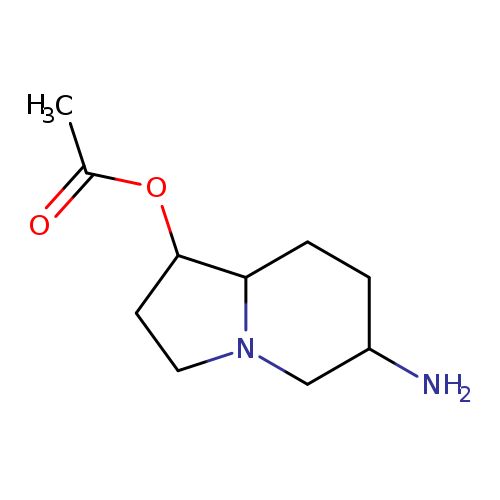
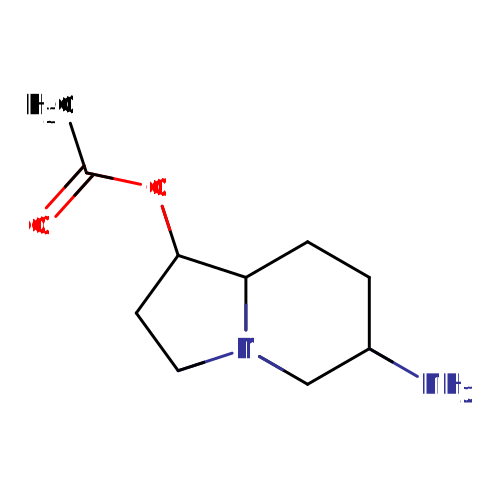
DescriptionSlaframine is a mycotoxin produced by the fungus Rizoctonia leguminicola. It is a parasympathomimetic compound and causes increased exocrine function, especially salivation. Along with swainsonine, the other biologially active compound of R. leguminicola, it is known to cause a condition called "slobbers syndrome" in livestock that has ingested contaminated feed. (1, 2)
Contaminant Sources
  • T3DB toxins
Contaminant Type
  • Amine
  • Ester
  • Ether
  • Fungal Toxin
  • Mycotoxin
  • Natural Compound
  • Organic Compound
Chemical Structure
Thumb
Synonyms
ValueSource
(1S,6S,8AS)-1-acetoxy-6-aminooctahydroindolizineMeSH, HMDB
Slaframine citrate salt (1:2)MeSH, HMDB
Chemical FormulaC10H18N2O2
Average Molecular Mass198.262 g/mol
Monoisotopic Mass198.137 g/mol
CAS Registry Number20084-93-9
IUPAC Name6-amino-octahydroindolizin-1-yl acetate
Traditional Nameslaframine
SMILESCC(=O)OC1CCN2CC(N)CCC12
InChI IdentifierInChI=1S/C10H18N2O2/c1-7(13)14-10-4-5-12-6-8(11)2-3-9(10)12/h8-10H,2-6,11H2,1H3
InChI KeyYYIUHLPAZILPSG-UHFFFAOYSA-N
Chemical Taxonomy
Description belongs to the class of organic compounds known as indolizidines. These are polycyclic compounds containing an indolizidine, which is a bicyclic heterocycle containing a saturated six-member ring fused to a saturated five-member ring, one of the bridging atoms being nitrogen.
KingdomOrganic compounds
Super ClassOrganoheterocyclic compounds
ClassIndolizidines
Sub ClassNot Available
Direct ParentIndolizidines
Alternative Parents
Substituents
  • Indolizidine
  • 3-aminopiperidine
  • Piperidine
  • N-alkylpyrrolidine
  • Pyrrolidine
  • Amino acid or derivatives
  • Carboxylic acid ester
  • Tertiary amine
  • Tertiary aliphatic amine
  • Monocarboxylic acid or derivatives
  • Carboxylic acid derivative
  • Azacycle
  • Organic oxide
  • Primary amine
  • Organopnictogen compound
  • Organooxygen compound
  • Organonitrogen compound
  • Primary aliphatic amine
  • Organic oxygen compound
  • Amine
  • Carbonyl group
  • Organic nitrogen compound
  • Hydrocarbon derivative
  • Aliphatic heteropolycyclic compound
Molecular FrameworkAliphatic heteropolycyclic compounds
External DescriptorsNot Available
Biological Properties
StatusDetected and Not Quantified
OriginExogenous
Cellular Locations
  • Cytoplasm
  • Extracellular
Biofluid LocationsNot Available
Tissue LocationsNot Available
PathwaysNot Available
ApplicationsNot Available
Biological Roles
Chemical RolesNot Available
Physical Properties
StateSolid
AppearanceWhite powder.
Experimental Properties
PropertyValue
Melting PointNot Available
Boiling PointNot Available
SolubilityNot Available
Predicted Properties
PropertyValueSource
Water Solubility250 g/LALOGPS
logP-0.07ALOGPS
logP-0.38ChemAxon
logS0.1ALOGPS
pKa (Strongest Basic)9.82ChemAxon
Physiological Charge2ChemAxon
Hydrogen Acceptor Count3ChemAxon
Hydrogen Donor Count1ChemAxon
Polar Surface Area55.56 ŲChemAxon
Rotatable Bond Count2ChemAxon
Refractivity52.83 m³·mol⁻¹ChemAxon
Polarizability21.7 ųChemAxon
Number of Rings2ChemAxon
Bioavailability1ChemAxon
Rule of FiveYesChemAxon
Ghose FilterYesChemAxon
Veber's RuleNoChemAxon
MDDR-like RuleNoChemAxon
Spectra
Spectra
Spectrum TypeDescriptionSplash KeyView
Predicted GC-MSPredicted GC-MS Spectrum - GC-MS (Non-derivatized) - 70eV, Positivesplash10-03dl-7900000000-82f2ebd8b74ca296ae06Spectrum
Predicted GC-MSPredicted GC-MS Spectrum - GC-MS (Non-derivatized) - 70eV, PositiveNot AvailableSpectrum
Predicted LC-MS/MSPredicted LC-MS/MS Spectrum - 10V, Positivesplash10-0532-0900000000-e31134aa571d68f62949Spectrum
Predicted LC-MS/MSPredicted LC-MS/MS Spectrum - 20V, Positivesplash10-00ei-0900000000-0aa0e3ad7c69dbd764afSpectrum
Predicted LC-MS/MSPredicted LC-MS/MS Spectrum - 40V, Positivesplash10-0006-9300000000-14ded616dbe500acc3d0Spectrum
Predicted LC-MS/MSPredicted LC-MS/MS Spectrum - 10V, Negativesplash10-0002-0900000000-17ca17bff4342baf2ea4Spectrum
Predicted LC-MS/MSPredicted LC-MS/MS Spectrum - 20V, Negativesplash10-0a4j-1900000000-9bb2c6c50e2aaf1c5dddSpectrum
Predicted LC-MS/MSPredicted LC-MS/MS Spectrum - 40V, Negativesplash10-052f-9600000000-46d6f441fe573e243688Spectrum
Predicted LC-MS/MSPredicted LC-MS/MS Spectrum - 10V, Positivesplash10-0002-0900000000-5141251c4241c3b70bb3Spectrum
Predicted LC-MS/MSPredicted LC-MS/MS Spectrum - 20V, Positivesplash10-000b-0900000000-f677d3548283e11f7354Spectrum
Predicted LC-MS/MSPredicted LC-MS/MS Spectrum - 40V, Positivesplash10-008d-9400000000-35f0355727c4637e8ea2Spectrum
Predicted LC-MS/MSPredicted LC-MS/MS Spectrum - 10V, Negativesplash10-0a4j-6900000000-6538746085fac967dfb3Spectrum
Predicted LC-MS/MSPredicted LC-MS/MS Spectrum - 20V, Negativesplash10-0a4i-6900000000-9ddfe2dcf6691f0632ebSpectrum
Predicted LC-MS/MSPredicted LC-MS/MS Spectrum - 40V, Negativesplash10-0a4l-9200000000-1e576b18d69f4123a41bSpectrum
1D NMR13C NMR SpectrumNot AvailableSpectrum
1D NMR1H NMR SpectrumNot AvailableSpectrum
1D NMR13C NMR SpectrumNot AvailableSpectrum
1D NMR1H NMR SpectrumNot AvailableSpectrum
1D NMR13C NMR SpectrumNot AvailableSpectrum
1D NMR1H NMR SpectrumNot AvailableSpectrum
1D NMR13C NMR SpectrumNot AvailableSpectrum
1D NMR1H NMR SpectrumNot AvailableSpectrum
1D NMR13C NMR SpectrumNot AvailableSpectrum
1D NMR1H NMR SpectrumNot AvailableSpectrum
1D NMR13C NMR SpectrumNot AvailableSpectrum
1D NMR1H NMR SpectrumNot AvailableSpectrum
1D NMR13C NMR SpectrumNot AvailableSpectrum
1D NMR1H NMR SpectrumNot AvailableSpectrum
1D NMR13C NMR SpectrumNot AvailableSpectrum
1D NMR1H NMR SpectrumNot AvailableSpectrum
1D NMR13C NMR SpectrumNot AvailableSpectrum
1D NMR1H NMR SpectrumNot AvailableSpectrum
1D NMR13C NMR SpectrumNot AvailableSpectrum
1D NMR1H NMR SpectrumNot AvailableSpectrum
Toxicity Profile
Route of ExposureOral, dermal, inhalation, and parenteral (contaminated drugs). (4)
Mechanism of ToxicitySlaframine is a parasympathomimetic compound and causes increased secretion by salivary glands, pancreas, and other exocrine and endocrine glands. This is due to its activity as a cholingergic agonist. Slaframine has a high affinity for muscarinic receptors, especially in the gastrointestinal tract, and it stimulates these to produce its parasympathomimetic effects. Slaframine is also known to affect the concentration of circulating metabolic hormones, though the mechanism of this is unknown. (1, 2)
MetabolismSlaframine is though to be activated in the liver by a hepatic microsomal flavoprotein oxidase to a ketoimine metabolite with a configuration similar to that of the parasympathetic neurotransmitter acetylcholine. (2)
Toxicity ValuesNot Available
Lethal DoseLD50: 11 mg/kg (Broiler chick) (3)
Carcinogenicity (IARC Classification)No indication of carcinogenicity to humans (not listed by IARC).
Uses/SourcesSlaframine is a mycotoxin produced by the fungus Rizoctonia leguminicola. (1)
Minimum Risk LevelNot Available
Health EffectsSlaframine is a parasympathomimetic compound and causes increased exocrine function, especially salivation. Along with swainsonine, the other biologially active compound of R. leguminicola, it is known to cause a condition called "slobbers syndrome" in livestock that has ingested contaminated feed. (1, 2)
SymptomsThe major symptom of "slobbers syndrome" is profuse salivation. Other symptoms include diarrhea, lacrimation, stiff joints, frequent urination, tremors, spontaneous abortion, labored breathing, loss of appetite, bloat, and possibly death. (2)
TreatmentThe effects of slaframine can be prevented by pre-treatment with an muscarinic receptor antagonist such as atropine or pirenzepine. (2)
Concentrations
Not Available
DrugBank IDNot Available
HMDB IDHMDB0258337
FooDB IDNot Available
Phenol Explorer IDNot Available
KNApSAcK IDC00002073
BiGG IDNot Available
BioCyc IDNot Available
METLIN IDNot Available
PDB IDNot Available
Wikipedia LinkSlaframine
Chemspider ID7969969
ChEBI IDNot Available
PubChem Compound ID9794202
Kegg Compound IDNot Available
YMDB IDNot Available
ECMDB IDNot Available
References
Synthesis ReferenceNot Available
MSDSNot Available
General ReferencesNot Available