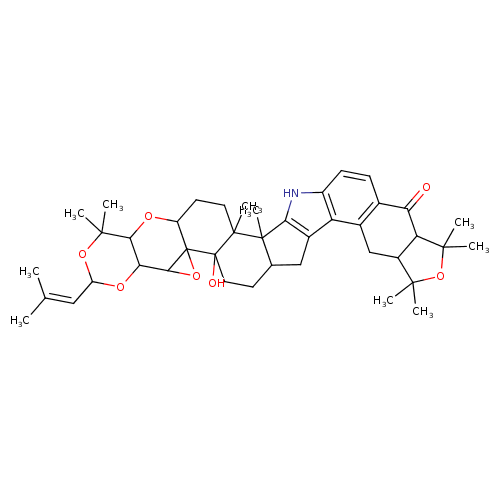
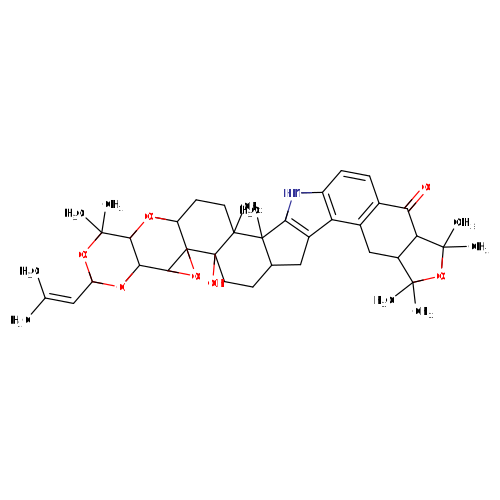
Paspalinine is a tremorgenic mycotoxin that is produced by the fungi Neotyphodium lolii and Acremonium lolii. It may be found in contaminated cereal crops such as oats, barley, millet, corn and rice. Tremorgenic mycotoxins affect central nervous system activity and have been implicated in a number of neurologic diseases of cattle collectively known as "staggers syndromes" or “ryegrass staggers”. (1, 2, 4)
belongs to the class of organic compounds known as naphthopyrans. Naphthopyrans are compounds containing a pyran ring fused to a naphthalene moiety. Furan is a 6 membered-ring non-aromatic ring with five carbon and one oxygen atoms. Naphthalene is a polycyclic aromatic hydrocarbon made up of two fused benzene rings.
Oral, dermal, inhalation, and parenteral (contaminated drugs). (5)
Mechanism of Toxicity
The neurological effects of Lolitrem B are a result of its ability to inhibit large conductance calcium-activated potassium channels (BK channels). Lolitrem B binds to the alpha subunit of the BK channel, inhibiting channel potassium currents. This causes tremorgenic effects either by directly affecting channels in the muscle or by acting on channels in the central nervous system. (2, 3)
No indication of carcinogenicity to humans (not listed by IARC).
Uses/Sources
Lolitrem B is a tremorgenic mycotoxin that is produced by the fungi Neotyphodium lolii and Acremonium lolii. It may be found in contaminated cereal crops such as oats, barley, millet, corn and rice. (1, 2, 4)
Minimum Risk Level
Symptoms of "ryegrass staggers" develop in livestock when concentrations exceed 2.5 ug/g in dry matter. (4)
Health Effects
Tremorgenic mycotoxins affect central nervous system activity. They cause a neurological disease of cattle known as "staggers syndrome" or “ryegrass staggers”. (1, 2)
Symptoms
Tremorgenic mycotoxins affect central nervous system activity, inducing neurologic symptoms including mental confusion, paralysis, tremors, seizures, and death. They cause a neurological disease of cattle known as "staggers syndrome" or “ryegrass staggers”, which is characterized by impaired motor coordination, muscle tremors, hyperexcitability, convulsions, and ataxia. Additional symptoms include increased blood pressure, heart rate and respiration rate. While the neurotoxic effects of lolitrem B have a long duration, they are also reversible. (1, 2, 3, 4)
Treatment
To control severe tremors caused by tremorgenic mycotoxins, methocarbamol should be administered. Generalized seizures may be treated with diazepam followed by methocarbamol or a barbiturate such as pentobarbital sodium. Gastric lavage should be performed and activated charcoal administered to limit further absorption of toxins. (6)