Record Information
Version1.0
Creation Date2010-05-20 15:13:49 UTC
Update Date2026-04-06 13:05:40 UTC
Accession NumberCHEM002732
Identification
Common NameJanthitrem F
ClassSmall Molecule
DescriptionJanthitrem F is produced by Penicillium janthinellum. Tremorgenic mycotoxin Janthitrem F belongs to the family of Diterpenes. These are terpene compounds formed by four isoprene units.
Contaminant Sources
  • FooDB Chemicals
  • T3DB toxins
Contaminant Type
  • Ester
  • Ether
  • Food Toxin
  • Fungal Toxin
  • Metabolite
  • Mycotoxin
  • Natural Compound
  • Organic Compound
Chemical Structure
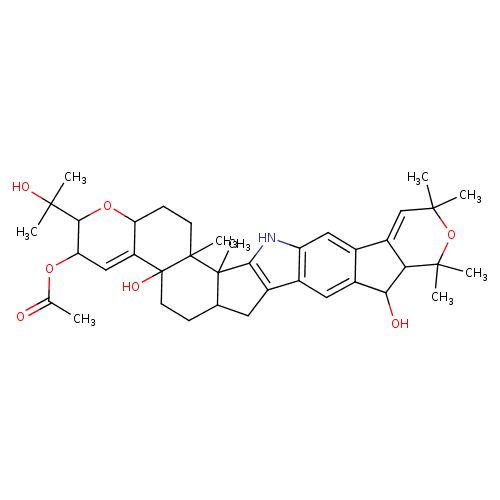
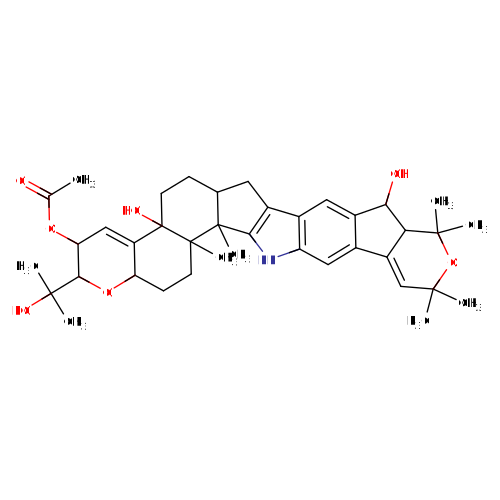
Thumb
Synonyms
ValueSource
10-0-Acetyljanthitrem eHMDB
Janthitrem e monoacetateHMDB
12,21-Dihydroxy-8-(2-hydroxypropan-2-yl)-2,3,23,23,25,25-hexamethyl-7,24-dioxa-31-azaoctacyclo[15.14.0.0²,¹⁵.0³,¹².0⁶,¹¹.0¹⁸,³⁰.0²⁰,²⁸.0²²,²⁷]hentriaconta-1(17),10,18(30),19,26,28-hexaen-9-yl acetic acidGenerator
Chemical FormulaC39H51NO7
Average Molecular Mass645.825 g/mol
Monoisotopic Mass645.367 g/mol
CAS Registry Number90986-52-0
IUPAC Name12,21-dihydroxy-8-(2-hydroxypropan-2-yl)-2,3,23,23,25,25-hexamethyl-7,24-dioxa-31-azaoctacyclo[15.14.0.0²,¹⁵.0³,¹².0⁶,¹¹.0¹⁸,³⁰.0²⁰,²⁸.0²²,²⁷]hentriaconta-1(17),10,18(30),19,26,28-hexaen-9-yl acetate
Traditional Name12,21-dihydroxy-8-(2-hydroxypropan-2-yl)-2,3,23,23,25,25-hexamethyl-7,24-dioxa-31-azaoctacyclo[15.14.0.0²,¹⁵.0³,¹².0⁶,¹¹.0¹⁸,³⁰.0²⁰,²⁸.0²²,²⁷]hentriaconta-1(17),10,18(30),19,26,28-hexaen-9-yl acetate
SMILESCC(=O)OC1C=C2C(CCC3(C)C4(C)C(CC5=C4NC4=C5C=C5C(O)C6C(=CC(C)(C)OC6(C)C)C5=C4)CCC23O)OC1C(C)(C)O
InChI IdentifierInChI=1S/C39H51NO7/c1-19(41)45-29-17-26-28(46-33(29)35(4,5)43)11-12-37(8)38(9)20(10-13-39(26,37)44)14-24-22-15-23-21(16-27(22)40-32(24)38)25-18-34(2,3)47-36(6,7)30(25)31(23)42/h15-18,20,28-31,33,40,42-44H,10-14H2,1-9H3
InChI KeySHMYDSYGDWIPKT-UHFFFAOYSA-N
Chemical Taxonomy
Description belongs to the class of organic compounds known as naphthopyrans. Naphthopyrans are compounds containing a pyran ring fused to a naphthalene moiety. Furan is a 6 membered-ring non-aromatic ring with five carbon and one oxygen atoms. Naphthalene is a polycyclic aromatic hydrocarbon made up of two fused benzene rings.
KingdomOrganic compounds
Super ClassOrganoheterocyclic compounds
ClassNaphthopyrans
Sub ClassNot Available
Direct ParentNaphthopyrans
Alternative Parents
Substituents
  • Naphthopyran
  • Naphthalene
  • 3-alkylindole
  • Indane
  • Indole
  • Indole or derivatives
  • Benzenoid
  • Pyran
  • Cyclic alcohol
  • Heteroaromatic compound
  • Tertiary alcohol
  • Pyrrole
  • Carboxylic acid ester
  • Secondary alcohol
  • Carboxylic acid derivative
  • Dialkyl ether
  • Ether
  • Monocarboxylic acid or derivatives
  • Oxacycle
  • Azacycle
  • Organic oxide
  • Organopnictogen compound
  • Carbonyl group
  • Hydrocarbon derivative
  • Alcohol
  • Organic nitrogen compound
  • Organic oxygen compound
  • Organonitrogen compound
  • Organooxygen compound
  • Aromatic heteropolycyclic compound
Molecular FrameworkAromatic heteropolycyclic compounds
External DescriptorsNot Available
Biological Properties
StatusDetected and Not Quantified
OriginExogenous
Cellular Locations
  • Extracellular
  • Membrane
Biofluid LocationsNot Available
Tissue LocationsNot Available
PathwaysNot Available
ApplicationsNot Available
Biological RolesNot Available
Chemical RolesNot Available
Physical Properties
StateSolid
AppearanceWhite powder.
Experimental Properties
PropertyValue
Melting PointNot Available
Boiling PointNot Available
SolubilityNot Available
Predicted Properties
PropertyValueSource
Water Solubility0.00074 g/LALOGPS
logP5.53ALOGPS
logP3.94ChemAxon
logS-5.9ALOGPS
pKa (Strongest Acidic)13.44ChemAxon
pKa (Strongest Basic)-3.1ChemAxon
Physiological Charge0ChemAxon
Hydrogen Acceptor Count6ChemAxon
Hydrogen Donor Count4ChemAxon
Polar Surface Area121.24 ŲChemAxon
Rotatable Bond Count3ChemAxon
Refractivity180.21 m³·mol⁻¹ChemAxon
Polarizability75.74 ųChemAxon
Number of Rings8ChemAxon
Bioavailability1ChemAxon
Rule of FiveNoChemAxon
Ghose FilterNoChemAxon
Veber's RuleNoChemAxon
MDDR-like RuleNoChemAxon
Spectra
Spectra
Spectrum TypeDescriptionSplash KeyView
Predicted GC-MSPredicted GC-MS Spectrum - GC-MS (Non-derivatized) - 70eV, Positivesplash10-053l-6001397000-5e051c0ed275f60036f0Spectrum
Predicted GC-MSPredicted GC-MS Spectrum - GC-MS (TMS_1_1) - 70eV, PositiveNot AvailableSpectrum
Predicted GC-MSPredicted GC-MS Spectrum - GC-MS (TMS_1_2) - 70eV, PositiveNot AvailableSpectrum
Predicted GC-MSPredicted GC-MS Spectrum - GC-MS (TMS_1_3) - 70eV, PositiveNot AvailableSpectrum
Predicted GC-MSPredicted GC-MS Spectrum - GC-MS (TMS_1_4) - 70eV, PositiveNot AvailableSpectrum
Predicted GC-MSPredicted GC-MS Spectrum - GC-MS (TMS_2_1) - 70eV, PositiveNot AvailableSpectrum
Predicted GC-MSPredicted GC-MS Spectrum - GC-MS (TMS_2_2) - 70eV, PositiveNot AvailableSpectrum
Predicted GC-MSPredicted GC-MS Spectrum - GC-MS (TMS_2_3) - 70eV, PositiveNot AvailableSpectrum
Predicted GC-MSPredicted GC-MS Spectrum - GC-MS (TMS_2_4) - 70eV, PositiveNot AvailableSpectrum
Predicted GC-MSPredicted GC-MS Spectrum - GC-MS (TMS_2_5) - 70eV, PositiveNot AvailableSpectrum
Predicted GC-MSPredicted GC-MS Spectrum - GC-MS (TMS_2_6) - 70eV, PositiveNot AvailableSpectrum
Predicted GC-MSPredicted GC-MS Spectrum - GC-MS (TMS_3_1) - 70eV, PositiveNot AvailableSpectrum
Predicted GC-MSPredicted GC-MS Spectrum - GC-MS (TMS_3_2) - 70eV, PositiveNot AvailableSpectrum
Predicted GC-MSPredicted GC-MS Spectrum - GC-MS (TMS_3_3) - 70eV, PositiveNot AvailableSpectrum
Predicted GC-MSPredicted GC-MS Spectrum - GC-MS (TMS_3_4) - 70eV, PositiveNot AvailableSpectrum
Predicted GC-MSPredicted GC-MS Spectrum - GC-MS (TBDMS_1_1) - 70eV, PositiveNot AvailableSpectrum
Predicted GC-MSPredicted GC-MS Spectrum - GC-MS (TBDMS_1_2) - 70eV, PositiveNot AvailableSpectrum
Predicted GC-MSPredicted GC-MS Spectrum - GC-MS (TBDMS_1_3) - 70eV, PositiveNot AvailableSpectrum
Predicted GC-MSPredicted GC-MS Spectrum - GC-MS (TBDMS_1_4) - 70eV, PositiveNot AvailableSpectrum
Predicted GC-MSPredicted GC-MS Spectrum - GC-MS (TBDMS_2_1) - 70eV, PositiveNot AvailableSpectrum
Predicted GC-MSPredicted GC-MS Spectrum - GC-MS (TBDMS_2_2) - 70eV, PositiveNot AvailableSpectrum
Predicted GC-MSPredicted GC-MS Spectrum - GC-MS (TBDMS_2_3) - 70eV, PositiveNot AvailableSpectrum
Predicted GC-MSPredicted GC-MS Spectrum - GC-MS (TBDMS_2_4) - 70eV, PositiveNot AvailableSpectrum
Predicted GC-MSPredicted GC-MS Spectrum - GC-MS (TBDMS_2_5) - 70eV, PositiveNot AvailableSpectrum
Predicted GC-MSPredicted GC-MS Spectrum - GC-MS (TBDMS_2_6) - 70eV, PositiveNot AvailableSpectrum
Predicted LC-MS/MSPredicted LC-MS/MS Spectrum - 10V, Positivesplash10-01t9-0000039000-6ccbd252201e95f8c229Spectrum
Predicted LC-MS/MSPredicted LC-MS/MS Spectrum - 20V, Positivesplash10-000i-0000094000-1c8bcf53644657bf5cd3Spectrum
Predicted LC-MS/MSPredicted LC-MS/MS Spectrum - 40V, Positivesplash10-015i-4000982000-9cdb46e8bf9e318f52d8Spectrum
Predicted LC-MS/MSPredicted LC-MS/MS Spectrum - 10V, Negativesplash10-0006-3000039000-aef5640a6d964df7e7f9Spectrum
Predicted LC-MS/MSPredicted LC-MS/MS Spectrum - 20V, Negativesplash10-0a7l-5000179000-15e37d5eda64656d53f4Spectrum
Predicted LC-MS/MSPredicted LC-MS/MS Spectrum - 40V, Negativesplash10-0a4i-9100240000-b47f70cc02730de61d5eSpectrum
Predicted LC-MS/MSPredicted LC-MS/MS Spectrum - 10V, Negativesplash10-0zgl-2000049000-45096214cf32661c05f8Spectrum
Predicted LC-MS/MSPredicted LC-MS/MS Spectrum - 20V, Negativesplash10-0a4i-9000000000-c01bbbf5bed889264ddbSpectrum
Predicted LC-MS/MSPredicted LC-MS/MS Spectrum - 40V, Negativesplash10-052f-9100030000-c91f6aab501b617b147dSpectrum
Predicted LC-MS/MSPredicted LC-MS/MS Spectrum - 10V, Positivesplash10-0002-0000029000-860ba3173daf6e70b5c0Spectrum
Predicted LC-MS/MSPredicted LC-MS/MS Spectrum - 20V, Positivesplash10-002k-0001049000-edd099508abf7d525413Spectrum
Predicted LC-MS/MSPredicted LC-MS/MS Spectrum - 40V, Positivesplash10-000b-7586946000-d18ecff3a6fd6da6c860Spectrum
Toxicity Profile
Route of ExposureOral, dermal, inhalation, and parenteral (contaminated drugs). (4)
Mechanism of ToxicityTremorgenic mycotoxins exert their toxic effects by interfering with neurotransmitter release, possibly by causing degeneration of nerve terminals. They are thought to inhibit gamma-aminobutyric acid (GABA) receptors, both pre- and postsynaptic, as well as inhibit transmitter breakdown at the GABA-T receptors. This would initially increase neurotransmitter levels, potentiating the GABA-induced chloride current, then lead to decreased levels of neurotransmitter in the synapse. (2)
MetabolismNot Available
Toxicity ValuesNot Available
Lethal DoseNot Available
Carcinogenicity (IARC Classification)No indication of carcinogenicity to humans (not listed by IARC).
Uses/SourcesJanthitrems are tremorgenic mycotoxins that have been found in the fungus Penicillium janthinellum. They may be found in contaminated cereal crops such as oats, barley, millet, corn and rice. (2, 3)
Minimum Risk LevelNot Available
Health EffectsTremorgenic mycotoxins affect central nervous system activity. They cause a neurological disease of cattle known as "staggers syndrome". (2)
SymptomsTremorgenic mycotoxins affect central nervous system activity, inducing neurologic symptoms including mental confusion, paralysis, tremors, seizures, and death. They cause a neurological disease of cattle known as "staggers syndrome", which is characterized by muscle tremors, hyperexcitability, convulsions and ataxia. (2)
TreatmentTo control severe tremors caused by tremorgenic mycotoxins, methocarbamol should be administered. Generalized seizures may be treated with diazepam followed by methocarbamol or a barbiturate such as pentobarbital sodium. Gastric lavage should be performed and activated charcoal administered to limit further absorption of toxins. (1)
Concentrations
Not Available
DrugBank IDNot Available
HMDB IDHMDB0030530
FooDB IDFDB002403
Phenol Explorer IDNot Available
KNApSAcK IDC00023595
BiGG IDNot Available
BioCyc IDNot Available
METLIN IDNot Available
PDB IDNot Available
Wikipedia LinkNot Available
Chemspider ID8184978
ChEBI ID190850
PubChem Compound ID10009398
Kegg Compound IDNot Available
YMDB IDNot Available
ECMDB IDNot Available
References
Synthesis ReferenceNot Available
MSDSNot Available
General References
1. Yannai, Shmuel. (2004) Dictionary of food compounds with CD-ROM: Additives, flavors, and ingredients. Boca Raton: Chapman & Hall/CRC.