Record Information
Version1.0
Creation Date2010-05-06 21:03:09 UTC
Update Date2026-04-03 05:06:37 UTC
Accession NumberCHEM002708
Identification
Common NameBeauvericin
ClassSmall Molecule
DescriptionBeauvericin is a mycotoxin with antibiotic and insecticidal effects. It was isolated from the fungus Beauveria bassiana, but is also produced by several other fungi, including several Fusarium species. It may therefore occur in grain (such as corn, wheat and barley) contaminated with these fungi. Beauvericin is active against Gram-positive bacteria and mycobacteria, and is also capable of inducing programmed cell death in mammals. (7)
Contaminant Sources
  • T3DB toxins
Contaminant Type
  • Amide
  • Amine
  • Fungal Toxin
  • Mycotoxin
  • Natural Compound
  • Organic Compound
  • Protein
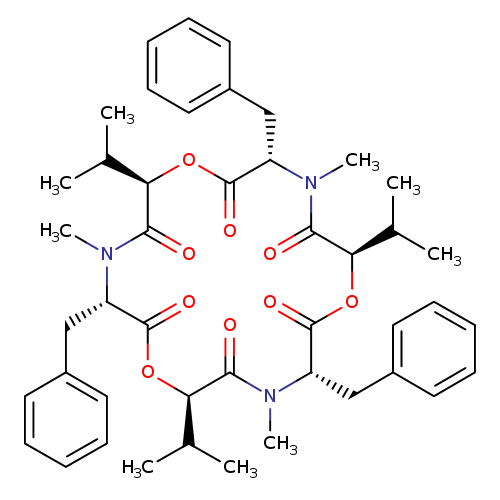
Chemical Structure
Thumb
Synonyms
ValueSource
(3S,6R,9S,12R,15S,18R)-3,9,15-Tribenzyl-6,12,18-triisopropyl-4,10,16-trimethyl-1,7,13-trioxa-4,10,16-triazacyclooctadecane-2,5,8,11,14,17-hexoneChEBI
Chemical FormulaC45H57N3O9
Average Molecular Mass783.949 g/mol
Monoisotopic Mass783.409 g/mol
CAS Registry Number26048-05-5
IUPAC Name(3S,6R,9S,12R,15S,18R)-3,9,15-tribenzyl-4,10,16-trimethyl-6,12,18-tris(propan-2-yl)-1,7,13-trioxa-4,10,16-triazacyclooctadecane-2,5,8,11,14,17-hexone
Traditional Namebeauvericin
SMILESCC(C)[C@H]1OC(=O)[C@H](CC2=CC=CC=C2)N(C)C(=O)[C@H](OC(=O)[C@H](CC2=CC=CC=C2)N(C)C(=O)[C@H](OC(=O)[C@H](CC2=CC=CC=C2)N(C)C1=O)C(C)C)C(C)C
InChI IdentifierInChI=1S/C45H57N3O9/c1-28(2)37-40(49)46(7)35(26-32-21-15-11-16-22-32)44(53)56-39(30(5)6)42(51)48(9)36(27-33-23-17-12-18-24-33)45(54)57-38(29(3)4)41(50)47(8)34(43(52)55-37)25-31-19-13-10-14-20-31/h10-24,28-30,34-39H,25-27H2,1-9H3/t34-,35-,36-,37+,38+,39+/m0/s1
InChI KeyGYSCAQFHASJXRS-FFCOJMSVSA-N
Chemical Taxonomy
Description belongs to the class of organic compounds known as cyclic depsipeptides. These are natural or synthetic compounds having sequences of amino and hydroxy carboxylic acid residues (usually α-amino and α-hydroxy acids) connected in a ring. The residues are commonly but not necessarily regularly alternating.
KingdomOrganic compounds
Super ClassOrganic acids and derivatives
ClassPeptidomimetics
Sub ClassDepsipeptides
Direct ParentCyclic depsipeptides
Alternative Parents
Substituents
  • Cyclic depsipeptide
  • Macrolide lactam
  • Alpha-amino acid ester
  • Macrolactam
  • Macrolide
  • Alpha-amino acid or derivatives
  • Tricarboxylic acid or derivatives
  • Monocyclic benzene moiety
  • Benzenoid
  • Tertiary carboxylic acid amide
  • Carboxamide group
  • Carboxylic acid ester
  • Lactam
  • Lactone
  • Carboxylic acid derivative
  • Oxacycle
  • Azacycle
  • Organoheterocyclic compound
  • Organic oxygen compound
  • Hydrocarbon derivative
  • Organic nitrogen compound
  • Organic oxide
  • Carbonyl group
  • Organopnictogen compound
  • Organooxygen compound
  • Organonitrogen compound
  • Aromatic heteromonocyclic compound
Molecular FrameworkAromatic heteromonocyclic compounds
External Descriptors
Biological Properties
StatusDetected and Not Quantified
OriginExogenous
Cellular LocationsNot Available
Biofluid LocationsNot Available
Tissue LocationsNot Available
PathwaysNot Available
ApplicationsNot Available
Biological Roles
Chemical RolesNot Available
Physical Properties
StateLiquid
AppearanceClear solution.
Experimental Properties
PropertyValue
Melting PointNot Available
Boiling PointNot Available
Solubility>10 mg/mL
Predicted Properties
PropertyValueSource
Water Solubility0.00088 g/LALOGPS
logP5.25ALOGPS
logP7.27ChemAxon
logS-6ALOGPS
pKa (Strongest Acidic)18.8ChemAxon
pKa (Strongest Basic)-6ChemAxon
Physiological Charge0ChemAxon
Hydrogen Acceptor Count6ChemAxon
Hydrogen Donor Count0ChemAxon
Polar Surface Area139.83 ŲChemAxon
Rotatable Bond Count9ChemAxon
Refractivity213.47 m³·mol⁻¹ChemAxon
Polarizability83.04 ųChemAxon
Number of Rings4ChemAxon
Bioavailability0ChemAxon
Rule of FiveNoChemAxon
Ghose FilterNoChemAxon
Veber's RuleNoChemAxon
MDDR-like RuleYesChemAxon
Spectra
Spectra
Spectrum TypeDescriptionSplash KeyView
Predicted LC-MS/MSPredicted LC-MS/MS Spectrum - 10V, Positivesplash10-001l-4013002900-c6c232d3f69c9a9a1c08Spectrum
Predicted LC-MS/MSPredicted LC-MS/MS Spectrum - 20V, Positivesplash10-001i-7593320000-4ce9355a4c694e81cc4fSpectrum
Predicted LC-MS/MSPredicted LC-MS/MS Spectrum - 40V, Positivesplash10-03di-5192020000-dd85d65bcace294f3c00Spectrum
Predicted LC-MS/MSPredicted LC-MS/MS Spectrum - 10V, Negativesplash10-00di-9020030000-258575fb2966c013816dSpectrum
Predicted LC-MS/MSPredicted LC-MS/MS Spectrum - 20V, Negativesplash10-052f-1390162100-3faf3bba6a97dde28f8aSpectrum
Predicted LC-MS/MSPredicted LC-MS/MS Spectrum - 40V, Negativesplash10-001i-5491302000-04a3f48a727cfed379bbSpectrum
Toxicity Profile
Route of ExposureOral, dermal, inhalation, and parenteral (contaminated drugs). (6)
Mechanism of ToxicityBeauvericin is cytotoxic and increases ion permeability in cell membranes by forming complexes with essential cations (Ca2+, Na+, K+) and by forming cation-selective channels in lipid membranes. This may affect ionic homeostasis, increasing the intracellular calcium concentration, and lead to apoptosis. Beauvericin is also genotoxic and causes DNA damage, either by directly forming DNA adducts, through increased intracellular calcium levels influencing endonuclease activity, or through oxidative stress. Beauvericin induces lipid peroxidation and production of reactive oxygen species, producing cytotoxic effects and immunosuppressive activity. In addition, beauvericin is a potent inhibitor of the acyl-CoA:cholesterol acyltransferase (ACAT), which plays an important role in cholesterol ester accumulation in atherogenesis and in cholesterol absorption from the intestine. In isolated terminal ilea and heart muscles of guinea pig, beauvericin decreases the contractility, shortening the action potential duration and depolarizing the membrane resting potential. Beauvericin is also known to inhibit certain cytochrome P-450 enzymes. (1, 2, 3, 4, 5)
MetabolismFree toxin may be removed by opsonization via the reticuloendothelial system (primarily the liver and kidneys) or it may be degraded through cellular internalization via the lysosomes. Lysosomes are membrane-enclosed organelles that contain an array of digestive enzymes, including several proteases.
Toxicity ValuesNot Available
Lethal DoseNot Available
Carcinogenicity (IARC Classification)Not listed by IARC.
Uses/SourcesBeauvericin is a mycotoxin with antibiotic and insecticidal effects. It was isolated from the fungus Beauveria bassiana, but is also produced by several other fungi, including several Fusarium species. It may therefore occur in grain (such as corn, wheat and barley) contaminated with these fungi. (7)
Minimum Risk LevelNot Available
Health EffectsBeauvericin is cytotoxic and immunosuppressive. It is also genotoxic and may thus be carcinogenic. (1)

SymptomsNot Available
TreatmentNot Available
Concentrations
Not Available
DrugBank IDNot Available
HMDB IDNot Available
FooDB IDNot Available
Phenol Explorer IDNot Available
KNApSAcK IDC00027924
BiGG IDNot Available
BioCyc IDNot Available
METLIN IDNot Available
PDB IDNot Available
Wikipedia LinkBeauvericin
Chemspider IDNot Available
ChEBI ID3000
PubChem Compound ID3007984
Kegg Compound IDNot Available
YMDB IDNot Available
ECMDB IDNot Available
References
Synthesis ReferenceNot Available
MSDSNot Available
General References
1. https://www.ncbi.nlm.nih.gov/pubmed/?term=12067253
2. https://www.ncbi.nlm.nih.gov/pubmed/?term=15892576
3. https://www.ncbi.nlm.nih.gov/pubmed/?term=16343425
4. https://www.ncbi.nlm.nih.gov/pubmed/?term=18804027
5. https://www.ncbi.nlm.nih.gov/pubmed/?term=18956271
6. https://www.ncbi.nlm.nih.gov/pubmed/?term=23685117
7. https://www.ncbi.nlm.nih.gov/pubmed/?term=23832252
8. https://www.ncbi.nlm.nih.gov/pubmed/?term=24291394
9. https://www.ncbi.nlm.nih.gov/pubmed/?term=24613870
10. https://www.ncbi.nlm.nih.gov/pubmed/?term=24720681
11. https://www.ncbi.nlm.nih.gov/pubmed/?term=25128875
12. https://www.ncbi.nlm.nih.gov/pubmed/?term=25178661
13. https://www.ncbi.nlm.nih.gov/pubmed/?term=25475336
14. https://www.ncbi.nlm.nih.gov/pubmed/?term=25606862
15. https://www.ncbi.nlm.nih.gov/pubmed/?term=25641103