Record Information
Version1.0
Creation Date2010-05-05 18:02:55 UTC
Update Date2026-03-26 19:45:26 UTC
Accession NumberCHEM002704
Identification
Common NameDicumarol
ClassSmall Molecule
DescriptionDicumarol is only found in individuals that have used or taken this drug. It is an oral anticoagulant that interferes with the metabolism of vitamin K. It is also used in biochemical experiments as an inhibitor of reductases. [PubChem] Dicumarol inhibits vitamin K reductase, resulting in depletion of the reduced form of vitamin K (vitamin KH2). As vitamin K is a cofactor for the carboxylation of glutamate residues on the N-terminal regions of vitamin K-dependent proteins, this limits the gamma-carboxylation and subsequent activation of the vitamin K-dependent coagulant proteins. The synthesis of vitamin K-dependent coagulation factors II, VII, IX, and X and anticoagulant proteins C and S is inhibited. Depression of three of the four vitamin K-dependent coagulation factors (factors II, VII, and X) results in decresed prothrombin levels and a decrease in the amount of thrombin generated and bound to fibrin. This reduces the thrombogenicity of clots.
Contaminant Sources
  • FooDB Chemicals
  • HMDB Contaminants - Urine
  • T3DB toxins
  • ToxCast & Tox21 Chemicals
Contaminant Type
  • Anticoagulant
  • Drug
  • Enzyme Inhibitor
  • Ester
  • Food Toxin
  • Fungal Toxin
  • Metabolite
  • Mycotoxin
  • Natural Compound
  • Organic Compound
  • Uncoupling Agent
  • Vitamin K Antagonist
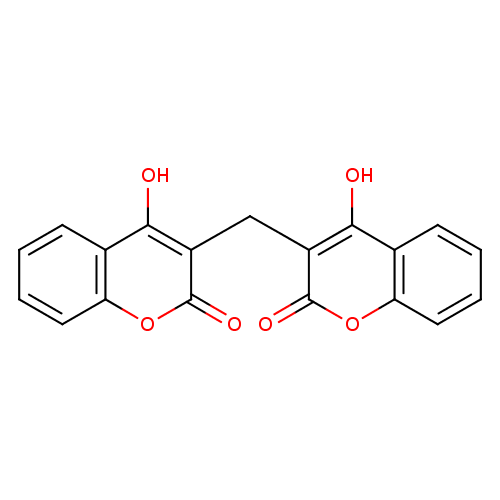
Chemical Structure
Thumb
Synonyms
ValueSource
3,3'-Methylen-bis(4-hydroxy-cumarin)ChEBI
3,3'-Methylene-bis(4-hydroxycoumarine)ChEBI
3,3'-Methylenebis(4-hydroxy-1,2-benzopyrone)ChEBI
3,3'-Methylenebis(4-hydroxy-2H-1-benzopyran-2-one)ChEBI
3,3'-Methylenebis(4-hydroxycoumarin)ChEBI
Bis(4-hydroxycoumarin-3-yl)methaneChEBI
Bis-3,3'-(4-hydroxycoumarinyl)methaneChEBI
Bis-hydroxycoumarinChEBI
Di-(4-hydroxy-3-coumarinyl)methaneChEBI
DicoumarolumChEBI
DicoumarolKegg
BishydroxycoumarinHMDB
DicoumarinHMDB
Chemical FormulaC19H12O6
Average Molecular Mass336.295 g/mol
Monoisotopic Mass336.063 g/mol
CAS Registry Number66-76-2
IUPAC Name4-hydroxy-3-[(4-hydroxy-2-oxo-2H-chromen-3-yl)methyl]-2H-chromen-2-one
Traditional Namedicoumarol
SMILESOC1=C(CC2=C(O)C3=C(OC2=O)C=CC=C3)C(=O)OC2=C1C=CC=C2
InChI IdentifierInChI=1S/C19H12O6/c20-16-10-5-1-3-7-14(10)24-18(22)12(16)9-13-17(21)11-6-2-4-8-15(11)25-19(13)23/h1-8,20-21H,9H2
InChI KeyDOBMPNYZJYQDGZ-UHFFFAOYSA-N
Chemical Taxonomy
Description belongs to the class of organic compounds known as 4-hydroxycoumarins. These are coumarins that contain one or more hydroxyl groups attached to C4-position the coumarin skeleton.
KingdomOrganic compounds
Super ClassPhenylpropanoids and polyketides
ClassCoumarins and derivatives
Sub ClassHydroxycoumarins
Direct Parent4-hydroxycoumarins
Alternative Parents
Substituents
  • 4-hydroxycoumarin
  • Benzopyran
  • 1-benzopyran
  • Pyranone
  • Pyran
  • Benzenoid
  • Heteroaromatic compound
  • Vinylogous acid
  • Lactone
  • Oxacycle
  • Organoheterocyclic compound
  • Organic oxygen compound
  • Hydrocarbon derivative
  • Organooxygen compound
  • Organic oxide
  • Aromatic heteropolycyclic compound
Molecular FrameworkAromatic heteropolycyclic compounds
External Descriptors
Biological Properties
StatusDetected and Not Quantified
OriginExogenous
Cellular Locations
  • Cytoplasm
  • Extracellular
  • Membrane
Biofluid LocationsNot Available
Tissue LocationsNot Available
Pathways
NameSMPDB LinkKEGG Link
Dicumarol PathwayNot AvailableNot Available
Applications
Biological Roles
Chemical Roles
Physical Properties
StateSolid
AppearanceWhite powder.
Experimental Properties
PropertyValue
Melting Point290°C
Boiling PointNot Available
Solubility128 mg/L
Predicted Properties
PropertyValueSource
Water Solubility0.066 g/LALOGPS
logP1.54ALOGPS
logP-1.6ChemAxon
logS-3.7ALOGPS
pKa (Strongest Acidic)-12ChemAxon
pKa (Strongest Basic)-3.1ChemAxon
Physiological Charge-1ChemAxon
Hydrogen Acceptor Count4ChemAxon
Hydrogen Donor Count2ChemAxon
Polar Surface Area93.06 ŲChemAxon
Rotatable Bond Count2ChemAxon
Refractivity89.19 m³·mol⁻¹ChemAxon
Polarizability32.32 ųChemAxon
Number of Rings4ChemAxon
Bioavailability1ChemAxon
Rule of FiveYesChemAxon
Ghose FilterNoChemAxon
Veber's RuleNoChemAxon
MDDR-like RuleNoChemAxon
Spectra
Spectra
Spectrum TypeDescriptionSplash KeyView
GC-MSGC-MS Spectrum - EI-B (Non-derivatized)splash10-0079-6914000000-95659ff5087535a07662Spectrum
Predicted GC-MSPredicted GC-MS Spectrum - GC-MS (Non-derivatized) - 70eV, Positivesplash10-0abi-1429000000-b3b5b41c6d8058aa0750Spectrum
Predicted GC-MSPredicted GC-MS Spectrum - GC-MS (2 TMS) - 70eV, Positivesplash10-00di-6111900000-373caca34eb4c76ecec6Spectrum
Predicted GC-MSPredicted GC-MS Spectrum - GC-MS (Non-derivatized) - 70eV, PositiveNot AvailableSpectrum
Predicted LC-MS/MSPredicted LC-MS/MS Spectrum - 10V, Positivesplash10-000i-0109000000-3c885b6fd0411c0ff106Spectrum
Predicted LC-MS/MSPredicted LC-MS/MS Spectrum - 20V, Positivesplash10-002r-0719000000-9268ef0a7aa4edc0f242Spectrum
Predicted LC-MS/MSPredicted LC-MS/MS Spectrum - 40V, Positivesplash10-00di-2911000000-04685f91d611459131c1Spectrum
Predicted LC-MS/MSPredicted LC-MS/MS Spectrum - 10V, Negativesplash10-000i-0129000000-e46a63fb14d246913958Spectrum
Predicted LC-MS/MSPredicted LC-MS/MS Spectrum - 20V, Negativesplash10-03di-0924000000-3d4892a9013fb818db2cSpectrum
Predicted LC-MS/MSPredicted LC-MS/MS Spectrum - 40V, Negativesplash10-052f-8941000000-5d292f12289cd60d251eSpectrum
Predicted LC-MS/MSPredicted LC-MS/MS Spectrum - 10V, Negativesplash10-000i-0009000000-cf75db3fcf76086bc0a2Spectrum
Predicted LC-MS/MSPredicted LC-MS/MS Spectrum - 20V, Negativesplash10-000i-0529000000-7a6f916db51a10874a5cSpectrum
Predicted LC-MS/MSPredicted LC-MS/MS Spectrum - 40V, Negativesplash10-00du-3910000000-e6d48e72ac9f9dddf912Spectrum
Predicted LC-MS/MSPredicted LC-MS/MS Spectrum - 10V, Positivesplash10-000i-0009000000-a487dc1a344a66353635Spectrum
Predicted LC-MS/MSPredicted LC-MS/MS Spectrum - 20V, Positivesplash10-01t9-0901000000-74ccf5992000b52087f7Spectrum
Predicted LC-MS/MSPredicted LC-MS/MS Spectrum - 40V, Positivesplash10-00ku-0392000000-56dee6c1117cdcc0532dSpectrum
1D NMR1H NMR SpectrumNot AvailableSpectrum
1D NMR13C NMR SpectrumNot AvailableSpectrum
1D NMR1H NMR SpectrumNot AvailableSpectrum
1D NMR13C NMR SpectrumNot AvailableSpectrum
1D NMR1H NMR SpectrumNot AvailableSpectrum
1D NMR13C NMR SpectrumNot AvailableSpectrum
1D NMR1H NMR SpectrumNot AvailableSpectrum
1D NMR13C NMR SpectrumNot AvailableSpectrum
1D NMR1H NMR SpectrumNot AvailableSpectrum
1D NMR13C NMR SpectrumNot AvailableSpectrum
1D NMR1H NMR SpectrumNot AvailableSpectrum
1D NMR13C NMR SpectrumNot AvailableSpectrum
1D NMR1H NMR SpectrumNot AvailableSpectrum
1D NMR13C NMR SpectrumNot AvailableSpectrum
1D NMR1H NMR SpectrumNot AvailableSpectrum
1D NMR13C NMR SpectrumNot AvailableSpectrum
1D NMR1H NMR SpectrumNot AvailableSpectrum
1D NMR13C NMR SpectrumNot AvailableSpectrum
1D NMR1H NMR SpectrumNot AvailableSpectrum
1D NMR13C NMR SpectrumNot AvailableSpectrum
Toxicity Profile
Route of ExposureOral, dermal, inhalation, and parenteral (contaminated drugs). (6)
Mechanism of ToxicityDicoumarol is an anticoagulant that competitively inhibits vitamin K, preventing the formation of prothrombin. It does this by inhibiting the enzyme NAD(P)H:quinone oxidoreductase-1, which is required for the reduction of vitamin K to its hydroquinone. Reduced vitamin K is a cofactor needed in the conversion of prothrombin precursor protein to active prothrombin, an essential protein for blood clotting. In addition, inhibition of NAD(P)H:quinone oxidoreductase-1 induces the generation of superoxide anion radicals that inhibit cell growth. Dicoumarol can also potently and reversible inhibit gap junctional intercellular communication, though the precise mechanism is unknown. (9, 2, 3, 4, 5)
MetabolismNot Available
Toxicity ValuesLD50=233 mg/kg (orally in mice) LD50=250 mg/kg (orally in rats)
Lethal DoseLD50: 233 mg/kg (Oral, Mouse) (1)
Carcinogenicity (IARC Classification)No indication of carcinogenicity to humans (not listed by IARC).
Uses/SourcesDicoumarol is a mycotoxin of combined plant and fungal origin. It is a derivative of coumarin, a substance made by plants which is transformed in mouldy feeds by a number of species of fungi into active dicoumarol. Dicoumarol is an anticoagulant that is used along with heparin for the treatment of deep venous thrombosis, as well as in biochemical experiments as an inhibitor of reductases. (9)
Minimum Risk LevelNot Available
Health EffectsDicoumarol is an anticoagulant. (9)
SymptomsDicoumarol can cause bleeding complications. (9)
TreatmentAdministration of Vitamin K is the antidote for dicoumarol toxicity. (9)
Concentrations
Not Available
DrugBank IDDB00266
HMDB IDHMDB0014411
FooDB IDFDB012523
Phenol Explorer IDNot Available
KNApSAcK IDC00002467
BiGG IDNot Available
BioCyc IDNot Available
METLIN IDNot Available
PDB IDNot Available
Wikipedia LinkDicumarol
Chemspider ID10183330
ChEBI ID4513
PubChem Compound ID54676038
Kegg Compound IDC00796
YMDB IDNot Available
ECMDB IDNot Available
References
Synthesis ReferenceNot Available
MSDSLink
General References
1. Thanos CG, Liu Z, Reineke J, Edwards E, Mathiowitz E: Improving relative bioavailability of dicumarol by reducing particle size and adding the adhesive poly(fumaric-co-sebacic) anhydride. Pharm Res. 2003 Jul;20(7):1093-100.
2. Cullen JJ, Hinkhouse MM, Grady M, Gaut AW, Liu J, Zhang YP, Weydert CJ, Domann FE, Oberley LW: Dicumarol inhibition of NADPH:quinone oxidoreductase induces growth inhibition of pancreatic cancer via a superoxide-mediated mechanism. Cancer Res. 2003 Sep 1;63(17):5513-20.
3. Mironov AA, Colanzi A, Polishchuk RS, Beznoussenko GV, Mironov AA Jr, Fusella A, Di Tullio G, Silletta MG, Corda D, De Matteis MA, Luini A: Dicumarol, an inhibitor of ADP-ribosylation of CtBP3/BARS, fragments golgi non-compact tubular zones and inhibits intra-golgi transport. Eur J Cell Biol. 2004 Jul;83(6):263-79.
4. Abdelmohsen K, Stuhlmann D, Daubrawa F, Klotz LO: Dicumarol is a potent reversible inhibitor of gap junctional intercellular communication. Arch Biochem Biophys. 2005 Feb 15;434(2):241-7.
5. https://www.ncbi.nlm.nih.gov/pubmed/?term=15639223
6. https://www.ncbi.nlm.nih.gov/pubmed/?term=16700548
7. https://www.ncbi.nlm.nih.gov/pubmed/?term=18347135
8. https://www.ncbi.nlm.nih.gov/pubmed/?term=19583730
9. https://www.ncbi.nlm.nih.gov/pubmed/?term=20480521
10. https://www.ncbi.nlm.nih.gov/pubmed/?term=28166217
11. https://www.ncbi.nlm.nih.gov/pubmed/?term=6033758