Record Information
Version1.0
Creation Date2010-04-28 18:51:41 UTC
Update Date2026-04-06 10:55:57 UTC
Accession NumberCHEM002672
Identification
Common Name15-Deacetylcalonectrin
ClassSmall Molecule
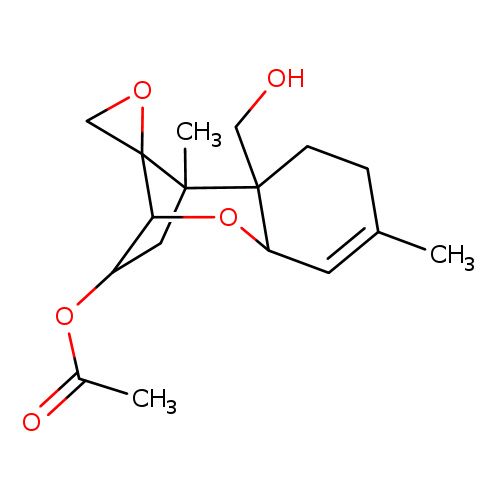
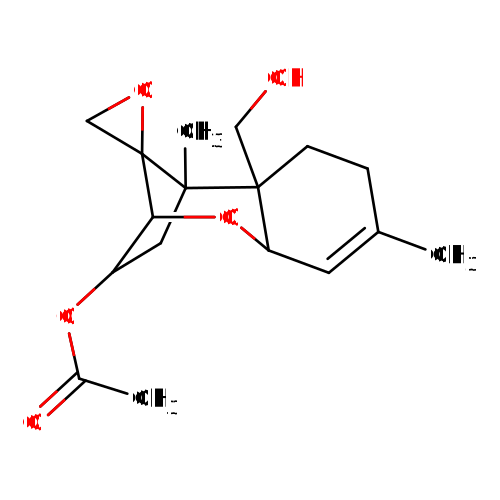
Description15-Deacetylcalonectrin is a metabolite of Calonectria nivalis 15-Deacetylcalonectrin belongs to the family of Trichothecenes. These are sesquiterpene mycotoxins structurally characterized by the presence of an epoxide ring and a benzoyran derivative with a variant number of hydroxyl, acetly, or other substituents [1]. (Reference: [1] http://www.inchem.org/documents/ehc/ehc/ehc105.htm).
Contaminant Sources
  • FooDB Chemicals
  • T3DB toxins
Contaminant Type
  • Ester
  • Ether
  • Food Toxin
  • Fungal Toxin
  • Lachrymator
  • Metabolite
  • Mycotoxin
  • Natural Compound
  • Organic Compound
Chemical Structure
Thumb
Synonyms
ValueSource
15-DecalonectrinHMDB
15-DesacetylcalonectrinHMDB
15-O-DeacetylcalonectrinHMDB
2'-(Hydroxymethyl)-1',5'-dimethyl-8'-oxaspiro[oxirane-2,12'-tricyclo[7.2.1.0²,⁷]dodecan]-5'-en-10'-yl acetic acidGenerator
Chemical FormulaC17H24O5
Average Molecular Mass308.370 g/mol
Monoisotopic Mass308.162 g/mol
CAS Registry Number38818-66-5
IUPAC Name2'-(hydroxymethyl)-1',5'-dimethyl-8'-oxaspiro[oxirane-2,12'-tricyclo[7.2.1.0²,⁷]dodecan]-5'-en-10'-yl acetate
Traditional Name2'-(hydroxymethyl)-1',5'-dimethyl-8'-oxaspiro[oxirane-2,12'-tricyclo[7.2.1.0²,⁷]dodecan]-5'-en-10'-yl acetate
SMILESCC(=O)OC1CC2(C)C3(CO3)C1OC1C=C(C)CCC21CO
InChI IdentifierInChI=1S/C17H24O5/c1-10-4-5-16(8-18)13(6-10)22-14-12(21-11(2)19)7-15(16,3)17(14)9-20-17/h6,12-14,18H,4-5,7-9H2,1-3H3
InChI KeyDFPPNUOWRKIOKO-UHFFFAOYSA-N
Chemical Taxonomy
Description belongs to the class of organic compounds known as trichothecenes. These are sesquiterpene mycotoxins structurally characterized by the presence of an epoxide ring and a benzopyran derivative with a variant number of hydroxyl, acetyl, or other substituents. The most important structural features causing the biological activities of trichothecenes are the 12,13-epoxy ring, the presence of hydroxyl or acetyl groups at appropriate positions on the trichothecene nucleus and the structure and position of the side-chain.
KingdomOrganic compounds
Super ClassLipids and lipid-like molecules
ClassPrenol lipids
Sub ClassSesquiterpenoids
Direct ParentTrichothecenes
Alternative Parents
Substituents
  • Trichothecene skeleton
  • Oxepane
  • Oxane
  • Carboxylic acid ester
  • Organoheterocyclic compound
  • Monocarboxylic acid or derivatives
  • Ether
  • Oxirane
  • Dialkyl ether
  • Carboxylic acid derivative
  • Oxacycle
  • Hydrocarbon derivative
  • Primary alcohol
  • Organic oxide
  • Organic oxygen compound
  • Organooxygen compound
  • Alcohol
  • Carbonyl group
  • Aliphatic heteropolycyclic compound
Molecular FrameworkAliphatic heteropolycyclic compounds
External DescriptorsNot Available
Biological Properties
StatusDetected and Not Quantified
OriginExogenous
Cellular Locations
  • Cytoplasm
  • Extracellular
Biofluid LocationsNot Available
Tissue LocationsNot Available
PathwaysNot Available
ApplicationsNot Available
Biological RolesNot Available
Chemical RolesNot Available
Physical Properties
StateSolid
AppearanceWhite powder.
Experimental Properties
PropertyValue
Melting Point184 - 186°C
Boiling PointNot Available
SolubilityNot Available
Predicted Properties
PropertyValueSource
Water Solubility0.67 g/LALOGPS
logP1.05ALOGPS
logP0.85ChemAxon
logS-2.7ALOGPS
pKa (Strongest Acidic)15ChemAxon
pKa (Strongest Basic)-2.8ChemAxon
Physiological Charge0ChemAxon
Hydrogen Acceptor Count4ChemAxon
Hydrogen Donor Count1ChemAxon
Polar Surface Area68.29 ŲChemAxon
Rotatable Bond Count3ChemAxon
Refractivity78.74 m³·mol⁻¹ChemAxon
Polarizability32.66 ųChemAxon
Number of Rings4ChemAxon
Bioavailability1ChemAxon
Rule of FiveYesChemAxon
Ghose FilterYesChemAxon
Veber's RuleNoChemAxon
MDDR-like RuleNoChemAxon
Spectra
Spectra
Spectrum TypeDescriptionSplash KeyView
Predicted GC-MSPredicted GC-MS Spectrum - GC-MS (Non-derivatized) - 70eV, Positivesplash10-00di-2790000000-58d5fe44c3d8451e2006Spectrum
Predicted GC-MSPredicted GC-MS Spectrum - GC-MS (1 TMS) - 70eV, Positivesplash10-000w-7974000000-b9f5a14f4ecaa9aa5353Spectrum
Predicted GC-MSPredicted GC-MS Spectrum - GC-MS (Non-derivatized) - 70eV, PositiveNot AvailableSpectrum
Predicted LC-MS/MSPredicted LC-MS/MS Spectrum - 10V, Positivesplash10-0a4m-0093000000-1a76e07ae046fa9a9b0fSpectrum
Predicted LC-MS/MSPredicted LC-MS/MS Spectrum - 20V, Positivesplash10-0007-1490000000-17c4d54e369c052c1cd9Spectrum
Predicted LC-MS/MSPredicted LC-MS/MS Spectrum - 40V, Positivesplash10-0g02-9560000000-35060a99d57781469262Spectrum
Predicted LC-MS/MSPredicted LC-MS/MS Spectrum - 10V, Negativesplash10-0a4i-3198000000-3fcf809901b942d3b454Spectrum
Predicted LC-MS/MSPredicted LC-MS/MS Spectrum - 20V, Negativesplash10-0ap1-2291000000-25170e54a6b6bfb982d3Spectrum
Predicted LC-MS/MSPredicted LC-MS/MS Spectrum - 40V, Negativesplash10-0a4l-4900000000-a44bc6833c08dedf141fSpectrum
Predicted LC-MS/MSPredicted LC-MS/MS Spectrum - 10V, Negativesplash10-0aor-0079000000-60809020eca26b8c9a62Spectrum
Predicted LC-MS/MSPredicted LC-MS/MS Spectrum - 20V, Negativesplash10-0a4i-9072000000-a130cf130eca5de8ca88Spectrum
Predicted LC-MS/MSPredicted LC-MS/MS Spectrum - 40V, Negativesplash10-0a4i-9151000000-849c4f3bf5f58763e733Spectrum
Predicted LC-MS/MSPredicted LC-MS/MS Spectrum - 10V, Positivesplash10-0a4i-0049000000-051e4a84519c33b4e7dcSpectrum
Predicted LC-MS/MSPredicted LC-MS/MS Spectrum - 20V, Positivesplash10-052g-0091000000-c1387d5eff85992eb943Spectrum
Predicted LC-MS/MSPredicted LC-MS/MS Spectrum - 40V, Positivesplash10-05mo-9140000000-6caa09c91f3ee2ceaaf7Spectrum
Toxicity Profile
Route of ExposureOral, dermal, inhalation, and parenteral (contaminated drugs). (6)
Mechanism of ToxicityUnlike many other mycotoxins, trichothecenes do not require metabolic activation to exert their biological activity, instead directly reacting with cellular components. Trichothecenes are cytotoxic to most eukaryotic cells due to their powerful ability to inhibit protein synthesis. They do this by freely moving across the plasma membrane and binding specifically to ribosomes with high-affinity. Specifically, they interfere with the active site of peptidyl transferase at the 3'-end of large 28S ribosomal RNA and inhibit the initiation, elongation or termination step of protein synthesis, as well as cause polyribosomal disaggregation. Protein synthesis is an essential function in all tissues, but tissues where cells are actively and rapidly growing and dividing are very susceptible to the toxins. Additionally, binding to ribosomes is thought to activate proteins in downstream signalling events related to immune response and apoptosis, such as mitogen-activated protein kinases. This is known as ribotoxic stress response. Trichothecenes may also induce some alterations in membrane structure, leading to increased lipid peroxidation and inhibition of electron transport activity in the mitochondria. They can further induce apoptosis through generation of reactive oxygen species. Further secondary effects of trichothecenes include inhibition of RNA and DNA synthesis, and also inhibition of mitosis. (8, 9, 2, 3, 4, 5)
MetabolismTrichothecenes are lipophilic and thus easily absorbed through the skin, gut, and pulmonary mucosa. They are metabolized mainly by cytochrome P-450 and trichothecene-specific carboxylesterase activity in the liver, although other tissues such as the kidney, spleen, and intestine also show some metabolic activity. Trichothecenes are metabolically transformed to less toxic metabolites by such reactions as hydrolysis, hydroxylation, de-epoxidation, and glucuronidation. Metabolites are excreted in the urine and feces. (7, 9)
Toxicity ValuesNot Available
Lethal DoseNot Available
Carcinogenicity (IARC Classification)No indication of carcinogenicity to humans (not listed by IARC).
Uses/SourcesTrichothecenes are a very large family of chemically related mycotoxins produced by various species of Fusarium, Myrothecium, Trichoderma, Trichothecium, Cephalosporium, Verticimonosporium, and Stachybotrys. They are produced on many different grains like wheat, oats or maize by various Fusarium species such as F. graminearum, F. sporotrichioides, F. poae and F. equiseti. Some molds that produce trichothecene mycotoxins, such as Stachybotrys chartarum, can grow in damp indoor environments and may contribute to health problems among building occupants. (8)
Minimum Risk LevelNot Available
Health EffectsTrichothecenes have multiorgan effects including anoerxia and weight loss, growth retardation, nervous disorders, cardiovascular alterations, immunodepression, hemostatic derangements, skin toxicity, decreased reproductive capacity, bone marrow damage, and alimentary toxic aleukia. (8, 9, 4)
SymptomsAfter direct dermal application or oral ingestion, the trichothecene mycotoxins can cause rapid irritation to the skin or intestinal mucosa, including skin irritation, burning and itching, rash or blisters, and bleeding. Eye contact can cause tearing, eye pain, conjunctivitis, burning sensations about the eyes, and blurred vision for up to 1 week. Symptoms also include nausea, vomiting, fatigue, dyspnea, and acute vascular effects leading to hypotension and shock. (8, 9)
TreatmentThere are no known antidotes to trichothecene mycotoxins. Treatments are directed at supporting hemopoietic abnormalities, gastrointestinal damage, and skin damage. Administer charcoal as a slurry in case of acute oral exposure. In case of inhalation: Move patient to fresh air. Monitor for respiratory distress. If cough or difficulty breathing develops, evaluate for respiratory tract irritation, bronchitis, or pneumonitis. Administer oxygen and assist ventilation as required. Treat bronchospasm with inhaled beta2 agonist and oral or parenteral corticosteroids. In case of eye exposure, Irrigate exposed eyes with copious amounts of room temperature water for at least 15 minutes. In case of dermal exposure, Remove contaminated clothing and wash exposed area thoroughly with soap and water. (1)

Concentrations
Not Available
DrugBank IDNot Available
HMDB IDHMDB0035724
FooDB IDFDB014448
Phenol Explorer IDNot Available
KNApSAcK IDNot Available
BiGG IDNot Available
BioCyc IDNot Available
METLIN IDNot Available
PDB IDNot Available
Wikipedia LinkNot Available
Chemspider IDNot Available
ChEBI IDNot Available
PubChem Compound ID587712
Kegg Compound IDNot Available
YMDB IDNot Available
ECMDB IDNot Available
References
Synthesis ReferenceNot Available
MSDSNot Available
General References
1. Simons K, Toomre D: Lipid rafts and signal transduction. Nat Rev Mol Cell Biol. 2000 Oct;1(1):31-9.
2. Watson AD: Thematic review series: systems biology approaches to metabolic and cardiovascular disorders. Lipidomics: a global approach to lipid analysis in biological systems. J Lipid Res. 2006 Oct;47(10):2101-11. Epub 2006 Aug 10.
3. Sethi JK, Vidal-Puig AJ: Thematic review series: adipocyte biology. Adipose tissue function and plasticity orchestrate nutritional adaptation. J Lipid Res. 2007 Jun;48(6):1253-62. Epub 2007 Mar 20.
4. Lingwood D, Simons K: Lipid rafts as a membrane-organizing principle. Science. 2010 Jan 1;327(5961):46-50. doi: 10.1126/science.1174621.
5. Yannai, Shmuel. (2004) Dictionary of food compounds with CD-ROM: Additives, flavors, and ingredients. Boca Raton: Chapman & Hall/CRC.
6. The lipid handbook with CD-ROM