Record Information
Version1.0
Creation Date2010-04-23 20:24:31 UTC
Update Date2026-04-03 00:16:01 UTC
Accession NumberCHEM002659
Identification
Common NameErgocryptine
ClassSmall Molecule
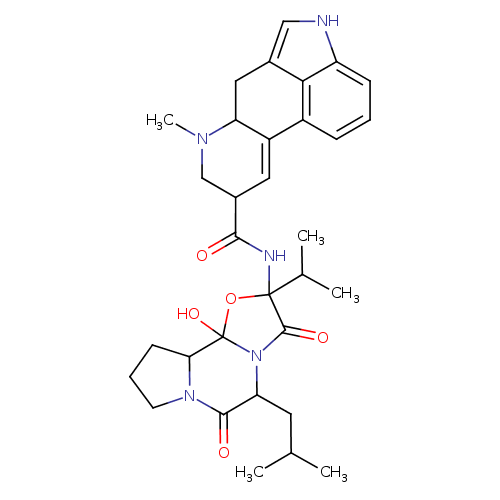
DescriptionErgocryptine is an alkaloid of the ergoline family. Like other ergoline alkaloids, it occurs in various species of vines of the Convolvulaceae (morning glory) family and in some species of lower fungi. Ergocryptine is one of 3 similar peptides referred to as ergotoxine alkaloids, the other two being ergocristine and ergocornine. Ergotoxines prepared into their hihydroergotoxine mesylates, commonly known as ergoloid mesylates, are used in the symptomatic therapy of age-related dementia. Long term exposure to some ergoline alkaloids can cause ergotism, a disease causing convulsive and gangrenous symptoms. (6, 3)
Contaminant Sources
  • T3DB toxins
Contaminant Type
  • Amide
  • Amine
  • Ether
  • Fungal Toxin
  • Mycotoxin
  • Natural Compound
  • Organic Compound
Chemical Structure
Thumb
Synonyms
ValueSource
Ergocryptine mesylateMeSH, HMDB, HMDB
Ergocryptine, (5'alpha,8alpha)-isomerMeSH, HMDB, HMDB
Ergocryptine monomethanesulfonate, (5'alpha,8alpha)-isomerMeSH, HMDB, HMDB
alpha-ErgocryptineMeSH, HMDB, HMDB
Ergocryptine citrate, (5'alpha)-isomerMeSH, HMDB, HMDB
Ergocryptine sulfate, (1:1) salt, (5'alpha)-isomerMeSH, HMDB, HMDB
Ergocryptine tartrate, (5'alpha)-isomerMeSH, HMDB, HMDB
Ergocryptine, (5'alpha(S),8alpha)-isomerMeSH, HMDB, HMDB
ErgokryptinMeSH, HMDB, HMDB
Ergocryptine monomethanesulfonate, (5'alpha)-isomerMeSH, HMDB, HMDB
Ergocryptine phosphate, (5'alpha)-isomerMeSH, HMDB, HMDB
Chemical FormulaC32H41N5O5
Average Molecular Mass575.698 g/mol
Monoisotopic Mass575.311 g/mol
CAS Registry Number511-09-1
IUPAC NameN-[2-hydroxy-7-(2-methylpropyl)-5,8-dioxo-4-(propan-2-yl)-3-oxa-6,9-diazatricyclo[7.3.0.0²,⁶]dodecan-4-yl]-6-methyl-6,11-diazatetracyclo[7.6.1.0²,⁷.0¹²,¹⁶]hexadeca-1(16),2,9,12,14-pentaene-4-carboxamide
Traditional Nameergocryptine
SMILESCC(C)CC1N2C(=O)C(NC(=O)C3CN(C)C4CC5=CNC6=CC=CC(=C56)C4=C3)(OC2(O)C2CCCN2C1=O)C(C)C
InChI IdentifierInChI=1S/C32H41N5O5/c1-17(2)12-25-29(39)36-11-7-10-26(36)32(41)37(25)30(40)31(42-32,18(3)4)34-28(38)20-13-22-21-8-6-9-23-27(21)19(15-33-23)14-24(22)35(5)16-20/h6,8-9,13,15,17-18,20,24-26,33,41H,7,10-12,14,16H2,1-5H3,(H,34,38)
InChI KeyYDOTUXAWKBPQJW-UHFFFAOYSA-N
Chemical Taxonomy
Description belongs to the class of organic compounds known as ergopeptines. These are ergoline derivatives that contain a tripeptide structure attached to the basic ergoline ring in the same location as the amide group of the lysergic acid derivatives.
KingdomOrganic compounds
Super ClassAlkaloids and derivatives
ClassErgoline and derivatives
Sub ClassLysergic acids and derivatives
Direct ParentErgopeptines
Alternative Parents
Substituents
  • Hybrid peptide
  • Ergopeptine
  • Alpha-dipeptide
  • Lysergic acid amide
  • Indoloquinoline
  • Benzoquinoline
  • Quinoline-3-carboxamide
  • N-acyl-alpha amino acid or derivatives
  • Pyrroloquinoline
  • Quinoline
  • Alpha-amino acid or derivatives
  • 3-alkylindole
  • Indole
  • Indole or derivatives
  • Isoindole or derivatives
  • Aralkylamine
  • N-alkylpiperazine
  • 1,4-diazinane
  • Benzenoid
  • Oxazolidinone
  • Piperazine
  • Pyrrolidine
  • Pyrrole
  • Heteroaromatic compound
  • Tertiary carboxylic acid amide
  • Oxazolidine
  • Carboxamide group
  • Amino acid or derivatives
  • Lactam
  • Tertiary aliphatic amine
  • Tertiary amine
  • Orthocarboxylic acid derivative
  • Secondary carboxylic acid amide
  • Organoheterocyclic compound
  • Carboxylic acid derivative
  • Oxacycle
  • Azacycle
  • Alkanolamine
  • Amine
  • Organopnictogen compound
  • Organic oxide
  • Hydrocarbon derivative
  • Carbonyl group
  • Organic oxygen compound
  • Organic nitrogen compound
  • Organonitrogen compound
  • Organooxygen compound
  • Aromatic heteropolycyclic compound
Molecular FrameworkAromatic heteropolycyclic compounds
External DescriptorsNot Available
Biological Properties
StatusDetected and Not Quantified
OriginExogenous
Cellular Locations
  • Membrane
Biofluid LocationsNot Available
Tissue LocationsNot Available
PathwaysNot Available
ApplicationsNot Available
Biological RolesNot Available
Chemical RolesNot Available
Physical Properties
StateSolid
AppearanceWhite powder.
Experimental Properties
PropertyValue
Melting PointNot Available
Boiling PointNot Available
SolubilityNot Available
Predicted Properties
PropertyValueSource
Water Solubility0.32 g/LALOGPS
logP3.29ALOGPS
logP3.31ChemAxon
logS-3.3ALOGPS
pKa (Strongest Acidic)9.7ChemAxon
pKa (Strongest Basic)7.78ChemAxon
Physiological Charge1ChemAxon
Hydrogen Acceptor Count6ChemAxon
Hydrogen Donor Count3ChemAxon
Polar Surface Area118.21 ŲChemAxon
Rotatable Bond Count5ChemAxon
Refractivity158.11 m³·mol⁻¹ChemAxon
Polarizability61.18 ųChemAxon
Number of Rings7ChemAxon
Bioavailability1ChemAxon
Rule of FiveNoChemAxon
Ghose FilterNoChemAxon
Veber's RuleNoChemAxon
MDDR-like RuleNoChemAxon
Spectra
Spectra
Spectrum TypeDescriptionSplash KeyView
Predicted LC-MS/MSPredicted LC-MS/MS Spectrum - 10V, Positivesplash10-004i-0012090000-6e841064f77b5f7dcf9cSpectrum
Predicted LC-MS/MSPredicted LC-MS/MS Spectrum - 20V, Positivesplash10-0uk9-2092030000-5f6ebe74cbb87491c357Spectrum
Predicted LC-MS/MSPredicted LC-MS/MS Spectrum - 40V, Positivesplash10-00di-6291000000-1b12285b5780c1e0ed0eSpectrum
Predicted LC-MS/MSPredicted LC-MS/MS Spectrum - 10V, Negativesplash10-0229-0029060000-ffcfc905abf908eebc20Spectrum
Predicted LC-MS/MSPredicted LC-MS/MS Spectrum - 20V, Negativesplash10-007a-6169060000-5406dbc6b4a16fa42a48Spectrum
Predicted LC-MS/MSPredicted LC-MS/MS Spectrum - 40V, Negativesplash10-01ba-9310000000-66ceeafcbf077b78132aSpectrum
Predicted LC-MS/MSPredicted LC-MS/MS Spectrum - 10V, Positivesplash10-004i-0000090000-a9e76acb28005ccdccdbSpectrum
Predicted LC-MS/MSPredicted LC-MS/MS Spectrum - 20V, Positivesplash10-004i-0072090000-79eef0dacc0a741cd076Spectrum
Predicted LC-MS/MSPredicted LC-MS/MS Spectrum - 40V, Positivesplash10-00di-1090000000-b9b05728810432b9fb35Spectrum
Predicted LC-MS/MSPredicted LC-MS/MS Spectrum - 10V, Negativesplash10-00di-0000090000-d91c67256ced4750de9eSpectrum
Predicted LC-MS/MSPredicted LC-MS/MS Spectrum - 20V, Negativesplash10-00di-0044190000-c3106e394d76359ad1c8Spectrum
Predicted LC-MS/MSPredicted LC-MS/MS Spectrum - 40V, Negativesplash10-00b9-8294120000-2af24b7b5d6bf7eef7bdSpectrum
MSMass Spectrum (Electron Ionization)splash10-00dl-9430000000-d1913de41bf4821ebcb2Spectrum
Toxicity Profile
Route of ExposureOral, dermal, inhalation, and parenteral (contaminated drugs). (5)
Mechanism of ToxicityErgoline alkaloids tend to act as a group, producing complex and variable effects of partial agonism or antagonism at adrenergic, dopaminergic, and serotonergic receptors. Variables relating to these effects are influenced by the agent, dosage, species, tissue, physiological, and endocrinological state, and experimental conditions. In particular, ergoline alkaloids have been shown to have the significant affinity towards the 5-HT1 and 5-HT2 serotonin receptors, D1 and D2 dopamine receptors, and alpha-adrenergic receptors. This can result in a number of different effects, including vasoconstriction, convulsions, and hallucinations. Ergometrine is also known to have a non-receptor specific oxytocic activity. (2, 3, 4)
MetabolismNot Available
Toxicity ValuesNot Available
Lethal DoseNot Available
Carcinogenicity (IARC Classification)No indication of carcinogenicity to humans (not listed by IARC).
Uses/SourcesErgocryptine is an alkaloid of the ergoline family. Like other ergoline alkaloids, it occurs in various species of vines of the Convolvulaceae (morning glory) family and in some species of lower fungi. Ergocryptine is one of 3 similar peptides referred to as ergotoxine alkaloids, the other two being ergocristine and ergocornine. Ergotoxines prepared into their hihydroergotoxine mesylates, commonly known as ergoloid mesylates, are used in the symptomatic therapy of age-related dementia. (6, 3)
Minimum Risk LevelNot Available
Health EffectsIngestion of ergoline alkaloids is known to cause the disease ergotism. Ergotism occurs in two forms, gangrenous and convulsive, likely depending on the different kinds and amounts of ergoline alkaloids present. (1)
SymptomsConvulsive ergotism can cause painful seizures and spasms, diarrhea, paresthesias, itching, headaches, nausea and vomiting. Usually the gastrointestinal effects precede the central nervous system effects. As well as seizures there can be hallucinations and mental effects including mania or psychosis. Gangrenous ergotism causes dry gangrene as a result of vasoconstriction induced in the more poorly vascularized distal structures, such as the fingers and toes. Symptoms include desquamation, weak periphery pulse, loss of peripheral sensation, edema and ultimately the death and loss of affected tissues. (7)
TreatmentTreatment for ergotism consists of vasodilators, anticoagulants and low molecular weight dextrans. If necessary, a sympathetic nerve blockade may be carried out, such as brachial plexus blockade. Temporary sedation (e.g. haloperidol) will be necessary in hallucination and diazepam is used for convulsions. There is no specific antidote. (8)

Concentrations
Not Available
DrugBank IDNot Available
HMDB IDHMDB0251911
FooDB IDNot Available
Phenol Explorer IDNot Available
KNApSAcK IDC00001721
BiGG IDNot Available
BioCyc IDNot Available
METLIN IDNot Available
PDB IDNot Available
Wikipedia LinkErgocryptine
Chemspider ID89473
ChEBI IDNot Available
PubChem Compound ID99049
Kegg Compound IDNot Available
YMDB IDNot Available
ECMDB IDNot Available
References
Synthesis ReferenceNot Available
MSDSNot Available
General ReferencesNot Available