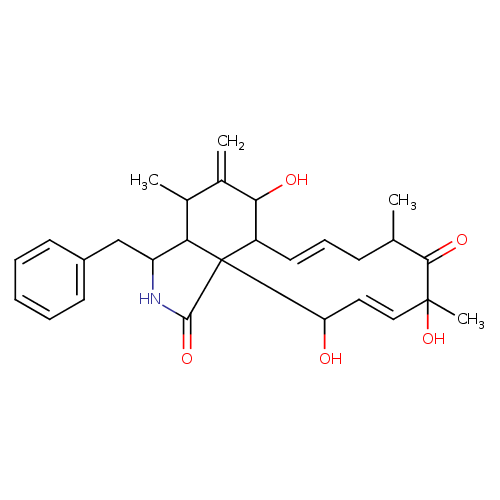
Cytochalasins are mycotoxins that have the ability to bind to actin filaments and block polymerization and the elongation of actin. As a result, they can change cellular morphology, inhibit cellular processes such as cell division, and cause cells to undergo apoptosis. Cytochalasins also have the ability to permeate cell membranes, prevent cellular translocation, cause cells to enucleate, and affect other aspects of biological processes unrelated to actin polymerization. Cytochalasin J is has been isolated from the fungus Phomopsis paspali. It also has shown CNS activity. (2, 3, 5, 6)
belongs to the class of organic compounds known as cytochalasans. These are fungal metabolites structurally characterized by the presence of an isoindolone nucleus fused to a macrocyclic ring, which can either a lactone, as in cytochalasin B, a carbonate, as in cytochalasin E, or a carbocycle, as in cytochalasin D, H, and K.
Oral, dermal, inhalation, and parenteral (contaminated drugs). (4)
Mechanism of Toxicity
Cytochalasins are known to bind to the barbed, fast growing plus ends of microfilaments, which then blocks both the assembly and disassembly of individual actin monomers from the bound end. Once bound, cytochalasin essentially caps the end of the new actin filament. One cytochalasin will bind to one actin filament. By blocking the polymerization and elongation of actin, cytochalasins can change cellular morphology, inhibit cellular processes such as cell division, and cause cells to undergo apoptosis. (2, 3, 5)
No indication of carcinogenicity to humans (not listed by IARC).
Uses/Sources
Cytochalasin J is has been isolated from the fungus Phomopsis paspali. (6)
Minimum Risk Level
Not Available
Health Effects
Major biological effects of cytochalasins include inhibition of the division of cytoplasm, reversible inhibition of cell movement, induction of nuclear extrusion, inhibition of such processes as phagocytosis, platelet aggregation and clot retraction, glucose transport, thyroid secretion, and release of growth hormone. Some cytochalasins have been shown to have developmental effects. (6)
Symptoms
Not Available
Treatment
Consider activated charcoal after gastrointestinal absportion. Nitroprusside is recommended to reverse peripheral ischemia secondary to vasoconstriction and for the treatment of hypertension. Anticoagulant therapy with intravenous heparin is also recommended. (1)